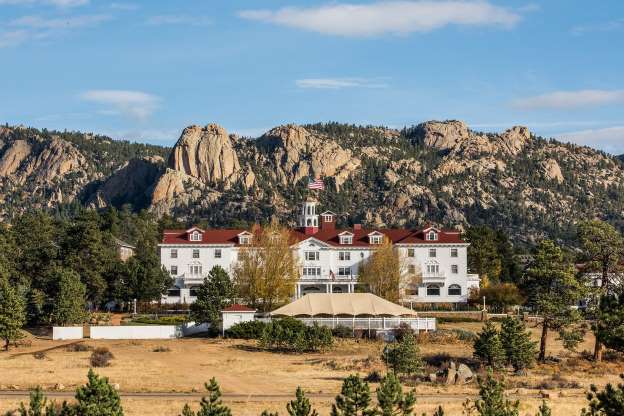
THE STANLEY HOTEL
Estes Park, CO
The Stanley Hotel is a sprawling and gorgeous hotel, boasting 142 rooms and views of the Rocky Mountains. It is here where author Stephen King, while on vacation with his wife, Tabitha, came up with the idea for his novel “The Shining.” The book tells the story of a family who comes to The Overlook, a similar Colorado hotel, to be its winter caretakers, only to learn the hotel is haunted by malevolent spirits. Following the popularity of “The Shining,” rumors of real-life hauntings swirled, leading the hotel to offer ghost tours. However, The Stanley Hotel does not appear in the film by Stanley Kubrick. Rather, the exteriors of the fictitious Overlook are actually The Timberline Lodge in Mount Hood, Oregon, in the 1980 horror classic
https://en.wikipedia.org/wiki/National_Register_of_Historic_Places.
The Stanley Hotel is a 142-room Colonial Revival hotel in Estes Park, Colorado, United States of America. Approximately five miles from the entrance to Rocky Mountain National Park, the Stanley offers panoramic views of Lake Estes, the Rockies and especially Long’s Peak. It was built by Freelan Oscar Stanley of Stanley Steamer fame and opened on July 4, 1909, catering to the American upper class at the turn of the century.[2] The hotel and its surrounding structures are listed on the National Register of Historic Places.[1]
The Stanley Hotel hosted the horror novelist Stephen King, serving as inspiration for the Overlook Hotel in his 1977 bestseller The Shining and its 1980 film adaption of the same name, as well as the location for the 1997 miniseries. Today, it includes a restaurant, spa, and bed-and-breakfast, and provides guided tours which feature the history and alleged paranormal activity of the site.
History
In 1903, the Yankee steam-powered car inventor Freelan Oscar Stanley (1849-1940) was stricken with a life-threatening resurgence of tuberculosis.[3] The most highly recommended treatment of the day was fresh, dry air with lots of sunlight and a hearty diet. Therefore, like many “lungers” of his day, Stanley resolved to take the curative air of Rocky Mountain Colorado. He and Flora arrived in Denver in March and, in June, decided to spend the rest of the summer in the mountains, in Estes Park. Over the course of the season, Stanley’s health improved dramatically.[2] Impressed by the beauty of the valley and grateful for his recovery, he decided to return every year. He lived to the ripe age of 91, dying of a heart attack in Newton, Massachusetts, one year after his wife, in 1940.
By 1907, Stanley had recovered completely. However, not content with the rustic accommodations, lazy pastimes and relaxed social scene of their new summer home, Stanley resolved to turn Estes Park into a resort town. In 1907, construction began on the Hotel Stanley, a 48-room grand hotel that catered to the class of wealthy urbanites who composed the Stanley’s’ social circle back east.[3]
The 4th Earl of Dunraven and Mount-Earl
The land was officially purchased in 1908 through the representatives of Lord Dunraven, the Anglo-Irish peer who had originally acquired it by stretching the provisions of the Homestead Act and pre-emption rights. Between 1872 and 1884, Dunraven claimed 15,000 acres (61 km2) of the Estes Valley in an unsuccessful attempt to create a private hunting preserve, making him one of the largest foreign holders of American lands. Unpopular with the local ranchers and farmers, Dunraven left the area for the last time in 1884 relegating the ranch to the management of an overseer.[2][3] Dunraven’s presence in Colorado had become so well known in the United States that his situation was parodied in Charles King’s novel Dunraven Ranch (1892) as well as James A. Michener’s Centennial (1974). His reputation was such that, when Stanley suggested “The Dunraven” as a name for his new hotel, 180 people signed a buckskin petition requesting that he name it for himself instead.
The structure was completed in 1909 and featured a hydraulic elevator, dual electric and gas lighting, running water, a telephone in every guest room and a fleet of specially-designed Stanley “Model Z” Mountain Wagons to bring guests from the train depot twenty miles away; all of this at a time when Estes Park was little more than a locale for hunters and naturalists. Originally, Stanley chose an ocher color for the hotel’s exterior with white accents and trim. The hotel was not equipped with heat until 1983 and closed for the winter every year. The presence of the hotel and Stanley’s own involvement greatly contributed to the growth of Estes Park (incorporated in 1917) and the creation of the Rocky Mountain National Park (established in 1915).
Stanley operated the hotel almost as a pastime remarking once that he spent more money than he made each summer. In 1926, he sold the Stanley to a private company incorporated for the sole purpose of running it. The venture failed and, in 1929, Stanley purchased his property out of foreclosure selling it again, in 1930, to fellow auto and hotel magnate Roe Emery of Denver. During Emery’s tenure as owner, the structures were painted white inside and out and most of the original electro-gas fixtures were replaced.
Share this:1 <img alt="I'm part of

 Mws R Writings