Short Story Share

Hansel and Gretel


Hansel and Gretel is one of our Favorite Fairy Tales.


An illustration for the story Hansel and Gretel by the author

Hard by a great forest dwelt a poor wood-cutter with his wife and his two children. The boy was called Hansel and the girl Gretel. He had little to bite and to break, and once, when great dearth fell on the land, he could no longer procure even daily bread.

Now when he thought over this by night in his bed, and tossed about in his anxiety. He groaned and said to his wife, “What is to become of us? How are we to feed our poor children, when we no longer have anything even for ourselves?”

“I’ll tell you what, husband,” answered the woman, “early tomorrow morning we will take the children out into the forest to where it is the thickest. There we will light a fire for them, and give each of them one more piece of bread, and then we will go to our work and leave them alone. They will not find the way home again, and we shall be rid of them.”

“No, wife,” said the man, “I will not do that. How can I bear to leave my children alone in the forest? The wild animals would soon come and tear them to pieces.”

“Oh! you fool,” said she, “then we must all four die of hunger, you may as well plane the planks for our coffins,” and she left him no peace until he consented.

“But I feel very sorry for the poor children, all the same,” said the man.

The two children had also not been able to sleep for hunger, and had heard what their step-mother had said to their father. Gretel wept bitter tears, and said to Hansel, “Now all is over with us.”

“Be quiet, Gretel,” said Hansel, “do not distress yourself, I will soon find a way to help us.” And when the old folks had fallen asleep, he got up, put on his little coat, opened the door below, and crept outside.

The moon shone brightly, and the white pebbles which lay in front of the house glittered like real silver pennies. Hansel stooped and stuffed the little pocket of his coat with as many as he could get in. Then he went back and said to Gretel, “Be comforted, dear little sister, and sleep in peace, God will not forsake us,” and he lay down again in his bed.

When day dawned, but before the sun had risen, the woman came and awoke the two children, saying, “Get up, you sluggards. We are going into the forest to fetch wood.” She gave each a little piece of bread, and said, “There is something for your dinner, but do not eat it up before then, for you will get nothing else.”

Gretel took the bread under her apron, as Hansel had the pebbles in his pocket. Then they all set out together on the way to the forest.

When they had walked a short time, Hansel stood still and peeped back at the house, and did so again and again. His father said, “Hansel, what are you looking at there and staying behind for? Pay attention, and do not forget how to use your legs.”

“Ah, father,” said Hansel, “I am looking at my little white cat, which is sitting up on the roof, and wants to say good-bye to me.”

The wife said, “Fool, that is not your little cat, that is the morning sun which is shining on the chimneys.”

Hansel, however, had not been looking back at the cat, but had been constantly throwing one of the white pebble-stones out of his pocket on the road.

When they had reached the middle of the forest, the father said, “Now, children, pile up some wood, and I will light a fire that you may not be cold.”

Hansel and Gretel gathered brushwood together, as high as a little hill. The brushwood was lighted, and when the flames were burning very high, the woman said, “Now, children, lay yourselves down by the fire and rest, we will go into the forest and cut some wood. When we have done, we will come back and fetch you away.”

Hansel and Gretel sat by the fire, and when noon came, each ate a little piece of bread, and as they heard the strokes of the wood-axe they believed that their father was near. It was not the axe, however, but a branch which he had fastened to a withered tree which the wind was blowing backwards and forwards. And as they had been sitting such a long time, their eyes closed with fatigue, and they fell fast asleep.

When at last they awoke, it was already dark night. Gretel began to cry and said, “How are we to get out of the forest now?”

But Hansel comforted her and said, “Just wait a little, until the moon has risen, and then we will soon find the way.” And when the full moon had risen, Hansel took his little sister by the hand, and followed the pebbles which shone like newly-coined silver pieces, and showed them the way.

They walked the whole night long, and by break of day came once more to their father’s house. They knocked at the door, and when the woman opened it and saw that it was Hansel and Gretel, she said, “You naughty children, why have you slept so long in the forest? We thought you were never coming back at all.”

The father, however, rejoiced, for it had cut him to the heart to leave them behind alone.

Not long afterwards, there was once more great dearth throughout the land, and the children heard their mother saying at night to their father:

“Everything is eaten again, we have one half loaf left, and that is the end. The children must go, we will take them farther into the wood, so that they will not find their way out again. There is no other means of saving ourselves.”

The man’s heart was heavy, and he thought, “It would be better for you to share the last mouthful with your children.” The woman, however, would listen to nothing that he had to say, but scolded and reproached him. He who says a must say b, likewise, and as he had yielded the first time, he had to do so a second time also.

The children, however, were still awake and had heard the conversation. When the old folks were asleep, Hansel again got up, and wanted to go out and pick up pebbles as he had done before, but the woman had locked the door, and Hansel could not get out. Nevertheless he comforted his little sister, and said, “Do not cry, Gretel, go to sleep quietly, the good God will help us.”

Early in the morning came the woman, and took the children out of their beds. Their piece of bread was given to them, but it was still smaller than the time before. On the way into the forest Hansel crumbled his in his pocket, and often stood still and threw a morsel on the ground.

“Hansel, why do you stop and look round?” Said the father. “Go on.”

“I am looking back at my little pigeon which is sitting on the roof, and wants to say good-bye to me, answered Hansel.

“Fool.” Said the woman, “That is not your little pigeon, that is the morning sun that is shining on the chimney.”

Hansel, however, little by little, threw all the crumbs on the path. The woman led the children still deeper into the forest, where they had never in their lives been before.

Then a great fire was again made, and the mother said, “Just sit there, you children, and when you are tired you may sleep a little. We are going into the forest to cut wood, and in the evening when we are done, we will come and fetch you away.”

When it was noon, Gretel shared her piece of bread with Hansel, who had scattered his by the way. Then they fell asleep and evening passed, but no one came to the poor children.

They did not awake until it was dark night, and Hansel comforted his little sister and said, “Just wait, Gretel, until the moon rises, and then we shall see the crumbs of bread which I have strewn about, they will show us our way home again.”

When the moon came they set out, but they found no crumbs, for the many thousands of birds which fly about in the woods and fields had picked them all up. Hansel said to Gretel, “We shall soon find the way.”

But they did not find it. They walked the whole night and all the next day too from morning till evening, but they did not get out of the forest, and were very hungry, for they had nothing to eat but two or three berries, which grew on the ground. And as they were so weary that their legs would carry them no longer, they lay down beneath a tree and fell asleep.

It was now three mornings since they had left their father’s house. They began to walk again, but they always came deeper into the forest, and if help did not come soon, they must die of hunger and weariness. When it was mid-day, they saw a beautiful snow-white bird sitting on a bough, which sang so delightfully that they stood still and listened to it. And when its song was over, it spread its wings and flew away before them, and they followed it until they reached a little house, on the roof of which it alighted. And when they approached the little house they saw that it was built of bread and covered with cakes, but that the windows were of clear sugar.

“We will set to work on that,” said Hansel, “and have a good meal. I will eat a bit of the roof, and you Gretel, can eat some of the window, it will taste sweet.”

Hansel reached up above, and broke off a little of the roof to try how it tasted, and Gretel leant against the window and nibbled at the panes. Then a soft voice cried from the parlor –

"Nibble, nibble, gnaw

who is nibbling at my little house?"

The children answered

"The wind, the wind,

the heaven-born wind,"

and went on eating without disturbing themselves. Hansel, who liked the taste of the roof, tore down a great piece of it, and Gretel pushed out the whole of one round window-pane, sat down, and enjoyed herself with it.

Suddenly the door opened, and a woman as old as the hills, who supported herself on crutches, came creeping out. Hansel and Gretel were so terribly frightened that they let fall what they had in their hands.

illustration for Hansel and Gretel

The old woman, however, nodded her head, and said, “Oh, you dear children, who has brought you here? Do come in, and stay with me. No harm shall happen to you.”

She took them both by the hand, and led them into her little house. Then good food was set before them, milk and pancakes, with sugar, apples, and nuts. Afterwards two pretty little beds were covered with clean white linen, and Hansel and Gretel lay down in them, and thought they were in heaven.

The old woman had only pretended to be so kind. She was in reality a wicked witch, who lay in wait for children, and had only built the little house of bread in order to entice them there. When a child fell into her power, she killed it, cooked and ate it, and that was a feast day with her. Witches have red eyes, and cannot see far, but they have a keen scent like the beasts, and are aware when human beings draw near. When Hansel and Gretel came into her neighborhood, she laughed with malice, and said mockingly, “I have them, they shall not escape me again.”

Early in the morning before the children were awake, she was already up, and when she saw both of them sleeping and looking so pretty, with their plump and rosy cheeks, she muttered to herself, that will be a dainty mouthful.

Then she seized Hansel with her shrivelled hand, carried him into a little stable, and locked him in behind a grated door. Scream as he might, it would not help him. Then she went to Gretel, shook her till she awoke, and cried, “Get up, lazy thing, fetch some water, and cook something good for your brother, he is in the stable outside, and is to be made fat. When he is fat, I will eat him.”

Gretel began to weep bitterly, but it was all in vain, for she was forced to do what the wicked witch commanded. And now the best food was cooked for poor Hansel, but Gretel got nothing but crab-shells. Every morning the woman crept to the little stable, and cried, “Hansel, stretch out your finger that I may feel if you will soon be fat.”

Hansel, however, stretched out a little bone to her, and the old woman, who had dim eyes, could not see it, and thought it was Hansel’s finger, and was astonished that there was no way of fattening him.

illustration for Hansel and Gretel

When four weeks had gone by, and Hansel still remained thin, she was seized with impatience and would not wait any longer.

“Now, then, Gretel,” she cried to the girl, “stir yourself, and bring some water. Let Hansel be fat or lean, to-morrow I will kill him, and cook him.”

Ah, how the poor little sister did lament when she had to fetch the water, and how her tears did flow down her cheeks. “Dear God, do help us,” she cried. “If the wild beasts in the forest had but devoured us, we should at any rate have died together.”

“Just keep your noise to yourself,” said the old woman, “it won’t help you at all.”

Early in the morning, Gretel had to go out and hang up the cauldron with the water, and light the fire.

“We will bake first,” said the old woman, “I have already heated the oven, and kneaded the dough.” She pushed poor Gretel out to the oven, from which flames of fire were already darting. “Creep in,” said the witch, “and see if it properly heated, so that we can put the bread in.” And once Gretel was inside, she intended to shut the oven and let her bake in it, and then she would eat her, too.

But Gretel saw what she had in mind, and said, “I do not know how I am to do it. How do I get in?”<> “Silly goose,” said the old woman, “the door is big enough. Just look, I can get in myself.” And she crept up and thrust her head into the oven.

Then Gretel gave her a push that drove her far into it, and shut the iron door, and fastened the bolt.

illustration for Hansel and Gretel

Oh. Then she began to howl quite horribly, but Gretel ran away, and the godless witch was miserably burnt to death. Gretel, however, ran like lightning to Hansel, opened his little stable, and cried, “Hansel, we are saved. The old witch is dead.”

Then Hansel sprang like a bird from its cage when the door is opened. How they did rejoice and embrace each other, and dance about and kiss each other. And as they had no longer any need to fear her, they went into the witch’s house, and in every corner there stood chests full of pearls and jewels.

“These are far better than pebbles.” Said Hansel, and thrust into his pockets whatever could be got in.

And Gretel said, “I, too, will take something home with me,” and filled her pinafore full.

“But now we must be off,” said Hansel, “that we may get out of the witch’s forest.”

When they had walked for two hours, they came to a great stretch of water.

“We cannot cross,” said Hansel, “I see no foot-plank, and no bridge.

“And there is also no ferry,” answered Gretel, “but a white duck is swimming there. If I ask her, she will help us over.” Then she cried –

"Little duck, little duck, dost thou see,

Hansel and Gretel are waiting for thee.

There's never a plank, or bridge in sight,

take us across on thy back so white."

The duck came to them, and Hansel seated himself on its back, and told his sister to sit by him.

“No,” replied Gretel, “that will be too heavy for the little duck. She shall take us across, one after the other.”

The good little duck did so, and when they were once safely across and had walked for a short time, the forest seemed to be more and more familiar to them, and at length they saw from afar their father’s house. Then they began to run, rushed into the parlor, and threw themselves round their father’s neck. The man had not known one happy hour since he had left the children in the forest. The woman, however, was dead. Gretel emptied her pinafore until pearls and precious stones ran about the room, and Hansel threw one handful after another out of his pocket to add to them. Then all anxiety was at an end, and they lived together in perfect happiness.

My tale is done, there runs a mouse, whosoever catches it, may make himself a big fur cap out of it.


Enjoy our complete collection of Short Stories for Children

Short Story Share

The Butterfly that Stamped

by Rudyard Kipling


Rudyard Kipling’s Just So Stories (1902) offer young readers the opportunity to identify literary devices like anthropomorphism and explore the characteristics of what makes a “tall tale” somewhat believable.


An illustration for the story The Butterfly that Stamped by the author Rudyard Kipling

THIS, O my Best Beloved, is a story–a new and a wonderful story–a story quite different from the other stories–a story about The Most Wise Sovereign Suleiman-bin-Daoud–Solomon the Son of David.

There are three hundred and fifty-five stories about Suleiman- bin-Daoud; but this is not one of them. It is not the story of the Lapwing who found the Water; or the Hoopoe who shaded Suleimanbin-Daoud from the heat. It is not the story of the Glass Pavement, or the Ruby with the Crooked Hole, or the Gold Bars of Balkis. It is the story of the Butterfly that Stamped.

Now attend all over again and listen!

Suleiman-bin-Daoud was wise. He understood what the beasts said, what the birds said, what the fishes said, and what the insects said. He understood what the rocks said deep under the earth when they bowed in towards each other and groaned; and he understood what the trees said when they rustled in the middle of the morning. He understood everything, from the bishop on the bench to the hyssop on the wall, and Balkis, his Head Queen, the Most Beautiful Queen Balkis, was nearly as wise as he was.

Suleiman-bin-Daoud was strong. Upon the third finger of the right hand he wore a ring. When he turned it once, Afrits and Djinns came Out of the earth to do whatever he told them. When he turned it twice, Fairies came down from the sky to do whatever he told them; and when he turned it three times, the very great angel Azrael of the Sword came dressed as a water-carrier, and told him the news of the three worlds,–Above–Below–and Here.

And yet Suleiman-bin-Daoud was not proud. He very seldom showed off, and when he did he was sorry for it. Once he tried to feed all the animals in all the world in one day, but when the food was ready an Animal came out of the deep sea and ate it up in three mouthfuls. Suleiman-bin-Daoud was very surprised and said, ‘O Animal, who are you?’ And the Animal said, ‘O King, live for ever! I am the smallest of thirty thousand brothers, and our home is at the bottom of the sea. We heard that you were going to feed all the animals in all the world, and my brothers sent me to ask when dinner would be ready.’ Suleiman-bin-Daoud was more surprised than ever and said, ‘O Animal, you have eaten all the dinner that I made ready for all the animals in the world.’ And the Animal said, ‘O King, live for ever, but do you really call that a dinner? Where I come from we each eat twice as much as that between meals.’ Then Suleiman-bin-Daoud fell flat on his face and said, ‘O Animal! I gave that dinner to show what a great and rich king I was, and not because I really wanted to be kind to the animals. Now I am ashamed, and it serves me right. Suleiman-bin-Daoud was a really truly wise man, Best Beloved. After that he never forgot that it was silly to show off; and now the real story part of my story begins.

He married ever so many wifes. He married nine hundred and ninety-nine wives, besides the Most Beautiful Balkis; and they all lived in a great golden palace in the middle of a lovely garden with fountains. He didn’t really want nine-hundred and ninety-nine wives, but in those days everybody married ever so many wives, and of course the King had to marry ever so many more just to show that he was the King.

Some of the wives were nice, but some were simply horrid, and the horrid ones quarrelled with the nice ones and made them horrid too, and then they would all quarrel with Suleiman-bin-Daoud, and that was horrid for him. But Balkis the Most Beautiful never quarrelled with Suleiman-bin-Daoud. She loved him too much. She sat in her rooms in the Golden Palace, or walked in the Palace garden, and was truly sorry for him.

Of course if he had chosen to turn his ring on his finger and call up the Djinns and the Afrits they would have magicked all those nine hundred and ninety-nine quarrelsome wives into white mules of the desert or greyhounds or pomegranate seeds; but Suleiman-bin-Daoud thought that that would be showing off. So, when they quarrelled too much, he only walked by himself in one part of the beautiful Palace gardens and wished he had never been born.

One day, when they had quarrelled for three weeks–all nine hundred and ninety-nine wives together–Suleiman-bin-Daoud went out for peace and quiet as usual; and among the orange trees he met Balkis the Most Beautiful, very sorrowful because Suleiman- bin-Daoud was so worried. And she said to him, ‘O my Lord and Light of my Eyes, turn the ring upon your finger and show these Queens of Egypt and Mesopotamia and Persia and China that you are the great and terrible King.’ But Suleiman-bin-Daoud shook his head and said, ‘O my Lady and Delight of my Life, remember the Animal that came out of the sea and made me ashamed before all the animals in all the world because I showed off. Now, if I showed off before these Queens of Persia and Egypt and Abyssinia and China, merely because they worry me, I might be made even more ashamed than I have been.’

And Balkis the Most Beautiful said, ‘O my Lord and Treasure of my Soul, what will you do?’

And Suleiman-bin-Daoud said, ‘O my Lady and Content of my Heart, I shall continue to endure my fate at the hands of these nine hundred and ninety-nine Queens who vex me with their continual quarrelling.’

So he went on between the lilies and the loquats and the roses and the cannas and the heavy-scented ginger-plants that grew in the garden, till he came to the great camphor-tree that was called the Camphor Tree of Suleiman-bin-Daoud. But Balkis hid among the tall irises and the spotted bamboos and the red lillies behind the camphor-tree, so as to be near her own true love, Suleiman-bin-Daoud.

Presently two Butterflies flew under the tree, quarrelling.

Suleiman-bin-Daoud heard one say to the other, ‘I wonder at your presumption in talking like this to me. Don’t you know that if I stamped with my foot all Suleiman-bin-Daoud’s Palace and this garden here would immediately vanish in a clap of thunder.’

Then Suleiman-bin-Daoud forgot his nine hundred and ninety-nine bothersome wives, and laughed, till the camphor-tree shook, at the Butterfly’s boast. And he held out his finger and said, ‘Little man, come here.’

The Butterfly was dreadfully frightened, but he managed to fly up to the hand of Suleiman-bin-Daoud, and clung there, fanning himself. Suleiman-bin-Daoud bent his head and whispered very softly, ‘Little man, you know that all your stamping wouldn’t bend one blade of grass. What made you tell that awful fib to your wife?–for doubtless she is your wife.’

The Butterfly looked at Suleiman-bin-Daoud and saw the most wise King’s eye twinkle like stars on a frosty night, and he picked up his courage with both wings, and he put his head on one side and said, ‘O King, live for ever. She is my wife; and you know what wives are like.

Suleiman-bin-Daoud smiled in his beard and said, ‘Yes, I know, little brother.

‘One must keep them in order somehow, said the Butterfly, and she has been quarrelling with me all the morning. I said that to quiet her.’

And Suleiman-bin-Daoud said, ‘May it quiet her. Go back to your wife, little brother, and let me hear what you say.’

Back flew the Butterfly to his wife, who was all of a twitter behind a leaf, and she said, ‘He heard you! Suleiman-bin-Daoud himself heard you!’

‘Heard me!’ said the Butterfly. ‘Of course he did. I meant him to hear me.’

‘And what did he say? Oh, what did he say?’

‘Well,’ said the Butterfly, fanning himself most importantly, ‘between you and me, my dear–of course I don’t blame him, because his Palace must have cost a great deal and the oranges are just ripening,–he asked me not to stamp, and I promised I wouldn’t.’

‘Gracious!’ said his wife, and sat quite quiet; but Suleiman-bin-Daoud laughed till the tears ran down his face at the impudence of the bad little Butterfly.

Balkis the Most Beautiful stood up behind the tree among the red lilies and smiled to herself, for she had heard all this talk. She thought, ‘If I am wise I can yet save my Lord from the persecutions of these quarrelsome Queens,’ and she held out her finger and whispered softly to the Butterfly’s Wife, ‘Little woman, come here.’ Up flew the Butterfly’s Wife, very frightened, and clung to Balkis’s white hand.

Balkis bent her beautiful head down and whispered, ‘Little woman, do you believe what your husband has just said?’

The Butterfly’s Wife looked at Balkis, and saw the most beautiful Queen’s eyes shining like deep pools with starlight on them, and she picked up her courage with both wings and said, ‘O Queen, be lovely for ever. You know what men-folk are like.’

And the Queen Balkis, the Wise Balkis of Sheba, put her hand to her lips to hide a smile and said, ‘Little sister, I know.’

‘They get angry,’ said the Butterfly’s Wife, fanning herself quickly, ‘over nothing at all, but we must humour them, O Queen. They never mean half they say. If it pleases my husband to believe that I believe he can make Suleiman-bin-Daoud’s Palace disappear by stamping his foot, I’m sure I don’t care. He’ll forget all about it to-morrow.’

‘Little sister,’ said Balkis, ‘you are quite right; but next time he begins to boast, take him at his word. Ask him to stamp, and see what will happen. We know what men-folk are like, don’t we? He’ll be very much ashamed.’

Away flew the Butterfly’s Wife to her husband, and in five minutes they were quarrelling worse than ever.

‘Remember!’ said the Butterfly. ‘Remember what I can do if I stamp my foot.’

‘I don’t believe you one little bit,’ said the Butterfly’s Wife. ‘I should very much like to see it done. Suppose you stamp now.’

‘I promised Suleiman-bin-Daoud that I wouldn’t,’ said the Butterfly, ‘and I don’t want to break my promise.’

‘It wouldn’t matter if you did,’ said his wife. ‘You couldn’t bend a blade of grass with your stamping. I dare you to do it,’ she said. Stamp! Stamp! Stamp!’

Suleiman-bin-Daoud, sitting under the camphor-tree, heard every word of this, and he laughed as he had never laughed in his life before. He forgot all about his Queens; he forgot all about the Animal that came out of the sea; he forgot about showing off. He just laughed with joy, and Balkis, on the other side of the tree, smiled because her own true love was so joyful.

Presently the Butterfly, very hot and puffy, came whirling back under the shadow of the camphor-tree and said to Suleiman, ‘She wants me to stamp! She wants to see what will happen, O Suleiman-bin-Daoud! You know I can’t do it, and now she’ll never believe a word I say. She’ll laugh at me to the end of my days!’

‘No, little brother,’ said Suleiman-bin-Daoud, ‘she will never laugh at you again,’ and he turned the ring on his finger–just for the little Butterfly’s sake, not for the sake of showing off,–and, lo and behold, four huge Djinns came out of the earth!

‘Slaves,’ said Suleiman-bin-Daoud, ‘when this gentleman on my finger’ (that was where the impudent Butterfly was sitting) ‘stamps his left front forefoot you will make my Palace and these gardens disappear in a clap of thunder. When he stamps again you will bring them back carefully.’

‘Now, little brother,’ he said, ‘go back to your wife and stamp all you’ve a mind to.’

Away flew the Butterfly to his wife, who was crying, ‘I dare you to do it! I dare you to do it! Stamp! Stamp now! Stamp!’ Balkis saw the four vast Djinns stoop down to the four corners of the gardens with the Palace in the middle, and she clapped her hands softly and said, ‘At last Suleiman-bin-Daoud will do for the sake of a Butterfly what he ought to have done long ago for his own sake, and the quarrelsome Queens will be frightened!’

The the butterfly stamped. The Djinns jerked the Palace and the gardens a thousand miles into the air: there was a most awful thunder-clap, and everything grew inky-black. The Butterfly’s Wife fluttered about in the dark, crying, ‘Oh, I’ll be good! I’m so sorry I spoke. Only bring the gardens back, my dear darling husband, and I’ll never contradict again.’

The Butterfly was nearly as frightened as his wife, and Suleiman-bin-Daoud laughed so much that it was several minutes before he found breath enough to whisper to the Butterfly, ‘Stamp again, little brother. Give me back my Palace, most great magician.’

‘Yes, give him back his Palace,’ said the Butterfly’s Wife, still flying about in the dark like a moth. ‘Give him back his Palace, and don’t let’s have any more horrid.magic.’

‘Well, my dear,’ said the Butterfly as bravely as he could, ‘you see what your nagging has led to. Of course it doesn’t make any difference to me–I’m used to this kind of thing–but as a favour to you and to Suleiman-bin-Daoud I don’t mind putting things right.’

The Butterfly that Stamped 2

So he stamped once more, and that instant the Djinns let down the Palace and the gardens, without even a bump. The sun shone on the dark-green orange leaves; the fountains played among the pink Egyptian lilies; the birds went on singing, and the Butterfly’s Wife lay on her side under the camphor-tree waggling her wings and panting, ‘Oh, I’ll be good! I’ll be good!’

Suleiman-bin-Daolld could hardly speak for laughing. He leaned back all weak and hiccoughy, and shook his finger at the Butterfly and said, ‘O great wizard, what is the sense of returning to me my Palace if at the same time you slay me with mirth!’

Then came a terrible noise, for all the nine hundred and ninety-nine Queens ran out of the Palace shrieking and shouting and calling for their babies. They hurried down the great marble steps below the fountain, one hundred abreast, and the Most Wise Balkis went statelily forward to meet them and said, ‘What is your trouble, O Queens?’

They stood on the marble steps one hundred abreast and shouted, ‘What is our trouble? We were living peacefully in our golden palace, as is our custom, when upon a sudden the Palace disappeared, and we were left sitting in a thick and noisome darkness; and it thundered, and Djinns and Afrits moved about in the darkness! That is our trouble, O Head Queen, and we are most extremely troubled on account of that trouble, for it was a troublesome trouble, unlike any trouble we have known.’

Then Balkis the Most Beautiful Queen–Suleiman-bin-Daoud’s Very Best Beloved–Queen that was of Sheba and Sable and the Rivers of the Gold of the South–from the Desert of Zinn to the Towers of Zimbabwe–Balkis, almost as wise as the Most Wise Suleiman-bin-Daoud himself, said, ‘It is nothing, O Queens! A Butterfly has made complaint against his wife because she quarrelled with him, and it has pleased our Lord Suleiman-bin-Daoud to teach her a lesson in low-speaking and humbleness, for that is counted a virtue among the wives of the butterflies.’

Then up and spoke an Egyptian Queen–the daughter of a Pharoah–and she said, ‘Our Palace cannot be plucked up by the roots like a leek for the sake of a little insect. No! Suleiman-bin-Daoud must be dead, and what we heard and saw was the earth thundering and darkening at the news.’

Then Balkis beckoned that bold Queen without looking at her, and said to her and to the others, ‘Come and see.’

They came down the marble steps, one hundred abreast, and beneath his camphor-tree, still weak with laughing, they saw the Most Wise King Suleiman-bin-Daoud rocking back and forth with a Butterfly on either hand, and they heard him say, ‘O wife of my brother in the air, remember after this, to please your husband in all things, lest he be provoked to stamp his foot yet again; for he has said that he is used to this magic, and he is most eminently a great magician–one who steals away the very Palace of Suleirnan-bin-Daoud himself. Go in peace, little folk!’ And he kissed them on the wings, and they flew away.

Then all the Queens except Balkis–the Most Beautiful and Splendid Balkis, who stood apart smiling–fell flat on their faces, for they said, ‘If these things are done when a Butterfly is displeased with his wife, what shall be done to us who have vexed our King with our loud-speaking and open quarrelling through many days?’

Then they put their veils over their heads, and they put their hands over their mouths, and they tiptoed back to the Palace most mousy-quiet.

Then Balkis–The Most Beautiful and Excellent Balkis–went forward through the red lilies into the shade of the camphor-tree and laid her hand upon Suleiman-bin-Daoud’s shoulder and said, ‘O my Lord and Treasure of my Soul, rejoice, for we have taught the Queens of Egypt and Ethiopia and Abyssinia and Persia and India and China with a great and a memorable teaching.’

And Suleiman-bin-Daoud, still looking after the Butterflies where they played in the sunlight, said, ‘O my Lady and Jewel of my Felicity, when did this happen? For I have been jesting with a Butterfly ever since I came into the garden.’ And he told Balkis what he had done.

Balkis–The tender and Most Lovely Balkis–said, ‘O my Lord and Regent of my Existence, I hid behind the camphor-tree and saw it all. It was I who told the Butterfly’s Wife to ask the Butterfly to stamp, because I hoped that for the sake of the jest my Lord would make some great magic and that the Queens would see it and be frightened.’ And she told him what the Queens had said and seen and thought.

Then Suleiman-bin-Daoud rose up from his seat under the camphor-tree, and stretched his arms and rejoiced and said, ‘O my Lady and Sweetener of my Days, know that if I had made a magic against my Queens for the sake of pride or anger, as I made that feast for all the animals, I should certainly have been put to shame. But by means of your wisdom I made the magic for the sake of a jest and for the sake of a little Butterfly, and–behold–it has also delivered me from the vexations of my vexatious wives! Tell me, therefore, O my Lady and Heart of my Heart, how did you come to be so wise?’ And Balkis the Queen, beautiful and tall, looked up into Suleiman-bin-Daoud’s eyes and put her head a little on one side, just like the Butterfly, and said, ‘First, O my Lord, because I loved you; and secondly, O my Lord, because I know what women-folk are.’

Then they went up to the Palace and lived happily ever afterwards.

But wasn’t it clever of Balkis?

THERE was never a Queen like Balkis,
  From here to the wide world's end;
But Balkis tailed to a butterfly
  As you would talk to a friend.

There was never a King like Solomon,
  Not since the world began;
But Solomon talked to a butterfly
  As a man would talk to a man.

She was Queen of Sabaea--
  And he was Asia's Lord--
But they both of 'em talked to butterflies
  When they took their walks abroad!
					

If you enjoyed this story, try Kipling’s How the Alphabet Was Made. Many of Kipling’s Just So Stories are often read in grades 2-3.

Short Story Share

The Cats of Ulthar

by H. P. Lovecraft


The Cats of Ulthar (1920)


An illustration for the story The Cats of Ulthar by the author H. P. Lovecraft
Byeon Sang-byeok, Painting of Cats and Sparrows, 1730

It is said that in Ulthar, which lies beyond the river Skai, no man may kill a cat; and this I can verily believe as I gaze upon him who sitteth purring before the fire. For the cat is cryptic, and close to strange things which men cannot see. He is the soul of antique Aegyptus, and bearer of tales from forgotten cities in Meroe and Ophir. He is the kin of the jungles lords, and heir to the secrets of hoary and sinister Africa. The Sphinx is his cousin, and he speaks her language; but he is more ancient than the Sphinx, and remembers that which she hath forgotten.

In Ulthar, before ever the burgesses forbade the killing of cats, there dwelt an old cotter and his wife who delighted to trap and slay the cats of their neighbors. Why they did this I know not; save that many hate the voice of the cat in the night, and take it ill that cats should run stealthily about yards and gardens at twilight. But whatever the reason, this old man and woman took pleasure in trapping and slaying every cat which came near to their hovel; and from some of the sounds heard after dark, many villagers fancied that the manner of slaying was exceedingly peculiar. But the villagers did not discuss such things with the old man and his wife; because of the habitual expression on the withered faces of the two, and because their cottage was so small and so darkly hidden under spreading oaks at the back of a neglected yard. In truth, much as the owners of cats hated these odd folk, they feared them more; and instead of berating them as brutal assassins, merely took care that no cherished pet or mouser should stray toward the remote hovel under the dark trees. When through some unavoidable oversight a cat was missed, and sounds heard after dark, the loser would lament impotently; or console himself by thanking Fate that it was not one of his children who had thus vanished. For the people of Ulthar were simple, and knew not whence it is all cats first came.

One day a caravan of strange wanderers from the South entered the narrow cobbled streets of Ulthar. Dark wanderers they were, and unlike the other roving folk who passed through the village twice every year. In the market-place they told fortunes for silver, and bought gay beads from the merchants. What was the land of these wanderers none could tell; but it was seen that they were given to strange prayers, and that they had painted on the sides of their wagons strange figures with human bodies and the heads of cats, hawks, rams and lions. And the leader of the caravan wore a headdress with two horns and a curious disk betwixt the horns.

There was in this singular caravan a little boy with no father or mother, but only a tiny black kitten to cherish. The plague had not been kind to him, yet had left him this small furry thing to mitigate his sorrow; and when one is very young, one can find great relief in the lively antics of a black kitten. So the boy whom the dark people called Menes smiled more often than he wept as he sat playing with his graceful kitten on the steps of an oddly painted wagon.

On the third morning of the wanderers stay in Ulthar, Menes could not find his kitten; and as he sobbed aloud in the market-place certain villagers told him of the old man and his wife, and of sounds heard in the night. And when he heard these things his sobbing gave place to meditation, and finally to prayer. He stretched out his arms toward the sun and prayed in a tongue no villager could understand; though indeed the villagers did not try very hard to understand, since their attention was mostly taken up by the sky and the odd shapes the clouds were assuming. It was very peculiar, but as the little boy uttered his petition there seemed to form overhead the shadowy, nebulous figures of exotic things; of hybrid creatures crowned with horn-flanked disks. Nature is full of such illusions to impress the imaginative.

That night the wanderers left Ulthar, and were never seen again. And the householders were troubled when they noticed that in all the village there was not a cat to be found. From each hearth the familiar cat had vanished; cats large and small, black, grey, striped, yellow and white. Old Kranon, the burgomaster, swore that the dark folk had taken the cats away in revenge for the killing of Menes kitten; and cursed the caravan and the little boy. But Nith, the lean notary, declared that the old cotter and his wife were more likely persons to suspect; for their hatred of cats was notorious and increasingly bold. Still, no one durst complain to the sinister couple; even when little Atal, the innkeepers son, vowed that he had at twilight seen all the cats of Ulthar in that accursed yard under the trees, pacing very slowly and solemnly in a circle around the cottage, two abreast, as if in performance of some unheard-of rite of beasts. The villagers did not know how much to believe from so small a boy; and though they feared that the evil pair had charmed the cats to their death, they preferred not to chide the old cotter till they met him outside his dark and repellent yard.

So Ulthar went to sleep in vain anger; and when the people awakened at dawnbehold! every cat was back at his accustomed hearth! Large and small, black, grey, striped, yellow and white, none was missing. Very sleek and fat did the cats appear, and sonorous with purring content. The citizens talked with one another of the affair, and marveled not a little. Old Kranon again insisted that it was the dark folk who had taken them, since cats did not return alive from the cottage of the ancient man .and his wife. But all agreed on one thing: that the refusal of all the cats to eat their portions of meat or drink their saucers of milk was exceedingly curious. And for two whole days the sleek, lazy cats of Ulthar would touch no food, but only doze by the fire or in the sun.

It was fully a week before the villagers noticed that no lights were appearing at dusk in the windows of the cottage under the trees. Then the lean Nith remarked that no one had seen the old man or his wife since the night the cats were away. In another week the burgomaster decided to overcome his fears and call at the strangely silent dwelling as a matter of duty, though in so doing he was careful to take with him Shang the blacksmith and Thul the cutter of stone as witnesses. And when they had broken down the frail door they found only this: two cleanly picked human skeletons on the earthen floor, and a number of singular beetles crawling in the shadowy corners.

There was subsequently much talk among the burgesses of Ulthar. Zath, the coroner, disputed at length with Nith, the lean notary; and Kranon and Shang and Thul were overwhelmed with questions. Even little Atal, the innkeepers son, was closely questioned and given a sweetmeat as reward. They talked of the old cotter and his wife, of the caravan of dark wanderers, of small Menes and his black kitten, of the prayer of Menes and of the sky during that prayer, of the doings of the cats on the night the caravan left, and of what was later found in the cottage under the dark trees in the repellent yard.

And in the end the burgesses passed that remarkable law which is told of by traders in Hatheg and discussed by travelers in Nir; namely, that in Ulthar no man may kill a cat.


The Cats of Ulthar was featured as The Short Story of the Day on Wed, Oct 24, 2018

Short Story Share

The Aged Mother

by Matsuo Basho


Also known as The Story of the Aged Mother, this Japanese folktale tells the story of an unkind ruler who issues cruel orders, including one demand that all old folks are to be abandoned and left to die. Basho tells a poignant story about a mother and her son and their love for one another.


An illustration for the story The Aged Mother by the author Matsuo Basho
Yoshitoshi, The moon and the abandoned old woman, 1892

Long, long ago there lived at the foot of the mountain a poor farmer and his aged, widowed mother. They owned a bit of land which supplied them with food, and they were humble, peaceful, and happy.

Shining was governed by a despotic leader who though a warrior, had a great and cowardly shrinking from anything suggestive of failing health and strength. This caused him to send out a cruel proclamation. The entire province was given strict orders to immediately put to death all aged people. Those were barbarous days, and the custom of abandoning old people to die was not uncommon. The poor farmer loved his aged mother with tender reverence, and the order filled his heart with sorrow. But no one ever thought twice about obeying the mandate of the governor, so with many deep and hopeless sighs, the youth prepared for what at that time was considered the kindest mode of death.

Just at sundown, when his day’s work was ended, he took a quantity of unwhitened rice which was the principal food for the poor, and he cooked, dried it, and tied it in a square cloth, which he swung in a bundle around his neck along with a gourd filled with cool, sweet water. Then he lifted his helpless old mother to his back and started on his painful journey up the mountain. The road was long and steep; the narrow road was crossed and re-crossed by many paths made by the hunters and woodcutters. In some place, they lost and confues, but he gave no heed. One path or another, it mattered not. On he went, climbing blindly upward — ever upward towards the high bare summit of what is known as Obatsuyama, the mountain of the “abandoning of the aged.”

The eyes of the old mother were not so dim but that they noted the reckless hastening from one path to another, and her loving heart grew anxious. Her son did not know the mountain’s many paths and his return might be one of danger, so she stretched forth her hand and snapping the twigs from brushes as they passed, she quietly dropped a handful every few steps of the way so that as they climbed, the narrow path behind them was dotted at frequent intervals with tiny piles of twigs. At last the summit was reached. Weary and heart sick, the youth gently released his burden and silently prepared a place of comfort as his last duty to the loved one. Gathering fallen pine needles, he made a soft cushion and tenderly lifted his old mother onto it. Hew rapped her padded coat more closely about the stooping shoulders and with tearful eyes and an aching heart he said farewell.

The trembling mother’s voice was full of unselfish love as she gave her last injunction. “Let not thine eyes be blinded, my son.” She said. “The mountain road is full of dangers. LOOK carefully and follow the path which holds the piles of twigs. They will guide you to the familiar path farther down”. The son’s surprised eyes looked back over the path, then at the poor old, shriveled hands all scratched and soiled by their work of love. His heart broke within and bowing to the ground, he cried aloud: “oh, Honorable mother, your kindness breaks my heart! I will not leave you. Together we will follow the path of twigs, and together we will die!”

Once more he shouldered his burden (how light it seemed now) and hastened down the path, through the shadows and the moonlight, to the little hut in the valley. Beneath the kitchen floor was a walled closet for food, which was covered and hidden from view. There the son hid his mother, supplying her with everything she needed, continually watching and fearing she would be discovered. Time passed, and he was beginning to feel safe when again the governor sent forth heralds bearing an unreasonable order, seemingly as a boast of his power. His demand was that his subjects should present him with a rope of ashes.

The entire province trembled with dread. The order must be obeyed yet who in all Shining could make a rope of ashes? One night, in great distress, the son whispered the news to his hidden mother. “Wait!” she said. “I will think. I will think” On the second day she told him what to do. “Make rope of twisted straw,” she said. “Then stretch it upon a row of flat stones and burn it on a windless night.” He called the people together and did as she said and when the blaze died down, there upon the stones, with every twist and fiber showing perfectly, lay a rope of ashes.

The governor was pleased at the wit of the youth and praised greatly, but he demanded to know where he had obtained his wisdom. “Alas! Alas!” cried the farmer, “the truth must be told!” and with deep bows he related his story. The governor listened and then meditated in silence. Finally he lifted his head. “Shining needs more than strength of youth,” he said gravely. “Ah, that I should have forgotten the well-known saying, “with the crown of snow, there cometh wisdom!” That very hour the cruel law was abolished, and custom drifted into as far a past that only legends remain.


The Aged Mother was featured as The Short Story of the Day on Sat, May 11, 2019


Note Well: some of the arcane words that were used in the original English translation were replaced with their modern-day equivalents.

This story is featured in our collection of Short Short Stories to read when you have five minutes to spare and Short Stories for Middle School II

Short Story Share

A Baby Tramp

by Ambrose Bierce


If you had seen little Jo standing at the street corner in the rain, you would hardly have admired him. It was apparently an ordinary autumn rainstorm, but the water which fell upon Jo (who was hardly old enough to be either just or unjust, and so perhaps did not come under the law of impartial distribution) appeared to have some property peculiar to itself: one would have said it was dark and adhesive — sticky. But that could hardly be so, even in Blackburg, where things certainly did occur that were a good deal out of the common.

For example, ten or twelve years before, a shower of small frogs had fallen, as is credibly attested by a contemporaneous chronicle, the record concluding with a somewhat obscure statement to the effect that the chronicler considered it good growing-weather for Frenchmen.

Some years later Blackburg had a fall of crimson snow; it is cold in Blackburg when winter is on, and the snows are frequent and deep. There can be no doubt of it — the snow in this instance was of the colour of blood and melted into water of the same hue, if water it was, not blood. The phenomenon had attracted wide attention, and science had as many explanations as there were scientists who knew nothing about it. But the men of Blackburg — men who for many years had lived right there where the red snow fell, and might be supposed to know a good deal about the matter — shook their heads and said something would come of it.

And something did, for the next summer was made memorable by the prevalence of a mysterious disease — epidemic, endemic, or the Lord knows what, though the physicians didn’t — which carried away a full half of the population. Most of the other half carried themselves away and were slow to return, but finally came back, and were now increasing and multiplying as before, but Blackburg had not since been altogether the same.

Of quite another kind, though equally ‘out of the common,’ was the incident of Hetty Parlow’s ghost. Hetty Parlow’s maiden name had been Brownon, and in Blackburg that meant more than one would think.

The Brownons had from time immemorial — from the very earliest of the old colonial days — been the leading family of the town. It was the richest and it was the best, and Blackburg would have shed the last drop of its plebeian blood in defence of the Brownon fair fame. As few of the family’s members had ever been known to live permanently away from Blackburg, although most of them were educated elsewhere and nearly all had travelled, there was quite a number of them. The men held most of the public offices, and the women were foremost in all good works. Of these latter, Hetty was most beloved by reason of the sweetness of her disposition, the purity of her character and her singular personal beauty. She married in Boston a young scapegrace named Parlow, and like a good Brownon brought him to Blackburg forthwith and made a man and a town councillor of him. They had a child which they named Joseph and dearly loved, as was then the fashion among parents in all that region. Then they died of the mysterious disorder already mentioned, and at the age of one whole year Joseph set up as an orphan.

Unfortunately for Joseph the disease which had cut off his parents did not stop at that; it went on and extirpated nearly the whole Brownon contingent and its allies by marriage; and those who fled did not return. The tradition was broken, the Brownon estates passed into alien hands, and the only Brownons remaining in that place were underground in Oak Hill Cemetery, where, indeed, was a colony of them powerful enough to resist the encroachment of surrounding tribes and hold the best part of the grounds. But about the ghost:

One night, about three years after the death of Hetty Parlow, a number of the young people of Blackburg were passing Oak Hill Cemetery in a wagon — if you have been there you will remember that the road to Greenton runs alongside it on the south. They had been attending a May Day festival at Greenton; and that serves to fix the date. Altogether there may have been a dozen, and a jolly party they were, considering the legacy of gloom left by the town’s recent sombre experiences. As they passed the cemetery the man driving suddenly reined in his team with an exclamation of surprise. It was sufficiently surprising, no doubt, for just ahead, and almost at the roadside, though inside the cemetery, stood the ghost of Hetty Parlow. There could be no doubt of it, for she had been personally known to every youth and maiden in the party. That established the thing’s identity; its character as ghost was signified by all the customary signs — the shroud, the long, undone hair, the ‘far-away look’ — everything. This disquieting apparition was stretching out its arms toward the west, as if in supplication for the evening star, which, certainly, was an alluring object, though obviously out of reach. As they all sat silent (so the story goes) every member of that party of merrymakers — they had merrymade on coffee and lemonade only — distinctly heard that ghost call the name ‘Joey, Joey!’ A moment later nothing was there. Of course one does not have to believe all that.

Now, at that moment, as was afterward ascertained, Joey was wandering about in the sagebrush on the opposite side of the continent, near Winnemucca, in the State of Nevada. He had been taken to that town by some good persons distantly related to his dead father, and by them adopted and tenderly cared for. But on that evening the poor child had strayed from home and was lost in the desert.

His after history is involved in obscurity and has gaps which conjecture alone can fill. It is known that he was found by a family of Piute Indians, who kept the little wretch with them for a time and then sold him — actually sold him for money to a woman on one of the east-bound trains, at a station a long way from Winnemucca. The woman professed to have made all manner of inquiries, but all in vain: so, being childless and a widow, she adopted him herself. At this point of his career Jo seemed to be getting a long way from the condition of orphanage; the interposition of a multitude of parents between himself and that woeful state promised him a long immunity from its disadvantages.

Mrs. Darnell, his newest mother, lived in Cleveland, Ohio. But her adopted son did not long remain with her. He was seen one afternoon by a policeman, new to that beat, deliberately toddling away from her house, and being questioned answered that he was ‘a doin’ home.’ He must have travelled by rail, somehow, for three days later he was in the town of Whiteville, which, as you know, is a long way from Blackburg. His clothing was in pretty fair condition, but he was sinfully dirty. Unable to give any account of himself he was arrested as a vagrant and sentenced to imprisonment in the Infants’ Sheltering Home — where he was washed.

Jo ran away from the Infants’ Sheltering Home at Whiteville — just took to the woods one day, and the Home knew him no more for ever.

We find him next, or rather get back to him, standing forlorn in the cold autumn rain at a suburban street corner in Blackburg; and it seems right to explain now that the raindrops falling upon him there were really not dark and gummy; they only failed to make his face and hands less so. Jo was indeed fearfully and wonderfully besmirched, as by the hand of an artist. And the forlorn little tramp had no shoes; his feet were bare, red, and swollen, and when he walked he limped with both legs. As to clothing — ah, you would hardly have had the skill to name any single garment that he wore, or say by what magic he kept it upon him. That he was cold all over and all through did not admit of a doubt; he knew it himself. Anyone would have been cold there that evening; but, for that reason, no one else was there. How Jo came to be there himself, he could not for the flickering little life of him have told, even if gifted with a vocabulary exceeding a hundred words. From the way he stared about him one could have seen that he had not the faintest notion of where (nor why) he was.

Yet he was not altogether a fool in his day and generation; being cold and hungry, and still able to walk a little by bending his knees very much indeed and putting his feet down toes first, he decided to enter one of the houses which flanked the street at long intervals and looked so bright and warm. But when he attempted to act upon that very sensible decision a burly dog came browsing out and disputed his right. Inexpressibly frightened, and believing, no doubt (with some reason, too), that brutes without meant brutality within, he hobbled away from all the houses, and with grey, wet fields to right of him and grey, wet fields to left of him — with the rain half blinding him and the night coming in mist and darkness, held his way along the road that leads to Greenton. That is to say, the road leads those to Greenton who succeed in passing the Oak Hill Cemetery. A considerable number every year do not.

Jo did not.

They found him there the next morning, very wet, very cold, but no longer hungry. He had apparently entered the cemetery gate — hoping, perhaps, that it led to a house where there was no dog — and gone blundering about in the darkness, falling over many a grave, no doubt, until he had tired of it all and given up. The little body lay upon one side, with one soiled cheek upon one soiled hand, the other hand tucked away among the rags to make it warm, the other cheek washed clean and white at last, as for a kiss from one of God’s great angels. It was observed — though nothing was thought of it at the time, the body being as yet unidentified — that the little fellow was lying upon the grave of Hetty Parlow. The grave, however, had not opened to receive him. That is a circumstance which, without actual irreverence, one may wish had been ordered otherwise.


A Baby Tramp was featured as The Short Story of the Day on Mon, Jan 19, 2015

Children’s Story Share

Rumpelstiltskin

by The Brothers Grimm


One of the Brothers Grimm’s most enduring fairy tales, Rumpelstiltskin was first published in their collection, “Kinder- und Hausmärchen,” translated as Children’s and Household Tales (1812). They didn’t invent the story — its origins may go back over four thousand years — but the Grimms made it a childhood classic.


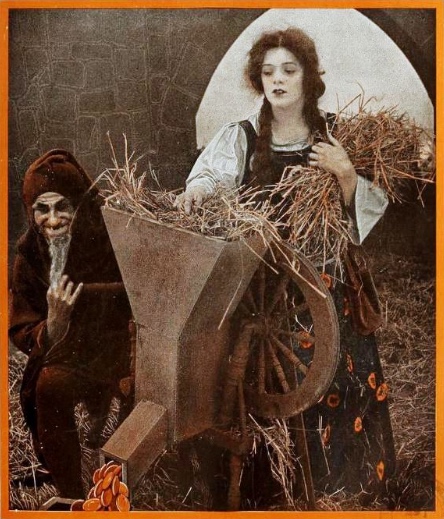
An illustration for the story Rumpelstiltskin by the author The Brothers Grimm

Once there was a miller who was poor, but who had a beautiful daughter. Now it happened that he had to go and speak to the King, and in order to make himself appear important he said to him, “I have a daughter who can spin straw into gold.” The King said to the miller, “That is an art which pleases me well; if your daughter is as clever as you say, bring her to-morrow to my palace, and I will try what she can do.”

And when the girl was brought to him he took her into a room which was quite full of straw, gave her a spinning-wheel and a reel, and said, “Now set to work, and if by to-morrow morning early you have not spun this straw into gold during the night, you must die.” Thereupon he himself locked up the room, and left her in it alone. So there sat the poor miller’s daughter, and for the life of her could not tell what to do; she had no idea how straw could be spun into gold, and she grew more and more miserable, until at last she began to weep.

But all at once the door opened, and in came a little man, and said, “Good evening, Mistress Miller; why are you crying so?” “Alas!” answered the girl, “I have to spin straw into gold, and I do not know how to do it.” “What will you give me,” said the manikin, “if I do it for you?” “My necklace,” said the girl. The little man took the necklace, seated himself in front of the wheel, and “whirr, whirr, whirr,” three turns, and the reel was full; then he put another on, and whirr, whirr, whirr, three times round, and the second was full too. And so it went on until the morning, when all the straw was spun, and all the reels were full of gold. By daybreak the King was already there, and when he saw the gold he was astonished and delighted, but his heart became only more greedy. He had the miller’s daughter taken into another room full of straw, which was much larger, and commanded her to spin that also in one night if she valued her life. The girl knew not how to help herself, and was crying, when the door again opened, and the little man appeared, and said, “What will you give me if I spin that straw into gold for you?” “The ring on my finger,” answered the girl. The little man took the ring, again began to turn the wheel, and by morning had spun all the straw into glittering gold.

The King rejoiced beyond measure at the sight, but still he had not gold enough; and he had the miller’s daughter taken into a still larger room full of straw, and said, “You must spin this, too, in the course of this night; but if you succeed, you shall be my wife.” “Even if she be a miller’s daughter,” thought he, “I could not find a richer wife in the whole world.”

When the girl was alone the manikin came again for the third time, and said, “What will you give me if I spin the straw for you this time also?” “I have nothing left that I could give,” answered the girl. “Then promise me, if you should become Queen, your first child.” “Who knows whether that will ever happen?” thought the miller’s daughter; and, not knowing how else to help herself in this strait, she promised the manikin what he wanted, and for that he once more span the straw into gold.

And when the King came in the morning, and found all as he had wished, he took her in marriage, and the pretty miller’s daughter became a Queen.

A year after, she had a beautiful child, and she never gave a thought to the manikin. But suddenly he came into her room, and said, “Now give me what you promised.” The Queen was horror-struck, and offered the manikin all the riches of the kingdom if he would leave her the child. But the manikin said, “No, something that is living is dearer to me than all the treasures in the world.” Then the Queen began to weep and cry, so that the manikin pitied her. “I will give you three days’ time,” said he, “if by that time you find out my name, then shall you keep your child.”

So the Queen thought the whole night of all the names that she had ever heard, and she sent a messenger over the country to inquire, far and wide, for any other names that there might be. When the manikin came the next day, she began with Caspar, Melchior, Balthazar, and said all the names she knew, one after another; but to every one the little man said, “That is not my name.” On the second day she had inquiries made in the neighborhood as to the names of the people there, and she repeated to the manikin the most uncommon and curious. “Perhaps your name is Shortribs, or Sheepshanks, or Laceleg?” but he always answered, “That is not my name.”

On the third day the messenger came back again, and said, “I have not been able to find a single new name, but as I came to a high mountain at the end of the forest, where the fox and the hare bid each other good night, there I saw a little house, and before the house a fire was burning, and round about the fire quite a ridiculous little man was jumping: he hopped upon one leg, and shouted—-

“To-day I bake, to-morrow brew,
The next I’ll have the young Queen’s child.
Ha! glad am I that no one knew
That Rumpelstiltskin I am styled.”

You may think how glad the Queen was when she heard the name! And when soon afterwards the little man came in, and asked, “Now, Mistress Queen, what is my name?” at first she said, “Is your name Conrad?” “No.” “Is your name Harry?” “No.”

“Perhaps your name is Rumpelstiltskin?”

“The devil has told you that! the devil has told you that!” cried the little man, and in his anger he plunged his right foot so deep into the earth that his whole leg went in; and then in rage he pulled at his left leg so hard with both hands that he tore himself in two.

Short Story Share

The Patient Cat

by Laura E. Richards


The Patient Cat was published in Ms. Richards’ collection of morality tales and poems, The Pig Brother and Other Fables and Stories (1881). Is it always wise to wait? Timing is everything in this feline morality tale.


An illustration for the story The Patient Cat by the author Laura E. Richards
A. N. Komarov, Wildcat in the Caucasus Mountains, 1905
The Patient Cat -w

HEN the spotted cat first found the nest, there was
nothing in it, for it was only just finished. So she said, “I will wait!” for she was a patient cat, and the summer was before her. She waited a week, and then she climbed up again to the top of the tree, and peeped into the nest. There lay two lovely blue eggs, smooth and shining.

The spotted cat said, “Eggs may be good, but young birds are better. I will wait.” So she waited; and while she was waiting, she caught mice and rats, and washed herself and slept, and did all that a spotted cat should do to pass the time away.

When another week had passed, she climbed the tree again and peeped into the[58] nest. This time there were five eggs. But the spotted cat said again, “Eggs may be good, but young birds are better. I will wait a little longer!”

So she waited a little longer and then went up again to look. Ah! there were five tiny birds, with big eyes and long necks, and yellow beaks wide open. Then the spotted cat sat down on the branch, and licked her nose and purred, for she was very happy. “It is worth while to be patient!” she said.

But when she looked again at the young birds, to see which one she should take first, she saw that they were very thin,—oh, very, very thin they were! The spotted cat had never seen anything so thin in her life.

“Now,” she said to herself, “if I were to wait only a few days longer, they would grow fat. Thin birds may be good, but fat birds are much better. I will wait!”

So she waited; and she watched the father-bird bringing worms all day long to the nest, and said, “Aha! they must be fattening fast! they will soon be as fat as I wish them to be. Aha! what a good thing it is to be patient.”

At last, one day she thought, “Surely, now they must be fat enough! I will not wait another day. Aha! how good they will be!”

So she climbed up the tree, licking her chops all the way and thinking of the fat young birds. And when she reached the top and looked into the nest, it was empty!!

Then the spotted cat sat down on the branch and spoke thus, “Well, of all the horrid, mean, ungrateful creatures I ever saw, those birds are the horridest, and the meanest, and the most ungrateful! Mi-a-u-ow!!!!”

Short Story Share

After Twenty Years

by O. Henry


The policeman on the beat moved up the avenue impressively. The impressiveness was habitual and not for show, for spectators were few. The time was barely 10 o’clock at night, but chilly gusts of wind with a taste of rain in them had well nigh depeopled the streets.

Trying doors as he went, twirling his club with many intricate and artful movements, turning now and then to cast his watchful eye adown the pacific thoroughfare, the officer, with his stalwart form and slight swagger, made a fine picture of a guardian of the peace. The vicinity was one that kept early hours. Now and then you might see the lights of a cigar store or of an all-night lunch counter; but the majority of the doors belonged to business places that had long since been closed.

When about midway of a certain block the policeman suddenly slowed his walk. In the doorway of a darkened hardware store a man leaned, with an unlighted cigar in his mouth. As the policeman walked up to him the man spoke up quickly.

“It’s all right, officer,” he said, reassuringly. “I’m just waiting for a friend. It’s an appointment made twenty years ago. Sounds a little funny to you, doesn’t it? Well, I’ll explain if you’d like to make certain it’s all straight. About that long ago there used to be a restaurant where this store stands–‘Big Joe’ Brady’s restaurant.”

“Until five years ago,” said the policeman. “It was torn down then.”

The man in the doorway struck a match and lit his cigar. The light showed a pale, square-jawed face with keen eyes, and a little white scar near his right eyebrow. His scarfpin was a large diamond, oddly set.

“Twenty years ago to-night,” said the man, “I dined here at ‘Big Joe’ Brady’s with Jimmy Wells, my best chum, and the finest chap in the world. He and I were raised here in New York, just like two brothers, together. I was eighteen and Jimmy was twenty. The next morning I was to start for the West to make my fortune. You couldn’t have dragged Jimmy out of New York; he thought it was the only place on earth. Well, we agreed that night that we would meet here again exactly twenty years from that date and time, no matter what our conditions might be or from what distance we might have to come. We figured that in twenty years each of us ought to have our destiny worked out and our fortunes made, whatever they were going to be.”

“It sounds pretty interesting,” said the policeman. “Rather a long time between meets, though, it seems to me. Haven’t you heard from your friend since you left?”

“Well, yes, for a time we corresponded,” said the other. “But after a year or two we lost track of each other. You see, the West is a pretty big proposition, and I kept hustling around over it pretty lively. But I know Jimmy will meet me here if he’s alive, for he always was the truest, stanchest old chap in the world. He’ll never forget. I came a thousand miles to stand in this door to-night, and it’s worth it if my old partner turns up.”

The waiting man pulled out a handsome watch, the lids of it set with small diamonds.

“Three minutes to ten,” he announced. “It was exactly ten o’clock when we parted here at the restaurant door.”

“Did pretty well out West, didn’t you?” asked the policeman.

“You bet! I hope Jimmy has done half as well. He was a kind of plodder, though, good fellow as he was. I’ve had to compete with some of the sharpest wits going to get my pile. A man gets in a groove in New York. It takes the West to put a razor-edge on him.”

The policeman twirled his club and took a step or two.

“I’ll be on my way. Hope your friend comes around all right. Going to call time on him sharp?”

“I should say not!” said the other. “I’ll give him half an hour at least. If Jimmy is alive on earth he’ll be here by that time. So long, officer.”

“Good-night, sir,” said the policeman, passing on along his beat, trying doors as he went.

There was now a fine, cold drizzle falling, and the wind had risen from its uncertain puffs into a steady blow. The few foot passengers astir in that quarter hurried dismally and silently along with coat collars turned high and pocketed hands. And in the door of the hardware store the man who had come a thousand miles to fill an appointment, uncertain almost to absurdity, with the friend of his youth, smoked his cigar and waited.

About twenty minutes he waited, and then a tall man in a long overcoat, with collar turned up to his ears, hurried across from the opposite side of the street. He went directly to the waiting man.

“Is that you, Bob?” he asked, doubtfully.

“Is that you, Jimmy Wells?” cried the man in the door.

“Bless my heart!” exclaimed the new arrival, grasping both the other’s hands with his own. “It’s Bob, sure as fate. I was certain I’d find you here if you were still in existence. Well, well, well! –twenty years is a long time. The old gone, Bob; I wish it had lasted, so we could have had another dinner there. How has the West treated you, old man?”

“Bully; it has given me everything I asked it for. You’ve changed lots, Jimmy. I never thought you were so tall by two or three inches.”

“Oh, I grew a bit after I was twenty.”

“Doing well in New York, Jimmy?”

“Moderately. I have a position in one of the city departments. Come on, Bob; we’ll go around to a place I know of, and have a good long talk about old times.”

The two men started up the street, arm in arm. The man from the West, his egotism enlarged by success, was beginning to outline the history of his career. The other, submerged in his overcoat, listened with interest.

At the corner stood a drug store, brilliant with electric lights. When they came into this glare each of them turned simultaneously to gaze upon the other’s face.

The man from the West stopped suddenly and released his arm.

“You’re not Jimmy Wells,” he snapped. “Twenty years is a long time, but not long enough to change a man’s nose from a Roman to a pug.”

“It sometimes changes a good man into a bad one, said the tall man. “You’ve been under arrest for ten minutes, ‘Silky’ Bob. Chicago thinks you may have dropped over our way and wires us she wants to have a chat with you. Going quietly, are you? That’s sensible. Now, before we go on to the station here’s a note I was asked to hand you. You may read it here at the window. It’s from Patrolman Wells.”

The man from the West unfolded the little piece of paper handed him. His hand was steady when he began to read, but it trembled a little by the time he had finished. The note was rather short.

“Bob: I was at the appointed place on time. When you struck the match to light your cigar I saw it was the face of the man wanted in Chicago. Somehow I couldn’t do it myself, so I went around and got a plain clothes man to do the job.

JIMMY.”


After Twenty Years was featured as The Short Story of the Day on Thu, Sep 28, 2017