A Man who wanted to buy an Ass went to market, and, coming across a likely-looking beast, arranged with the owner that he should be allowed to take him home on trial to see what he was like. When he reached home, he put him into his stable along with the other asses. The newcomer took a look round, and immediately went and chose a place next to the laziest and greediest beast in the stable. When the master saw this he put a halter on him at once, and led him off and handed him over to his owner again. The latter was a good deal surprised to see him back so soon, and said, “Why, do you mean to say you have tested him already?” “I don’t want to put him through any more tests,” replied the other: “I could see what sort of beast he is from the companion he chose for himself.”
There on the top of the down,
The wild heather round me and over me June’s high blue,
When I look’d at the bracken so bright and the heather so brown,
I thought to myself I would offer this book to you,
This, and my love together,
To you that are seventy-seven,
With a faith as clear as the heights of the June-blue heaven,
And a fancy as summer-new
As the green of the bracken amid the gloom of the heather.
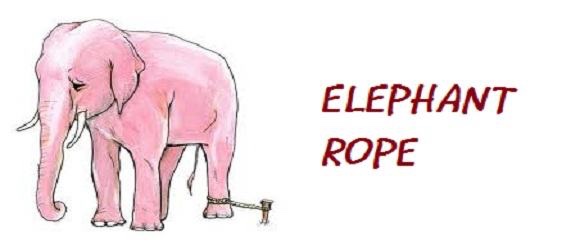
A gentleman was walking through an elephant camp, and he spotted that the elephants weren’t being kept in cages or held by the use of chains.
All that was holding them back from escaping the camp, was a small piece of rope tied to one of their legs.
As the man gazed upon the elephants, he was completely confused as to why the elephants didn’t just use their strength to break the rope and escape the camp. They could easily have done so, but instead, they didn’t try to at all.
Curious and wanting to know the answer, he asked a trainer nearby why the elephants were just standing there and never tried to escape.
The trainer replied; “when they are very young and much smaller we use the same size rope to tie them and, at that age, it’s enough to hold them. As they grow up, they are conditioned to believe they cannot break away. They believe the rope can still hold them, so they never try to break free.”
The only reason that the elephants weren’t breaking free and escaping from the camp was that over time they adopted the belief that it just wasn’t possible.Report this ad
Moral of the story:
No matter how much the world tries to hold you back, always continue with the belief that what you want to achieve is possible. Believing you can become successful is the most important step in actually achieving it.
This story was first published in 1894 as The Dream of an Hour before being republished under this title in 1895. We encourage students and teachers to use our The Story of An Hour Study Guide and Feminist Literature Study Guide.
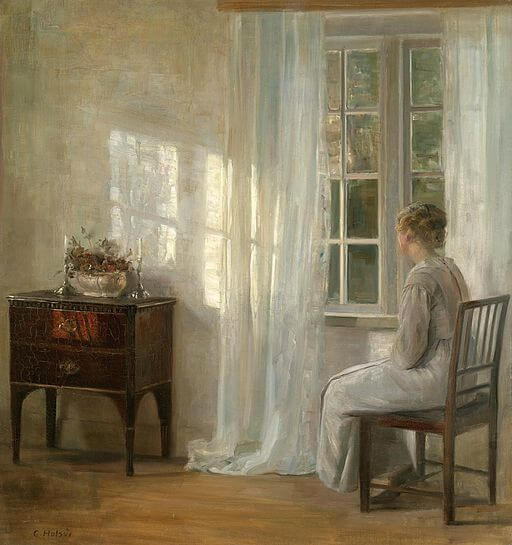
Carl Halsoe, Waiting by the Window, 1863
Knowing that Mrs. Mallard was afflicted with a heart trouble, great care was taken to break to her as gently as possible the news of her husband’s death.
It was her sister Josephine who told her, in broken sentences; veiled hints that revealed in half concealing. Her husband’s friend Richards was there, too, near her. It was he who had been in the newspaper office when intelligence of the railroad disaster was received, with Brently Mallard’s name leading the list of “killed.” He had only taken the time to assure himself of its truth by a second telegram, and had hastened to forestall any less careful, less tender friend in bearing the sad message.
She did not hear the story as many women have heard the same, with a paralyzed inability to accept its significance. She wept at once, with sudden, wild abandonment, in her sister’s arms. When the storm of grief had spent itself she went away to her room alone. She would have no one follow her.
There stood, facing the open window, a comfortable, roomy armchair. Into this she sank, pressed down by a physical exhaustion that haunted her body and seemed to reach into her soul.
She could see in the open square before her house the tops of trees that were all aquiver with the new spring life. The delicious breath of rain was in the air. In the street below a peddler was crying his wares. The notes of a distant song which someone was singing reached her faintly, and countless sparrows were twittering in the eaves.
There were patches of blue sky showing here and there through the clouds that had met and piled one above the other in the west facing her window.
She sat with her head thrown back upon the cushion of the chair, quite motionless, except when a sob came up into her throat and shook her, as a child who has cried itself to sleep continues to sob in its dreams.
She was young, with a fair, calm face, whose lines bespoke repression and even a certain strength. But now there was a dull stare in her eyes, whose gaze was fixed away off yonder on one of those patches of blue sky. It was not a glance of reflection, but rather indicated a suspension of intelligent thought.
There was something coming to her and she was waiting for it, fearfully. What was it? She did not know; it was too subtle and elusive to name. But she felt it, creeping out of the sky, reaching toward her through the sounds, the scents, the color that filled the air.
Now her bosom rose and fell tumultuously. She was beginning to recognize this thing that was approaching to possess her, and she was striving to beat it back with her will–as powerless as her two white slender hands would have been. When she abandoned herself a little whispered word escaped her slightly parted lips. She said it over and over under the breath: “free, free, free!” The vacant stare and the look of terror that had followed it went from her eyes. They stayed keen and bright. Her pulses beat fast, and the coursing blood warmed and relaxed every inch of her body.
She did not stop to ask if it were or were not a monstrous joy that held her. A clear and exalted perception enabled her to dismiss the suggestion as trivial. She knew that she would weep again when she saw the kind, tender hands folded in death; the face that had never looked save with love upon her, fixed and gray and dead. But she saw beyond that bitter moment a long procession of years to come that would belong to her absolutely. And she opened and spread her arms out to them in welcome.
There would be no one to live for during those coming years; she would live for herself. There would be no powerful will bending hers in that blind persistence with which men and women believe they have a right to impose a private will upon a fellow-creature. A kind intention or a cruel intention made the act seem no less a crime as she looked upon it in that brief moment of illumination.
And yet she had loved him–sometimes. Often she had not. What did it matter! What could love, the unsolved mystery, count for in the face of this possession of self-assertion which she suddenly recognized as the strongest impulse of her being!
“Free! Body and soul free!” she kept whispering.
Josephine was kneeling before the closed door with her lips to the keyhole, imploring for admission. “Louise, open the door! I beg; open the door–you will make yourself ill. What are you doing, Louise? For heaven’s sake open the door.”
“Go away. I am not making myself ill.” No; she was drinking in a very elixir of life through that open window.
Her fancy was running riot along those days ahead of her. Spring days, and summer days, and all sorts of days that would be her own. She breathed a quick prayer that life might be long. It was only yesterday she had thought with a shudder that life might be long.
She arose at length and opened the door to her sister’s importunities. There was a feverish triumph in her eyes, and she carried herself unwittingly like a goddess of Victory. She clasped her sister’s waist, and together they descended the stairs. Richards stood waiting for them at the bottom.
Someone was opening the front door with a latchkey. It was Brently Mallard who entered, a little travel-stained, composedly carrying his grip-sack and umbrella. He had been far from the scene of the accident, and did not even know there had been one. He stood amazed at Josephine’s piercing cry; at Richards’ quick motion to screen him from the view of his wife.
When the doctors came they said she had died of heart disease–of the joy that kills.
I wade through the Christmas morning obstacle course, around the scattered toys and books and abandoned candy canes. I grab a crumpled ball of wrapping paper and stuff it deep inside an overflowing trash bag full of tinsel and tape and cardboard packages. When the bag begins to overflow, I stuff the last handful of Christmas cheer into its plastic prison and tie it shut.
My siblings were happy to have me home from school, for the first hour. They then promptly forgot that they hadn’t seen me in months, and returned to bickering, sugar cookies,and singing Christmas carols out of tune. I sift through the aftermath of their Christmas morning, and clean up the wreckage. I head for the door.
“Don’t forget the crockpot,” my mother calls, “Take it to the dumpster, too.”
I carry the overfilled garbage bag and the old crockpot outside to the dumpster, into the cold, wet December afternoon. I consider how funny it is that my mother received this fine kitchen appliance on this same day, a year ago, and it has somehow already found its way to the dumpster. I open the lid and toss it in, along with the wrapping paper, the packages, the candy canes, and tinsel. I look up the street, at the soggy paper luminaries.
Everything is on its way out, isn’t it? I like being surprised when a kitchen appliance lasts more than a year, but why am I surprised in the first place? It’s almost like everything is just in a different state of being thrown away. Everything is going to get trashed; it’s just a matter of time.
How long will it be before we trash that brand new coffee maker we unwrapped this morning? Or the iPad? Or the new set of coffee mugs? How long will those things last? Five years? Ten? Twenty years?
I pull my brand new scarf and sweater tighter over my shoulders, and hesitate, before going back inside. I wonder, how long until I throw them out, too? How long before I tear a hole in the sweater, or the scarf gets lost?
Everything is just in a different stage of being thrown out, I’m sure of it. Everything is headed for the trash—the only difference is the amount of time it takes to get there. And that’s scary as hell. What is not going to end up in the trash, eventually? Anything?
My mind wanders, and I step back inside. My younger siblings clamber around the TV, eating candy canes and sugar cookies, watching Linus Van Pelt monologue about Christmas trees needing love.
Maybe that was it. Maybe this cliché answer of “Love and Christmas Cheer” is the one that won’t end up in the trash. Maybe love is the one thing that’s not on a path to the landfill. Maybe the Beatles really were right, and it’s as simple as that. If that were true, though, I think we would have better answers for everything.
“Watch Charlie Brown with us!” my little sister yells at me, as I turn to leave. There’s no escaping my siblings. When they want something from me, it’s as good as theirs. So I sit down beside them, and watch Lucy Van Pelt declare Charlie Brown a completely hopeless loser.
It’s not love. Love is erased when everything melts. Love is dependent on the people who carry it, the people who nurture it, the people who use it. My sister leans her head against me, and I understand that there is only one thing not destined for the trash.
Family.
That’s cliché, too. Almost as cliché as love. But it seems inarguable. Even when you’re in the ground, there’s no way to become unrelated to your siblings, or your parents, or your children. There’s no way to disconnect from them. You’ll always be family to them, and they’ll always be family to you, whether or not you like it. You can try to forget them, or disown them, or escape them, but they’re always there.
It’s in your DNA, and no escaping that.
“Do you wanna watch the Grinch with us?” my little sister asks me, as Charlie Brown ends.








 Mws R Writings