Short Story Share

After Twenty Years

by O. Henry


The policeman on the beat moved up the avenue impressively. The impressiveness was habitual and not for show, for spectators were few. The time was barely 10 o’clock at night, but chilly gusts of wind with a taste of rain in them had well nigh depeopled the streets.

Trying doors as he went, twirling his club with many intricate and artful movements, turning now and then to cast his watchful eye adown the pacific thoroughfare, the officer, with his stalwart form and slight swagger, made a fine picture of a guardian of the peace. The vicinity was one that kept early hours. Now and then you might see the lights of a cigar store or of an all-night lunch counter; but the majority of the doors belonged to business places that had long since been closed.

When about midway of a certain block the policeman suddenly slowed his walk. In the doorway of a darkened hardware store a man leaned, with an unlighted cigar in his mouth. As the policeman walked up to him the man spoke up quickly.

“It’s all right, officer,” he said, reassuringly. “I’m just waiting for a friend. It’s an appointment made twenty years ago. Sounds a little funny to you, doesn’t it? Well, I’ll explain if you’d like to make certain it’s all straight. About that long ago there used to be a restaurant where this store stands–‘Big Joe’ Brady’s restaurant.”

“Until five years ago,” said the policeman. “It was torn down then.”

The man in the doorway struck a match and lit his cigar. The light showed a pale, square-jawed face with keen eyes, and a little white scar near his right eyebrow. His scarfpin was a large diamond, oddly set.

“Twenty years ago to-night,” said the man, “I dined here at ‘Big Joe’ Brady’s with Jimmy Wells, my best chum, and the finest chap in the world. He and I were raised here in New York, just like two brothers, together. I was eighteen and Jimmy was twenty. The next morning I was to start for the West to make my fortune. You couldn’t have dragged Jimmy out of New York; he thought it was the only place on earth. Well, we agreed that night that we would meet here again exactly twenty years from that date and time, no matter what our conditions might be or from what distance we might have to come. We figured that in twenty years each of us ought to have our destiny worked out and our fortunes made, whatever they were going to be.”

“It sounds pretty interesting,” said the policeman. “Rather a long time between meets, though, it seems to me. Haven’t you heard from your friend since you left?”

“Well, yes, for a time we corresponded,” said the other. “But after a year or two we lost track of each other. You see, the West is a pretty big proposition, and I kept hustling around over it pretty lively. But I know Jimmy will meet me here if he’s alive, for he always was the truest, stanchest old chap in the world. He’ll never forget. I came a thousand miles to stand in this door to-night, and it’s worth it if my old partner turns up.”

The waiting man pulled out a handsome watch, the lids of it set with small diamonds.

“Three minutes to ten,” he announced. “It was exactly ten o’clock when we parted here at the restaurant door.”

“Did pretty well out West, didn’t you?” asked the policeman.

“You bet! I hope Jimmy has done half as well. He was a kind of plodder, though, good fellow as he was. I’ve had to compete with some of the sharpest wits going to get my pile. A man gets in a groove in New York. It takes the West to put a razor-edge on him.”

The policeman twirled his club and took a step or two.

“I’ll be on my way. Hope your friend comes around all right. Going to call time on him sharp?”

“I should say not!” said the other. “I’ll give him half an hour at least. If Jimmy is alive on earth he’ll be here by that time. So long, officer.”

“Good-night, sir,” said the policeman, passing on along his beat, trying doors as he went.

There was now a fine, cold drizzle falling, and the wind had risen from its uncertain puffs into a steady blow. The few foot passengers astir in that quarter hurried dismally and silently along with coat collars turned high and pocketed hands. And in the door of the hardware store the man who had come a thousand miles to fill an appointment, uncertain almost to absurdity, with the friend of his youth, smoked his cigar and waited.

About twenty minutes he waited, and then a tall man in a long overcoat, with collar turned up to his ears, hurried across from the opposite side of the street. He went directly to the waiting man.

“Is that you, Bob?” he asked, doubtfully.

“Is that you, Jimmy Wells?” cried the man in the door.

“Bless my heart!” exclaimed the new arrival, grasping both the other’s hands with his own. “It’s Bob, sure as fate. I was certain I’d find you here if you were still in existence. Well, well, well! –twenty years is a long time. The old gone, Bob; I wish it had lasted, so we could have had another dinner there. How has the West treated you, old man?”

“Bully; it has given me everything I asked it for. You’ve changed lots, Jimmy. I never thought you were so tall by two or three inches.”

“Oh, I grew a bit after I was twenty.”

“Doing well in New York, Jimmy?”

“Moderately. I have a position in one of the city departments. Come on, Bob; we’ll go around to a place I know of, and have a good long talk about old times.”

The two men started up the street, arm in arm. The man from the West, his egotism enlarged by success, was beginning to outline the history of his career. The other, submerged in his overcoat, listened with interest.

At the corner stood a drug store, brilliant with electric lights. When they came into this glare each of them turned simultaneously to gaze upon the other’s face.

The man from the West stopped suddenly and released his arm.

“You’re not Jimmy Wells,” he snapped. “Twenty years is a long time, but not long enough to change a man’s nose from a Roman to a pug.”

“It sometimes changes a good man into a bad one, said the tall man. “You’ve been under arrest for ten minutes, ‘Silky’ Bob. Chicago thinks you may have dropped over our way and wires us she wants to have a chat with you. Going quietly, are you? That’s sensible. Now, before we go on to the station here’s a note I was asked to hand you. You may read it here at the window. It’s from Patrolman Wells.”

The man from the West unfolded the little piece of paper handed him. His hand was steady when he began to read, but it trembled a little by the time he had finished. The note was rather short.

“Bob: I was at the appointed place on time. When you struck the match to light your cigar I saw it was the face of the man wanted in Chicago. Somehow I couldn’t do it myself, so I went around and got a plain clothes man to do the job.

JIMMY.”


After Twenty Years was featured as The Short Story of the Day on Thu, Sep 28, 2017

Short Story Share

The Terrible Old Man

by H. P. Lovecraft


Written on January 28, 1920, and originally published in Tryout magazine in 1921, The Terrible Old Man is of particular interest to fans of H.P. Lovecraft because it marks the introduction of Lovecraft’s fictional geography, setting his work for the first time in the fictional New England town of Kingsport. H.P. Lovecraft’s story is featured in our collection of Halloween Stories, a fine example of Gothic Literature


An illustration for the story The Terrible Old Man by the author H. P. Lovecraft
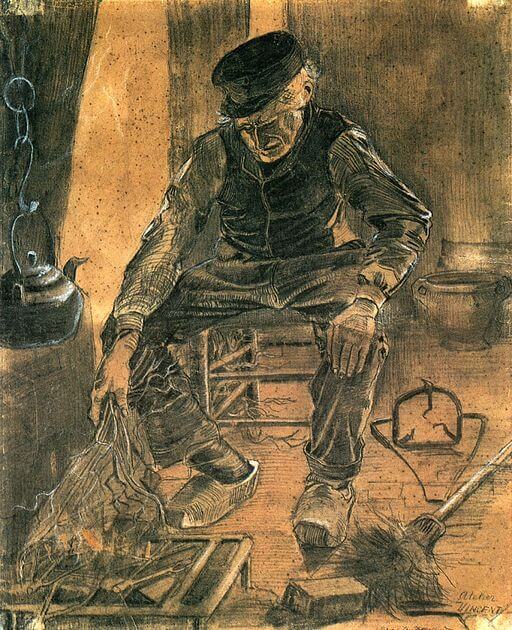
Vincent van Gogh, An Old Man Putting Dry Rice on the Hearth, 1881

It was the design of Angelo Ricci and Joe Czanek and Manuel Silva to call on the Terrible Old Man. This old man dwells all alone in a very ancient house on Water Street near the sea, and is reputed to be both exceedingly rich and exceedingly feeble; which forms a situation very attractive to men of the profession of Messrs. Ricci, Czanek, and Silva, for that profession was nothing less dignified than robbery.

The inhabitants of Kingsport say and think many things about the Terrible Old Man which generally keep him safe from the attention of gentlemen like Mr. Ricci and his colleagues, despite the almost certain fact that he hides a fortune of indefinite magnitude somewhere about his musty and venerable abode. He is, in truth, a very strange person, believed to have been a captain of East India clipper ships in his day; so old that no one can remember when he was young, and so taciturn that few know his real name. Among the gnarled trees in the front yard of his aged and neglected place he maintains a strange collection of large stones, oddly grouped and painted so that they resemble the idols in some obscure Eastern temple. This collection frightens away most of the small boys who love to taunt the Terrible Old Man about his long white hair and beard, or to break the small-paned windows of his dwelling with wicked missiles; but there are other things which frighten the older and more curious folk who sometimes steal up to the house to peer in through the dusty panes. These folk say that on a table in a bare room on the ground floor are many peculiar bottles, in each a small piece of lead suspended pendulum-wise from a string. And they say that the Terrible Old Man talks to these bottles, addressing them by such names as Jack, Scar-Face, Long Tom, Spanish Joe, Peters, and Mate Ellis, and that whenever he speaks to a bottle the little lead pendulum within makes certain definite vibrations as if in answer.

Those who have watched the tall, lean, Terrible Old Man in these peculiar conversations, do not watch him again. But Angelo Ricci and Joe Czanek and Manuel Silva were not of Kingsport blood; they were of that new and heterogeneous alien stock which lies outside the charmed circle of New England life and traditions, and they saw in the Terrible Old Man merely a tottering, almost helpless grey-beard, who could not walk without the aid of his knotted cane, and whose thin, weak hands shook pitifully. They were really quite sorry in their way for the lonely, unpopular old fellow, whom everybody shunned, and at whom all the dogs barked singularly. But business is business, and to a robber whose soul is in his profession, there is a lure and a challenge about a very old and very feeble man who has no account at the bank, and who pays for his few necessities at the village store with Spanish gold and silver minted two centuries ago.

Messrs. Ricci, Czanek, and Silva selected the night of April 11th for their call. Mr. Ricci and Mr. Silva were to interview the poor old gentleman, whilst Mr. Czanek waited for them and their presumable metallic burden with a covered motor-car in Ship Street, by the gate in the tall rear wall of their hosts grounds. Desire to avoid needless explanations in case of unexpected police intrusions prompted these plans for a quiet and unostentatious departure.

As prearranged, the three adventurers started out separately in order to prevent any evil-minded suspicions afterward. Messrs. Ricci and Silva met in Water Street by the old man’s front gate, and although they did not like the way the moon shone down upon the painted stones through the budding branches of the gnarled trees, they had more important things to think about than mere idle superstition. They feared it might be unpleasant work making the Terrible Old Man loquacious concerning his hoarded gold and silver, for aged sea-captains are notably stubborn and perverse. Still, he was very old and very feeble, and there were two visitors. Messrs. Ricci and Silva were experienced in the art of making unwilling persons voluble, and the screams of a weak and exceptionally venerable man can be easily muffled. So they moved up to the one lighted window and heard the Terrible Old Man talking childishly to his bottles with pendulums. Then they donned masks and knocked politely at the weather-stained oaken door.

Waiting seemed very long to Mr. Czanek as he fidgeted restlessly in the covered motor-car by the Terrible Old Man’s back gate in Ship Street. He was more than ordinarily tender-hearted, and he did not like the hideous screams he had heard in the ancient house just after the hour appointed for the deed. Had he not told his colleagues to be as gentle as possible with the pathetic old sea-captain? Very nervously he watched that narrow oaken gate in the high and ivy-clad stone wall. Frequently he consulted his watch, and wondered at the delay. Had the old man died before revealing where his treasure was hidden, and had a thorough search become necessary? Mr. Czanek did not like to wait so long in the dark in such a place. Then he sensed a soft tread or tapping on the walk inside the gate, heard a gentle fumbling at the rusty latch, and saw the narrow, heavy door swing inward. And in the pallid glow of the single dim street-lamp he strained his eyes to see what his colleagues had brought out of that sinister house which loomed so close behind. But when he looked, he did not see what he had expected; for his colleagues were not there at all, but only the Terrible Old Man leaning quietly on his knotted cane and smiling hideously. Mr. Czanek had never before noticed the colour of that mans eyes; now he saw that they were yellow.

Little things make considerable excitement in little towns, which is the reason that Kingsport people talked all that spring and summer about the three unidentifiable bodies, horribly slashed as with many cutlasses, and horribly mangled as by the tread of many cruel boot-heels, which the tide washed in. And some people even spoke of things as trivial as the deserted motor-car found in Ship Street, or certain especially inhuman cries, probably of a stray animal or migratory bird, heard in the night by wakeful citizens. But in this idle village gossip the Terrible Old Man took no interest at all. He was by nature reserved, and when one is aged and feeble, one’s reserve is doubly strong. Besides, so ancient a sea-captain must have witnessed scores of things much more stirring in the far-off days of his unremembered youth.


The Terrible Old Man was featured as The Short Story of the Day on Thu, Oct 18, 2018

A Fable

by Mark Twain


An illustration for the story A Fable by the author Mark Twain
Thomas Landseer etching, Three Cats

Once upon a time an artist who had painted a small and very beautiful picture placed it so that he could see it in the mirror. He said, “This doubles the distance and softens it, and it is twice as lovely as it was before.”

The animals out in the woods heard of this through the housecat, who was greatly admired by them because he was so learned, and so refined and civilized, and so polite and high-bred, and could tell them so much which they didn’t know before, and were not certain about afterward. They were much excited about this new piece of gossip, and they asked questions, so as to get at a full understanding of it. They asked what a picture was, and the cat explained.

“It is a flat thing,” he said; “wonderfully flat, marvelously flat, enchantingly flat and elegant. And, oh, so beautiful!”

That excited them almost to a frenzy, and they said they would give the world to see it. Then the bear asked:

“What is it that makes it so beautiful?”

“It is the looks of it,” said the cat.

This filled them with admiration and uncertainty, and they were more excited than ever. Then the cow asked:

“What is a mirror?”

“It is a hole in the wall,” said the cat. “You look in it, and there you see the picture, and it is so dainty and charming and ethereal and inspiring in its unimaginable beauty that your head turns round and round, and you almost swoon with ecstasy.”

The ass had not said anything as yet; he now began to throw doubts. He said there had never been anything as beautiful as this before, and probably wasn’t now. He said that when it took a whole basketful of sesquipedalian adjectives to whoop up a thing of beauty, it was time for suspicion.

It was easy to see that these doubts were having an effect upon the animals, so the cat went off offended. The subject was dropped for a couple of days, but in the meantime curiosity was taking a fresh start, aid there was a revival of interest perceptible. Then the animals assailed the ass for spoiling what could possibly have been a pleasure to them, on a mere suspicion that the picture was not beautiful, without any evidence that such was the case. The ass was not, troubled; he was calm, and said there was one way to find out who was in the right, himself or the cat: he would go and look in that hole, and come back and tell what he found there. The animals felt relieved and grateful, and asked him to go at once–which he did.

But he did not know where he ought to stand; and so, through error, he stood between the picture and the mirror. The result was that the picture had no chance, and didn’t show up. He returned home and said:

“The cat lied. There was nothing in that hole but an ass. There wasn’t a sign of a flat thing visible. It was a handsome ass, and friendly, but just an ass, and nothing more.”

The elephant asked:

“Did you see it good and clear? Were you close to it?”

“I saw it good and clear, O Hathi, King of Beasts. I was so close that I touched noses with it.”

“This is very strange,” said the elephant; “the cat was always truthful before–as far as we could make out. Let another witness try. Go, Baloo, look in the hole, and come and report.”

So the bear went. When he came back, he said:

“Both the cat and the ass have lied; there was nothing in the hole but a bear.”

Great was the surprise and puzzlement of the animals. Each was now anxious to make the test himself and get at the straight truth. The elephant sent them one at a time.

First, the cow. She found nothing in the hole but a cow.

The tiger found nothing in it but a tiger.

The lion found nothing in it but a lion.

The leopard found nothing in it but a leopard.

The camel found a camel, and nothing more.

Then Hathi was wroth, and said he would have the truth, if he had to go and fetch it himself. When he returned, he abused his whole subjectry for liars, and was in an unappeasable fury with the moral and mental blindness of the cat. He said that anybody but a near-sighted fool could see that there was nothing in the hole but an elephant.

MORAL, BY THE CAT

You can find in a text whatever you bring, if you will stand between it and the mirror of your imagination. You may not see your ears, but they will be there.


A Fable was featured as The Short Story of the Day on Fri, Sep 14, 2018

Short Story

Monday Or Tuesday

by Virginia Woolf


Published in 1921, Monday or Tuesday was one of eight short stories in her collection with the same title.


An illustration for the story Monday Or Tuesday by the author Virginia Woolf
Monday or Tuesday, first edition cover, 1921
Monday or Tuesday heron


[Photo by Chris Harshaw, Tricolor heron fishing, 2008]

LAZY AND INDIFFERENT, shaking space easily from his wings, knowing his way, the heron passes over the church beneath the sky. White and distant, absorbed in itself, endlessly the sky covers and uncovers, moves and remains. A lake? Blot the shores of it out! A mountain? Oh, perfect the sun gold on its slopes. Down that falls. Ferns then, or white feathers, for ever and ever–

Desiring truth, awaiting it, laboriously distilling a few words, for ever desiring—(a cry starts to the left, another to the right. Wheels strike divergently. Omnibuses conglomerate in conflict)—for ever desiring—(the clock asseverates with twelve distinct strokes that it is midday; light sheds gold scales; children swarm)—for ever desiring truth. Red is the dome; coins hang on the trees; smoke trails from the chimneys; bark, shout, cry “Iron for sale”—and truth?

Radiating to a point men’s feet and women’s feet, black or gold-encrusted—(This foggy weather—Sugar? No, thank you—The commonwealth of the future)—the firelight darting and making the room red, save for the black figures and their bright eyes, while outside a van discharges, Miss Thingummy drinks tea at her desk, and plate-glass preserves fur coats——

Flaunted, leaf-light, drifting at corners, blown across the wheels, silver-splashed, home or not home, gathered, scattered, squandered in separate scales, swept up, down, torn, sunk, assembled– and truth?

Now to recollect by the fireside on the white square of marble. From ivory depths words rising shed their blackness, blossom and penetrate. Fallen the book; in the flame, in the smoke, in the momentary sparks– or now voyaging, the marble square pendant, minarets beneath and the Indian seas, while space rushes blue and stars glint truth? Or now, content with closeness?

Lazy and indifferent the heron returns; the sky veils her stars; then bares them.

Funny Short Story

Short Story Share

Short Story~ By Aesop

An illustration for the story The Ass and His Purchaser by the author Aesop

The Ass and His Purchaser

by Aesop


An illustration for the story The Ass and His Purchaser by the author Aesop
John Constable, Donkeys in the Stable, 1825

A Man who wanted to buy an Ass went to market, and, coming across a likely-looking beast, arranged with the owner that he should be allowed to take him home on trial to see what he was like. When he reached home, he put him into his stable along with the other asses. The newcomer took a look round, and immediately went and chose a place next to the laziest and greediest beast in the stable. When the master saw this he put a halter on him at once, and led him off and handed him over to his owner again. The latter was a good deal surprised to see him back so soon, and said, “Why, do you mean to say you have tested him already?” “I don’t want to put him through any more tests,” replied the other: “I could see what sort of beast he is from the companion he chose for himself.”

A man is known by the company he keeps.


    Short Story Share

    June Bracken And Heather

    by Alfred Lord Tennyson


    An illustration for the story June Bracken And Heather by the author Alfred Lord Tennyson
    There on the top of the down,
    The wild heather round me and over me June’s high blue,
    When I look’d at the bracken so bright and the heather so brown,
    I thought to myself I would offer this book to you,
    This, and my love together,
    To you that are seventy-seven,
    With a faith as clear as the heights of the June-blue heaven,
    And a fancy as summer-new
    As the green of the bracken amid the gloom of the heather.