Top 10 things to know about the Day of the Dead
We’ve all heard about the Day of the Dead or seen the classic sugar skull paintings—but what does this celebration really represent?
By Logan Ward
Here’s one thing we know: Día de los Muertos, or Day of the Dead, is not a Mexican version of Halloween. Though related, the two annual events differ greatly in traditions and tone. Whereas Halloween is a dark night of terror and mischief, Day of the Dead festivities unfold over two days in an explosion of color and life-affirming joy. Sure, the theme is death, but the point is to demonstrate love and respect for deceased family members. In towns and cities throughout Mexico, revelers don funky makeup and costumes, hold parades and parties, sing and dance, and make offerings to lost loved ones.
The rituals are rife with symbolic meaning. The more you understand about this feast for the senses, the more you will appreciate it. Here are 10 essential things you should know about Mexico’s most colorful annual event. [See more stunning photos from Day of the Dead celebrations.]
Thanks to efforts by the United Nations Educational, Scientific and Cultural Organization, or UNESCO, the term “cultural heritage” is not limited to monuments and collections of objects. It also includes living expressions of culture—traditions—passed down from generation to generation. In 2008, UNESCO recognized the importance of Día de los Muertos by adding the holiday to its list of Intangible Cultural Heritage of Humanity. Today Mexicans from all religious and ethnic backgrounds celebrate Día de los Muertos, but at its core, the holiday is a reaffirmation of indigenous life.
There are endless variations of the Catrina sold in many forms during the holiday—and throughout the year in Mexico.
Right:
Participants walk down a mural-painted street during Dia de los Muertos.Photograph by Tino Soriano, National Geographic (Left)
Papel picado, or pierced papers, blow in the wind in San Miguel de Allende, Mexico. You can find papel picado around Mexico throughout the year, but especially around Day of the Dead.
Right:
A Mexican woman sits at at a gravesite covered in marigolds and other flowers… Read MorePhotograph by Raul Touzon (Left) and Photograph by Jan Sochor, Alamy (Right)
History
Day of the Dead originated several thousand years ago with the Aztec, Toltec, and other Nahua people, who considered mourning the dead disrespectful. For these pre-Hispanic cultures, death was a natural phase in life’s long continuum. The dead were still members of the community, kept alive in memory and spirit—and during Día de los Muertos, they temporarily returned to Earth. Today’s Día de los Muertos celebration is a mash-up of pre-Hispanic religious rites and Christian feasts. It takes place on November 1 and 2—All Saints’ Day and All Souls’ Day on the Catholic calendar—around the time of the fall maize harvest.
Altars
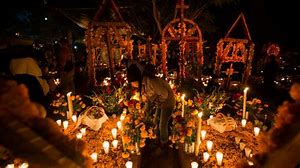
The centerpiece of the celebration is an altar, or ofrenda, built in private homes and cemeteries. These aren’t altars for worshipping; rather, they’re meant to welcome spirits back to the realm of the living. As such, they’re loaded with offerings—water to quench thirst after the long journey, food, family photos, and a candle for each dead relative. If one of the spirits is a child, you might find small toys on the altar. Marigolds are the main flowers used to decorate the altar. Scattered from altar to gravesite, marigold petals guide wandering souls back to their place of rest. The smoke from copal incense, made from tree resin, transmits praise and prayers and purifies the area around the altar.
Literary Calaveras
Calavera means “skull.” But during the late 18th and early 19th centuries, calavera was used to describe short, humorous poems, which were often sarcastic tombstone epitaphs published in newspapers that poked fun at the living. These literary calaveras eventually became a popular part of Día de los Muertos celebrations. Today the practice is alive and well. You’ll find these clever, biting poems in print, read aloud, and broadcast on television and radio programs.
The Calavera Catrina
In the early 20th century, Mexican political cartoonist and lithographer José Guadalupe Posada created an etching to accompany a literary calavera. Posada dressed his personification of death in fancy French garb and called it Calavera Garbancera, intending it as social commentary on Mexican society’s emulation of European sophistication. “Todos somos calaveras,” a quote commonly attributed to Posada, means “we are all skeletons.” Underneath all our manmade trappings, we are all the same.
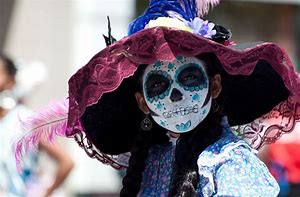
In 1947 artist Diego Rivera featured Posada’s stylized skeleton in his masterpiece mural “Dream of a Sunday Afternoon in Alameda Park.” Posada’s skeletal bust was dressed in a large feminine hat, and Rivera made his female and named her Catrina, slang for “the rich.” Today, the calavera Catrina, or elegant skull, is the Day of the Dead’s most ubiquitous symbol.
Food of the Dead
You work up a mighty hunger and thirst traveling from the spirit world back to the realm of the living. At least that’s the traditional belief in Mexico. Some families place their dead loved one’s favorite meal on the altar. Other common offerings:
Pan de muerto, or bread of the dead, is a typical sweet bread (pan dulce), often featuring anise seeds and decorated with bones and skulls made from dough. The bones might be arranged in a circle, as in the circle of life. Tiny dough teardrops symbolize sorrow.
Sugar skulls are part of a sugar art tradition brought by 17th-century Italian missionaries. Pressed in molds and decorated with crystalline colors, they come in all sizes and levels of complexity.
Drinks, including pulque, a sweet fermented beverage made from the agave sap; atole, a thin warm porridge made from corn flour, with unrefined cane sugar, cinnamon, and vanilla added; and hot chocolate.
Marigolds and family photos decorate a Day of the Dead altar in San Miguel de Allende, Mexico.
Right:
A woman adds finishing touches on her Catrina makeup ahead of the Catrinas… Read MorePhotograph by Corbis Documentary/Getty Images (Left) and Photograph by Alejandro Ayala Xinhua, eyevine/Redux (Right)
Costumes
Day of the Dead is an extremely social holiday that spills into streets and public squares at all hours of the day and night. Dressing up as skeletons is part of the fun. People of all ages have their faces artfully painted to resemble skulls, and, mimicking the calavera Catrina, they don suits and fancy dresses. Many revelers wear shells or other noisemakers to amp up the excitement—and also possibly to rouse the dead and keep them close during the fun.
Papel Picado
You’ve probably seen this beautiful Mexican paper craft plenty of times in stateside Mexican restaurants. The literal translation, pierced paper, perfectly describes how it’s made. Artisans stack colored tissue paper in dozens of layers, then perforate the layers with hammer and chisel points. Papel picado isn’t used exclusively during Day of the Dead, but it plays an important role in the holiday. Draped around altars and in the streets, the art represents the wind and the fragility of life.
Dancers in traditional costumes perform in front of the Santo Domingo church in Oaxaca, Mexico.Photograph by Craig Lovell, Eagle Visions Photography/Alamy (Left) and Photograph by Richard Ellis, Alamy (Right)
Day of the Dead Today
Thanks to recognition by UNESCO and the global sharing of information, Día de los Muertos is more popular than ever—in Mexico and, increasingly, abroad. For more than a dozen years, the New York-based nonprofit cultural organization Mano a Mano: Mexican Culture Without Borders has staged the city’s largest Day of the Dead celebration. But the most authentic celebrations take place in Mexico. If you find yourself in Mexico City the weekend before Day of the Dead this year, make sure to stop by the grand parade where you can join in on live music, bike rides and other activities in celebration throughout the city.
Take Your Pick
Countless communities in Mexico celebrate Day of the Dead, but styles and customs differ by region, depending on the region’s predominant pre-Hispanic culture. Here are a few places that stand out for their colorful and moving celebrations:
Pátzcuaro
One of the most moving Day of the Dead celebrations takes place each year in Pátzcuaro, a municipality in the state of Michoacán about 225 miles west of Mexico City. Indigenous people from the countryside converge on the shores of Pátzcuaro Lake, where they pile into canoes, a single candle burning in each bow, and paddle over to a tiny island called Janitzio for an all-night vigil in an indigenous cemetery.
Mixquic
In this Mexico City suburb, bells from the historic Augustinian convent toll and community members bearing candles and flowers process to the local cemetery, where they clean and decorate the graves of their loved ones.
A Catrina and Catrin pose before an ofrenda, an altar set for deceased loved ones. Ofrendas display portraits, crosses, candles, flowers, incense, and water, a refreshment for the spirits who have made the long trip home from the hereafter. … Read MorePhotograph by Austin Beahm, National Geographic Your Shot
Cempasúchil, or marigolds, blanket a cemetery in Oaxaca, Mexico. These “flowers of the dead” originate in Mexico and are essential to Día de los Muertos. Aztecs used marigolds to cure hiccups, to heal those who had been struck by lightning, and to protect travelers who were crossing rivers. … Read MorePhotograph by willem kuijpers, National Geographic Your Shot
Artist José Guadalupe Posada’s original Catrina, named “Calavera Garbancera,” was painted to depict Mexican natives who were adopting European aristocratic fashion such as… Read MorePhotograph by Daniel Kudish, National Geographic Your Shot
On Gede, the Haitian Day of the Dead, voodoo believers paint their faces and wear purple and black to dress like spirits. Spicy rum is poured across gravestones, bones are arranged throughout the cemetery, and voodoos gather on tombs to call upon Baron Samedi, the Gede master of the dead. … Read MorePhotograph by Ricardo Arduengo, National Geographic Your Shot
The forever queen of El Día is Catrina, an elegant female skeleton first etched by José Guadalupe Posada. This rose-crowned, Kahlo-esque Catrina was photographed during Hollywood Forever Cemetery’s Día de los Muertos, which honored Posada’s art in 2017. … Read MorePhotograph by Melissa Cormican, National Geographic Your Shot
During Día de los Muertos in Mexico City, children dress up as skeletons and participate in parades. On November 1, festival events specifically honor deceased children and on November 2 deceased adults are honored—each day a reminder that life is precious and fleeting. … Read MorePhotograph by Alejandro Pérez, National Geographic Your Shot
In the town of Sumpango, Guatemala, Día de los Muertos activities include a giant kite festival. The enormous kites, some over 60 feet tall, are constructed from bamboo, agave ropes, and cloth. They illustrate both modern and Biblical themes. … Read MorePhotograph by Camilo Sarti, National Geographic Your Shot
Nearly the entire population of San Juan Chamula, Mexico, is indigenous, and their heritage is reflected in the town’s cemeteries. Tzotzil is the predominate language, and graves… Read MorePhotograph by Rodrigo Pardo, National Geographic Your Shot
In San Francisco, an integral part of Día de los Muertos is the festival of altars—a tradition kept alcohol-free out of respect. Many altars, or ofrendas, incorporate favorite treats of the deceased, in hopes that their spirits will visit and consume the food’s essence. … Read MorePhotograph by steve shpall, National Geographic Your Shot
Día de los Muertos often celebrates and preserves ancient indigenous culture. During a celebration in California, this woman’s feathered costume is reminiscent of plumy Xochiquetzal, a “womb and tomb” Aztec fertility goddess who is often honored with marigolds on Day of the Dead. … Read MorePhotograph by Melissa Cormican, National Geographic Your Shot
A child dressed as a skeleton charro, or cowboy, hollers between rows of giant agave plants in Oaxaca, Mexico. Further north in Michoacán, mezcal made from agave is buried underground for nine months in a “mezcal cemetery” and unearthed only for Día de los Muertos. … Read MorePhotograph by Eva Lepiz, National Geographic Your Shot
Candlelight graveyard vigils, like this one in Oaxaca, are common during Día de los Muertos. While there are some solitary moments of remembrance, vigils are traditionally lively and… Read MorePhotograph by Mariana Yañez, National Geographic Your Shot
Los Angeles’s Hollywood Forever Cemetery hosts the largest Día de los Muertos celebration outside of Mexico. Here, and in Mexico, colorful flower and banner decorations are crafted from thin paper or fresh flowers in order to symbolize the fragility of life. … Read MorePhotograph by Dotan Saguy, National Geographic Your Shot
On Día de los Muertos in Terlingua, Texas, locals convene at the Trading Company for face-painting and music, then travel to the cemetery to honor deceased old-time miners. Butterflies… Read MorePhotograph by Michael Anglin, National Geographic Your Shot
San Andres Mixquic is known for its extensive Day of the Dead festivities complete with candlelit vigils, colorful street performances, mariachi bands, warm pozole stew, skull-shaped bread,cotton candy, and fried grasshoppers. … Read MorePhotograph by Mauricio Challu, National Geographic Your Shot
Women in San Andres, Mexico, cook albóndigas, or meatballs, which are considered a comfort food and commonly found on ofrendas during Día de los Muertos. They are prepared with chopped mint and served in brothy soup or smoky tomato chipotlesauce. … Read MorePhotograph by Pauline Stevens, National Geographic Your Shot
Pan de muerto, the “bread of the dead,” is a soft, sweet bread with hints of anise and orange. The round loaves are often decorated with dough that resemble bones and teardrops, and… Read MorePhotograph by Cintia Soto, National Geographic Your Shot
Sumpango’s Barriletes Gigantes kite festival is set against the backdrop of Volcán de Fuego, an active Guatemalan volcano. Día de los Muertos, held the same day as the kite festival, will be particularly poignant this year, as locals honor those lost in a tragic eruption during 2018. … Read MorePhotograph by Gloria Gonzalez, National Geographic Your Shot
Tuxtepec
This small city in the northeastern part of Oaxaca state is best known for its sawdust rugs. For days, locals painstakingly arrange colored sawdust, flower petals, rice, pine needles, and other organic materials in elaborate, ruglike patterns on city streets. Traditionally made for important processions, Tuxtepec’s sawdust rugs are judged in a contest held during Día de los Muertos.
Aguascalientes
Located roughly 140 miles north of Guadalajara, Aguascalientes—birthplace of engraver José Guadalupe Posada—stretches its Day of the Dead celebrations to nearly a week during its Festival de Calaveras (Festival of Skulls). The festival culminates in a grand parade of skulls along Avenida Madero.
PUBLISHED October 26, 2017 https://www.nationalgeographic.com/travel/destinations/north-america/mexico/top-ten-day-of-dead-mexico/




Wow
LikeLike
Nice post dear, I read that one of the ancheny mountain group would bring their dead out to their homes during the day of the dead to honor them then return them after wards.
❤️✌️
BY FOR NOW
LikeLike
🌎🌹
LikeLike
I’m on a different planet, apparently. I only once saw this in the South Pacific.
LikeLike
That’s a nice sentiment
LikeLike
They celebrate in the cemeteries and tell stories about their dead loved ones. My favorite saying from this cultural celebration is, “No one is ever truly dead as long as there is someone alive who remembers them.”
LikeLike