Short Story Share

The Father

by Bjørnstjerne Bjørnson


Bjørnson uses just over one thousand words to spin this powerful morality tale about a wealthy man’s spiritual journey at various stages of his son’s life.


An illustration for the story The Father by the author Bjørnstjerne Bjørnson
Winslow Homer, The Fog Warning, 1885

THE man whose story is here to be told was the wealthiest and most influential person in his parish; his name was Thord Overaas. He appeared in the priest’s study one day, tall and earnest. “I have gotten a son,” said he, “and I wish to present him for baptism.”

“What shall his name be?”

“Finn,—after my father.”

“And the sponsors?”

They were mentioned, and proved to be the best men and women of Thord’s relations in the parish.

“Is there anything else?” inquired the priest, and looked up.

The peasant hesitated a little.

“I should like very much to have him baptized by himself,” said he, finally.

“That is to say on a week-day?”

“Next Saturday, at twelve o’clock noon.”

“Is there anything else?” inquired the priest.

“There is nothing else;” and the peasant twirled his cap, as though he were about to go.

Then the priest rose. “There is yet this, however,” said he, and walking toward Thord, he took him by the hand and looked gravely into his eyes: “God grant that the child may become a blessing to you!”

One day sixteen years later, Thord stood once more in the priest’s study.

“Really, you carry your age astonishingly well, Thord,” said the priest; for he saw no change whatever in the man.

“That is because I have no troubles,” replied Thord.

To this the priest said nothing, but after a while he asked: “What is your pleasure this evening?”

“I have come this evening about that son of mine who is to be confirmed to-morrow.”

“He is a bright boy.”

“I did not wish to pay the priest until I heard what number the boy would have when he takes his place in church to-morrow.”

“He will stand number one.’

“So I have heard; and here are ten dollars for the priest.”

“Is there anything else I can do for you?” inquired the priest, fixing his eyes on Thord.

“There is nothing else.”

Thord went out.

Eight years more rolled by, and then one day a noise was heard outside of the priest’s study, for many men were approaching, and at their head was Thord, who entered first.

The priest looked up and recognized him.

“You come well attended this evening, Thord,”

“I am here to request that the banns may be published for my son; he is about to marry Karen Storliden, daughter of Gudmund, who stands here beside me.”

“Why, that is the richest girl in the parish.”

“So they say,” replied the peasant, stroking back his hair with one hand.

The priest sat a while as if in deep thought, then entered the names in his book, without making any comments, and the men wrote their signatures underneath. Thord laid three dollars on the table.

“One is all I am to have,” said the priest.

“I know that very well; but he is my only child, I want to do it handsomely.”

The priest took the money.

“This is now the third time, Thord, that you have come here on your son’s account.”

“But now I am through with him,” said Thord, and folding up his pocket-book he said farewell and walked away.

The men slowly followed him.

A fortnight later, the father and son were rowing across the lake, one calm, still day, to Storliden to make arrangements for the wedding.

“This thwart is not secure,” said the son, and stood up to straighten the seat on which he was sitting.

At the same moment the board he was standing on slipped from under him; he threw out his arms, uttered a shriek, and fell overboard.

“Take hold of the oar!” shouted the father, springing to his feet and holding out the oar.

But when the son had made a couple of efforts he grew stiff.

“Wait a moment!” cried the father, and began to row toward his son.

Then the son rolled over on his back, gave his father one long look, and sank.

Thord could scarcely believe it; he held the boat still, and stared at the spot where his son had gone down, as though he must surely come to the surface again. There rose some bubbles, then some more, and finally one large one that burst; and the lake lay there as smooth and bright as a mirror again.

For three days and three nights people saw the father rowing round and round the spot, without taking either food or sleep; he was dragging the lake for the body of his son. And toward morning of the third day he found it, and carried it in his arms up over the hills to his gard.

It might have been about a year from that day, when the priest, late one autumn evening, heard some one in the passage outside of the door, carefully trying to find the latch. The priest opened the door, and in walked a tall, thin man, with bowed form and white hair. The priest looked long at him before he recognized him. It was Thord.

“Are you out walking so late?” said the priest, and stood still in front of him.

“Ah, yes! it is late,” said Thord, and took a seat.

The priest sat down also, as though waiting. A long, long silence followed. At last Thord said:

“I have something with me that I should like to give to the poor; I want it to be invested as a legacy in my son’s name.”

He rose, laid some money on the table, and sat down again. The priest counted it.

“It is a great deal of money,” said he.

“It is half the price of my gard. I sold it today.”

The priest sat long in silence. At last he asked, but gently:

“What do you propose to do now, Thord?”

“Something better.”

They sat there for a while, Thord with downcast eyes, the priest with his eyes fixed on Thord. Presently the priest said, slowly and softly:

“I think your son has at last brought you a true blessing.”

“Yes, I think so myself,” said Thord, looking up, while two big tears coursed slowly down his cheeks.


The Father was featured as The Short Story of the Day on Sat, Jun 15, 2019

A Tale~Cat Nights

✨ Cat Nights begin on August 17 when Sirius the Dog Star is no longer visible in the night sky. This term harkens back to the days when people were afraid of witches. A rather obscure old Irish legend said that a witch could turn herself into a cat eight times, but on the ninth time (August 17), she couldn’t regain her human form. This bit of folklore also gives us the saying, “A cat has nine lives.” Because August is a yowly time for cats, this may have prompted the speculation about witches on the prowl in the first place. Also, nights continue to get longer. Cats, crepuscular creatures, are nocturnal hunters. Their superior night vision means that the nights belong to them. 🐾

  • Farmers Almanac

Short Story Share

An Inquiry

by Anton Chekhov


An illustration for the story An Inquiry by the author Anton Chekhov
Rouble note, 1938

IT was midday. Voldyrev, a tall, thick-set country gentleman with a cropped head and prominent eyes, took off his overcoat, mopped his brow with his silk handkerchief, and somewhat diffidently went into the government office. There they were scratching away. . . .

“Where can I make an inquiry here?” he said, addressing a porter who was bringing a trayful of glasses from the furthest recesses of the office. “I have to make an inquiry here and to take a copy of a resolution of the Council.”

“That way please! To that one sitting near the window!” said the porter, indicating with the tray the furthest window. Voldyrev coughed and went towards the window; there, at a green table spotted like typhus, was sitting a young man with his hair standing up in four tufts on his head, with a long pimply nose, and a long faded uniform. He was writing, thrusting his long nose into the papers. A fly was walking about near his right nostril, and he was continually stretching out his lower lip and blowing under his nose, which gave his face an extremely care-worn expression.

“May I make an inquiry about my case here . . . of you? My name is Voldyrev, and, by the way, I have to take a copy of the resolution of the Council of the second of March.”

The clerk dipped his pen in the ink and looked to see if he had got too much on it. Having satisfied himself that the pen would not make a blot, he began scribbling away. His lip was thrust out, but it was no longer necessary to blow: the fly had settled on his ear.

“Can I make an inquiry here?” Voldyrev repeated a minute later, “my name is Voldyrev, I am a landowner. . . .”

“Ivan Alexeitch!” the clerk shouted into the air as though he had not observed Voldyrev, “will you tell the merchant Yalikov when he comes to sign the copy of the complaint lodged with the police! I’ve told him a thousand times!”

“I have come in reference to my lawsuit with the heirs of Princess Gugulin,” muttered Voldyrev. “The case is well known. I earnestly beg you to attend to me.”

Still failing to observe Voldyrev, the clerk caught the fly on his lip, looked at it attentively and flung it away. The country gentleman coughed and blew his nose loudly on his checked pocket handkerchief. But this was no use either. He was still unheard. The silence lasted for two minutes. Voldyrev took a rouble note from his pocket and laid it on an open book before the clerk. The clerk wrinkled up his forehead, drew the book towards him with an anxious air and closed it.

“A little inquiry. . . . I want only to find out on what grounds the heirs of Princess Gugulin. . . . May I trouble you?”

The clerk, absorbed in his own thoughts, got up and, scratching his elbow, went to a cupboard for something. Returning a minute later to his table he became absorbed in the book again: another rouble note was lying upon it.

“I will trouble you for one minute only. . . . I have only to make an inquiry.”

The clerk did not hear, he had begun copying something.

Voldyrev frowned and looked hopelessly at the whole scribbling brotherhood.

“They write!” he thought, sighing. “They write, the devil take them entirely!”

He walked away from the table and stopped in the middle of the room, his hands hanging hopelessly at his sides. The porter, passing again with glasses, probably noticed the helpless expression of his face, for he went close up to him and asked him in a low voice:

“Well? Have you inquired?”

“I’ve inquired, but he wouldn’t speak to me.”

“You give him three roubles,” whispered the porter.

“I’ve given him two already.”

“Give him another.”

Voldyrev went back to the table and laid a green note on the open book.

The clerk drew the book towards him again and began turning over the leaves, and all at once, as though by chance, lifted his eyes to Voldyrev. His nose began to shine, turned red, and wrinkled up in a grin.

“Ah . . . what do you want?” he asked.

“I want to make an inquiry in reference to my case. . . . My name is Voldyrev.”

“With pleasure! The Gugulin case, isn’t it? Very good. What is it then exactly?”

Voldyrev explained his business.

The clerk became as lively as though he were whirled round by a hurricane. He gave the necessary information, arranged for a copy to be made, gave the petitioner a chair, and all in one instant. He even spoke about the weather and asked after the harvest. And when Voldyrev went away he accompanied him down the stairs, smiling affably and respectfully, and looking as though he were ready any minute to fall on his face before the gentleman. Voldyrev for some reason felt uncomfortable, and in obedience to some inward impulse he took a rouble out of his pocket and gave it to the clerk. And the latter kept bowing and smiling, and took the rouble like a conjuror, so that it seemed to flash through the air.

“Well, what people!” thought the country gentleman as he went out into the street, and he stopped and mopped his brow with his handkerchief.


An Inquiry was featured as The Short Story of the Day on Mon, Feb 13, 2017

The Story of the Pussy Willows

Pussy willow

Two flowering male catkins from a goat willow tree (Salix caprea).

Pussy willow used as Lunar New Year decoration.

Easter postcard (Germany, 1902)

Pussy willow is a name given to many of the smaller species of the genus Salix (willows and sallows) when their furry catkins are young in early spring. These species include (among many others):

  • Goat willow or goat sallow (Salix caprea), a small tree native to northern Europe and northwest Asia.
  • Grey willow or grey sallow (Salix cinerea), a small tree native to northern Europe.
  • American pussy willow (Salix discolor), native to northern North America.

Before the male catkins of these species come into full flower they are covered in fine, greyish fur, leading to a fancied likeness to tiny cats, also known as “pussies”. The catkins appear long before the leaves, and are one of the earliest signs of spring. At other times of year trees of most of these species are usually known by their ordinary names.

Short Story Share

The Terrible Old Man

by H. P. Lovecraft


Written on January 28, 1920, and originally published in Tryout magazine in 1921, The Terrible Old Man is of particular interest to fans of H.P. Lovecraft because it marks the introduction of Lovecraft’s fictional geography, setting his work for the first time in the fictional New England town of Kingsport. H.P. Lovecraft’s story is featured in our collection of Halloween Stories, a fine example of Gothic Literature


An illustration for the story The Terrible Old Man by the author H. P. Lovecraft
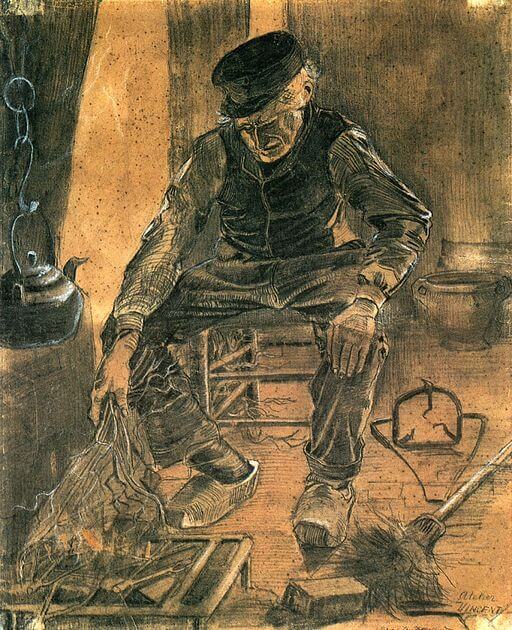
Vincent van Gogh, An Old Man Putting Dry Rice on the Hearth, 1881

It was the design of Angelo Ricci and Joe Czanek and Manuel Silva to call on the Terrible Old Man. This old man dwells all alone in a very ancient house on Water Street near the sea, and is reputed to be both exceedingly rich and exceedingly feeble; which forms a situation very attractive to men of the profession of Messrs. Ricci, Czanek, and Silva, for that profession was nothing less dignified than robbery.

The inhabitants of Kingsport say and think many things about the Terrible Old Man which generally keep him safe from the attention of gentlemen like Mr. Ricci and his colleagues, despite the almost certain fact that he hides a fortune of indefinite magnitude somewhere about his musty and venerable abode. He is, in truth, a very strange person, believed to have been a captain of East India clipper ships in his day; so old that no one can remember when he was young, and so taciturn that few know his real name. Among the gnarled trees in the front yard of his aged and neglected place he maintains a strange collection of large stones, oddly grouped and painted so that they resemble the idols in some obscure Eastern temple. This collection frightens away most of the small boys who love to taunt the Terrible Old Man about his long white hair and beard, or to break the small-paned windows of his dwelling with wicked missiles; but there are other things which frighten the older and more curious folk who sometimes steal up to the house to peer in through the dusty panes. These folk say that on a table in a bare room on the ground floor are many peculiar bottles, in each a small piece of lead suspended pendulum-wise from a string. And they say that the Terrible Old Man talks to these bottles, addressing them by such names as Jack, Scar-Face, Long Tom, Spanish Joe, Peters, and Mate Ellis, and that whenever he speaks to a bottle the little lead pendulum within makes certain definite vibrations as if in answer.

Those who have watched the tall, lean, Terrible Old Man in these peculiar conversations, do not watch him again. But Angelo Ricci and Joe Czanek and Manuel Silva were not of Kingsport blood; they were of that new and heterogeneous alien stock which lies outside the charmed circle of New England life and traditions, and they saw in the Terrible Old Man merely a tottering, almost helpless grey-beard, who could not walk without the aid of his knotted cane, and whose thin, weak hands shook pitifully. They were really quite sorry in their way for the lonely, unpopular old fellow, whom everybody shunned, and at whom all the dogs barked singularly. But business is business, and to a robber whose soul is in his profession, there is a lure and a challenge about a very old and very feeble man who has no account at the bank, and who pays for his few necessities at the village store with Spanish gold and silver minted two centuries ago.

Messrs. Ricci, Czanek, and Silva selected the night of April 11th for their call. Mr. Ricci and Mr. Silva were to interview the poor old gentleman, whilst Mr. Czanek waited for them and their presumable metallic burden with a covered motor-car in Ship Street, by the gate in the tall rear wall of their hosts grounds. Desire to avoid needless explanations in case of unexpected police intrusions prompted these plans for a quiet and unostentatious departure.

As prearranged, the three adventurers started out separately in order to prevent any evil-minded suspicions afterward. Messrs. Ricci and Silva met in Water Street by the old man’s front gate, and although they did not like the way the moon shone down upon the painted stones through the budding branches of the gnarled trees, they had more important things to think about than mere idle superstition. They feared it might be unpleasant work making the Terrible Old Man loquacious concerning his hoarded gold and silver, for aged sea-captains are notably stubborn and perverse. Still, he was very old and very feeble, and there were two visitors. Messrs. Ricci and Silva were experienced in the art of making unwilling persons voluble, and the screams of a weak and exceptionally venerable man can be easily muffled. So they moved up to the one lighted window and heard the Terrible Old Man talking childishly to his bottles with pendulums. Then they donned masks and knocked politely at the weather-stained oaken door.

Waiting seemed very long to Mr. Czanek as he fidgeted restlessly in the covered motor-car by the Terrible Old Man’s back gate in Ship Street. He was more than ordinarily tender-hearted, and he did not like the hideous screams he had heard in the ancient house just after the hour appointed for the deed. Had he not told his colleagues to be as gentle as possible with the pathetic old sea-captain? Very nervously he watched that narrow oaken gate in the high and ivy-clad stone wall. Frequently he consulted his watch, and wondered at the delay. Had the old man died before revealing where his treasure was hidden, and had a thorough search become necessary? Mr. Czanek did not like to wait so long in the dark in such a place. Then he sensed a soft tread or tapping on the walk inside the gate, heard a gentle fumbling at the rusty latch, and saw the narrow, heavy door swing inward. And in the pallid glow of the single dim street-lamp he strained his eyes to see what his colleagues had brought out of that sinister house which loomed so close behind. But when he looked, he did not see what he had expected; for his colleagues were not there at all, but only the Terrible Old Man leaning quietly on his knotted cane and smiling hideously. Mr. Czanek had never before noticed the colour of that mans eyes; now he saw that they were yellow.

Little things make considerable excitement in little towns, which is the reason that Kingsport people talked all that spring and summer about the three unidentifiable bodies, horribly slashed as with many cutlasses, and horribly mangled as by the tread of many cruel boot-heels, which the tide washed in. And some people even spoke of things as trivial as the deserted motor-car found in Ship Street, or certain especially inhuman cries, probably of a stray animal or migratory bird, heard in the night by wakeful citizens. But in this idle village gossip the Terrible Old Man took no interest at all. He was by nature reserved, and when one is aged and feeble, one’s reserve is doubly strong. Besides, so ancient a sea-captain must have witnessed scores of things much more stirring in the far-off days of his unremembered youth.


The Terrible Old Man was featured as The Short Story of the Day on Thu, Oct 18, 2018

A Fable

by Mark Twain


An illustration for the story A Fable by the author Mark Twain
Thomas Landseer etching, Three Cats

Once upon a time an artist who had painted a small and very beautiful picture placed it so that he could see it in the mirror. He said, “This doubles the distance and softens it, and it is twice as lovely as it was before.”

The animals out in the woods heard of this through the housecat, who was greatly admired by them because he was so learned, and so refined and civilized, and so polite and high-bred, and could tell them so much which they didn’t know before, and were not certain about afterward. They were much excited about this new piece of gossip, and they asked questions, so as to get at a full understanding of it. They asked what a picture was, and the cat explained.

“It is a flat thing,” he said; “wonderfully flat, marvelously flat, enchantingly flat and elegant. And, oh, so beautiful!”

That excited them almost to a frenzy, and they said they would give the world to see it. Then the bear asked:

“What is it that makes it so beautiful?”

“It is the looks of it,” said the cat.

This filled them with admiration and uncertainty, and they were more excited than ever. Then the cow asked:

“What is a mirror?”

“It is a hole in the wall,” said the cat. “You look in it, and there you see the picture, and it is so dainty and charming and ethereal and inspiring in its unimaginable beauty that your head turns round and round, and you almost swoon with ecstasy.”

The ass had not said anything as yet; he now began to throw doubts. He said there had never been anything as beautiful as this before, and probably wasn’t now. He said that when it took a whole basketful of sesquipedalian adjectives to whoop up a thing of beauty, it was time for suspicion.

It was easy to see that these doubts were having an effect upon the animals, so the cat went off offended. The subject was dropped for a couple of days, but in the meantime curiosity was taking a fresh start, aid there was a revival of interest perceptible. Then the animals assailed the ass for spoiling what could possibly have been a pleasure to them, on a mere suspicion that the picture was not beautiful, without any evidence that such was the case. The ass was not, troubled; he was calm, and said there was one way to find out who was in the right, himself or the cat: he would go and look in that hole, and come back and tell what he found there. The animals felt relieved and grateful, and asked him to go at once–which he did.

But he did not know where he ought to stand; and so, through error, he stood between the picture and the mirror. The result was that the picture had no chance, and didn’t show up. He returned home and said:

“The cat lied. There was nothing in that hole but an ass. There wasn’t a sign of a flat thing visible. It was a handsome ass, and friendly, but just an ass, and nothing more.”

The elephant asked:

“Did you see it good and clear? Were you close to it?”

“I saw it good and clear, O Hathi, King of Beasts. I was so close that I touched noses with it.”

“This is very strange,” said the elephant; “the cat was always truthful before–as far as we could make out. Let another witness try. Go, Baloo, look in the hole, and come and report.”

So the bear went. When he came back, he said:

“Both the cat and the ass have lied; there was nothing in the hole but a bear.”

Great was the surprise and puzzlement of the animals. Each was now anxious to make the test himself and get at the straight truth. The elephant sent them one at a time.

First, the cow. She found nothing in the hole but a cow.

The tiger found nothing in it but a tiger.

The lion found nothing in it but a lion.

The leopard found nothing in it but a leopard.

The camel found a camel, and nothing more.

Then Hathi was wroth, and said he would have the truth, if he had to go and fetch it himself. When he returned, he abused his whole subjectry for liars, and was in an unappeasable fury with the moral and mental blindness of the cat. He said that anybody but a near-sighted fool could see that there was nothing in the hole but an elephant.

MORAL, BY THE CAT

You can find in a text whatever you bring, if you will stand between it and the mirror of your imagination. You may not see your ears, but they will be there.


A Fable was featured as The Short Story of the Day on Fri, Sep 14, 2018

Funny Short Story

Short Story Share