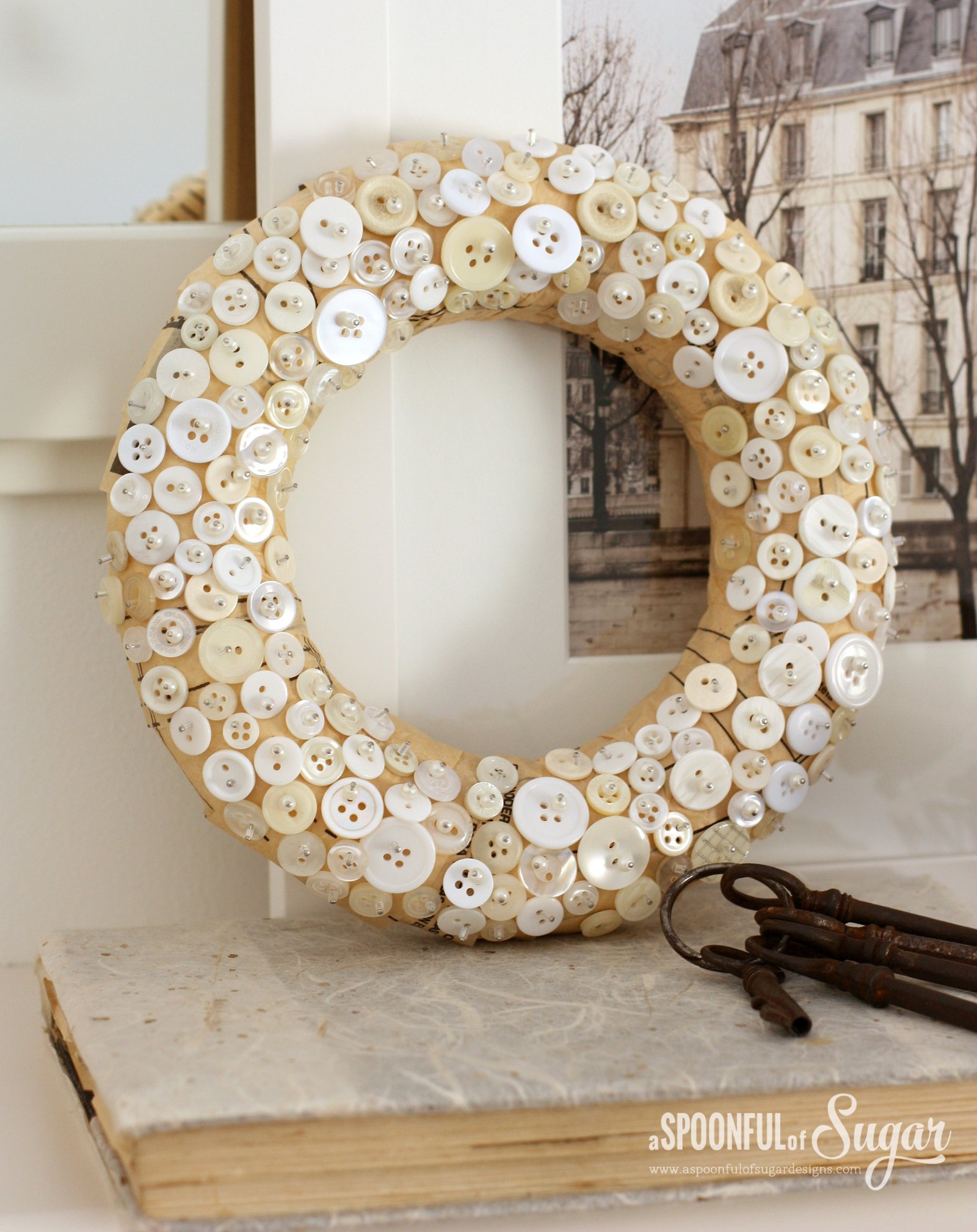
Christmas Button Wreath is a fun project to make in an afternoon and would be a great activity for older children. If you would like to make a Christmas Button Wreath, you will need:
polystyrene wreath form (I bought mine from Lincraft)
vintage dressmaking tissue
buttons ( I used small and medium buttons in white, cream, and clear – you will need a lot!)
applique pins (these are short pins designed for applique – I bought mine from Lincraft)
small beads
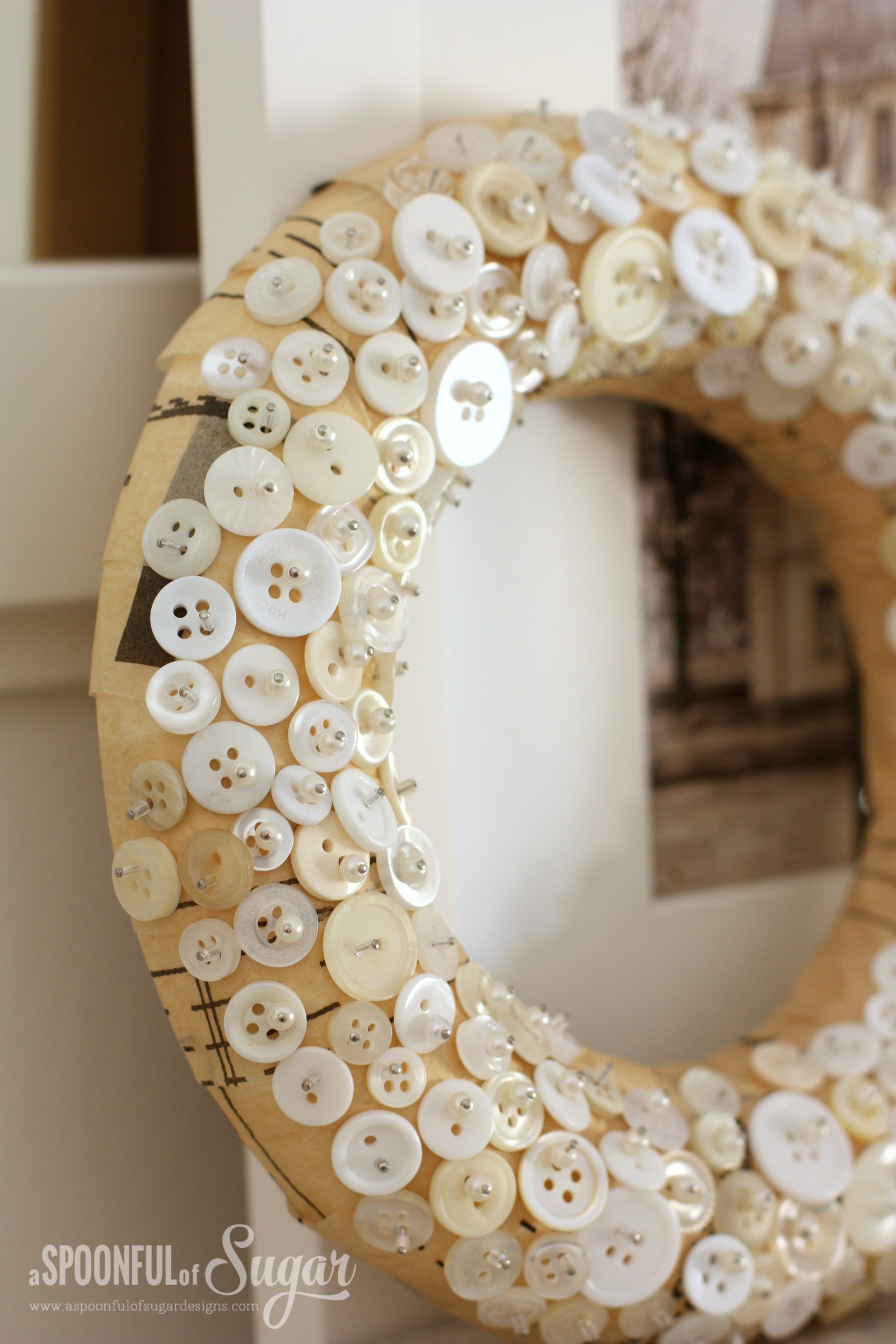
Firstly you need to cover the wreath form so that the foam is not visible. I cut 2 inch wide strips of dressmaking tissue and wrapped this around the wreath, securing with pins at the beginning and end of each strip. Tissue was a good choice as you can easy crinkle it to make it fit the form nicely and it adds a bit of texture. The colour of the vintage tissue was perfect for my Christmas theme and pairs well with buttons. Next you pin on the buttons, varying them by size and colour. Thread a small bead onto the end of the pin and then secure the button with a pin. By using a bead, this prevents the buttons from falling off the pins. Buttons will large holes may not be suitable.
I chose to cover only the front part of the wreath so that the tissue paper was still visible on the sides. However if you prefer you can cover the entire wreath form.
I couldn’t resist tying some of my vintage French spools with lace and displaying them with the wreath. The lovely french photograph is from The Paris Print Shop.
Check out the Button Tree we made a few years ago using a similar technique to the Button Wreath. You can find more of our Christmas projects here.
Caution: This craft is not recommended if you have young children as the buttons may fall off and become a choking hazard.
This is the first pose, which is to be started on the top of the mat. And, this will also be the last position in the set of exercises explained below. So, you will start with mountain pose and also end with mountain pose. After taking a few deep breaths, and calming yourself, you should stand tall, and start inhaling with your arms raised upwards toward the sky. Relax your shoulders, and stretch them to left while you exhale. Using the next inhale for drawing back to the centre, exhale and stretch towards the right.
The Mountain Pose is a starting pose for many other yoga poses and is commonly practiced in yoga sessions. As the name suggests, you are strong and standing tall during the pose. While the pose can be performed by itself, it is most commonly used as a resting or transition pose, much like the Child’s Pose. It is used as a starting point for many other poses as it allows the body to integrate the preceding pose with the following one.
The Sanskrit name of Mountain Pose, tadasana, comes from tada meaning mountain and asana meaning posture. In Mountain Pose, the body stands erect with arms at the sides. Some variations incorporate Namaste position where palms of the hands are pressed together in front of the chest and fingers pointing upward. During the pose, focus on balance and breathing as you achieve a connection between mind, body, and spirit.
The day has always been celebrated without your presence The talk never has included you But when it’s mentioned, it’s of course blamed on you.
No verbal request for you to attend No reaching out to you to try and heal or mend It’s okay to point fingers at you Even though it’s okay to assume.
If you were meant to be there There’d be no doubt left in the air You’d feel that, right? No need to fuss or fight
Instead, Thanksgiving changed When no one spoke your name When life without you was expected Needless to say, the lack of effort, feeling rejected.
When Thanksgiving changed you weren’t there Even though you wanted to be, you wanted them to care You wanted to be included more than in a passing thought It was belonging that you sought.
Go ahead and pass the blame Don’t let it change anything But when this old life nears its end Maybe then…
The first Thanksgiving was celebrated in 1621 over a three-day harvest festival. It included 50 Pilgrims and 90 Wampanoag Indians, and historians believe that only 5 women were present.
2. Turkey wasn’t always the star of the show.
On the first Thanksgiving table, you wouldn’t have found pumpkin pie, cranberry sauce, or even turkey. Instead, you may have found venison, duck, goose, oysters, eel, and fish, along with pumpkins and cranberries.
3. Sarah Josepha Hale, author of the children’s poem “Mary Had a Little Lamb,” is largely responsible for Thanksgiving’s recognition as a national holiday.
Hale grew up celebrating Thanksgiving, and as the editor of “Godey’s Lady Book,” she frequently wrote editorials and articles about the holiday. During the Civil War, she urged Americans to “put aside sectional feelings and local incidents” and rally around the unifying spirit of Thanksgiving. For over three decades, Hale lobbied government officials to officially recognize Thanksgiving. Finally, in 1863, President Abraham Lincoln proclaimed Thanksgiving a fixed national holiday.
4. But not all Presidents were on board.
Before Abraham Lincoln proclaimed Thanksgiving a national holiday on October 3, 1863, each President had to recognize Thanksgiving as a holiday each year. But one President refused. Thomas Jefferson would not declare Thanksgiving a national holiday, as the day involved prayer, and Jefferson firmly believed in the separation of church and state.
5. Harry Truman is frequently credited with being the first president to pardon a turkey, but there’s more to the story.
He was the first to receive a ceremonial turkey from the National Turkey Federation – and he had it for dinner.
6. Turkey-pardoning wasn’t a formal practice until 1989.
John F. Kennedy was the first to let his Thanksgiving turkey go, followed by Richard Nixon, who sent his turkey to a petting zoo. In 1989, George H.W. Bush formalized the turkey pardoning tradition.
7. The tradition of watching football on Thanksgiving began in 1876.
The original Thanksgiving Day match-up pitted Yale against Princeton. The first Thanksgiving NFL games, however, weren’t played until 1920.
8. The inaugural Macy’s Thanksgiving Day Parade was actually meant to celebrate Christmas.
If you treat Thanksgiving as the start of Christmastime, you’re not alone. Although the first parade occurred on Thanksgiving, its organizers intended the parade to be a celebration heralding in the Christmas season. The “Macy’s Christmas Parade” first occurred in 1924, and over 250,000 people attended. It quickly became a New York tradition and a nationally televised event.
WATCH: 5 Things You Didn’t Know About the Macy’s Thanksgiving Day ParadeClick to expand
UP NEXT
9. The first Macy’s Thanksgiving Day Parade Balloon, Felix The Cat, flew in 1927.
The first giant balloon to float over NYC’s streets, Felix the Cat was inflated with helium and—with no plan to deflate the giant balloon—parade organizers simply let him fly off. He popped shortly thereafter.
10. Green Bean Casserole was invented by a Campbell’s Soup recipe developer.
Ever wonder how Cream of Mushroom Soup became an essential casserole ingredient? The first green bean casserole was cooked up in 1955 by Dorcas Reilly, who worked in the home economics department at the Campbell Soup Company. She devised the idea to add frozen green beans to the canned Cream of Mushroom Soup, then topped the whole concoction with crispy onions. And the green bean casserole was born. Today, Campbell’s estimates that 40% of Cream of Mushroom Soup sales go to making green bean casserole.
11. Americans collectively eat 45 million turkeys to celebrate the holiday, the average size of which is 16 pounds.
That means that Americans consume about 720 million pounds of turkey on this special day.
12. But don’t forget about the sideboard.
With indulgent sides like stuffing, mashed potatoes, green bean casserole, mac and cheese, and much more, the calories start to add up. Americans consume an average of 4,500 calories on Thanksgiving, and around 159 grams of fat. Let’s get our stretchy pants on.
13. What’s the price tag of the big meal?
According to the American Farm Bureau, the cost of a classic thanksgiving dinner—which includes turkey and stuffing, sweet potatoes, green beans, cranberries, carrots and veggies, pumpkin pie, milk and coffee—was $48.90 in 2018. For a meal that’ll feed 10 people, that doesn’t sound too bad.
14. In practice, however, Americans tend to spend a lot more.
CNBC reports that, to build up that sideboard, Americans spend an average of $334 to host around 11 guests for the big meal.
15. Pack up the car.
According to AAA, approximately 54.3 million Americans travel 50 miles or more to celebrate the holiday. Honestly, this is no surprise—we already know that Southerners will go to great lengths to gather together at Grandma’s house.











 Mws R Writings