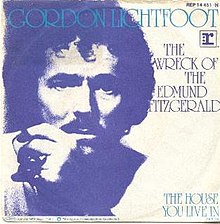
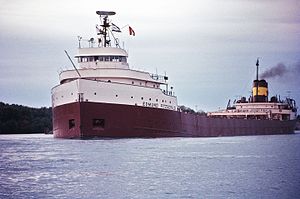
The Wreck of the Edmund Fitzgerald” is a song written, composed, and performed by Canadian singer-songwriter Gordon Lightfoot to commemorate the sinking of the bulk carrier SS Edmund Fitzgerald on Lake Superior on November 10, 1975. Lightfoot drew his inspiration from Newsweek’s article on the event, “The Cruelest Month”, which it published in its November 24, 1975, issue.[1] Lightfoot considers this song to be his finest work.[2]
Appearing originally on Lightfoot’s 1976 album Summertime Dream, the single version hit number 1 in his native Canada (in the RPM national singles survey) on November 20, 1976, barely a year after the disaster.[3] In the United States, it reached number 1 in Cashbox and number 2 for two weeks in the Billboard Hot 100 (behind Rod Stewart’s “Tonight’s The Night”), making it Lightfoot’s second-most-successful single behind “Sundown”. Overseas it was at best a minor hit, peaking at number 40 in the UK Singles Chart.[4
Fitzgerald left Superior, Wisconsin, at 2:15 p.m. on the afternoon of November 9, 1975,[34] under the command of Captain Ernest M. McSorley. She was en route to the steel mill on Zug Island, near Detroit, Michigan,[35] with a cargo of 26,116 long tons (29,250 short tons; 26,535 t) of taconite ore pellets and soon reached her full speed of 16.3 miles per hour (14.2 kn; 26.2 km/h).[36] Around 5 p.m., Fitzgerald joined a second freighter under the command of Captain Jesse B. “Bernie” Cooper, Arthur M. Anderson, destined for Gary, Indiana, out of Two Harbors, Minnesota.[37] The weather forecast was not unusual for November and the National Weather Service (NWS) predicted that a storm would pass just south of Lake Superior by 7 a.m. on November 10.[38]
SS Wilfred Sykes loaded opposite Fitzgerald at the Burlington Northern Dock #1 and departed at 4:15 p.m., about two hours after Fitzgerald. In contrast to the NWS forecast, Captain Dudley J. Paquette of Sykes predicted that a major storm would directly cross Lake Superior. From the outset, he chose a route that took advantage of the protection offered by the lake’s north shore in order to avoid the worst effects of the storm. The crew of Sykes followed the radio conversations between Fitzgerald and Anderson during the first part of their trip and overheard their captains deciding to take the regular Lake Carriers’ Association downbound route.[39] The NWS altered its forecast at 7:00 p.m., issuing gale warnings for the whole of Lake Superior.[40] Anderson and Fitzgerald altered course northward seeking shelter along the Ontario coast[37] where they encountered a winter storm at 1:00 a.m. on November 10. Fitzgerald reported winds of 52 knots (96 km/h; 60 mph) and waves 10 feet (3.0 m) high.[41] Captain Paquette of Sykes reported that after 1 a.m., he overheard McSorley say that he had reduced the ship’s speed because of the rough conditions. Paquette said he was stunned to later hear McSorley, who was not known for turning aside or slowing down, state that “we’re going to try for some lee from Isle Royale. You’re walking away from us anyway … I can’t stay with you.”[39]
At 2:00 a.m. on November 10, the NWS upgraded its warnings from gale to storm, forecasting winds of 35–50 knots (65–93 km/h; 40–58 mph).[42] Until then, Fitzgerald had followed Anderson, which was travelling at a constant 14.6 miles per hour (12.7 kn; 23.5 km/h),[37] but the faster Fitzgerald pulled ahead at about 3:00 a.m.[43] As the storm center passed over the ships, they experienced shifting winds, with wind speeds temporarily dropping as wind direction changed from northeast to south and then northwest.[41] After 1:50 p.m., when Anderson logged winds of 50 knots (93 km/h; 58 mph), wind speeds again picked up rapidly and it began to snow at 2:45 p.m., reducing visibility; Anderson lost sight of Fitzgerald, which was about 16 miles (26 km) ahead at the time.[44]
Shortly after 3:30 p.m., Captain McSorley radioed Anderson to report that Fitzgerald was taking on water and had lost two vent covers and a fence railing. The vessel had also developed a list.[45] Two of Fitzgerald’s six bilge pumps ran continuously to discharge shipped water.[46] McSorley said that he would slow his ship down so that Anderson could close the gap between them.[45] In a broadcast shortly afterward, the United States Coast Guard (USCG) warned all shipping that the Soo Locks had been closed and they should seek safe anchorage. Shortly after 4:10 p.m., McSorley called Anderson again to report a radar failure and asked Anderson to keep track of them.[47] Fitzgerald, effectively blind, slowed to let Anderson come within a 10-mile (16 km) range so she could receive radar guidance from the other ship.[48]
For a time, Anderson directed Fitzgerald toward the relative safety of Whitefish Bay; then, at 4:39 p.m., McSorley contacted the USCG station in Grand Marais, Michigan, to inquire whether the Whitefish Point light and navigation beacon were operational. The USCG replied that their monitoring equipment indicated that both instruments were inactive.[49] McSorley then hailed any ships in the Whitefish Point area to report the state of the navigational aids, receiving an answer from Captain Cedric Woodard of Avafors between 5:00 and 5:30 p.m. that the Whitefish Point light was on but not the radio beacon.[43] Woodard testified to the Marine Board that he overheard McSorley say, “Don’t allow nobody on deck,”[50] as well as something about a vent that Woodard could not understand.[51] Some time later, McSorley told Woodard, “I have a ‘bad list,’ I have lost both radars, and am taking heavy seas over the deck in one of the worst seas I have ever been in.”[52]
THE END >
By late in the afternoon of November 10, sustained winds of over 50 knots (93 km/h; 58 mph) were recorded by ships and observation points across eastern Lake Superior.[53] Anderson logged sustained winds as high as 58 knots (107 km/h; 67 mph) at 4:52 p.m.,[47] while waves increased to as high as 25 feet (7.6 m) by 6:00 p.m.[54] Anderson was also struck by 70-to-75-knot (130 to 139 km/h; 81 to 86 mph) gusts[53] and rogue waves as high as 35 feet (11 m).[15]
The last communication from the ship came at approximately 7:10 p.m., when Anderson notified Fitzgerald of an upbound ship and asked how she was doing. McSorley reported, “We are holding our own.” She sank minutes later. No distress signal was received, and ten minutes later, Anderson lost the ability either to raise Fitzgerald by radio or to detect her on radar.[50]




 Mws R Writings