When it comes to nature, the general rule of thumb is this: The dangerous stuff looks scary, and the harmless stuff looks beautiful (or, at the very least, unassuming). So it might be a surprise, then, to learn that plants and flowers—often beautiful, always unassuming—rank among the most dangerous things on the planet. And no, we’re not just talking about the exotic blooms hiding in the Amazon—we’re referring to the very plants and herbs that grow in your own backyard. Read on to find out which dangerous plants might be lurking just a few feet away.
1.Oleander
Shutterstock
Known for its striking flowers in the summertime, the oleander plant also holds a deadly secret: every part of it is highly toxic. According to a 2010 study published in Heart Views, parts of the oleander plant contain cardiac glycosides, compounds that can cause acute cardiac toxicity and digestive issues. Those who ingest the plant can also suffer symptoms that range from an erratic pulse to a coma.
2.Rosary Pea
Shutterstock
Native to tropical areas and often found in Florida, the rosary pea is considered one of the most invasive—and one of the most dangerous—plant species. According to the Centers For Disease Control and Prevention (CDC), the plant’s seeds contain the poison abrin. And it turns out, there’s enough abrin in just one seed to kill you if swallowed.
3.White Snakeroot
Shutterstock
Ageratina altissima, or white snakeroot, is a poisonous herb found in North America that contains a toxic alcohol called tremetol. But just how poisonous is this plant? Well, back when explorers were first settling Indiana and Ohio in the early 19th century, it’s estimated that up to half of their deaths—including that of Abraham Lincoln’s mother, Nancy Hanks Lincoln—were caused by indirectly ingesting white snakeroot. Cattle and other livestock in the area would eat the seemingly benign herb and pass the poisonous tremetol to humans via their milk. The illness was known as fatal milk sickness.
4.American Pokeweed
Shutterstock
American pokeweed is found in almost every area in the U.S., save for a few states in the northwestern region. And while the plant does produce a purple-black berry known as a pokeberry, the last thing you’d ever want to do is eat one. According to the National Capital Poison Center (NCPC), consuming these can cause everything from nausea and vomiting to low blood pressure. If you have children, make sure to monitor them when they’re playing in your yard, as the NCPC notes that youngsters often mistake these berries for grapes.
5.Deadly Nightshade
Shutterstock
Unsurprisingly, the deadly nightshade plant is, well, deadly. Due to the alkaloids in its stems, leaves, berries, and roots, the plant is incredibly poisonous to the body. Even rubbing up against it can cause irritation to the skin, according to the Royal Horticultural Society. It would take just two berries from this plant to kill a child and between 10 and 20 to kill an adult.
6.Water Hemlock
Shutterstock
If you know anything about water hemlock, then it’s likely that you’re familiar with the plant’s claim to fame: killing Socrates. According to the United States Department of Agriculture (USDA), this plant contains the toxin cicutoxin, which, when ingested, acts directly on the central nervous system. In the most extreme cases, that could result in grand mal seizures and death.
7.Lily of the Valley
Shutterstock
This perennial outdoor ornamental herb, a popular staple of outdoor gardens everywhere, can actually be incredibly toxic, according to the Canadian Biodiversity Information Facility (CBIF). Its toxicity comes from the cardiac glycosides and saponins present in the plants, which can affect the heart if eaten. Lily of the valley is so toxic, in fact, that the CBIF notes cases where both people and animals have fallen ill by merely drinking water the plant was in.
8.Rhubarb
Shutterstock
Sure, it’s great in rhubarb pie, but ingesting large amounts of this plant’s leaves can kill you, according to the BBC. Because it contains deadly oxalic acid, ingesting too many rhubarb leaves can cause kidney failure. Thankfully, experts at the University of California, Santa Clara note that you’d have to eat some 12 pounds of rhubarb to really get sick.
9.Foxglove
Shutterstock
The foxglove plant produces digoxin, an active ingredient in medications that prevent heart failure. According to the NCPC, by ingesting foxglove, you’re essentially “taking an unregulated dose of heart medicine,” which can, ironically, cause heart failure. As such, you should keep this plant far, far away from children and animals.
10.Wisteria
Shutterstock
When it comes to dangerous plants in your backyard, wisteria is one of the worst ones there is. According to one case study from the Santa Clara Valley Medical Center, the wisteria plant can cause headaches, gastroenteritis, hematemesis, dizziness, confusion, diaphoresis, and, frighteningly, syncopal episodes (or temporary drops in blood flow to the brain that result in a loss of consciousness and control of the muscles). These symptoms typically last for five to seven days after eating more than a few berries from the plant—if they don’t kill you, that is.
11.Dieffenbachia
Shutterstock
When it comes to dieffenbachia, it’s small children and pets that you should be concerned about. Why? Well, both your animals and your youngsters can’t differentiate a dangerous backyard plant from a snack, and they are therefore the most likely to take a big bite out of a dieffenbachia leaf. If your pet or small child does ingest a dieffenbachia leaf containing insoluble calcium oxalate crystals, they will experience excessive drooling, oral pain, vomiting, and a decreased appetite.
12.Daffodil
Shutterstock
If you seek help quickly, ingesting daffodils won’t kill you. However, according to the NCPC, ingestion can be fatal to small children and pets if left untreated. And while all parts of a daffodil contain the toxic chemical lycorine, it’s the oxalates—or toxic chemicals found in the plant’s bulb—that do the most damage to your body. If you experience throat pain, difficulty swallowing, and severe drooling that persists for several hours, get thee to a doctor, stat.
13. Hydrangea
Shutterstock
As far as the poisonous nature of the popular hydrangea plant is concerned, only the flower buds are truly harmful when ingested, according to the Canadian Biodiversity Information Facility. If consumed, humans can experience an upset stomach, skin irritation, and, in more serious cases, convulsions and coma.
14. Rhododendron
Shutterstock
The honey produced (and sometimes eaten) from the common rhododendron plant is also called “mad honey”—and for good reason. According to the NCPC, the toxins found in the plant cause confusion in those who ingest it, along with dangerously low blood pressure and sometimes even death. (Fun fact: The earliest case of rhododendron poisoning is said to have occurred in the first century B.C.E. when Roman troops were allegedly poisoned with its honey. The day after they were poisoned, they were so confused that they lost a battle.)
15. Yew
Shutterstock
In ancient cultures, yew is also called the “tree of death,” as it was once used as an offering to the gods of death. And there’s a reason why: According to Cornell University’s Department of Animal Science, the yew plant, found in all corners of the world, is dangerously toxic. No matter how you consume the plant, its toxins have the potential to cause cardiac arrhythmia and stop your heart entirely. Animals that eat the plant are often found deceased next to it just 24 to 48 hours after consumption.
16. Philodendron
Shutterstock
Due to the relatively minimal care required to maintain philodendron plants, they’re commonly found in backyards all over the country. However, as reported by ABC News, they contain a toxin in their leaves called calcium oxalate that can cause inflammation of the mucous membranes in the mouth and throat when ingested. Though it’s not deadly in most cases of ingestion by humans, it can prove fatal to smaller children and pets—and the more they eat, the worse off they are.
17 . Devil’s Helmet
Shutterstock
Just a few years ago, a gardener died after simply brushing up against a devil’s helmet plant. And believe it or not, the plant’s exterior isn’t even its most poisonous part. As poison expert John Robertson told BBC News, the most poisonous part of the plant is actually its roots, as ingestion of this specific part causes heart failure. Most fatalities, he says, occur within the first few hours of eating the plant’s roots.
18. Tulips
Shutterstock
Tulips might make your garden shine, but they also have the potential to poison your pet. According to the ASPCA, this plant is toxic to dogs, cats, and horses in its bulb especially, and symptoms of ingestion range from vomiting and diarrhea to hypersalivation and depression.
19. Poison Ivy
Shutterstock
As its name suggests, poison ivy is, well, poisonous. Found all over the United States, this plant contains a resin called urushiol that causes an epidermal allergic reaction characterized by redness, itching, and swelling. If the plant sets on fire and you inhale the smoke, it can also affect your breathing.
20. Angel’s Trumpet
Shutterstock
Angel’s trumpet is a tropical plant known for its Bugle-shaped flowers. And while it’s aesthetically pleasing, the last thing you’d ever want to do is find out what it tastes like: As one 2008 case report published in Paediatrics & Child Health notes, ingestion can cause dangerous hallucinogenic symptoms like loss of consciousness and delirium
This plant is very useful in the air purification process. Areca palm helps to remove toluene and xylene from the air inside and it can also help to increase the overall air purification. It’s very useful and beneficial for people who have asthma and need effective air purification.
Money Plant
This plant is also very useful in increasing the overall air quality and the air purification process. The money plant helps to reduce the toxins: benzene, formaldehyde, toluene and xylene from the air. This amazing air-purifying plant is great for people who have asthma, for people who have other lung problems and for people who are exposed to high city smog living conditions.
Spider Plant
This remarkable plant promotes high air purification. Spider plant is suitable for decreasing the levels of formaldehyde, toluene, and xylene in the air. This plant is also very useful and great for placing in homes that have been painted recently. We can also mention that this plant is suitable for apartments or homes, which are exposed to city chemical air pollutants
Purple Waffle Plant
Do you have this plant in your home? Well, if your answer is no, then you definitely should. This remarkable plant will help you to eliminate the toxic compound – formaldehyde from the air. We can also mention that this plant will help you to increase overall air purification and it’s very useful and effective for increasing the quality of the air within any house or apartment. This plant is very good for people who live in the city, and they are exposed to high amounts of toxic smog and car fumes. People who live near the industrial factories should definitely get one of these.
Bamboo Palm
This plant is very effective in removing the formaldehyde toxic compound from the air indoors and it’s also very useful for acting as a natural humidifier – for most areas inside the house. This amazing plant can help you remove xylene and toluene – two toxic compounds from the air inside. It’s also great for people who live in high polluted areas and where car fume exposure is at high levels. Bamboo palm is suitable for homes and shops, which may be exposed to gasoline
Variegated Wax Plant
Variegated wax plant will help you to improve the overall air quality in your home, by removing and eliminating benzene and formaldehyde from the air inside. You should also know that this plant will increase the overall air purification levels. The variegated wax plant can help people who suffer from lung diseases, such as: emphysema or asthma. This amazing plant is also very useful and beneficial for people who are exposed to car fumes, petrol, paint fumes, industrial or city smog, or heavy cleaning products.
Lilyturf
Have you ever heard of lilyturf? Well, if you haven’t, then you should definitely read this – this amazing plant will help you to remove ammonia, toluene, xylene and formaldehyde from the air inside your house or apartment. This remarkable plant is capable of increasing the oxygen levels and it can help to improve the air quality. We can also mention that the lilyturf plant is also great for people who are exposed to cleaning products, paint fumes, city or industrial smog, or vehicle fumes. The lilyturf plant can help you clean the air for people who suffer from lung diseases, including asthma and emphysema.
Boston Fern
You should definitely get one of this plants in your home, because it will help you remove the formaldehyde from the air. You should also know that this plant also works well as a natural type of air humidifier. This plant is very good in removing xylene and toluene from the air as well. Some people say that this plant is one of the best air-purifiers in the world. This remarkable plant is perfect for people who live in areas where exposure to gasoline exists. Boston fern is the best plant for homes that are exposed to city smog. And we can also mention that this plant is very useful for purifying the air for people who have asthma or other breathing problems.
Dwarf Date Palm
This plant is absolutely amazing. It will help you reduce the toxins: xylene, toluene and formaldehyde from the air inside your house or apartment. You should also know that this plant will increase the oxygen levels in your home and it’s very useful in improving the air quality in highly exposed areas. The dwarf date palm is great for placing in homes that may be exposed to paint fumes, factory smog, car fumes, or heavy cleaning solvents. This amazing air-purifying plant is very useful for improving the air quality for asthmatics and people who have other lung problems.
Moth Orchids
This plant is your best choice if you want to purify the air inside your house. We can also say that this plant is also very effective in removing xylene and toluene. The moth orchids plant can increase the air quality in your home significantly. It’s suitable for homes and apartments that are exposed to factory or city smoke, smoke or fumes. You should also know that this plant is very useful and beneficial for purifying the air in homes, which are freshly painted or where paint fumes exist.
Barberton Daisy
Barberton daisy – it works great in removing benzene, formaldehyde and trichloroethylene from your home. This amazing plant is the best plant if you want to increase the oxygen levels in your house or your apartment. It will help you purify the air as well. This remarkable plans it very useful and beneficial for homes that are exposed to fuel fumes, car fumes, factory or city smog, smoke, etc. This plant is also very useful for people who are exposed to heavy cleaning solvents.
As you can see, these amazing plants will purify the air in your home, increase oxygen levels and remove all the toxic compounds from the air inside your house or apartment. And they are completely safe for you, your family and your pert. So, you should definitely get one of these plants. Thanks for reading and don’t forget to share with your friends and family.
It may seem strange to cultivate a list of flowers you should avoid planting in your garden, however it is vital to be aware of some eye-catching beauties that are more trouble than they’re worth. These plants are either toxic, invasive or could potentially cause damage to your other healthy flowers. It is best to avoid growing these 9 plants in your garden, no matter how enticing they may be.
Bamboo
Though the thought of a living privacy fence between you and your neighbor and the feel of a tropical paradise in your backyard may be appealing, bamboo can often become an unexpected source of frustration when it begins to take over. Once established, this plant roots very deeply and grows incredibly quickly, meaning that when you’ve committed to bamboo, there’s no escaping it.
If you still want to enjoy this hardy (and lovely) plant, it is a good idea to grow it in large raised planters that can prevent spread.
Tansy
Another invasive species that quickly becomes the only plant in your garden by overtaking the rest of your flowers, tansy is also toxic when ingested. Avoid this plant if you have pets or small children that could find their way into the garden.
Mimosa tree
Though these trees add an exciting exotic flair to your garden, with their delicate leaves and captivating blooms, mimosas won’t exactly win you any favor in the neighborhood popularity contest. When the wind picks up, this tree spreads seedlings wide and far, where they take root in the most inconvenient locations and are almost impossible to eradicate completely.
Mint
Okay, so saying that you should NEVER plant mint in your garden may be a little extreme. When contained properly, mint is an amazing herb with hundreds of uses. However, it is one of the most invasive herb plants and can quickly become nothing more than a fragrant weed that you have to cut back or pull out each year. If you still want to grow mint, dedicate an entire garden area to various varieties or grow it in a container. You could even dig a hole in the ground large enough for the entire pot of mint and contain the roots that way.
English Ivy
Though you may be dreaming of an idyllic ivy-covered wall, this plant is far more trouble than it’s worth. It tends to work its way into any crack available, forcing apart fences, bricks, and even the foundation of your home. There’s a reason that you see many dilapidated houses with a thick layer of ivy; it needs little care and it incredibly difficult to keep under control.
Wisteria
Unless you plan to dedicate hours to pruning your wisteria every couple of months, it is best to avoid this fairy-like purple plant. The roots spread throughout your entire garden, causing shoots to pop up and destroy your other plants. Even if you are an expert pruner and keep your wisteria on a tight leash, you are still likely to miss a runner and will quickly begin to regret the day you planted this invasive species.
Deadly nightshade
Deadly nightshade (or belladonna) carries that name for a reason. Every single part of this plant is incredibly poisonous. In fact, just two berries could kill a small child. Belladonna should have no place in your garden due to its extreme toxicity. Place this plant on the “no exceptions” list.
Female Ginko Bilboa trees
Unlike the male version of these trees, the female ginko produces nasty, unuseable fruit that leaves a mess on the ground and has been noted to smell like vomit. Doesn’t exactly sound like something you want near your front door, does it?
The male plant can make a wonderful addition to your yard, but it is is a good idea to avoid the female, unless of course, you want to deter unsolicited visitors with its toxic fruit.
Water hyacinth
Often a popular choice for backyard ponds or other water features due to its water purification abilities, the water hyacinth may seem sweet at first but will quickly take over any other water plants. Instead of a pond or pretty fountain, you may simply have a bed of purple flowers that can often be a hassle to get rid of. Opt for less invasive water plants such as waterlilies.
Keep Your Roses Healthy and Blooming with These Pruning Tips
By Rosalie Davis
November 28, 2018
Pixabay
Sure, pruning roses can be a chore, but your efforts will be rewarded by a healthier, well-shaped plant that blooms abundantly and lives longer. Pruning out dead or diseased canes helps to increase air flow and sun penetration around living canes, which helps to ward off disease and encourage more flowering.
Rose Pruning Tips
Wear thick gloves and a couple layers of long-sleeve shirts while pruning to avoid the dreaded thorns.
Wear safety goggles (or sunglasses), too; branches can whip back unexpectedly.
For trimming thin canes and deadheading, hand pruners will get the job done, but loppers or a small hand-saw might be needed for bigger canes.
Make sure your pruning tools are clean and sharp. If they were previously used to prune a diseased plant, give them a quick wipe down with rubbing alcohol to sterilize. Additionally, after cutting out dead or diseased material from your rose, sterilize your pruning tool again before using it on a healthy cane.
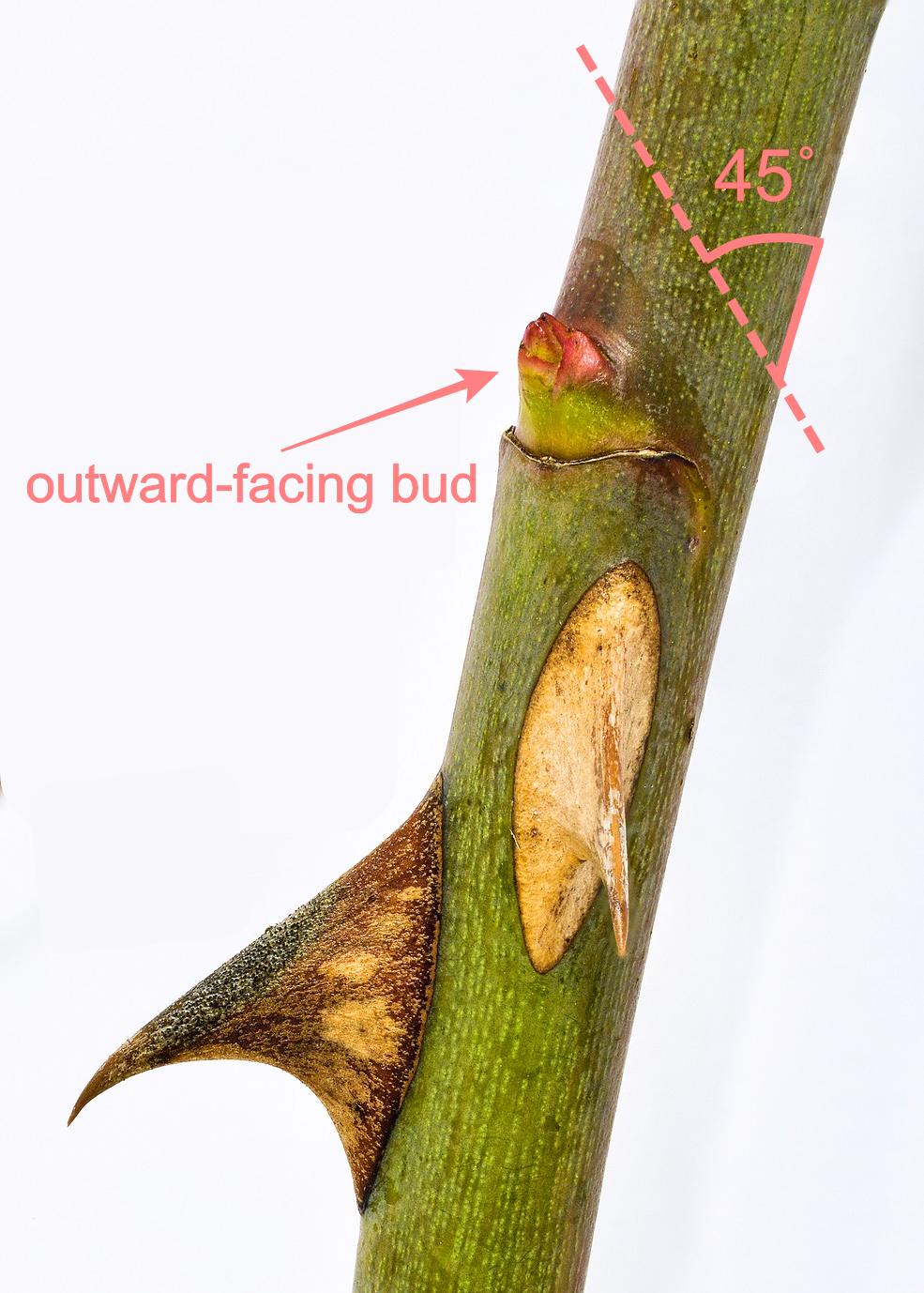
Always cut stems at a 45 degree angle just above (at least ¼ inch) an outward-facing bud. This will encourage the plant to grow outward, rather than in on itself.
Pruning Roses by Type
Hybrid and Floribunda Roses
These roses bloom more than once per season and generally bloom on new wood.
In late winter or very early spring, the roses need a good clearing out and cutting back before they start greening up and branching. About the time forsythias bloom, take out all the dead wood, crossing canes, and spindly growth. Then shape and prune back everything else, taking into account the style of the garden and the size and nature of the variety. Cut back old wood about 30 to 40 percent before growth begins. Always cut to a live bud pointing away from the center of the shrub to encourage outward growth. Start deadheading after the first flush of flower, and continue throughout the summer to encourage more blooms.
Species Roses, Old Roses, and Once-Blooming Shrub Roses
Generally hardier then other roses, these more primitive types bloom first on old wood mid-summer; re-bloomers repeat on the current season’s growth.
In early spring, remove diseased, broken, or dead branches. After flowering, prune lightly and selectively to shape the bushes and control growth.
Climbing and Rambling Roses
These roses tend to bloom on old wood.
It’s fine to remove winter-killed branches or otherwise damaged wood early in the year, but defer your annual pruning until summer, after the peak of bloom. Prune to remove undesirable canes and to shape and train growth. Side branches tend to flower more heavily than central leaders.
A kitchen garden is simply a space dedicated to growing edible plants that you’ll use in the kitchen! Kitchen gardens are also known as potager gardens, which comes from the French term for this style of garden, jardin potager. Learn more about kitchen gardens.
Before you pick out your plants, make sure your garden site receives plenty of sun and that your soil drains nicely (without pooling after rain). If the soil doesn’t drain well, even after you add compost and organic amendments, consider raised beds.
Finally, if you lack a gardening space, starting a kitchen garden in containers on a patio, balcony, or rooftop works well. Some of us just prefer container gardening!
Kitchen Garden Plants
Cherry Tomatoes
Cherry tomatoes are a must-have for your small-space garden. These tiny treasures can be grown one plant per 12-inch pot or in hanging baskets.
How about this for a name? ‘Baby Boomer’ cherry tomatoes are perfect for the patio. Wildly prolific, each determinate bush unleashes a bumper crop of 300 one-inch one-ounce little sweeties bursting with great big flavor. GROWING TIP: Plants call for caging.
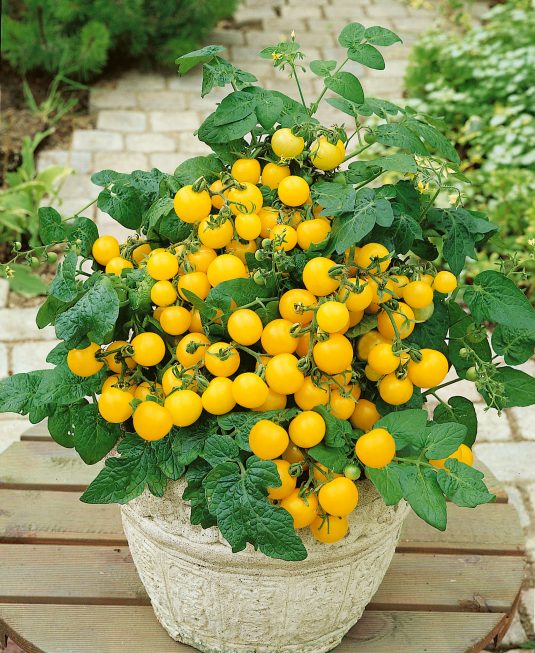
‘Patio Choice’ (see below image) gives you the choice of red or yellow fruiting plants. Yellow fruits are 1 inch across and the plants are 18 inches tall. Red fruits are a little larger.
‘Patio Choice’ Yellow Cherry Tomatoes
‘Sweet ‘n’ Neat’ bears clusters of 1-inch red cherry tomatoes on a plant that grows to be only 10 inches tall. Starts bearing fruit in only 48 days from transplanting.
For an even larger cherry, try ‘Totem’. Its red fruits are 2 ½ inches across and each 18- to 30-inch tall plant can bear up to 10 lbs. of them!
Bush Tomato Varieties
You are not restricted to growing only cherry-size tomatoes. There are plenty of bush varieties that don’t take up a lot of room but still bear large fruits. Plant one in a 5-gallon or larger pot.
‘Atlas’ is a hybrid beefsteak that grows only 2 to 3 feet tall but bears gorgeous 1-pound fruits 65 days from transplanting. It is good for container growing or put it right in the ground. Give it a wire cage for support and stand back!
Look for anything with “bush” in its name. We grow ‘Bush Blue Ribbon’, ‘Bush Early Girl’ and ‘Bush Goliath’ in large nursery pots every year, positioning them around the edge of the driveway to take advantage of the day-long sun there. All three grow to a manageable size that can be corralled in a regular tomato cage and bear early, medium-sized tomatoes.
Lettuce
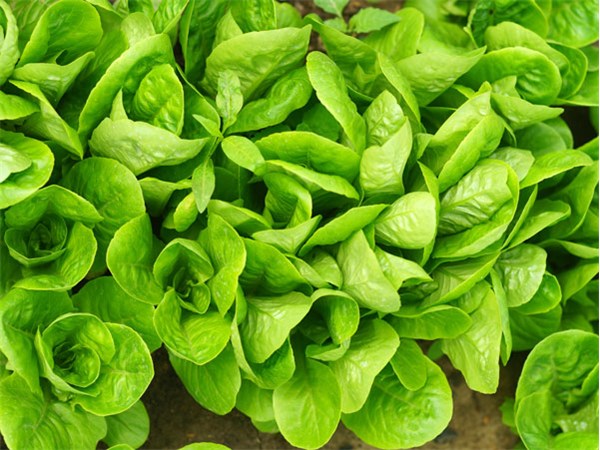
Lettuce is the most practical container plant. They don’t need a lot of root space so a 6- to 8-inch deep pot works great or plant them around the edge of a larger container, leaving room in the middle for a pepper or tomato. Leaf lettuces can be harvested as a cut-and-come-again crop by snipping off the outer leaves as needed and letting the rest of the plant continue to grow.
Choose a variety of colors and textures for an interesting salad mix.
If you want to harvest whole heads, look for ‘Little Gem’, a mini-romaine that forms a single-serving sized 4-inch wide head in only 35 days. The small green heads are perfect for individual salads, and its firm upright habit makes it great for sandwiches as well.
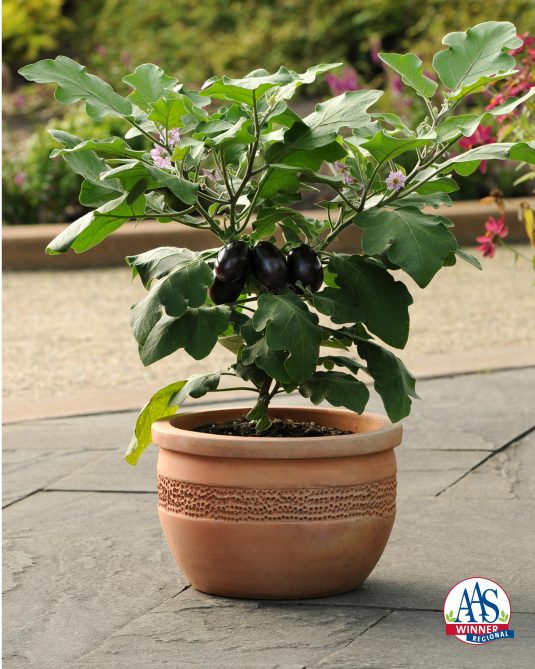
Eggplant is not only a delicious edible, but a pretty plant as well, with its purple flowers and velvety leaves. Plant one in a 2-gallon pot and grow it right out front alongside the ornamentals.
‘Patio Baby’ Eggplant
‘Patio Baby’ grows 18 to 24 inches tall and forms lots of lovely little 2- to 3-inch long tender purple fruits in 50 days.
‘Fairy Tale’ has larger 2-inch wide by 4-inch long fruits that are lavender with white stripes. Forming clusters of 4-6 fruits in 50 days, they are as eye-catching as they are delicious. The plants reach between 18 and 24 inches tall.
Peppers
Whether you like your peppers hot or sweet, they make great container plants. Use any 8-inch or deeper pots you have, one plant per 2 gallons of soil.
‘Tangerine Dream’ bears 3-inch long, sweet orange peppers on an 18-inch tall plant in 70 days. We grew this one last year for the first time and loved its flavor.
‘Mini-Belle Mix’ offers multicolored little 1¼ by 1¼ inch sweet bell peppers that ripen to red, orange, or yellow in 60 days. Plants are only 24 inches tall.
‘Sweet Heat’ bears mildly spicy 3- to 4-inch long fruits on a 12-inch tall plant in 56 days.
‘Thai Hot’ is as pretty as it is prolific, dripping with bright red 3-inch long HOT peppers. The plants are only 16 inches tall and start to bear fruit in only 40 days.
Carrots
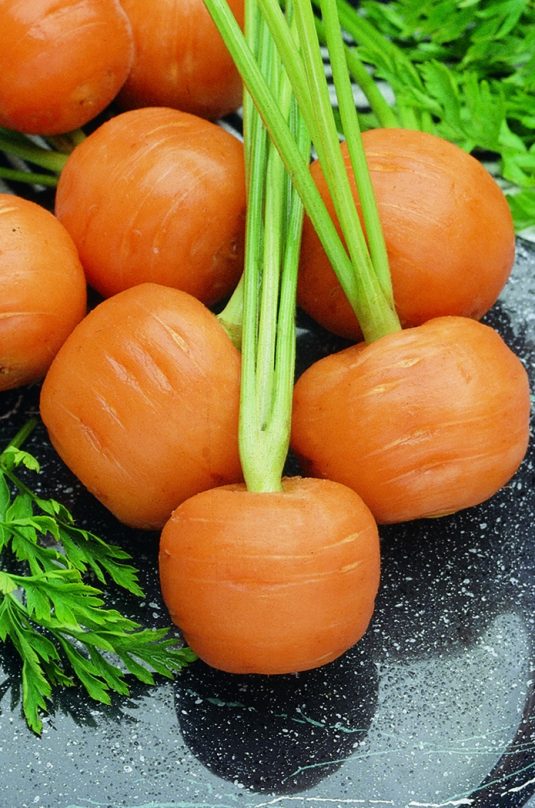
Who knew you could grow carrots in a container? Use a very deep one, 12 inches or more, if you are planning on long roots otherwise try these true baby carrots. They’ll need a 6- to 8-inch deep pot. (Once you have mastered carrots, give other root crops like radishes and beets a go.)
‘Thumbelina’ carrots need no peeling.
‘Adelaide’ grows only 3 to 4 inches long in 50 days.
‘Little Finger’ reaches 3 to 5 inches long in 62 days.
‘Parisian Market’ and ‘Thumbelina’ form round carrots in 50 to 70 days.
Squash and Cucumbers
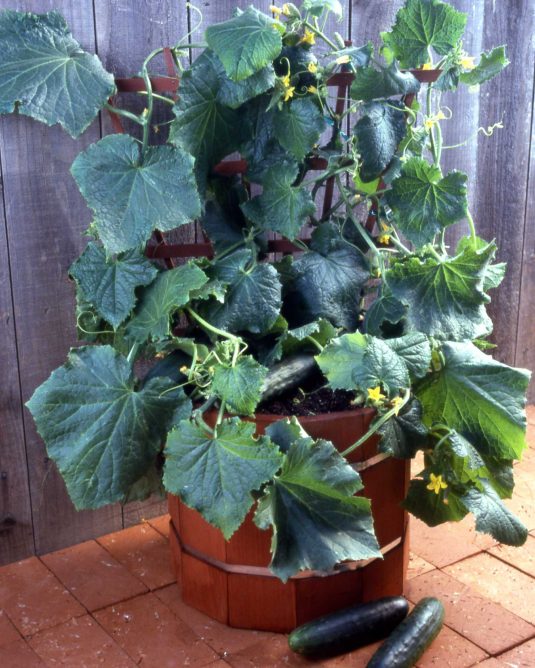
Squash and cukes are usually out of the question for a small garden, but these varieties have been bred to stay bushy and not take over. Plant one each in a 5-gallon or larger container and encourage the vining types to grow up a trellis.
‘Butterbaby’ is a mini butternut squash that bears 1- to 1½-lb. tan fruits on short vines in 100 days. Since the single-serving-size fruits are so lightweight, the vines can be grown on a trellis to save room.
‘Honey Bear’ acorn squash is another small, single-serving-size winter squash that weighs only 1 to 1 ¼ lbs. each. The plants are compact and bushy and bear in 85 days.
‘Pick-A-Bushel’ is a semi-bush cucumber with 2-foot long vines that can be encouraged to climb a trellis. Each plant bears between 18 and 20 3- to 5-inch pickling cukes in 50 days.
For slicing cucumbers, look for old standbys like:
‘Spacemaster’ was developed at Cornell in 1980 and is still popular with home gardeners today. It bears 7- to 8-inch long cukes on 3-foot vines in 60 days.
‘Salad Bush’ the 1998 AAS winning cuke bears 8-inch tender-skinned fruits on 24-inch vines.
‘Fanfare’ isa 1994 AAS winner that bears 9-inch long cukes on 24- to 30-inch long vines in 63 days.
‘Salad Bush’ cucumbers take up little space when grown in a container with a trellis.
These are just a few of the dwarf delights available for your kitchen garden this year. Don’t let a lack of space keep you from growing the foods you crave!
Get inspired by Robin Sweetser’s backyard gardening tips and tricks. Robin has been a contributor to The Old Farmer’s Almanac and the All-Seasons Garden Guide for many years. She and her partner Tom have a small greenhouse business and also sell plants, cut flowers, and vegetables at their local Farmer’s Market.









 Mws R Writings