When it comes to dairy products, getting your money’s worth from them can seem like an impossible task. Too often that gallon of milk ends up down the drain once the expiration date hits. But there is hope — and it lies in your freezer. Value and convenience can be found in freezing certain foods, and to the surprise of many, milk is one of them. Learn how to safely freeze and thaw milk for later use so you can save money and reduce waste.
Can You Freeze Milk?
Good news! According to the Dairy Council of California, it’s perfectly fine to freeze milk for later use. You just have to make sure you do so before the expiration or “best by” date. If you find yourself always pouring out-of-date milk down the drain, this simple solution can save you money and reduce food waste.
How to Freeze Milk
You can actually freeze milk in its original container, so long as that container is plastic. If your milk comes in a glass or cardboard container, transfer it into a freezer-safe plastic container before you freeze. Milk will expand when frozen, causing glass or cardboard to break — and you don’t want that mess in your freezer.
ADVERTISEMENT
Because milk will expand, it’s important that you don’t place a completely full jug of milk straight into the freezer. Leave one to two inches of headspace in each container, whether you’re freezing the entire jug or you’re separating it out into individual containers. Then simply reseal the lid, shake vigorously, and place in the freezer.
Write the date on the milk with a marker. Milk will save in the freezer for up to three months, although it’s best to use it sooner rather than later, as it can absorb odors from food stored nearby.
How to Thaw Milk
For safe consumption, milk will need to be thawed either in the refrigerator or in cold water. Do not thaw milk at room temperature, because this can risk the quality of the milk if it gets too warm.
To safely thaw milk, place it in the refrigerator to slowly thaw. To speed things up, you can also fill a sink or a large bowl with cold water and place the entire container in the water. Replace the water as it warms up.
You may notice the texture of the milk after it’s thawed is a bit grainy. This is because the fat separates. But fear not! A vigorous shake will help return the milk to its original texture. Thawed milk should be consumed within three to four days.
Image Source/Getty Images
How Milk Changes After Freezing
Although thawed milk will retain its nutrients, you may notice a difference in its appearance. The fat may separate, causing the texture to be slightly grainy, which is why shaking it prior to use is necessary.
You may also use an immersion blender to mix the fats back into the milk. Because of their lower fat content, skim milk and low-fat milk freeze best.
Another change you might notice in your milk is the flavor, and not because the milk has gone bad. Storing milk in the freezer (even with a sturdy plastic container) can cause it to absorb odors from particularly pungent foods (looking at you, seafood). This is why you should try to use your frozen milk sooner rather than later, and avoid storing it next to foods with strong odors.
Here are a few clues: He never lived in the White House. He owned slaves, but he struggled with the moral implications of owning another human being and freed every single one of them in his will. This president was born in the state that has produced the most U.S. presidents. In addition to being president, he was also well-known as a great military leader.
$2
This man wasn’t only the president but also an accomplished architect. He was a bibliophile whose personal collection became the helped establish the Libary of Congress. When he was 76, he founded the University of Virginia, designing its buildings and curriculum. He died deeply in debt, despite his hidden talents.
$5
This man is generally considered to be one of the greatest presidents of all time yet despite this, there’s a typo in the memorial that bears his name. He delivered what is arguably the most important proclamations in American history. He was one of four presidents to share a very grim fate.
Not sure what’s keeping you up at night? It could be all that hot sauce that you keep in your bag.
In one study, men were given tabasco sauce and mustard with their evening meals and had a more difficult time falling asleep. Scientists believe it may have something to do with thermoregulation—the body’s process of regulating its core internal temperature in order to get to sleep.
It’s not just Tabasco sauce either. Spicy meals, in general, could potentially contribute to insomnia and difficulty sleeping.
(1929-1968)UPDATED: JAN 16, 2020 | ORIGINAL: MAR 9, 2015
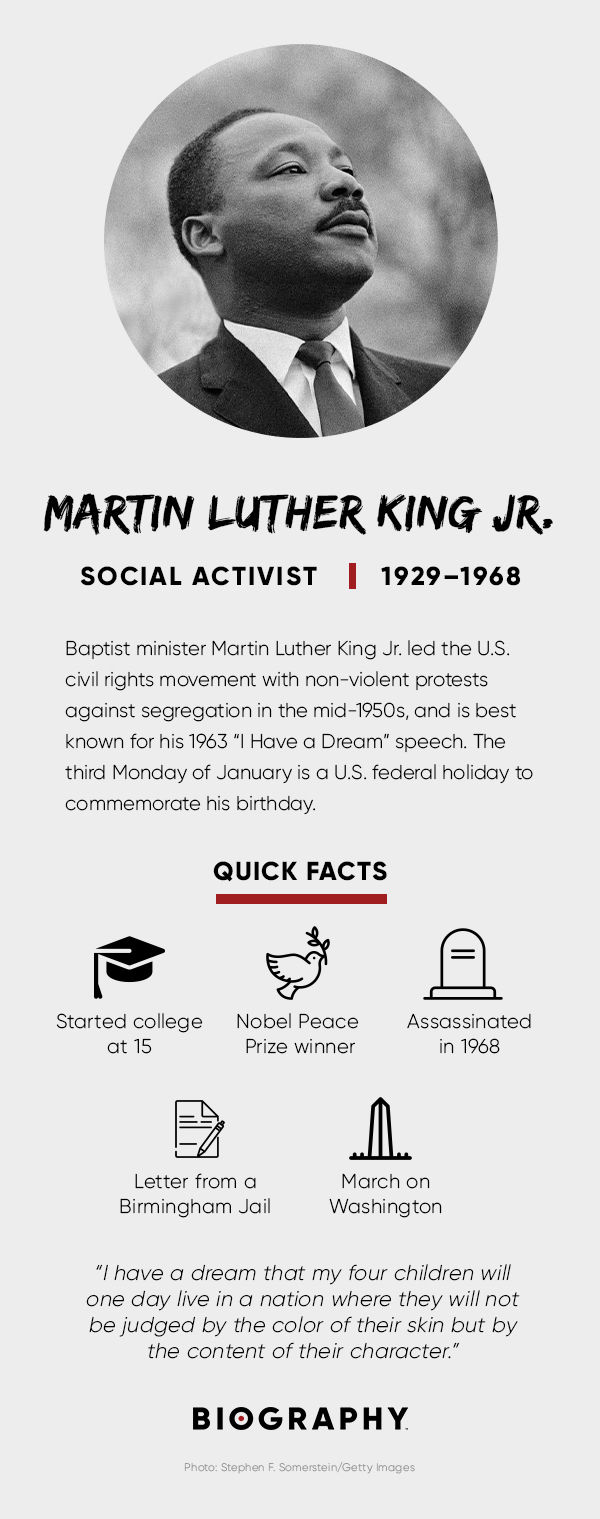
Martin Luther King Jr. was a scholar and minister who led the civil rights movement. After his assassination, he was memorialized by Martin Luther King Jr. Day.
Who Was Martin Luther King Jr?
Martin Luther King Jr. was a Baptist minister and civil-rights activist who had a seismic impact on race relations in the United States, beginning in the mid-1950s.
Among his many efforts, King headed the Southern Christian Leadership Conference (SCLC). Through his activism and inspirational speeches, he played a pivotal role in ending the legal segregation of African-American citizens in the United States, as well as the creation of the Civil Rights Act of 1964 and the Voting Rights Act of 1965.
King won the Nobel Peace Prize in 1964, among several other honors. He continues to be remembered as one of the most influential and inspirational African-American leaders in history.
Early Life
Born as Michael King Jr. on January 15, 1929, Martin Luther King Jr. was the middle child of Michael King Sr. and Alberta Williams King.
The King and Williams families had roots in rural Georgia. Martin Jr.’s grandfather, A.D. Williams, was a rural minister for years and then moved to Atlanta in 1893.
He took over the small, struggling Ebenezer Baptist church with around 13 members and made it into a forceful congregation. He married Jennie Celeste Parks and they had one child that survived, Alberta.
Martin Sr. came from a family of sharecroppers in a poor farming community. He married Alberta in 1926 after an eight-year courtship. The newlyweds moved to A.D.’s home in Atlanta.
Martin Sr. stepped in as pastor of Ebenezer Baptist Church upon the death of his father-in-law in 1931. He too became a successful minister and adopted the name Martin Luther King Sr. in honor of the German Protestant religious leader Martin Luther. In due time, Michael Jr. would follow his father’s lead and adopt the name himself.
READ MORE: Martin Luther King Jr. and Martin Luther: The Parallels Between the Two Leaders
King had an older sister, Willie Christine, and a younger brother, Alfred Daniel Williams King. The King children grew up in a secure and loving environment. Martin Sr. was more the disciplinarian, while his wife’s gentleness easily balanced out the father’s strict hand.
Though they undoubtedly tried, King’s parents couldn’t shield him completely from racism. Martin Sr. fought against racial prejudice, not just because his race suffered, but because he considered racism and segregation to be an affront to God’s will. He strongly discouraged any sense of class superiority in his children which left a lasting impression on Martin Jr.
Growing up in Atlanta, Georgia, King entered public school at age five. In May 1936 he was baptized, but the event made little impression on him.
In May 1941, King was 12 years old when his grandmother, Jennie, died of a heart attack. The event was traumatic for King, more so because he was out watching a parade against his parents’ wishes when she died. Distraught at the news, young King jumped from a second-story window at the family home, allegedly attempting suicide.
King attended Booker T. Washington High School, where he was said to be a precocious student. He skipped both the ninth and eleventh grades, and entered Morehouse College in Atlanta at age 15, in 1944. He was a popular student, especially with his female classmates, but an unmotivated student who floated through his first two years.
Although his family was deeply involved in the church and worship, King questioned religion in general and felt uncomfortable with overly emotional displays of religious worship. This discomfort continued through much of his adolescence, initially leading him to decide against entering the ministry, much to his father’s dismay.
But in his junior year, King took a Bible class, renewed his faith and began to envision a career in the ministry. In the fall of his senior year, he told his father of his decision.
Reverend Martin Luther King, Jr. speaks with people after delivering a sermon on May 13, 1956, in Montgomery, Alabama. Photo: Michael Ochs Archives/Getty Images
Martin Luther King, Jr. spending time with his son, Martin III, and daughter Yolanda. Photo: Marvin Koner/Corbis
Education and Spiritual Growth
In 1948, King earned a sociology degree from Morehouse College and attended the liberal Crozer Theological Seminary in Chester, Pennsylvania. He thrived in all his studies, and was valedictorian of his class in 1951, and elected student body president. He also earned a fellowship for graduate study.
But King also rebelled against his father’s more conservative influence by drinking beer and playing pool while at college. He became involved with a white woman and went through a difficult time before he could break off the affair.
During his last year in seminary, King came under the guidance of Morehouse College President Benjamin E. Mays who influenced King’s spiritual development. Mays was an outspoken advocate for racial equality and encouraged King to view Christianity as a potential force for social change. After being accepted at several colleges for his doctoral study, King enrolled at Boston University.
In 1954, while still working on his dissertation, King became pastor of the Dexter Avenue Baptist Church of Montgomery, Alabama. He completed his Ph.D. and earned his degree in 1955. King was only 25 years old.
During the work on his doctorate, King met Coretta Scott, an aspiring singer and musician at the New England Conservatory school in Boston. They were married in June 1953 and had four children, Yolanda, Martin Luther King III, Dexter Scott and Bernice.
Montgomery Bus Boycott
On March 2, 1955, a 15-year-old girl refused to give up her seat to a white man on a Montgomery city bus in violation of local law. Teenager Claudette Colvin was then arrested and taken to jail.
At first, the local chapter of the NAACPfelt they had an excellent test case to challenge Montgomery’s segregated bus policy. But then it was revealed that Colvin was pregnant and civil rights leaders feared this would scandalize the deeply religious black community and make Colvin (and, thus the group’s efforts) less credible in the eyes of sympathetic whites.
On December 1, 1955, they got another chance to make their case. That evening, 42-year-old Rosa Parks boarded the Cleveland Avenue bus to go home after an exhausting day at work. She sat in the first row of the “colored” section in the middle of the bus. As the bus traveled its route, all the seats in the white section filled up, then several more white passengers boarded the bus.
The bus driver noted that there were several white men standing and demanded that Parks and several other African Americans give up their seats. Three other African American passengers reluctantly gave up their places, but Parks remained seated.
The driver asked her again to give up her seat and again she refused. Parks was arrested and booked for violating the Montgomery City Code. At her trial a week later, in a 30-minute hearing, Parks was found guilty and fined $10 and assessed $4 court fee.
On the night that Parks was arrested, E.D. Nixon, head of the local NAACP chapter met with King and other local civil rights leaders to plan a Montgomery Bus Boycott. King was elected to lead the boycott because he was young, well-trained with solid family connections and had professional standing. But he was also new to the community and had few enemies, so it was felt he would have strong credibility with the black community.
In his first speech as the group’s president, King declared, “We have no alternative but to protest. For many years we have shown an amazing patience. We have sometimes given our white brothers the feeling that we liked the way we were being treated. But we come here tonight to be saved from that patience that makes us patient with anything less than freedom and justice.”
King’s skillful rhetoric put new energy into the civil rights struggle in Alabama. The bus boycott involved 382 days of walking to work, harassment, violence, and intimidation for Montgomery’s African American community. Both King’s and Nixon’s homes were attacked.
But the African American community also took legal action against the city ordinance arguing that it was unconstitutional based on the Supreme Court’s “separate is never equal” decision in Brown v. Board of Education. After being defeated in several lower court rulings and suffering large financial losses, the city of Montgomery lifted the law mandating segregated public transportation.
Southern Christian Leadership Conference
Flush with victory, African American civil rights leaders recognized the need for a national organization to help coordinate their efforts. In January 1957, King, Ralph Abernathy and 60 ministers and civil rights activists founded the Southern Christian Leadership Conference to harness the moral authority and organizing power of black churches. They would help conduct non-violent protests to promote civil rights reform.
King’s participation in the organization gave him a base of operation throughout the South, as well as a national platform. The organization felt the best place to start to give African Americans a voice was to enfranchise them in the voting process. In February 1958, the SCLC sponsored more than 20 mass meetings in key southern cities to register black voters in the South. King met with religious and civil rights leaders and lectured all over the country on race-related issues.
In 1959, with the help of the American Friends Service Committee, and inspired by Mahatma Gandhi’s success with non-violent activism, King visited Gandhi’s birthplace in India. The trip affected him in a profound way, increasing his commitment to America’s civil rights struggle.
African American civil rights activist Bayard Rustin, who had studied Gandhi’s teachings, became one of King’s associates and counseled him to dedicate himself to the principles of nonviolence. Rustin served as King’s mentor and advisor throughout his early activism and was the main organizer of the 1963 March on Washington.
But Rustin was also a controversial figure at the time, being a homosexual with alleged ties to the Communist Party. Though his counsel was invaluable to King, many of his other supporters urged him to distance himself from Rustin.
Greensboro Sit-In
In February 1960, a group of African American students in North Carolina began what became known as the Greensboro sit-in movement.
The students would sit at racially segregated lunch counters in the city’s stores. When asked to leave or sit in the colored section, they just remained seated, subjecting themselves to verbal and sometimes physical abuse.
The movement quickly gained traction in several other cities. In April 1960, the SCLC held a conference at Shaw University in Raleigh, North Carolina with local sit-in leaders. King encouraged students to continue to use nonviolent methods during their protests.
Out of this meeting, the Student Nonviolent Coordinating Committeeformed and for a time, worked closely with the SCLC. By August of 1960, the sit-ins had been successful in ending segregation at lunch counters in 27 southern cities.
By 1960, King was gaining national exposure. He returned to Atlanta to become co-pastor with his father at Ebenezer Baptist Church but also continued his civil rights efforts.
On October 19, 1960, King and 75 students entered a local department store and requested lunch-counter service but were denied. When they refused to leave the counter area, King and 36 others were arrested.
Realizing the incident would hurt the city’s reputation, Atlanta’s mayor negotiated a truce and charges were eventually dropped. But soon after, King was imprisoned for violating his probation on a traffic conviction.
The news of his imprisonment entered the 1960 presidential campaign when candidate John F. Kennedy made a phone call to Coretta Scott King. Kennedy expressed his concern for King’s harsh treatment for the traffic ticket and political pressure was quickly set in motion. King was soon released.
Letter from Birmingham Jail
In the spring of 1963, King organized a demonstration in downtown Birmingham, Alabama. With entire families in attendance, city police turned dogs and fire hoses on demonstrators.
King was jailed along with large numbers of his supporters, but the event drew nationwide attention. However, King was personally criticized by black and white clergy alike for taking risks and endangering the children who attended the demonstration.
In his famous Letter from Birmingham Jail, King eloquently spelled out his theory of non-violence: “Nonviolent direct action seeks to create such a crisis and foster such a tension that a community, which has constantly refused to negotiate, is forced to confront the issue.”
“I have decided to stick with love. Hate is too great a burden to bear.” Photo: Michael Ochs Archives/Getty Images“Our lives begin to end the day we become silent about the things that matter.”
‘I Have a Dream’ Speech
By the end of the Birmingham campaign, King and his supporters were making plans for a massive demonstration on the nation’s capital composed of multiple organizations, all asking for peaceful change.
On August 28, 1963, the historic March on Washington drew more than 200,000 people in the shadow of the Lincoln Memorial. It was here that King made his famous “I Have a Dream” speech, emphasizing his belief that someday all men could be brothers
“I have a dream that my four children will one day live in a nation where they will not be judged by the color of their skin but by the content of their character.” — Martin Luther King, Jr. / “I Have A Dream” speech, August 28, 1963
The rising tide of civil rights agitation produced a strong effect on public opinion. Many people in cities not experiencing racial tension began to question the nation’s Jim Crow laws and the near-century of second-class treatment of African American citizens.
Nobel Peace Prize
This resulted in the passage of the Civil Rights Act of 1964, authorizing the federal government to enforce desegregation of public accommodations and outlawing discrimination in publicly owned facilities. This also led to King receiving the Nobel Peace Prize in 1964.
King’s struggle continued throughout the 1960s. Often, it seemed as though the pattern of progress was two steps forward and one step back.
On March 7, 1965, a civil rights march, planned from Selma to Montgomery, Alabama’s capital, turned violent as police with nightsticks and tear gas met the demonstrators as they tried to cross the Edmund Pettus Bridge.
King was not in the march, however, the attack was televised showing horrifying images of marchers being bloodied and severely injured. Seventeen demonstrators were hospitalized in a day that would be called “Bloody Sunday.”
A second march was canceled due to a restraining order to prevent the march from taking place. A third march was planned and this time King made sure he was part of it. Not wanting to alienate southern judges by violating the restraining order, a different approach was taken.
On March 9, 1965, a procession of 2,500 marchers, both black and white, set out once again to cross the Pettus Bridge and confronted barricades and state troopers. Instead of forcing a confrontation, King led his followers to kneel in prayer and they then turned back.
Alabama governor George Wallacecontinued to try to prevent another march until President Lyndon B. Johnsonpledged his support and ordered U.S. Army troops and the Alabama National Guard to protect the protestors.
On March 21, approximately 2,000 people began a march from Selma to Montgomery, the state capitol. On March 25, the number of marchers, which had grown to an estimated 25,000, gathered in front of the state capitol where King delivered a televised speech. Five months after the historic peaceful protest, President Johnson signed the 1965 Voting Rights Act.
From late 1965 through 1967, King expanded his civil rights efforts into other larger American cities, including Chicago and Los Angeles. But he met with increasing criticism and public challenges from young black power leaders.
King’s patient, non-violent approach and appeal to white middle-class citizens alienated many black militants who considered his methods too weak, too late and ineffective.
To address this criticism, King began making a link between discrimination and poverty, and he began to speak out against the Vietnam War. He felt that America’s involvement in Vietnam was politically untenable and the government’s conduct in the war discriminatory to the poor. He sought to broaden his base by forming a multi-racial coalition to address the economic and unemployment problems of all disadvantaged people.
Assassination
By 1968, the years of demonstrations and confrontations were beginning to wear on King. He had grown tired of marches, going to jail, and living under the constant threat of death. He was becoming discouraged at the slow progress of civil rights in America and the increasing criticism from other African American leaders.
Plans were in the works for another march on Washington to revive his movement and bring attention to a widening range of issues. In the spring of 1968, a labor strike by Memphis sanitation workers drew King to one last crusade.
On April 3, he gave his final and what proved to be an eerily prophetic speech, “I’ve Been to the Mountaintop,” in which he told supporters at the Mason Temple in Memphis, “I’ve seen the promised land. I may not get there with you. But I want you to know tonight that we, as a people, will get to the promised land.”
The next day, while standing on a balcony outside his room at the Lorraine Motel, Martin Luther King Jr. was killed by a sniper’s bullet. The shooter, a malcontent drifter and former convict named James Earl Ray, was eventually apprehended after a two-month, international manhunt.
The assassination sparked riots and demonstrations in more than 100 cities across the country. In 1969, Ray pleaded guilty to assassinating King and was sentenced to 99 years in prison. He died in prison on April 23, 1998.
Legacy
King’s life had a seismic impact on race relations in the United States. Years after his death, he is the most widely known African American leader of his era.
His life and work have been honored with a national holiday, schools and public buildings named after him, and a memorial on Independence Mall in Washington, D.C.
But his life remains controversial as well. In the 1970s, FBI files, released under the Freedom of Information Act, revealed that he was under government surveillance, and suggested his involvement in adulterous relationships and communist influences.
Over the years, extensive archival studies have led to a more balanced and comprehensive assessment of his life, portraying him as a complex figure: flawed, fallible and limited in his control over the mass movements with which he was associated, yet a visionary leader who was deeply committed to achieving social justice through nonviolent means.
Martin Luther King Jr. Day
In 1983, President Ronald Reagan signed into law a bill creating Martin Luther King Jr. Day, a federal holiday honoring the legacy of the slain civil rights leader.
Martin Luther King Jr. Day was first celebrated in 1986, and in all 50 states in 2000.
Abafado, Andropogon citratus, Andropogon flexuosus, British Indian Lemongrass, Cana Santa, Capim-Cidrao, Capim-Santo, Ceylon Citronella Grass, Cimbopogone, Citronella, Citrongräss, Citronnelle, Citronnelle de Ceylan, Citronnelle des Indes, Citronnelle de Java, Citronnelle de Madagascar, Cochin Lemongrass, Cymbopogon citratus, Cymbopogon flexuosus, Cymbopogon nardis, East Indian Lemongrass, Fever Grass, Grass Tea, Guatemala Lemongrass, Herbe Citron, Hierba de Limón, Jonc Odorant, Lemon Grass, Lemon Grass Stalk, Limonaria, Limon Out, Madagascar Lemongrass, Sakumau, Sera, Sereh, Squinant, Ta-Khraj, Tej-Sar, Verveine Indienne, West Indian Lemongrass, Zacate Limon.<br/><br/>
Overview Information
Lemongrass is a plant. The leaves and the oil are used to make medicine.
ADVERTISEMENTLemongrass is commonly taken orally, applied directly to the skin, or inhaled as aromatherapy for many different conditions. But there is limited scientific research to support any of its common uses.
In food and beverages, lemongrass is used as a flavoring. For example, lemongrass leaves are commonly used as “lemon” flavoring in herbal teas.
In manufacturing, lemongrass is used as a fragrance in deodorants, soaps, and cosmetics. Lemongrass is also used in making vitamin Aand natural citral.
How does it work?
Lemongrass might help prevent the growth of some bacteria and yeast. Lemongrass also contains substances that are thought to relieve pain and swelling, reduce fever, improve levels of sugar and cholesterol in the blood, stimulate the uterus and menstrual flow, and have antioxidant properties.
Uses & Effectiveness?
Insufficient Evidence for
Dandruff. Early research suggests that applying a lemongrass oil solution to the hair reduces dandruff in some people.
High cholesterol. Early research suggests that taking lemongrass oil by mouth does not reduce cholesterol levels in people with high cholesterol.
Rheumatoid arthritis (RA). Early research suggests that applying lemongrass oil to the skin can decrease pain in adults with RA. However, more research is needed to know if this is more than just a placebo effect.
Yeast infection in the mouth (thrush).Early research suggests that drinking lemongrass tea decreases symptoms of thrush in people with HIV/AIDS.
Stomach and intestinal cramps.
Stomach ache.
High blood pressure.
Convulsions.
Pain and swelling.
Vomiting.
Cough.
Achy joints (rheumatism).
Fever.
Common cold.
Diabetes.
Exhaustion.
Headache.
Use as an antiseptic and astringent.
Other conditions.
More evidence is needed to rate the effectiveness of lemongrass for these uses.
Side Effects & Safety
Lemongrass is LIKELY SAFE for most people when used in food amounts. It is POSSIBLY SAFE when taken by mouth, applied to the skin, or inhaled as aromatherapy short-term for medicinal purposes. Rarely, lemongrass oil might cause a rash of skin irritation when applied to the skin. However, there have been some toxic side effects, such as lung problemsafter inhaling lemongrass and a fatal poisoning after a child swallowed a lemongrass oil-based insect repellent.
Special Precautions & Warnings:
Pregnancy and breast-feeding: It is LIKELY UNSAFE to take lemongrass by mouth during pregnancy. Lemongrass seems to be able to start menstrual flow, so there is a concern that it might cause a miscarriage.
There is not enough reliable information about the safety of taking lemongrass if you are pregnant or breast-feeding. Stay on the safe side and avoid use.
It’s a pitch Hollywood celebs love: that the alkaline diet — also known as the alkaline ash diet or alkaline acid diet — can help you lose weight and avoid problems like arthritis and cancer. The theory is that some foods, like meat, wheat, refined sugar, and processed foods, cause your body to produce acid, which is bad for you.
So, according to the “science” behind this diet, eating specific foods that make your body more alkaline can protect against those conditions as well as shed pounds. The alkaline diet really rocketed into the news when Victoria Beckham tweeted about an alkaline diet cookbook in January 2013.
What You Can and Can’t Eat
Most fruits and vegetables, soybeans and tofu, and some nuts, seeds, and legumes are alkaline-promoting foods, so they’re fair game.
Dairy, eggs, meat, most grains, and processed foods, like canned and packaged snacks and convenience foods, fall on the acid side and are not allowed.
Most books that tout the alkaline diet say you shouldn’t have alcohol or caffeine, either.
Level of Effort: High
You’ll be cutting out a lot of foods you may be used to eating.
Limitations: Many foods are off-limits, and so are alcohol and caffeine.
Cooking and shopping: You can get fruits and vegetables at the grocery store. It may take a while to learn how to prep and cook your meals when you use fresh foods.
Does It Allow for Restrictions or Preferences?
Vegetarians and vegans: This diet is mostly to completely vegetarian. It also works for vegans, in that dairy is off-limits.
Gluten-free: The diet excludes wheat, but to avoid gluten completely, you’ll need to check food labels carefully, as gluten is not just in wheat.
Besides wheat, the diet nixes most of the other major triggers for food allergies, including milk, eggs, peanuts, walnuts, fish, and shellfish. It’s also good for people who are trying to avoid fat and sugar.
What Else You Should Know
Cost: Many web sites with information about the alkaline diet also sell courses, books, supplements, and alkaline-infused water, food, and drinks. You do not need to buy these things to follow the alkaline diet. There are many free alkaline food charts online that list foods you can buy at the grocery store.
What Dr. Melinda Ratini Says:
Does It Work?
Maybe, but not for the reasons it claims.
First, a little chemistry: A pH level measures how acid or alkaline something is. A pH of 0 is totally acidic, while a pH of 14 is completely alkaline. A pH of 7 is neutral. Those levels vary throughout your body. Your blood is slightly alkaline, with a pH between 7.35 and 7.45. Your stomach is very acidic, with a pH of 3.5 or below, so it can break down food. And your urine changes, depending on what you eat — that’s how your body keeps the level in your blood steady.
The alkaline diet claims to help your body maintain its blood pH level. In fact, nothing you eat is going to substantially change the pH of your blood. Your body works to keep that level constant.
But the foods you’re supposed to eat on the alkaline diet are good for you and will support a healthy weight loss: lots of fruits and vegetables, and lots of water. Avoiding sugar, alcohol, and processed foods is healthy weight-loss advice, too.
As to the other health claims, there’s some early evidence that a diet low in acid-producing foods like animal protein (such as meat and cheese) and bread and high in fruits and veggies could help prevent kidney stones, keep bones and muscles strong, improve heart health and brain function, reduce low back pain, and lower risk for type 2 diabetes. But researchers aren’t sure of some of these claims yet.
People who believe in the alkaline diet say that though acid-producing foods shift our pH balance for only a little while, if you keep shifting your blood pH over and over, you can cause long-lasting acidity.
Is It Good for Certain Conditions?’
Following an alkaline diet means choosing fruits and vegetables over higher-calorie, higher-fat choices. You will also shun prepared foods, which often have a lot of sodium.
That’s great news for heart health because these steps help lower blood pressure and cholesterol, which are big risk factors for heart disease.
Getting to a healthy weight is also important in preventing and treating diabetes and osteoarthritis.
Some studies have found that an alkaline environment may make certain chemotherapy drugs more effective or less toxic. But it has not been shown that an alkaline diet can do this or help prevent cancer. If you have cancer, talk to your doctor or dietitian about your nutritional needs before starting any type of diet.
The Final Word
The emphasis on fruits and vegetables that is at the core of alkaline diets offers the promise of healthy weight loss. No special gear or supplements are required.
You’ll have the best success with it if you like to choose and experiment with new foods and love to cook.
But following an alkaline diet will be tough for many people.
A lot of favorite foods that are allowed in moderation in other plans (including lean meat, low-fat dairy, bread, and sweets) are forbidden here. Protein is limited to plant-based sources such as beans and tofu. This means you will have to make sure you get enough protein and calcium.
Eating out also can be a challenge. If you travel a lot for work or have a busy schedule, you might feel bogged down by all the food selection and prep.
Finally, many alkaline diets fail to address a major factor in weight loss and wellness success: exercise. You should include fitness in any healthy eating plan that you choose. The American Heart Association and the CDC recommend getting at least 150 minutes of exercise each week. If you have any medical problems or are out of shape, talk to your doctor first.










 Mws R Writings