
| NISUS |
| [nahy-suhs] |
| noun an effort or striving toward a particular goal or attainment; impulse. |

| NISUS |
| [nahy-suhs] |
| noun an effort or striving toward a particular goal or attainment; impulse. |
noun
dé·grin·go·lade | ˌdā-ˌgraⁿ(ŋ)-gə-ˈläd
How to pronounce dégringolade (audio)
: a rapid decline or deterioration (as in strength, position, or condition) : downfall
Keep scrolling for more
Synonyms
decadence, declension, declination, decline, degeneracy, degeneration, degradation, descent, deterioration, devolution, downfall, downgrade, ebb, eclipse, fall
Antonyms
ascent, rise, upswing
If dégringolade looks French to you, you have a good eye. We lifted this noun directly from French, and even in English it is usually styled with an acute accent over the first “e,” as in French. The French noun in turn comes from the verb dégringoler (“to tumble down”), which itself derives from the Middle French desgringueler (from des-, meaning “down,” and gringueler, meaning “to tumble”). Although dégringolade retains the sense of a sudden tumble in English, it tends to be applied to more metaphorical situations – a rapid fall from a higher position in society, for example. These days, dégringolade is fairly rare in American English. We rely far more heavily on its familiar synonym downfall.
the sad dégringolade of the holiday from a solemn day of remembrance to just another excuse to go shopping a sad dégringolade for a theater company that once premiered important American plays
French, from dégringoler to tumble down, from Middle French desgringueler, from des- de- + gringueler to tumble, from Middle Dutch crinkelen to make curl, from crinc, cring ring, circle
noun [sven-gah-lee, sfen-]
a person who completely dominates another, usually with selfish or sinister motives.
Lou Pearlman, who died on Friday in federal prison in Miami, at the age of sixty-two, was arguably the great pop Svengali of our time. John Seabrook, “We Live in the Pop-Culture World That Lou Pearlman Created,” The New Yorker, August 22, 2016
Though he comes across in his own writings as witty and self-aware, the picture that emerges decades later is of a moody, manipulative Svengali, blinded by his ego to what was really happening on the raft. A. O. Scott, “‘The Raft’ Review: A Crew of 10 Set Adrift With a Moody Svengali,” New York Times, June 6, 2019
Two terms survive from George du Maurier’s novel Trilby (1894). The first is Svengali, the evil musician who hypnotizes, controls, and exploits Trilby O’Ferrall, a young Irish girl, and makes her a great singer who is unable to perform without his help. In the stage version of the novel, the actress who played Trilby wore a sort of soft felt hat with an indented crown, now called a trilby or trilbyhat. The trilby is now commonly mistaken for a different hat, the fedora. Svengali in its extended sense of “a person who completely dominates another, usually with selfish or sinister motives” is recorded by the early 1900s.
noun rem·o·ra ri-ˈmȯr-ə also ˈremərə
1: any of a family (Echeneidae) of marine bony fishes that have the anterior dorsal fin modified into a suctorial disk on the head by means of which they adhere especially to other fishes 2: hindrance, drag
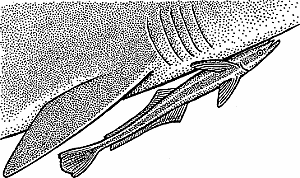
Also known as shark suckers or suckerfish, remoras are long, thin, dark fishes that are distributed throughout the world in warm seas. Ancient sailors believed remoras had the power to slow or even stop a ship by attaching themselves to it; the name remora, which means “delay” in Latin, arose from this ancient superstition. The poor remora’s reputation isn’t much better today. Even though remoras don’t harm their hosts, they are popularly thought of as unwanted guests who get a free ride and a free meal by way of the efforts of others. It is therefore common to see remora used metaphorically in such contexts as “hungry paparazzi who attach themselves like remoras to celebrities.”
Recent Examples on the Web This year, scientists tackled the sticky issue of creating strong underwater adhesives by mimicking the way remoras (also known as suckerfish) suction onto sharks. — Danielle Hall, Smithsonian, “The Top Ten Ocean Stories of 2017,” 16 Dec. 2017 When a bigger fish attacks and eats prey, the remora will detach itself and feast on the remains once its host is done. — National Geographic, “Watch: Confused Suckerfish Tries to Latch Onto Diver,” 11 Aug. 2017
These example sentences are selected automatically from various online news sources to reflect current usage of the word ‘remora.’ Views expressed in the examples do not represent the opinion of Merriam-Webster or its editors
1567, in the meaning defined at sense
Late Latin, from Latin, delay, from remorari to delay, from re- + morari to delay — more at moratorium
play adjective INK-horn
nounHISTORICAL
Picture an ancient scribe, pen in hand, a small ink bottle made from an animal’s horn strapped to his belt, ready to record the great events of history. In 14th-century England, such ink bottles were dubbed (not surprisingly) inkhorns. During the Renaissance, learned writers often borrowed words from Latin and Greek, eschewing vulgar English alternatives. But in the 16th century, some scholars argued for the use of native terms over Latinate forms, and a lively intellectual debate over the merits of each began. Those who favored English branded what they considered ostentatious Latinisms “inkhorn terms” after the bottles carried by scholars, and since then we have used inkhorn as an adjective for Latinate or pretentious language.
NOUN sleepwalking.
“she would have liked to wake up from her somnambulism to find herself back in bed”
late 18th century: from French somnambulisme, from Latin somnus ‘sleep’ + ambulare ‘to walk’.

NOUN
the process of growth or increase, typically by the gradual accumulation of additional layers or matter.”the accretion of sediments in coastal mangroves” · “the growing accretion of central government authority”
accumulation · collecting · gathering · amassing · cumulation · accrual · growth · formation · enlargement · increase · gain · augmentation · rise · mushrooming · snowballing · amassment thing formed or added by gradual growth or increase.” the city has a historic core surrounded by recent accretions” · “about one-third of California was built up by accretions”
addition · extension · growth · appendage · add-on · supplement astronomy the coming together and cohesion of matter under the influence of gravitation to form larger bodies
early 17th century: from Latin accretio(n-), from accrescere ‘become larger’ ( see accrete).




 Mws R Writings