To bake eggs in the oven, start by preheating your oven to 325°. Place one egg in each cup in a muffin tin, then carefully pour water into each cup until it reaches the brim. Baking hard boiled eggs can result in the formation of small brown spots on the eggshell (nothing to be worried about, just a chemical reaction). Pouring water over each egg prevented some of those unattractive spots from appearing on the egg shell. The water bath also resulted in a more evenly cooked yolk than eggs that were cooked in the muffin tin without water. Cook the eggs for exactly 30 minutes. While the eggs are baking, prepare an ice bath in a large bowl. When the eggs come out of the oven, immediately take them out of the muffin tin using tongs and place them in the ice bath to cool. After cooling for at least five minutes, peel and prepare as desired.
Hard Boiled Eggs vs. Oven Baked Eggs
Baked hard boiled eggs don’t cook as consistently as boiled hard boiled eggs (the yolks are not as even in color and texture as boiled eggs). Because of this, we only recommend this method if you want to cook a large batch of hard boiled eggs that you don’t have to keep a close eye on.
EDGAR ALLEN POE was born in Boston, January 19, 1809, and after a tempestuous life of forty years, he died in the city of Baltimore, October 7, 1849.
His father, the son of a distinguished officer in the Revolutionary army, was educated for the law, but having married the beautiful English actress, Elizabeth Arnold, he abandoned the law, and in company with his wife, led a wandering life on the stage. The two died within a short time of each other, leaving three children entirely destitute. Edgar, the second son, a bright, beautiful boy, was adopted by John Allen, a wealthy citizen of Richmond. Allen, having no children of his own, became very much attached to Edgar, and used his wealth freely in educating the boy. At the age of seven, he was sent to school at Stoke Newington, near London, where he remained for six years. During the next three years, he studied under private tutors, at the residence of the Allen’s in Richmond. In 1826 he entered the University of Virginia, where he remained less than a year.
After a year or two of fruitless life at home, a cadetship was obtained for him at West Point. He was soon tried by court-martial and expelled from school because he drank to excess and neglected his studies. Thus ended his school days.
In 1829 he published “Al Aaraaf and Minor Poems.” “This work,” says his biographer, Mr. Stoddard, “was not a remarkable production for a young gentleman of twenty.” Poe himself was ashamed of the volume.
After his stormy school life, he returned to Richmond, where he was kindly received by Mr. Allen. Poe’s conduct was such that Mr. Allen was obliged to turn him out of doors, and, dying soon after, he made no mention of Poe in his will.
Now wholly thrown upon his own resources, he took up literature as a profession, but in this, he failed to gain a living. He enlisted as a private soldier but was soon recognized as the West Point cadet and a discharge procured.
In 1833 Poe won two prizes of $100 each for a tale in prose, and for a poem. John P. Kennedy, one of the committees who made the award, now gave him means of support, and secured employment for him as editor of the “Southern Literary Messenger” at Richmond. After a short but successful editorial work on “The Messenger,” his old habits returned, he quarreled with his publishers and was dismissed. While in Richmond he married his cousin, Virginia Clem, and in January 1837, removed to New York. Here he gained poor support by writing for periodicals.
His literary work may be summed up as follows: In 1838 appeared a fiction entitled “The Narrative of Arthur Gorden Pym;” 1839, editor of Burton’s “Gentleman’s Magazine,” Philadelphia; next, editor of “Graham’s Magazine;” 1840, “Tales of the Grotesque and Arabesque,” in two volumes; 1845, “The Raven,” published by the “American Review;” then sub-editor of the “Mirror” underemployment of N. P. Willis and Geo. P. Norris; next associate editor of the “Broadway Journal.”
His wife died in 1848. His poverty was now such that the press made appeals to the public for his support.
In 1848 he published “Eureka, a Prose Poem.”
He went to Richmond in 1849, where he was engaged to a lady of considerable fortune. In October he started for New York to arrange for the wedding, but at Baltimore, he met some of his former boon companions and spent the night in drinking. In the morning he was found in a state of delirium and died in a few hours.
The most remarkable of his tales are “The Gold Bug,” “The Fall of the House of Usher,” “The Murders of the Rue Morgue,” “The Purloined Letter,” “A Descent into Maelstrom,” and “The Facts in the Case of M. Valdemar.” “The Raven” and “The Bells” alone would make the name of Poe immortal. The teachers of Baltimore placed a monument over his grave in 1875.
Poe has been severely censured by many writers for his wild and stormy life, but we notice that Ingram and some other prominent authors claim that he has been willfully slandered and that many of the charges brought against him are not true. His ungovernable temper and high spirit led him into disputes with his friends, hence he was not enabled to hold any one position for a great length of time. Like Byron and Burns, he had faults in personal life, but his ungovernable passions are sleeping, while the sad strains of “The Raven,” the clear and harmonious tones of “The Bells,” and the powerful images of his fancy live in the immortal literature of his time.
Freeman delivers this well crafted tale with cunning and patience, just like the cat’s. It is about the need for companionship, even by those who can survive alone in the harshest conditions.
Von Grzanka, Felis Catus-Cat on Snow, 2010
The snow was falling, and the Cat’s fur was stiffly pointed with it, but he was imperturbable. He sat crouched, ready for the death-spring, as he had sat for hours. It was night—but that made no difference—all times were as one to the Cat when he was in wait for prey. Then, too, he was under no constraint of human will, for he was living alone that winter. Nowhere in the world was any voice calling him; on no hearth was there a waiting dish. He was quite free except for his own desires, which tyrannized over him when unsatisfied as now. The Cat was very hungry—almost famished, in fact. For days the weather had been very bitter, and all the feebler wild things which were his prey by inheritance, the born serfs to his family, had kept, for the most part, in their burrows and nests, and the Cat’s long hunt had availed him nothing. But he waited with the inconceivable patience and persistency of his race; besides, he was certain. The Cat was a creature of absolute convictions, and his faith in his deductions never wavered. The rabbit had gone in there between those low-hung pine boughs. Now her little doorway had before it a shaggy curtain of snow, but in there she was. The Cat had seen her enter, so like a swift grey shadow that even his sharp and practised eyes had glanced back for the substance following, and then she was gone. So he sat down and waited, and he waited still in the white night, listening angrily to the north wind starting in the upper heights of the mountains with distant screams, then swelling into an awful crescendo of rage, and swooping down with furious white wings of snow like a flock of fierce eagles into the valleys and ravines. The Cat was on the side of a mountain, on a wooded terrace. Above him a few feet away towered the rock ascent as steep as the wall of a cathedral. The Cat had never climbed it—trees were the ladders to his heights of life. He had often looked with wonder at the rock, and miauled bitterly and resentfully as man does in the face of a forbidding Providence. At his left was the sheer precipice. Behind him, with a short stretch of woody growth between, was the frozen perpendicular wall of a mountain stream. Before him was the way to his home. When the rabbit came out she was trapped; her little cloven feet could not scale such unbroken steeps. So the Cat waited. The place in which he was looked like a maelstrom of the wood. The tangle of trees and bushes clinging to the mountain-side with a stern clutch of roots, the prostrate trunks and branches, the vines embracing everything with strong knots and coils of growth, had a curious effect, as of things which had whirled for ages in a current of raging water, only it was not water, but wind, which had disposed everything in circling lines of yielding to its fiercest points of onset. And now over all this whirl of wood and rock and dead trunks and branches and vines descended the snow. It blew down like smoke over the rock-crest above; it stood in a gyrating column like some death-wraith of nature, on the level, then it broke over the edge of the precipice, and the Cat cowered before the fierce backward set of it. It was as if ice needles pricked his skin through his beautiful thick fur, but he never faltered and never once cried. He had nothing to gain from crying, and everything to lose; the rabbit would hear him cry and know he was waiting.
It grew darker and darker, with a strange white smother, instead of the natural blackness of night. It was a night of storm and death superadded to the night of nature. The mountains were all hidden, wrapped about, overawed, and tumultuously overborne by it, but in the midst of it waited, quite unconquered, this little, unswerving, living patience and power under a little coat of grey fur.
A fiercer blast swept over the rock, spun on one mighty foot of whirlwind athwart the level, then was over the precipice.
Then the Cat saw two eyes luminous with terror, frantic with the impulse of flight, he saw a little, quivering, dilating nose, he saw two pointing ears, and he kept still, with every one of his fine nerves and muscles strained like wires. Then the rabbit was out—there was one long line of incarnate flight and terror—and the Cat had her.
Then the Cat went home, trailing his prey through the snow.
The Cat lived in the house which his master had built, as rudely as a child’s block-house, but staunchly enough. The snow was heavy on the low slant of its roof, but it would not settle under it. The two windows and the door were made fast, but the Cat knew a way in. Up a pine-tree behind the house he scuttled, though it was hard work with his heavy rabbit, and was in his little window under the eaves, then down through the trap to the room below, and on his master’s bed with a spring and a great cry of triumph, rabbit and all. But his master was not there; he had been gone since early fall and it was now February. He would not return until spring, for he was an old man, and the cruel cold of the mountains clutched at his vitals like a panther, and he had gone to the village to winter. The Cat had known for a long time that his master was gone, but his reasoning was always sequential and circuitous; always for him what had been would be, and the more easily for his marvellous waiting powers so he always came home expecting to find his master.
When he saw that he was still gone, he dragged the rabbit off the rude couch which was the bed to the floor, put one little paw on the carcass to keep it steady, and began gnawing with head to one side to bring his strongest teeth to bear.
It was darker in the house than it had been in the wood, and the cold was as deadly, though not so fierce. If the Cat had not received his fur coat unquestioningly of Providence, he would have been thankful that he had it. It was a mottled grey, white on the face and breast, and thick as fur could grow.
The wind drove the snow on the windows with such force that it rattled like sleet, and the house trembled a little. Then all at once the Cat heard a noise, and stopped gnawing his rabbit and listened, his shining green eyes fixed upon a window. Then he heard a hoarse shout, a halloo of despair and entreaty; but he knew it was not his master come home, and he waited, one paw still on the rabbit. Then the halloo came again, and then the Cat answered. He said all that was essential quite plainly to his own comprehension. There was in his cry of response inquiry, information, warning, terror, and finally, the offer of comradeship; but the man outside did not hear him, because of the howling of the storm.
Then there was a great battering pound at the door, then another, and another. The Cat dragged his rabbit under the bed. The blows came thicker and faster. It was a weak arm which gave them, but it was nerved by desperation. Finally the lock yielded, and the stranger came in. Then the Cat, peering from under the bed, blinked with a sudden light, and his green eyes narrowed. The stranger struck a match and looked about. The Cat saw a face wild and blue with hunger and cold, and a man who looked poorer and older than his poor old master, who was an outcast among men for his poverty and lowly mystery of antecedents; and he heard a muttered, unintelligible voicing of distress from the harsh piteous mouth. There was in it both profanity and prayer, but the Cat knew nothing of that.
The stranger braced the door which he had forced, got some wood from the stock in the corner, and kindled a fire in the old stove as quickly as his half-frozen hands would allow. He shook so pitiably as he worked that the Cat under the bed felt the tremor of it. Then the man, who was small and feeble and marked with the scars of suffering which he had pulled down upon his own head, sat down in one of the old chairs and crouched over the fire as if it were the one love and desire of his soul, holding out his yellow hands like yellow claws, and he groaned. The Cat came out from under the bed and leaped up on his lap with the rabbit. The man gave a great shout and start of terror, and sprang, and the Cat slid clawing to the floor, and the rabbit fell inertly, and the man leaned, gasping with fright, and ghastly, against the wall. The Cat grabbed the rabbit by the slack of its neck and dragged it to the man’s feet. Then he raised his shrill, insistent cry, he arched his back high, his tail was a splendid waving plume. He rubbed against the man’s feet, which were bursting out of their torn shoes.
The man pushed the Cat away, gently enough, and began searching about the little cabin. He even climbed painfully the ladder to the loft, lit a match, and peered up in the darkness with straining eyes. He feared lest there might be a man, since there was a cat. His experience with men had not been pleasant, and neither had the experience of men been pleasant with him. He was an old wandering Ishmael among his kind; he had stumbled upon the house of a brother, and the brother was not at home, and he was glad.
He returned to the Cat, and stooped stiffly and stroked his back, which the animal arched like the spring of a bow.
Then he took up the rabbit and looked at it eagerly by the firelight. His jaws worked. He could almost have devoured it raw. He fumbled—the Cat close at his heels—around some rude shelves and a table, and found, with a grunt of self-gratulation, a lamp with oil in it. That he lighted; then he found a frying-pan and a knife, and skinned the rabbit, and prepared it for cooking, the Cat always at his feet.
When the odour of the cooking flesh filled the cabin, both the man and the Cat looked wolfish. The man turned the rabbit with one hand and stooped to pat the Cat with the other. The Cat thought him a fine man. He loved him with all his heart, though he had known him such a short time, and though the man had a face both pitiful and sharply set at variance with the best of things.
It was a face with the grimy grizzle of age upon it, with fever hollows in the cheeks, and the memories of wrong in the dim eyes, but the Cat accepted the man unquestioningly and loved him. When the rabbit was half cooked, neither the man nor the Cat could wait any longer. The man took it from the fire, divided it exactly in halves, gave the Cat one, and took the other himself. Then they ate.
Then the man blew out the light, called the Cat to him, got on the bed, drew up the ragged coverings, and fell asleep with the Cat in his bosom.
The man was the Cat’s guest all the rest of the winter, and winter is long in the mountains. The rightful owner of the little hut did not return until May. All that time the Cat toiled hard, and he grew rather thin himself, for he shared everything except mice with his guest; and sometimes game was wary, and the fruit of patience of days was very little for two. The man was ill and weak, however, and unable to eat much, which was fortunate, since he could not hunt for himself. All day long he lay on the bed, or else sat crouched over the fire. It was a good thing that fire-wood was ready at hand for the picking up, not a stone’s-throw from the door, for that he had to attend to himself.
The Cat foraged tirelessly. Sometimes he was gone for days together, and at first the man used to be terrified, thinking he would never return; then he would hear the familiar cry at the door, and stumble to his feet and let him in. Then the two would dine together, sharing equally; then the Cat would rest and purr, and finally sleep in the man’s arms.
Towards spring the game grew plentiful; more wild little quarry were tempted out of their homes, in search of love as well as food. One day the Cat had luck—a rabbit, a partridge, and a mouse. He could not carry them all at once, but finally he had them together at the house door. Then he cried, but no one answered. All the mountain streams were loosened, and the air was full of the gurgle of many waters, occasionally pierced by a bird-whistle. The trees rustled with a new sound to the spring wind; there was a flush of rose and gold-green on the breasting surface of a distant mountain seen through an opening in the wood. The tips of the bushes were swollen and glistening red, and now and then there was a flower; but the Cat had nothing to do with flowers. He stood beside his booty at the house door, and cried and cried with his insistent triumph and complaint and pleading, but no one came to let him in. Then the cat left his little treasures at the door, and went around to the back of the house to the pine-tree, and was up the trunk with a wild scramble, and in through his little window, and down through the trap to the room, and the man was gone.
The Cat cried again—that cry of the animal for human companionship which is one of the sad notes of the world; he looked in all the corners; he sprang to the chair at the window and looked out; but no one came. The man was gone and he never came again.
The Cat ate his mouse out on the turf beside the house; the rabbit and the partridge he carried painfully into the house, but the man did not come to share them. Finally, in the course of a day or two, he ate them up himself; then he slept a long time on the bed, and when he waked the man was not there.
Then the Cat went forth to his hunting-grounds again, and came home at night with a plump bird, reasoning with his tireless persistency in expectancy that the man would be there; and there was a light in the window, and when he cried his old master opened the door and let him in.
His master had strong comradeship with the Cat, but not affection. He never patted him like that gentler outcast, but he had a pride in him and an anxiety for his welfare, though he had left him alone all winter without scruple. He feared lest some misfortune might have come to the Cat, though he was so large of his kind, and a mighty hunter. Therefore, when he saw him at the door in all the glory of his glossy winter coat, his white breast and face shining like snow in the sun, his own face lit up with welcome, and the Cat embraced his feet with his sinuous body vibrant with rejoicing purrs.
The Cat had his bird to himself, for his master had his own supper already cooking on the stove. After supper the Cat’s master took his pipe, and sought a small store of tobacco which he had left in his hut over winter. He had thought often of it; that and the Cat seemed something to come home to in the spring. But the tobacco was gone; not a dust left. The man swore a little in a grim monotone, which made the profanity lose its customary effect. He had been, and was, a hard drinker; he had knocked about the world until the marks of its sharp corners were on his very soul, which was thereby calloused, until his very sensibility to loss was dulled. He was a very old man.
He searched for the tobacco with a sort of dull combativeness of persistency; then he stared with stupid wonder around the room. Suddenly many features struck him as being changed. Another stove-lid was broken; an old piece of carpet was tacked up over a window to keep out the cold; his fire-wood was gone. He looked and there was no oil left in his can. He looked at the coverings on his bed; he took them up, and again he made that strange remonstrant noise in his throat. Then he looked again for his tobacco.
Finally he gave it up. He sat down beside the fire, for May in the mountains is cold; he held his empty pipe in his mouth, his rough forehead knitted, and he and the Cat looked at each other across that impassable barrier of silence which has been set between man and beast from the creation of the world.
We’ve all been there—there, meaning the drive-thru, with our tummies rumbling. In a weak moment, throwing caution to the pick-up window might not seem like a grave mistake, but the terrible feeling that rises in your gut as soon as you dispose of the last empty ketchup packet is more than just regret.
Science, known for ruining everything, has shown that a single junk food meal can have a huge impact on your body—and not in a good way. Couple that with the fact that the largest study of fast food to date found that the portion sizes, calories, fat, and sodium have increased across the board, and you’ve got trouble.
Take the fast food standby, the hamburger. Even a single quarter-pound patty rings in at an excess of 500 calories, 25 grams of fat (nearly half of those saturated, accounting for more than half of your recommended daily intake, plus some trans fats), 40 grams of carbs, 10 grams of sugar, and 1,000 milligrams of sodium. It easily makes the list of foods nutritionists never eat, so you shouldn’t either.
When that burger hits your bloodstream, which begins roughly 15 minutes after your first bite, you’ll experience a massive surge of glucose as your body converts all those calories to energy. That triggers the release of insulin to offset the spike—sometimes, a bit too much insulin, which leads you to feel hungry again in a few hours. Repeating this pattern can lead to insulin resistance, a precursor to diabetes. Researchers attribute this to oxidative stress on cells that occurs when taking in an excessive number of calories in one sitting.
All that saturated fat also has a pretty instantaneous effect, too. When researchers fed healthy men a fast food meal high in saturated fat and then measured their endothelial function, they found that their arteries were significantly impaired and did not dilate as much. This is the first step to atherosclerosis, the restriction of blood flow that can lead to cardiac disease. Find out more about the effects eating fast food has on your immune system.
The high amounts of sodium in that all-beef patty can compound the problem. A separate study published in the American Journal of Clinical Nutrition found that salty foods can negatively impact blood vessel function in as little as 30 minutes.
And that’s not all. Researchers served study participants a 1,000-calorie meal loaded with saturated fat, and found that within four hours, everyone who consumed it had elevated triglycerides and fatty acids in their blood, as well as impaired arterial function. But less expectedly, the study authors also noted that the test subject’s immune systems had responded to the meal the same way they would have to an infection.
So next time temptation hits and you think about giving in “just this once,” consider that a quarter-pounder is going to give you so much more than indigestion—and that’s without fries and a soda—and keep on driving. Sure enough, that soda has some unpleasant effects on your body, too—find out how just one can affect you.
Drop a slice of lemon into a glass of cool water or a mug of hot and drink it before breakfast. Instagram and “wellness experts” swear it boosts metabolism, eliminates toxins, and helps you lose weight.
People who know how the body works, however, point out that what lemon water really does is make your water taste like lemon. “It’s not going to burn fat by any stretch of the imagination,” says Karen Ansel, R.D.N., author of Healing Superfoods for Anti-Aging: Stay Younger, Live Longer.
It’s obvious that if you’re using lemon water as a replacement for something else-a 400-calorie mega mocha whipped-cream-topped “coffee,” perhaps-yeah, you’ll lose weight. And there’s a little glimmer of hope that on its own, the water part of the equation may indirectly help your pounds-off efforts. “Drinking about 16 ounces of water before a meal has been shown to help with weight loss,” Ansel says. One study published in the journal Obesity found that obese adults who drank that much tap water before a meal (not sparkling) lost 2.8 pounds more over 12 weeks than people who didn’t “pre-load” with water, possibly because it made participants feel more full. “But adding lemon won’t do anything at all to help you burn more calories,” Ansel says.
True, lemons have nutrients in them, like vitamin C. But even an entire half a lemon in eight ounces of water won’t really change your body’s vitamin status much. And lemon as “detoxer”? Your liver already has detoxing covered for you.
So if you like the taste of lemon water and it starts your day off right in some way, then great. Just be sure to chase your morning glass with a plain-water rinse. “Lemon is very acidic and not great for tooth enamel,” Ansel says. Erosive food and drinks can weaken tooth enamel and brushing within about 30 minutes can remove some of it. Rinse right away after drinking lemon water, then wait a bit before you brush.
2 cans (10 oz. each) Ro-Tel Tomatoes with green chiles, mild (If you can’t find Ro-Tel tomatoes where you live, use a 14.5 oz. can petite diced tomatoes and a 4 oz. can diced green chiles.)
1 medium-large onion, chopped small
2 T olive oil, divided
1 lb. cauliflower rice (If you can’t find pre-chopped riced cauliflower in your store, chop a small head of cauliflower in the food processor.)
1/2 cup sliced green onion
1 lb. ground beef
1 T Kalyn’s Taco Seasoning Mix (See note)
1 tsp. salt (or to taste)
2 cups + 1 cup grated Mexican Blend Cheese (Use less cheese if you prefer; we wanted it cheesy!)
DIRECTIONS:
Dump the Ro-Tel tomatoes into a colander placed in the sink and let them drain while you prep other ingredients.
Heat oven to 375F/190C and spray a large casserole dish with olive oil or non-stick spray. (I used an oval-shaped dish that was 11″ long and 8″ wide at the widest point.)
Chop the onion, heat 1 tablespoon olive oil in a large frying pan, and cook onion until it’s cooked through and starting to get some color.
Add the cauliflower rice and cook over medium-high heat until the moisture in the cauliflower has mostly evaporated and there’s no water in the bottom of the pan, about 3-4 minutes.
Turn off heat and stir in the sliced green onions. Transfer the cooked cauliflower rice to a bowl.
Heat the second tablespoon of olive oil to the pan, add the ground beef, and cook until it’s browned, breaking apart with a turner as it cooks. Add the Taco Seasoning and cook 1-2 minutes more, then add the drained Ro-Tel Tomatoes and cook another minute or two.
Stir in the cauliflower rice, season with salt to taste, and cook until it’s heated through.
Turn off heat and stir in 2 cups grated Mexican blend cheese.
Transfer mixture to the casserole dish and top with another cup of grated Mexican Blend.
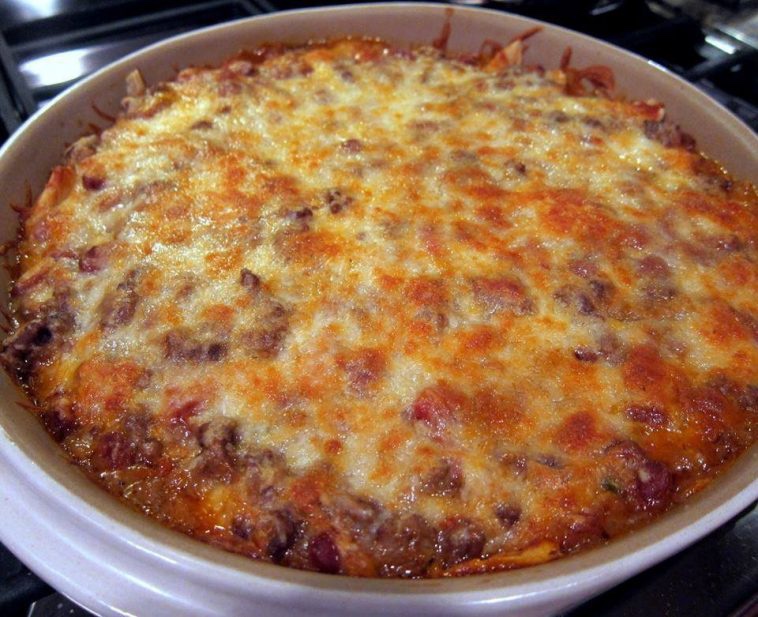
Bake about 30 minutes, or until the casserole is bubbling hot and cheese is nicely browned on top.
Serve hot, with things like salsa, green tabasco sauce , Sour Cream, Guacamole, Pico de Gallo, or chopped avocado to add at the table as desired.








 Mws R Writings