Continue reading More About The Mediterranian DietThe Mediterranean diet is anything but new—it’s been around since the 1960s—but it’s still hailed by registered dietitians and nutrition experts as one of the healthiest diets. In fact, it was named the Best Diet Overall for 2022 by U.S. News for incorporating a diverse array of nutritious foods.
Kate Bratskeir, Emily Shiffer
Tag: Mediterranean Diet

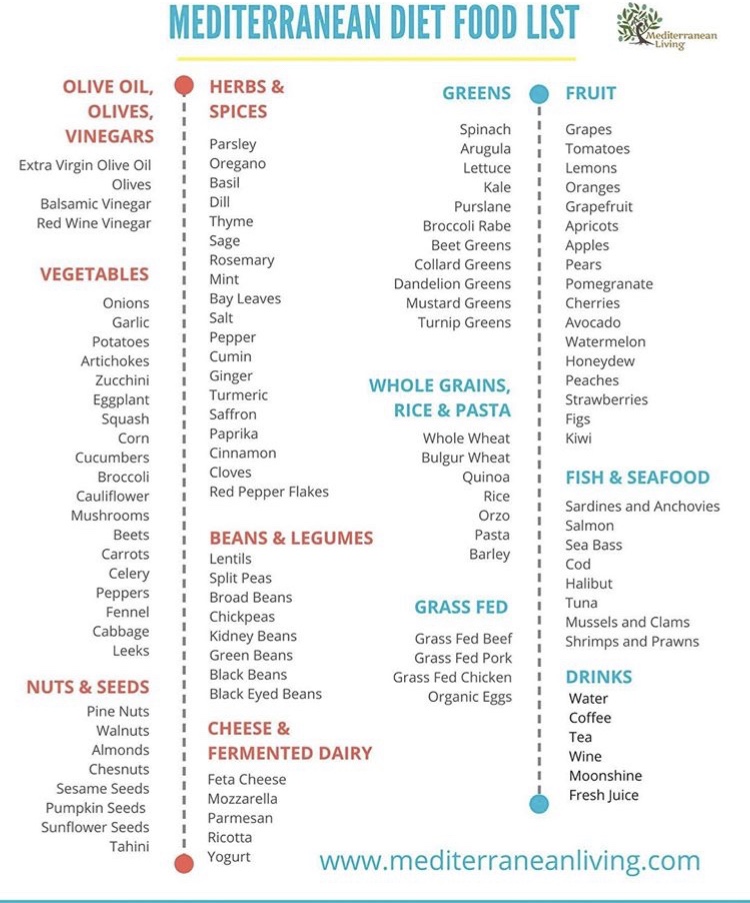
Mediterranean Diet~ some info- food list

Ways To Follow The Mediterranean Diet
1. Switch Up Your Oil

If you’ve been cooking with vegetable oil or coconut oil, make the switch to extra-virgin olive oil. Olive oil is rich in monounsaturated fatty acids which may improve HDL cholesterol, the “good” type of cholesterol. HDL cholesterol ferries “bad” LDL particles out of arteries, according to a 2017 study in Circulation. Use olive oil in homemade salad dressings and vinaigrettes. Drizzle it on finished dishes like fish or chicken to boost flavor. Swap butter for olive oil in mashed potatoes, pasta, and more.
2. Eat More Fish

Featured Recipe: Plank-Grilled Miso Salmon
The go-to protein in the Mediterranean diet is fish. In particular, this diet emphasizes fatty fish like salmon, sardines, and mackerel. These fish are rich in heart- and brain-healthy omega-3 fatty acids. Even those fish that are leaner and have less fat (like cod or tilapia) are still worth it, as they provide a good source of protein. If you currently don’t get a lot of fish in your diet, an easy point of entry is to designate one day each week as “fish” night. Cooking fish in parchment paper or foil packets is one no-fuss, no-mess way to put dinner on the table. Or try incorporating it in some of your favorite foods, like tacos, stir-frys, and soups.
3. Eat Veggies All Day Long

Featured Recipe: Baked Vegetable Soup
If you look at your diet and worry that there’s barely a green to be seen, this is the perfect opportunity to fit in more veggies. A good way to do this is to eat one serving at snacktime, like crunching on bell pepper strips or throwing a handful of spinach into a smoothie), and one at dinner, like these quick and easy side dishes. Aim for at least two servings per day. More is better. At least three servings can help you bust stress, Australian research notes.
4. Help Yourself to Whole Grains

Featured Recipe: Mediterranean Chickpea Quinoa Bowl
Experiment with “real” whole grains that are still in their “whole” form and haven’t been refined. Quinoa cooks up in just 20 minutes, making it a great side dish for weeknight meals. Barley is full of fiber and it’s filling: pair it with mushrooms for a steamy, satisfying soup. A hot bowl of oatmeal is perfect for breakfast on a cold winter morning. Even popcorn is a whole grain—just keep it healthy by eating air-popped corn and forgo the butter (try a drizzle of olive oil instead). Supplement your intake with other whole-grain products, like whole-wheat bread and pasta. Look for the term “whole” or “whole grain” on the food package and in the ingredient list—it should be listed as the first ingredient. But if you still find it too hard to make the switch from your old refined favorites, phase in a whole grain by using whole-grain blends of pastas and rice or mixing whole grains half-and-half with a refined one (like half whole-wheat pasta and half white).
5. Snack on Nuts

Featured Recipe: Tropical Fruit & Nuts Snack
Nuts are another Mediterranean diet staple. Grabbing a handful, whether that’s almonds, cashews, or pistachios, can make for a satisfying, on-the-go snack. One study in Nutrition Journal found that if people replaced their standard snack (cookies, chips, crackers, snack mix, cereal bars) with almonds, their diets would be lower in empty calories, added sugar, and sodium. Plus, nuts contain more fiber and minerals, such as potassium, than processed snack foods.
6. Enjoy Fruit for Dessert

Featured Recipe: Red Fruit Salad
Generally a good source of fiber, vitamin C and antioxidants, fresh fruit is a healthy way to indulge your sweet tooth. If it helps you to eat more, add a little sugar—drizzle slices of pear with honey or sprinkle a little brown sugar on grapefruit. Keep fresh fruit visible at home and keep a piece or two at work so you have a healthful snack when your stomach starts growling. Lots of grocery stores stock exotic fruit—pick a new one to try each week and expand your fruit horizons.
7. Sip (a Little) Wine

The people who live along the Mediterranean—the Spanish, Italian, French, Greek, and others—are not known to shy away from wine, but that doesn’t mean you should pour it at your leisure. Dietitians and experts who developed the Mediterranean diet for the New England Journal of Medicine study advised women to stick to a three-ounce serving and men, a five-ounce serving, per day. When you do sip, try to do so with a meal—even better if that meal is shared with loved ones. If you’re a teetotaler, you shouldn’t start to drink just for this diet.
8. Savor Every Bite

http://www.eatingwell.com/article/16372/8-ways-to-follow-the-mediterranean-diet-for-better-health/
Mediterranean Diet Info Share


One Day Of Mediterranean Diet Plan
Breakfast

Breakfast (280 calories)
• 1 serving Fig & Ricotta Toast
• 1 cup of coffee with 1/4 cup steamed milk
A.M. Snack

A.M. Snack (101 calories)
• 1 medium pear
Lunch

Lunch (371 calories)
• 1 serving Edamame & Chicken Greek Salad (2 3/4 cup)
• 1 clementine
P.M. Snack

P.M. Snack (177 calories)
• 1 4-inch whole-wheat pita bread, toasted
• 3 Tbsp. hummus drizzled with 1 tsp. olive oil
Dinner

Dinner (563 calories)
• 1 serving Dijon Salmon with Green Bean Pilaf
• 5 oz. glass of Pinot Noir, or Chardonnay
http://www.eatingwell.com/article/289833/1-day-mediterranean-diet-meal-plan/

Mediterranean Diet/Did You Know?
Mediterranean diet: A heart-healthy eating plan
The heart-healthy Mediterranean diet is a healthy eating plan based on typical foods and recipes of Mediterranean-style cooking. Here’s how to adopt the Mediterranean diet.
If you’re looking for a heart-healthy eating plan, the Mediterranean diet might be right for you.
The Mediterranean diet incorporates the basics of healthy eating — plus a splash of flavorful olive oil and perhaps a glass of red wine — among other components characterizing the traditional cooking style of countries bordering the Mediterranean Sea.
Most healthy diets include fruits, vegetables, fish and whole grains, and limit unhealthy fats. While these parts of a healthy diet are tried-and-true, subtle variations or differences in proportions of certain foods may make a difference in your risk of heart disease.
Benefits of the Mediterranean diet
Research has shown that the traditional Mediterranean diet reduces the risk of heart disease. The diet has been associated with a lower level of oxidized low-density lipoprotein (LDL) cholesterol — the “bad” cholesterol that’s more likely to build up deposits in your arteries.
In fact, a meta-analysis of more than 1.5 million healthy adults demonstrated that following a Mediterranean diet was associated with a reduced risk of cardiovascular mortality as well as overall mortality.
The Mediterranean diet is also associated with a reduced incidence of cancer, and Parkinson’s and Alzheimer’s diseases. Women who eat a Mediterranean diet supplemented with extra-virgin olive oil and mixed nuts may have a reduced risk of breast cancer.
For these reasons, most if not all major scientific organizations encourage healthy adults to adapt a style of eating like that of the Mediterranean diet for prevention of major chronic diseases.
Key components of the Mediterranean diet
The Mediterranean diet emphasizes:
- Eating primarily plant-based foods, such as fruits and vegetables, whole grains, legumes and nuts
- Replacing butter with healthy fats such as olive oil and canola oil
- Using herbs and spices instead of salt to flavor foods
- Limiting red meat to no more than a few times a month
- Eating fish and poultry at least twice a week
- Enjoying meals with family and friends
- Drinking red wine in moderation (optional)
- Getting plenty of exercise
Fruits, vegetables, nuts and grains

©2009 Oldways Preservation and Exchange Trust
The Mediterranean diet traditionally includes fruits, vegetables, pasta and rice. For example, residents of Greece eat very little red meat and average nine servings a day of antioxidant-rich fruits and vegetables.
Grains in the Mediterranean region are typically whole grain and usually contain very few unhealthy trans fats, and bread is an important part of the diet there. However, throughout the Mediterranean region, bread is eaten plain or dipped in olive oil — not eaten with butter or margarines, which contain saturated or trans fats.
Nuts are another part of a healthy Mediterranean diet. Nuts are high in fat (approximately 80 percent of their calories come from fat), but most of the fat is not saturated. Because nuts are high in calories, they should not be eaten in large amounts — generally no more than a handful a day. Avoid candied or honey-roasted and heavily salted nuts.
Healthy fats
The focus of the Mediterranean diet isn’t on limiting total fat consumption, but rather to make wise choices about the types of fat you eat. The Mediterranean diet discourages saturated fats and hydrogenated oils (trans fats), both of which contribute to heart disease.
The Mediterranean diet features olive oil as the primary source of fat. Olive oil provides monounsaturated fat — a type of fat that can help reduce LDL cholesterol levels when used in place of saturated or trans fats.
“Extra-virgin” and “virgin” olive oils — the least processed forms — also contain the highest levels of the protective plant compounds that provide antioxidant effects.
Monounsaturated fats and polyunsaturated fats, such as canola oil and some nuts, contain the beneficial linolenic acid (a type of omega-3 fatty acid). Omega-3 fatty acids lower triglycerides, decrease blood clotting, are associated with decreased sudden heart attack, improve the health of your blood vessels, and help moderate blood pressure.
Fatty fish — such as mackerel, lake trout, herring, sardines, albacore tuna and salmon — are rich sources of omega-3 fatty acids. Fish is eaten on a regular basis in the Mediterranean diet.
Wine
The health effects of alcohol have been debated for many years, and some doctors are reluctant to encourage alcohol consumption because of the health consequences of excessive drinking.
However, alcohol — in moderation — has been associated with a reduced risk of heart disease in some research studies.
The Mediterranean diet typically includes a moderate amount of wine. This means no more than 5 ounces (148 milliliters) of wine daily for women (or men over age 65), and no more than 10 ounces (296 milliliters) of wine daily for men under age 65.
If you’re unable to limit your alcohol intake to the amounts defined above, if you have a personal or family history of alcohol abuse, or if you have heart or liver disease, refrain from drinking wine or any other alcohol.
Putting it all together
The Mediterranean diet is a delicious and healthy way to eat. Many people who switch to this style of eating say they’ll never eat any other way. Here are some specific steps to get you started:
- Eat your veggies and fruits — and switch to whole grains. An abundance and variety of plant foods should make up the majority of your meals. Strive for seven to 10 servings a day of veggies and fruits. Switch to whole-grain bread and cereal, and begin to eat more whole-grain rice and pasta products.
- Go nuts. Keep almonds, cashews, pistachios and walnuts on hand for a quick snack. Choose natural peanut butter, rather than the kind with hydrogenated fat added. Try tahini (blended sesame seeds) as a dip or spread for bread.
- Pass on the butter. Try olive or canola oil as a healthy replacement for butter or margarine. Use it in cooking. Dip bread in flavored olive oil or lightly spread it on whole-grain bread for a tasty alternative to butter. Or try tahini as a dip or spread.
- Spice it up. Herbs and spices make food tasty and are also rich in health-promoting substances. Season your meals with herbs and spices rather than salt.
- Go fish. Eat fish once or twice a week. Fresh or water-packed tuna, salmon, trout, mackerel and herring are healthy choices. Grilled fish tastes good and requires little cleanup. Avoid fried fish, unless it’s sauteed in a small amount of canola oil.
- Rein in the red meat. Substitute fish and poultry for red meat. When eaten, make sure it’s lean and keep portions small (about the size of a deck of cards). Also avoid sausage, bacon and other high-fat meats.
- Choose low-fat dairy. Limit higher fat dairy products such as whole or 2 percent milk, cheese and ice cream. Switch to skim milk, fat-free yogurt and low-fat cheese.
- Raise a glass to healthy eating. If it’s OK with your doctor, have a glass of wine at dinner. If you don’t drink alcohol, you don’t need to start. Drinking purple grape juice may be an alternative to wine.
 Mws R Writings