Most Americans are under orders to stay at home. Though they are allowed to go out just to exercise, gyms and other facilities where people can work out are closed. That should not discourage people who want to stay or get in shape because, as research has found, walking is often just as beneficial a workout.
It’s easy to forget that walking is actually an aerobic activity. After all, about 7 billion people do it every day. It’s low-impact, simple, natural, accessible, and has many health benefits.
A study from the University of Utah showed that the body may actually be made to walk. Walking is physically easier on the body, but the body still requires to take in more oxygen than in sedentary mode, providing the same benefits as running.
Not even a third of American adults exercise on a regular basis, according to the Centers for Disease Control and Prevention. Just about 23% meet the federal guidelines for aerobic activity and strength training. But people in some places are less active than others — these are the 50 laziest cities in America.
The rule of thumb is to get at least 150 minutes of moderate-intensity aerobic exercise a week, according to the 2018 Physical Activity Guidelines for Americans. Breaking the numbers down, that’s 30 minutes five days a week. This sounds like a small price to pay if you want to significantly improve both your physical and mental health.
“Castor oil is a skin-conditioning agent, meaning that it can help make the skin soft and supple,” Dr. Bailey says. “It has been shown to penetrate skin and can increase penetration of other ingredients in skincare products.”
So, what’s the best way to add it to your beauty routine? Here’s a look at some of the most commonly touted skin and hair benefits of castor oil, whether they’re worth trying, and any side effects to consider.
The research on castor oil as a skin salve is pretty limited, says Robin Evans, M.D., a clinical instructor of dermatology at Albert Einstein College of Medicine and founder of Southern Connecticut Dermatology. However, slathering the stuff on will, at the very least, give your skin a dewy, more youthful glow. “It can function as a lubricant. Moist skin looks better than dry skin—think of a raisin versus a grape,” Dr. Evans says.
Some of the benefits are thought to come from ricinoleic acid, an anti-inflammatory fatty acid that boasts antimicrobial and antioxidant properties. “Since dry skin is oftentimes inflamed, the presence of ricinoleic acid is important, as it can decrease inflammation,” explains Gary Goldenberg, M.D., assistant clinical professor of dermatology at the Icahn School of Medicine at Mount Sinai in New York. If you struggle with dry skin, he recommends applying castor oil to your skin before bed or mixing with your go-to moisturizer to use once or twice a day.
It’s not the right choice for everyone though. If you have a condition like eczema, findings suggest that castor oil could further irritate your skin. It’s also mildly comedogenic—or pore-clogging—so it might exacerbate blackheads and whiteheads if your skin is already oily, says Dr. Evans.
2. It can tame frizz for a smoother look.
Because castor oil functions as a lubricant, it can add help make dry, frizzy strands look smoother, Dr. Evans says. But in that respect, you’d likely get the same benefits from any type of oil you might already have in the pantry. Less is more here, otherwise, you run the risk of looking greasy.
3. Your hair will look seriously shiny.
What’s more, castor oil can make your locks a little more lustrous. (It specifically causes a change in the reflection of your hair strands, Dr. Bailey says.) However, it can make your hair mat up, which is why Dr. Bailey recommends diluting it with coconut oil and using it as a hair treatment. Create a one-to-one mix, about two to three tablespoons of each. Then, massage it on your hair, comb it through, and let it sit for a few hours. (You can wear a shower cap to protect your clothes or sheets.) Then, rinse thoroughly.
4. It can help reverse hair damage.
Your hair can be damaged by a slew of different things, including harsh shampoo, hair dye, over-drying, and elements in the environment. Castor oil combats this in two different ways, Dr. Goldenberg says: It can hydrate your hair shaft, as well as your hair follicles, which live in your the scalp. And again, it can decrease inflammation going on in your scalp. “I recommend using it as one of the ingredients in a hair mask once per week,” Dr. Goldenberg says.
5. You can use it to hydrate rough cuticles.
Dry, cracked cuticles don’t exactly feel great—and because these bits of skin act as protective grout, it’s important to keep the area healthy. “Castor oil, like many oils, is rich is fatty acids that are hydrating by nature,” says Dr. Goldenberg. “I recommend applying it before bed time to the cuticles and nail folds.”
6. It can help make your eyebrows look fuller.
It’s the same reason that castor oil can lead to softer hair—it’s a hydrating oil. If you want to try it on your eyebrows, Dr. Goldenberg recommends applying a little oil to your brows before bed and gently washing it off in the A.M. It won’t necessarily make your brow hairs grow, but it will help condition them to give them a fuller appearance.
7. Or, get rid of dandruff with a DIY treatment.
This, once again, goes back to ricinoleic acid and its anti-inflammatory properties, Dr. Goldenberg says. Dandruff is often caused by skin inflammation and castor oil can help soothe the issue, he says. For best results, he recommends applying castor oil to your scalp before bed and sleeping in a shower cap. Then, wash your hair first thing in the morning.
Are there side effects of castor oil? Who shouldn’t use it?
Avoid ingesting castor oil if you’re pregnant. Castor oil has long been used as a folk remedy to jumpstart labor; in addition to stimulating intestinal contractions, some animal studies suggest that it could trigger contractions in the uterus. Whether it actually works is unclear, but it’s better to err on the side of caution and avoid consuming it, says Sherry Ross, M.D., OB/GYN at Providence St. John’s Medical Center in Santa Monica, California. But if you’re looking to use it for a skin or hair pick-me-up? Dr. Ross says to go right ahead.
Additional reporting and writing by Marygrace Taylor
You’re bound to confuse your partner’s, child’s, or even pet’s toothbrush, towel, or hairbrush for your own if everyone’s beauty and health essentials are the same color. Ditch the matchy-matchy approach and assign a different color to each member of the family. Implement the color-coded system for bathroom essentials and beyond to prevent embarrassing mix-ups.
Trim the Toy Chest
Take a cue from organizer extraordinaire Marie Kondo and rid your children’s toy chests of blocks, dolls, and games that no longer spark joy. In the process, you’ll free up space for any new toys you add this year. Donate the discarded items to charity, and arrange the keepers neatly in baskets and containers. Stow small knickknacks in clear Muji pouches for fuss-free storage and retrieval.
Adopt the One-Hanger Approach
No outfit is complete without coordinating accessories, so why store purses, scarves, hats, and belts on a separate shelf or hanger in the closet? Cut the clutter and save yourself a daily rummage through the closet by arranging matching tops and bottoms on a single hanger, then drape the perfect accessories for that outfit on the same hanger.
Take Your Receipts Digital
If you’re a diligent record keeper, you no doubt have a box or kitchen drawer overflowing with carefully saved receipts. Cure drawer disarray and make it easier to retrieve the receipt you need for a return or exchange by taking your receipts digital with an app like Shoeboxed. Simply download the app on your smartphone, use the phone’s camera to take a photo of your latest receipt, and recycle the physical copy. The app will let you search for and pull up any of your uploaded receipts in seconds.
Use Storage-Smart Furniture
Tidying up before the guests arrive takes mere minutes when your living and guest rooms are stocked with multipurpose furnishings that double as storage. Opt for lift-top coffee or side tables, sofas with under-cushion storage, and lidded ottomans to keep throw blankets, magazines, electronics, and other knickknacks off the floor and under wraps but right at hand when needed.
Go Vertical
The garage floor is one of the most cluttered surfaces in the home, primarily because the storage potential of the garage walls is so often overlooked. Line the garage walls with shelves, racks, slat walls, or pegboards to keep paint cans, tools, and bicycles safely stowed but accessible. Set up a pulley system to keep seldom-used garage accessories like ladders hoisted high and out of the way of everyday garage activities.
Keep Documentation Close By
Get your anemic air conditioner or flaky fridge up and running again in a flash by keeping both the appliance manual and warranty close at hand. Make it easier to find what you need by keeping all the manuals and warranties for the appliances in a given room in a single folder or binder that you store in that room. For example, put the documentation for your fridge, range, dishwasher, and coffee maker in a folder that you keep in a kitchen drawer or cupboard.
Establish Work Zones
Beat procrastination and clutter in one fell swoop by dividing your home office into three zones—work, reference, and supply—that will be used only for the designated purpose. The work zone should be used solely for work and should contain only the essentials you need to remain productive, such as your desk, computer, and printer. The reference zone, a hub for looking up information, is where you keep filing cabinets, books, and binders. Treat the supply zone like the supply closet at an actual office: Keep a few pens, printer paper, and stationery on a shelf or table in your work zone, and visit the supply area only when you have a shortage.
Go Half In, Half Out
Whether your collectibles of choice are vintage barware, model planes, or trinkets from your travels, putting too many of them on display can take up valuable space on end tables, bookshelves, and mantels and clutter an otherwise charming space. Instead, take the half-in, half-out approach to organize your collection: Stow half of the collection in bins or trunks, and put the other half on display. Your space will be tidier, you can switch out pieces when you want a change, and visitors will love this curated expression of your personality and interests.
Keep the Bathroom Ajar
Jamming hand soaps, cotton swabs, and other grooming supplies in drawers and under-sink cabinets can lead to chaotic clutter that forces overnight guests to dig through everything to find what they need. If you have space to spare, buy bargain apothecary jars, fill them with frequently used grooming supplies, and display them attractively on the countertops. This strategy will free up your closed storage for cleaning products, toilet paper, and beauty supplies, while keeping items that guests may need in plain sight.
Let Your Jewels Hang Out
If your jewelry box is overflowing and you don’t have the budget or space for a jewelry armoire, transfer rings, necklaces, and bracelets to a wall-mounted hanging organizer. Similar in appearance to picture frames, these organizers are equipped with hooks that keep your favorite jewelry in full view and free of tangles.
Mind the Mesh
Are you constantly dealing with stray socks or giving socks to the wrong family member on laundry day? Next time, wash and dry all of the socks and undergarments for each family member in a separate mesh bag. When the dry cycle is finished, each person’s socks will be clean and sitting in his or her respective mesh bag, ready to be sorted and worn.
Condense the Closet
The start of a new season is the best time to survey the contents of your closet and purge it of clothes you no longer wear. As a general guideline, if you haven’t worn an item in a year, you’re unlikely to wear it again. Be ruthless, then bag up the discards for donation or sell them at a yard sale. While you’re at it, check for missing buttons, tricky zippers, or small tears on the clothes you’re keeping, and make any necessary repairs.
Avoid Lost Linens
Do you find yourself dressing the beds in mismatching sheets and pillowcases more often than not? Try this trick: Before you put a set of linens in the closet, fold the fitted sheet, flat sheet, and one pillowcase, then stash all the folded linens inside the remaining pillowcase. You’ll never again lose a piece of the set, and the linens inside the pillowcase will stay clean and wrinkle-free until you’re ready to use them.
Elevate the Envelope
If you’re a sentimentalist who saves every greeting card you’ve ever received, you may also have a few drawers in your home overrun by the envelopes they arrived in. Rather than letting these colorful pockets take up space in your drawers, use glue or double-sided tape to stick an envelope to the front or back cover of a planner or folder where it can serve as storage space for receipts, coupons, or business cards.
Purge Post-It Passwords
Storing passwords for your online accounts on Post-it notes stuck to the monitor is not just distracting, it’s also risky. The notes can easily fall off and get lost, and if you have housemates or frequent guests, yours won’t be the only pair of eyes on them. Transfer those passwords to a dedicated password book or password manager software to keep your work space clean and protect your online accounts from prying eyes.
Every year on April 22, trees are planted, litter is cleaned up, and awareness for the issues plaguing the planet are raised. In honor of the holiday, which is celebrating its 50th anniversary in 2020, we’ve gathered together 10 fascinating facts about Earth Day.
1. EARTH DAY WAS CREATED THROUGH THE TIRELESS EFFORTS OF WISCONSIN SENATOR GAYLORD NELSON.
Gaylord Nelson speaks at an Earth Day event in 2003.ALEX WONG/GETTY IMAGES
Senator Gaylord Nelson arrived in Washington in 1963 looking to make the fledgling conservation movement—sparked in part by Rachel Carson’s New York Times bestseller Silent Spring, which warned against the harmful effects of widespread pesticide usage—a part of the national discourse. After witnessing the aftermath of an oil spill in California in 1969, Nelson doubled down on his commitment to raising environmental awareness. Drawing inspiration from the energetic anti-war movement of the time, he enlisted support from both sides of the political spectrum, and on April 22, 1970, Earth Day was born.
2. JOHN F. KENNEDY PLAYED A ROLE IN EARLY EFFORTS TO PROMOTE ENVIRONMENTAL CONSERVATION.
In 1963, Gaylord Nelson proposed a “conservation tour” to Attorney General Robert F. Kennedy and Arthur Schlesinger, a member of President Kennedy’s “Best and Brightest” cabinet. Schlesinger privately endorsed the idea to the president, while Nelson wrote a direct memo to Kennedy, a bold move for a freshman senator from Wisconsin. Kennedy, however, was incredibly receptive, and on September 24, 1963, JFK embarked on a conservation-themed multi-state tour.
The president, accompanied by Secretary of the Interior Stewart Udall, Secretary of Agriculture Orville Freeman, as well as Nelson and a few additional senators, visited 11 states in five days. Nelson was disappointed in the president’s speeches, saying they “didn’t have much sweep or drama to them.” In addition, members of the press ignored environmental issues and instead focused their questions on the tense nuclear situation with the Soviet Union. It would be another seven years until Earth Day became a reality.
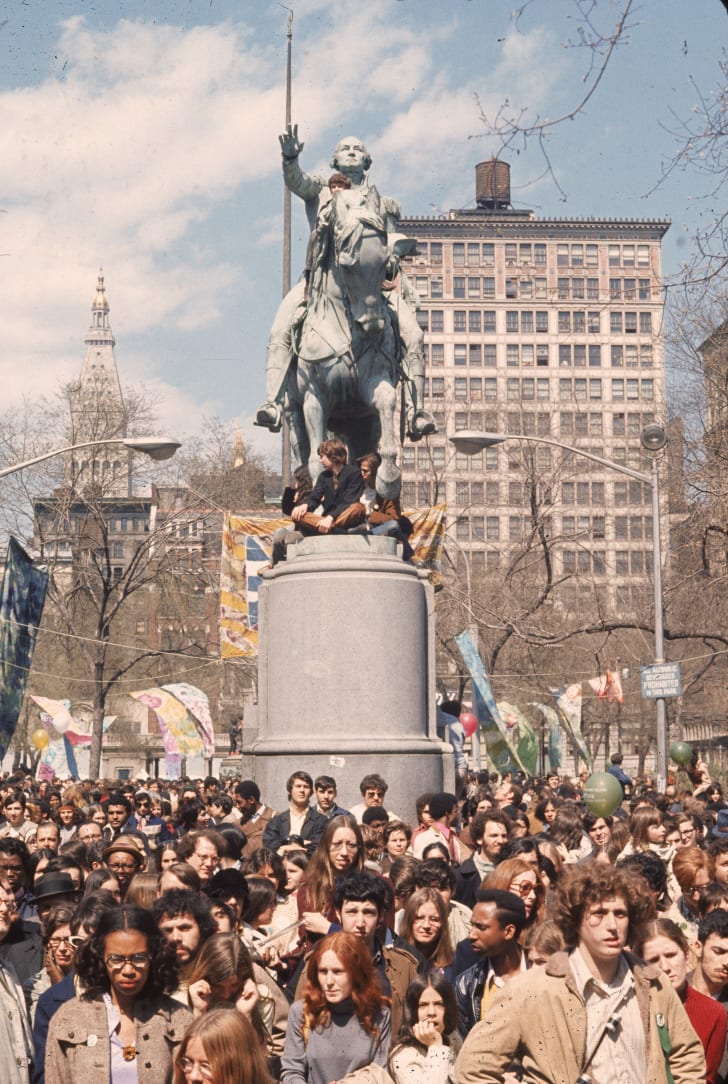
3. THE FIRST EARTH DAY SAW 20 MILLION AMERICANS TAKE TO THE STREETS.
Crowds gather in Union Square in New York City for the first Earth Day in 1970. HULTON ARCHIVE/GETTY IMAGES
The first Earth Day marked a strange combination of boisterous rallies and sober reflection on the state of the planet. Protests, demonstrations, fundraisers, nature walks, speeches, concerts, and every sort of civic gathering imaginable took place at colleges, VFW halls, public squares, and parks across the United States on April 22, 1970. Environmental crusaders found themselves thrust into the limelight, and pop culture icons like poet Allen Ginsberg were asked to speak on behalf of Mother Earth.
✕
Some of the more colorful displays of the day included mock trials for polluting objects, like an old Chevrolet, which was sentenced to death by sledgehammer. (The car ultimately survived the beating and was donated to an art class.) In New York City, Earth Day celebrations effectively shut downparts of the city. Twenty-thousand people packed into Union Square to see Paul Newman and hear a speech by Mayor John Lindsay, who arrived on an electric bus.
4. THE DATE OF EARTH DAY WAS SPECIFICALLY SELECTED TO MOBILIZE COLLEGE STUDENTS.
To head up the Earth Day project, Senator Nelson enlisted Denis Hayes, then a graduate student at Harvard University. As national coordinator, Hayes recruited a staff of 85 energetic young environmental crusaders and grassroots organizers, along with thousands of field volunteers, in order to promote the fledgling holiday across the nation. The team knew that in order to gain the most traction, college students would need to play a central role, as they did in the Vietnam protests of the era. The date that Hayes selected for the first Earth Day was a calculated choice: April 22 on most college campuses falls right between Spring Break and final exams.
5. EARTH DAY FACED CRITICISM FROM THE VERY BEGINNING.
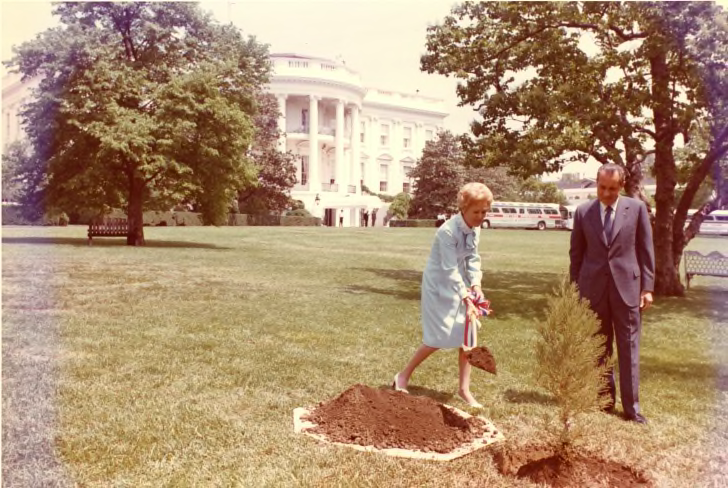
President Richard Nixon and his wife, Pat, plant a tree on the White House lawn during the first Earth Day.
According to Grist, the first Earth Day faced staunch opposition from conservative groups like the John Birch Society, which claimed that the event was a thinly veiled attempt to honor the 100th anniversary of the birth of Vladimir Lenin. In addition to detractors on the far right of the political spectrum, bleeding-heart environmental crusaders weren’t satisfied, either. Earth Day, they claimed, simply served as a distraction from the more pressing social issues of the day. Journalist I.F. Stone said, “The country is slipping into a wider war in Southeast Asia and we’re sitting here talking about litterbugs.” Critics of the holiday also point to the trend of “greenwashing,” an attempt by corporations with poor environmental track records to appear conscientious if only once a year.
6. EARTH DAY SPARKED AN UNPRECEDENTED SLATE OF ENVIRONMENTAL LEGISLATION.
With bipartisan support in Congress and thousands of civic demonstrations across the country, support for environmental reform in 1970 was undeniable. According to the EPA, “Public opinion polls indicate that a permanent change in national priorities followed Earth Day 1970. When polled in May 1971, 25 percent of the U.S. public declared protecting the environment to be an important goal, a 2500 percent increase over 1969.”
The 1970s saw the passage of the most comprehensive environmental legislation in U.S. history, including the Clean Air Act, the Water Quality Improvement Act, the Endangered Species Act, the Toxic Substances Control Act, and the Surface Mining Control and Reclamation Act. In addition, just eight months after the first Earth Day, Richard Nixon approved the creation of a new organization tasked with monitoring the nation’s natural assets: the Environmental Protection Agency.
7. ALTHOUGH IT BEGAN AS AN AMERICAN MOVEMENT, EARTH DAY IS NOW AN INTERNATIONAL PHENOMENON…
In 1990, Earth Day expanded to include countries and peoples across the globe, with 200 million people in 141 nations getting involved. A decade later, at the turn of the new millennium, Earth Day shed light on the emerging Clean Energy movement and expanded its reach, spreading to 184 countries with the help of 5000 environmental organizations. Global activities included a massive traveling drum chain in Gabon, Africa, and an unprecedented gathering of hundreds of thousands of concerned citizens at the National Mall in Washington, D.C. According to Earth Day Network, after 40 years, more than 1 billion people participate in Earth Day activities, making it the largest secular civic event in the world.
8. …AND INTERNATIONALLY, IT’S KNOWN AS INTERNATIONAL MOTHER EARTH DAY.
Earth Day is now observed around the world, albeit under a different name: In 2009, the United Nations General Assembly decided to designate April 22 as International Mother Earth Day. The symbol of Mother Earth serves as a common metaphor and representation of our planet in many countries and cultures. In the United States, the holiday is still commonly referred to as Earth Day.
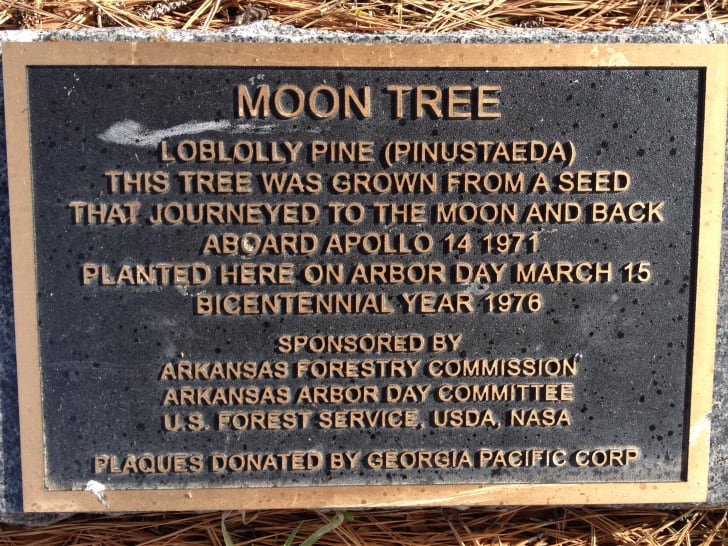
9. IN 2009, NASA PLANTED A HISTORIC “MOON TREE” TO CELEBRATE EARTH DAY.
Most of Roosa’s original “Moon Trees” were planted in time for the U.S. Bicentennial in 1976.
During the Apollo 14 moon mission in 1971, astronaut Stuart Roosa brought with him hundreds of tree seeds including Loblolly Pine, Sycamore, Sweetgum, Redwood, and Douglas Fir. Roosa was a former smokejumper for the U.S. Forest Service, and he transported the seeds in his personal effects as a tribute to his former employer. Roosa and his seeds orbited the Moon 34 times in the command module Kitty Hawk. Scientists were curious whether or not exposure to the microgravity of space would impact the growth of these seeds when returned to Earth.
The experiment seemed like a lost cause when, during the post-mission decontamination process, the seed canisters broke open and the seeds were thought to be useless. However, most of the tree seeds were still fit for germination and were successfully planted and cultivated. These trees were planted around National Monuments, as well as in sites all over the world. After decades of growing side-by-side with their Earth cousins, the Moon Trees showed no differences at all. On Earth Day 2009, NASA, in partnership with the United States National Arboretum and American Forests, planted a second generation Moon Sycamore on the arboretum’s grounds in Washington, D.C.
SPONSORED BY IBMMAXIMIZE YOUR CLOUD INVESTMENTWe’ve lowered IBM Cloud bare metal server prices and included up to 20TB of bandwidth. Same power and flexibility. New competitive prices.SEE MORE
10. THE THEME FOR EARTH DAY 2020 IS “CLIMATE ACTION.”
Every year since Earth Day 2016, there has been a new theme attached to the holiday in anticipation for its 50th anniversary in 2020. In 2016, it was Trees for the Earth, followed by Environmental and Climate Literacy in 2017, End Plastic Pollution in 2018, and Protect Our Species in 2019. For 2020, organizers went with an obvious campaign: Climate Action.
Organizers are hopeful that this will be a day to raise awareness of both the dangers of climate change and the opportunities people have to make a difference in the fight. And despite the social distancing necessitated by the coronavirus pandemic, demonstrations and conferences are still happening, albeit virtually. Head to the Earth Day 2020 website find out more.
The enormous challenges — but also the vast opportunities — of acting on climate change have distinguished the issue as the most pressing topic for the 50th anniversary. Climate change represents the biggest challenge to the future of humanity and the life-support systems that make our world habitable.
At the end of 2020, nations will be expected to increase their national commitments to the 2015 Paris Agreement on climate change. The time is now for citizens to call for greater global ambition to tackle our climate crisis. Unless every country in the world steps up – and steps up with urgency and ambition — we are consigning current and future generations to a dangerous future.
Earth Day 2020 will be far more than a day. It must be a historic moment when citizens of the world rise up in a united call for the creativity, innovation, ambition, and bravery that we need to meet our climate crisis and seize the enormous opportunities of a zero-carbon future.
BUILDING ON THE EARTH DAY LEGACY
The first Earth Day in 1970 mobilized millions of Americans for the protection of the planet. On April 22, 1970, 20 million Americans — 10% of the U.S. population at the time — took to the streets, college campuses and hundreds of cities to protest environmental ignorance and demand a new way forward for our planet. The first Earth Day is credited with launching the modern environmental movement and is now recognized as the planet’s largest civic event.
Earth Day led to passage of landmark environmental laws in the United States, including the Clean Air, Clean Water and Endangered Species Acts. Many countries soon adopted similar laws, and in 2016, the United Nations chose Earth Day as the day to sign the Paris Climate Agreement into force.
Photo Credit: University of Michigan School for Environment and Sustainability via Flickr
“Despite that amazing success and decades of environmental progress, we find ourselves facing an even more dire, almost existential, set of global environmental challenges, from loss of biodiversity to climate change to plastic pollution, that call for action at all levels of government,” said Denis Hayes, the organizer of the first Earth Day in 1970 and Earth Day Network’s Board Chair Emeritus.
“Progress has slowed, climate change impacts grow, and our adversaries have become better financed,” said Earth Day Network president Kathleen Rogers. “We find ourselves today in a world facing global threats that demand a unified global response. For Earth Day 2020, we will build a new generation of environmentalist activists, engaging millions of people worldwide.”




 © Amawasri – Getty Images Castor oil with beans on wooden surface






 Mws R Writings