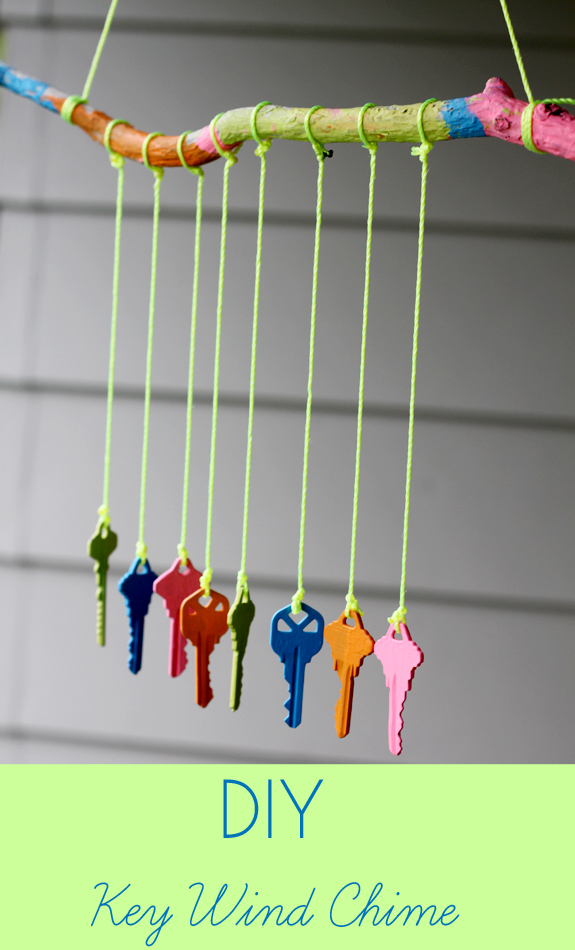
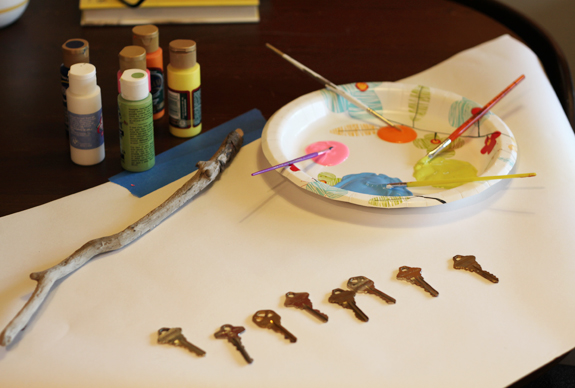
Optional: Paint your keys and stick. Choose a few coordinating colors and have your child paint the keys and stick. Our keys took two coats, let the first side dry before flipping and painting the other side.
Tie a piece of string to either end of the stick so that you have a way to hang it.
Tie a piece of string to each key.
Tie the keys to the stick making sure that they are close enough to each other that they will chime when the wind blows them.
Gift, hang, enjoy!
I hope this project inspires a little crafty recycling in your home. I’m sure you and your little ones will love turning trash into treasure. And whoever receives your thoughtful handy work is sure to be pleased as punch. I know they make me smile every time I enter my garden.
I have all three of my grandkids today and this weekend. Leaves little time to work on my webpage.
So, I just wanted to let you know, in case there was not much activity from my page. I will do my best to create posts this weekend, but I did want to explain.
Don’t forget about me, and please look at past content, in case you need something to read.
When your neighbor lets her dog bark all day long while you’re trying to work from home, it’s infuriating, for sure. But ask yourself: Why is this bothering me? Is it because you’re on deadline and feeling frustrated with yourself for procrastinating on this assignment? Are you actually concerned about the well-being of the dog? Has a past poor interaction with this neighbor bled into how you’re reacting this time?
We all have thoughts about who we are: our strengths and weaknesses, values, likes and dislikes, things that upset us. These affect the way that we respond to challenges.“It is also good to have an idea about how certain situations may affect our ‘self.’ For example, we may respond differently if we are overtired or hungry. Checking in with our Self might help us to respond more mindfully,” Volpitta says.
If your car gets a flat tire on the way to a job interview, it might feel like an emergency in the moment. But as frustrating as it feels, most situations likely aren’t as disastrous as they seem. Being able to diffuse a stressful scenario with the understanding that there is a way out and that maybe this will even one day make for a funny anecdote (after you calm down enough to call HR) can help.
Putting the situation in perspective—of the rest of your day, this quarter, your child’s teenage years, etc.—and being able to break the solution down into doable steps is an important part of building resilience.
3. Consider Where to Turn for Support
When you and your partner get into a spat, you likely don’t complain to your mother-in-law. That same logic should go into whom you head for when you need help with other problems. For example, don’t confide in the office gossip when your cube-mate’s stinky lunches are driving you crazy. Going straight to the source may feel trickier but will likely get you closer to the resolution you want: “Jill, do you mind, please, eating your tuna wrap in the office kitchen?”
Likewise, thinking through which person—a friend, a pastor, your dad—will offer what you might need (advice, a supportive ear, paid therapy services) in a troubling time can help you feel more in charge of what’s happening. “So often, we think that we need to handle challenges on our own, but knowing who to go to and how to ask for help is a hallmark of resilience,” Volpitta says.
4. Identify Strategies to Cope and Move Forward
Sometimes, knowing what won’t be helpful when dealing with unfortunate incidents can help you rule out how to respond. If, for example, texting your sister an apology after your last argument made her feel like you didn’t care enough to call, pick up the phone this time. And if hitting the bar with your work posse made the last round of layoffs even more painful (especially the day after), see if anyone is up for a power walk—or a trip to that new ax-throwing joint—this time to burn off that anger.
Then think about what will be useful for moving forward: Call on those supports, for sure (see No. 3). But can you also use some planning skills to plot the next step? “Resilient people have multiple strategies,” Volpitta says. “If one strategy isn’t working, they move on and try something else. They also know that saying no or quitting is sometimes the best strategy.” So know when to cut your losses if it is appropriate for the situation.
5. Flex your Mindfulness Muscle
No, it doesn’t start with S. But, according to Volpitta, mindfulness is a truly helpful way of becoming more mentally strong. Practicing mindfulness, whether through formal practice or simply being present in the moment, gives our brains the chance to best determine how to respond and strengthen those resilient pathways. Consider these 10 little ways to practice mindfulness every day.
The 4 Ss—self, situation, supports, and strategies—can be powerful tools to build your brain’s emotional resilience factor. The missing S? Start now.
A weed can be any plant growing where you don’t want it to, but there are some particularly weedy species to keep an eye out for. These aggressive plants choke out the garden plants you’ve worked so hard to grow. Use this handy guide to identify weeds by photo and know how to best remove them.Each product we feature has been independently selected and reviewed by our editorial team. If you make a purchase using the links included, we may earn commission.
Dandelion
Type: Broadleaf perennial
Size: 12 inches tall, 6 – 16 inches wide
Where It Grows: Lawns and gardens in sun or shade
Appearance: This common lawn weed has a strong taproot; leaves are deeply notched. Yellow flowers mature to puffballs. Dandelion seeds are like parachutes that fly away in the wind—they’re the plants that you would blow on and “make a wish” when you were younger.
Lawn Weed Control Tip: Mulch to prevent dandelions in gardens. Pull dandelion weeds by hand or use a postemergence herbicide (designed for use on weeds after they appear) in lawns. Each product we feature has been independently selected and reviewed by our editorial team. If you make a purchase using the links included, we may earn a commission.
Tips on Caring for Your Yard
Oxalis
Type: Broadleaf perennial
Size: To 20 inches tall
Where It Grows: Sunny or shady landscape, lawn, or garden areas
Appearance: This garden weed has light green leaves that look like clover and cup-shape yellow flowers in summer and fall.
Control: Mulch garden areas in spring to prevent weeds. Pull oxalis weeds by hand or spray weeds with a postemergence herbicide in spring or fall.
Test Garden Tip: The leaves of oxalis are edible in small quantities and have a sharp, sour taste. However, plants should not be eaten if they have been treated with pesticide. The plant can be harmful if eaten in large amounts.Each product we feature has been independently selected and reviewed by our editorial team. If you make a purchase using the links included, we may earn commission.
Identifying and Controlling Common Garden Pests
Crabgrass
Type: Grassy annual
Size: To 18 inches tall and 20 inches wide
Where It Grows: Lawn, landscape, and garden areas in sun or shade
Appearance: Crabgrass is exactly what it sounds like: A grassy weed. This lawn weed grows roots anywhere the stem makes soil contact. Seed heads spread out like four fingers.
Control: Mulch your lawn to prevent crabgrass or use a preemergence herbicide; pull plants by hand or spot-treat with a nonselective postemergence herbicide.
Test Garden Tip: Each plant can produce up to 150,000 seeds, so this lawn weed can spread quickly.Each product we feature has been independently selected and reviewed by our editorial team. If you make a purchase using the links included, we may earn commission.
Bindweed
Type: Broadleaf perennial
Size: Climbs 6 feet or more
Where It Grows: Landscape and garden areas in sun
Appearance: Identify this garden weed by its arrowhead-shape leaves on twining vines. Bindweed also produces white to pale pink morning glory-type flowers.
Control: Mulch your garden to prevent bindweed. Repeatedly chop down growing bindweed plants and/or treat with a postemergence herbicide.
Test Garden Tip: Wandering roots produce offspring 20-30 feet from the mother vine.Each product we feature has been independently selected and reviewed by our editorial team. If you make a purchase using the links included, we may earn commission.
White Clover
Type: Broadleaf perennial
Size: 8-10 inches tall, 12 inches wide
Where It Grows: Lawn, landscape, and garden areas in sun to partial shade
Appearance: White clover has three-lobe leaves frame round white flower clusters.
Control: Mulch your garden beds to prevent white clover in landscape areas. Use a postemergence herbicide in lawns or hand-pull the weeds.
Test Garden Tip: Clover adds nitrogen to the soil so as far as weeds go, this one is moderately helpful.Each product we feature has been independently selected and reviewed by our editorial team. If you make a purchase using the links included, we may earn commission.
Nutsedge
Type: Grassy perennial
Size: 2 feet tall, 1 foot wide
Where It Grows: Lawn, landscape, or garden areas with moist soil in sun or shade
Appearance: Nutsedge has grassy leaves and nutlike tubers on the root system.
Control: Mulch garden areas in spring to prevent nutsedge. Pull plants by hand or spray with a postemergence herbicide.Each product we feature has been independently selected and reviewed by our editorial team. If you make a purchase using the links included, we may earn commission.
Creeping Charlie
Type: Broadleaf perennial
Size: 4 inches tall, several feet wide
Where It Grows: Shady lawn, landscape, or garden areas
Appearance: Identify this lawn weed and groundcover by its scalloped leaves and clusters of purple flowers in late spring.
Control: Mulch garden areas in spring to prevent creeping charlie. Pull plants by hand or spray with a postemergence herbicide in spring or fall.Each product we feature has been independently selected and reviewed by our editorial team. If you make a purchase using the links included, we may earn commission.
Lamb’s-Quarter
Type: Broadleaf annual
Size: To 4 feet tall and 18 inches wide
Where It Grows: Landscape and garden areas in sun or shade
Appearance: Lamb’s-quarter’s scalloped leaves have gray undersides to them.
Control: Mulch your garden to prevent lamb’s-quarter. Pull weed plants by hand or use a postemergence herbicide.Each product we feature has been independently selected and reviewed by our editorial team. If you make a purchase using the links included, we may earn commission.
Plantain
Type: Broadleaf perennial
Size: To 8 inches tall and 12 inches wide
Where It Grows: Moist lawn and garden areas in sun or shade
Appearance: When you’re identifying weeds in your garden, to spot plantains, look for broad, flat leaves around a low rosette.
Test Garden Tip: Each plantain plant can produce more than 15,000 seeds.Each product we feature has been independently selected and reviewed by our editorial team. If you make a purchase using the links included, we may earn commission.
Dayflower
Type: Annual grass relative
Size: To 30 inches tall and wide
Where It Grows: Sunny or shady landscape areas
Appearance: Dayflowers have dark green leaves sprouting from a stem and brilliant blue flowers through the summer.
Control: Mulch the garden to prevent weeds or use a preemergence herbicide in spring. Pull weeds by hand or spot-treat with a nonselective postemergence herbicide.Each product we feature has been independently selected and reviewed by our editorial team. If you make a purchase using the links included, we may earn commission.
Purslane
Type: Broadleaf annual
Size: To 6 inches tall and 2 feet wide
Where it grows: Dry, sunny landscape and garden areas
Appearance: Identify this weed groundcover by its fleshy, dark green leaves and small yellow flowers at the ends of the stems.
Control: Mulch your garden to prevent purslane or use a preemergence herbicide in the spring. Pull plants by hand or spot-treat with a nonselective postemergence herbicide.Each product we feature has been independently selected and reviewed by our editorial team. If you make a purchase using the links included, we may earn commission.
Velvetleaf
Type: Broadleaf annual
Size: To 6 feet tall and 3 feet wide
Where It Grows: Fertile, sunny landscape and garden areas
Appearance: Velvetleaf gets its name after its large, velvety heart-shape leaves up to 10 inches across. The weed blooms with yellow flowers in summer.
Weed Control: Mulch your garden to prevent velvetleaf or use a preemergence herbicide in spring; pull plants by hand or use a postemergence herbicide.Each product we feature has been independently selected and reviewed by our editorial team. If you make a purchase using the links included, we may earn commission.
Wild Violet
Type: Broadleaf perennial
Size: 6 inches tall, 6 inches wide
Where It Grows: Shady lawn, landscape, or garden areas
Appearance: Wild violet is a groundcover with heart-shape leaves and purple flowers in late spring.
Control: Mulch garden beds in spring to prevent wild violet. Pull weeds by hand or spray with a postemergence herbicide in spring or fall.
Test Garden Tip: Not always considered a weed, this plant is sometimes grown as an ornamental in shade gardens. Each product we feature has been independently selected and reviewed by our editorial team. If you make a purchase using the links included, we may earn a commission.
Smartweed
Type: Broadleaf annual
Size: To 42 inches tall and 30 inches wide
Where It Grows: Sunny landscape and garden areas
Appearance: Identify garden weeds like smartweed by its lance-shape leaves often marked with purple chevrons. It’s an upright plant with pink or white flowers in summer and fall.
Control: To prevent this weed, mulch garden beds in spring. Pull plants by hand or apply a postemergence herbicide once it grows.
Test Garden Tip: This weed is native to areas of North America. Unlike many exotic weeds, it does support local wildlife.Each product we feature has been independently selected and reviewed by our editorial team. If you make a purchase using the links included, we may earn commission.
Quickweed
Type: Broadleaf annual
Size: To 2 feet tall and wide
Where It Grows: Sunny landscape and garden areas
Appearance: Quickweed has jagged, hairy leaves and small white daisy-shape flowers in summer.
Control: Use a mulch or a preemergence herbicide in spring to prevent quickweed. If plants do grow, pull them by hand or spot-treat them with a postemergence herbicide.Each product we feature has been independently selected and reviewed by our editorial team. If you make a purchase using the links included, we may earn commission.
Pigweed
Type: Broadleaf annual
Size: 6 feet tall, 2 feet wide
Where it grows: Sunny landscape or garden areas
Appearance: Pigweeds are tall plants with a taproot. Identify weeds by their hairy-looking clusters of green flowers (though some varieties are grown as annuals).
Control: Mulch garden areas in spring to prevent pigweed or use a preemergence herbicide in spring. Pull weeds by hand or spray with a postemergence herbicide. Each product we feature has been independently selected and reviewed by our editorial team. If you make a purchase using the links included, we may earn commission.
Canada Thistle
Type: Broadleaf perennial
Size: To 6 feet tall and 3 feet wide
Where It Grows: Sunny lawn, landscape, or garden areas
Appearance: Canada thistle has spiny, gray-green leaves and purple flowers.
Control: Mulch your garden to prevent it in landscape areas. Use a postemergence herbicide in lawns in spring or fall, or dig the weed out by hand.
Test Garden Tip: Thistle has an extensive root system that can grow several feet out from the main plant.Each product we feature has been independently selected and reviewed by our editorial team. If you make a purchase using the links included, we may earn commission.
Knotweed
Type: Broadleaf annual
Size: To 8 inches tall and 2 feet wide
Where It Grows: Sunny or partly shaded lawn, landscape, or garden areas
Appearance: Knotweed is an invasive groundcover with blue-green leaves sparsely appearing on long stems.
Control: Prevent knotweed with a deep layer of mulch or apply a preemergence herbicide in spring. Once the plant grows, hand-pull or spot-treat it with an herbicide.Each product we feature has been independently selected and reviewed by our editorial team. If you make a purchase using the links included, we may earn commission.
Pokeweed
Type: Broadleaf perennial
Size: To 10 feet tall and 2 feet wide
Where It Grows: Sunny landscape or garden areas
Appearance: Identify this garden weed by its light green leaves, clusters of white flowers, and dark purple berries.
Control: Prevent pokeweed with a deep layer of mulch. Once the plant grows, hand-pull or spot-treat it with an herbicide.Each product we feature has been independently selected and reviewed by our editorial team. If you make a purchase using the links included, we may earn commission.
Poison Ivy
Type: Broadleaf perennial
Size: To 15 feet tall and wide
Where It Grows: Sunny or shady landscape or garden areas
Appearance: Poison ivy can be a vine, shrub, or groundcover. The weed has leaves divided into three leaflets and can sprout clusters of green berries.
Control: Prevent poison ivy with a deep layer of mulch. If the weed starts to grow in your yard, spot-treat it with an herbicide.
Test Garden Tip: The plant contains oils that cause a severe allergic skin reaction in many people when touched. These oils are present even on dead leaves and can become airborne and inhaled if the plant is burned. Each product we feature has been independently selected and reviewed by our editorial team. If you make a purchase using the links included, we may earn a commission.
Black Nightshade
Type: Broadleaf annual
Size: 2 feet tall, 2 feet wide
Where It Grows: Landscape or garden areas with rich soil in sun or shade
Appearance: Black nightshade can be a bushy or climbing plant with white or purple flowers and purple or red fruits.
Control: Mulch your garden to prevent black nightshade. Pull the weed by hand or treat with a postemergence herbicide.
Test Garden Tip: All parts of this plant are poisonous (including the fruits).Each product we feature has been independently selected and reviewed by our editorial team. If you make a purchase using the links included, we may earn commission.
Black Medic
Type: Broadleaf annual or short-lived perennial
Size: 1-2 feet tall, 1 foot wide
Where It Grows: Poor, dry, soil in full sun
Appearance: Identify this garden weed by its clover-type leaves and small, yellow flowers.
Control: Mulch to prevent black medic in gardens. Pull weeds by hand or use a postemergence herbicide. Discourage it by keeping the soil well-watered and amended with organic matter (such as compost). Each product we feature has been independently selected and reviewed by our editorial team. If you make a purchase using the links included, we may earn a commission.
Quackgrass
Type: Grassy perennial
Size: To 3 feet tall and several feet wide
Where It Grows: Landscape and garden areas in sun or shade
Appearance: This garden weed has wheatlike flower spikes, which appear above slender clumps of grassy foliage.
Control: Mulch your garden prevent quackgrass. Dig plants out by hand, being sure to remove every bit of root.Each product we feature has been independently selected and reviewed by our editorial team. If you make a purchase using the links included, we may earn commission.
Dock
Type: Broadleaf perennial
Size: To 4 feet tall and 2 feet wide
Where It Grows: Landscape and garden areas in sun or shade
Appearance: Dock produces large, wavy-edge leaves and large seed heads covered with brown seeds.
Control: Mulch to prevent dock. Pull and dig up plants or treat with a postemergence herbicide.
Test Garden Tip: Each plant can produce up to 40,000 seeds that wait decades before sprouting.Each product we feature has been independently selected and reviewed by our editorial team. If you make a purchase using the links included, we may earn commission.
Henbit
Type: Broadleaf annual
Size: To 12 inches tall and wide
Where It Grows: Lawn, landscape, and garden areas in sun or shade
Appearance: This lawn weed is a low, creeping plant with scallop-edge leaves and purple flowers.
Control: Mulch to prevent henbit in gardens or use preemergence herbicide in spring. Pull plants by hand or treat in lawns with a broadleaf, postemergence herbicide.Each product we feature has been independently selected and reviewed by our editorial team. If you make a purchase using the links included, we may earn commission.
Fleabane
Type: Broadleaf annual
Size: 2 feet tall and 18 inches wide
Where It Grows: Landscape and garden areas in sun to partial shade
Appearance: Fleabane has slender leaves attached to an upright, branching stem. It produces puffy white to pale lavender daisies.
Control: Mulch your garden to prevent fleabane or use a preemergence herbicide in spring. Pull plants by hand or spot-treat with a postemergence herbicide.Each product we feature has been independently selected and reviewed by our editorial team. If you make a purchase using the links included, we may earn commission.
Nettle
Type: Broadleaf perennial
Size: To 6 feet tall and 3 feet wide
Where It Grows: Garden areas with rich, moist soil
Appearance: This garden weed has sawtooth-edge leaves and yellowish flower clusters covered with stinging hairs.
Control: Mulch to prevent nettle. Dig out weeds or treat with a postemergence herbicide.
Test Garden Tip: Always wear gloves when working around this plant (the sharp hairs can irritate skin).Each product we feature has been independently selected and reviewed by our editorial team. If you make a purchase using the links included, we may earn commission.
Prostrate Spurge
Type: Broadleaf annual
Size: 3 inches tall, 18 inches wide
Where It Grows: Lawn, landscape, and garden areas with dry soil
Appearance: Green or purple-blushed leaves of prostrate spurge form dense mats.
Control: Mulch your garden to prevent prostrate spurge or use a preemergence herbicide in lawns. Pull weeds when young or spot-treat with a postemergence herbicide.Each product we feature has been independently selected and reviewed by our editorial team. If you make a purchase using the links included, we may earn commission.
Chickweed
Type: Broadleaf annual
Size: 6 inches tall, 12 inches wide
Where It Grows: Lawn, garden, and landscape areas with rich, moist soil in sun or shade
Appearance: This garden and lawn weed creates lush green mats studded with small, star-shape flowers.
Control: Mulch to prevent chickweed in gardens or use a preemergence herbicide in early spring. Pull weeds by hand.
Test Garden Tip: Each plant can produce more than 15,000 seeds.Each product we feature has been independently selected and reviewed by our editorial team. If you make a purchase using the links included, we may earn commission.
Musk Thistle
Type: Broadleaf biennial
Size: To 6 feet tall and 18 inches wide
Where It Grows: Landscape and garden areas in full sun
Appearance: Musk thistle has prickly leaves growing off of tall stems topped by heavy 2-inch purple flowers.
Control: Mulch your garden to prevent musk thistle. Use a postemergence herbicide or dig the weed out yourself.Each product we feature has been independently selected and reviewed by our editorial team. If you make a purchase using the links included, we may earn commission.
Ragweed
Type: Broadleaf annual
Size: To 4 feet tall and 2 feet wide
Where It Grows: Landscape and garden areas in sun or partial shade
Appearance: Ragweed grows finely cut green leaves that are almost fern-like.
Control: Mulch your garden to prevent ragweed. Use a postemergence herbicide or pull it out by hand.Each product we feature has been independently selected and reviewed by our editorial team. If you make a purchase using the links included, we may earn commission.
Yellow Sweet Clover
Type: Broadleaf annual
Size: 1-3 feet tall, 12-18 inches wide
Where It Grows: Landscape and garden areas
Appearance: Identify this garden weed by its lanky branches, clover-like leaves, and fragrant yellow flowers.
Control: Mulch your garden to prevent yellow sweet clover. Pull plants by hand or spot-treat a postemergence herbicide.Each product we feature has been independently selected and reviewed by our editorial team. If you make a purchase using the links included, we may earn commission.
Yellow Salsify
Type: Broadleaf biennial or short-lived perennial
Size: To 3 feet tall and 2 feet wide
Where It Grows: Sunny landscape and garden areas
Appearance: Spot yellow salsify by its gray-green leaves. Yellow flowers on the plant are followed by large puffballs.
Control: Mulch your garden to prevent yellow salsify. Pull plants by hand or treat them with a postemergence herbicide. Each product we feature has been independently selected and reviewed by our editorial team. If you make a purchase using the links included, we may earn a commission.
There’s also early evidence to show that it may be beneficial for certain cancers, Alzheimer’s disease and other diseases, too.
A ketogenic diet typically limits carbs to 20–50 grams per day. While this may seem challenging, many nutritious foods can easily fit into this way of eating.
Here are 16 healthy foods to eat on a ketogenic diet.
1. Seafood
Fish and shellfish are very keto-friendly foods. Salmon and other fish are rich in B vitamins, potassium, and selenium, yet virtually carb-free (4).
However, the carbs in different types of shellfish vary. For instance, while shrimp and most crabs contain no carbs, other types of shellfish do (5).
While these shellfish can still be included on a ketogenic diet, it’s important to account for these carbs when you’re trying to stay within a narrow range.
Here are the carb counts for 3.5-ounce (100-gram) servings of some popular types of shellfish (6, 7, 8, 9, 10):
Clams: 5 grams
Mussels: 7 grams
Octopus: 4 grams
Oysters: 4 grams
Squid: 3 grams
Salmon, sardines, mackerel and other fatty fish are very high in omega-3 fats, which have been found to lower insulin levels and increase insulin sensitivity in overweight and obese people (11Trusted Source).
In addition, frequent fish intake has been linked to a decreased risk of disease and improved mental health (12Trusted Source, 13Trusted Source).
Aim to consume at least two servings of seafood weekly.
SUMMARY:Many types of seafood are carb-free or very low in carbs. Fish and shellfish are also good sources of vitamins, minerals and omega-3s.
2. Low-Carb Vegetables
Non-starchy vegetables are low in calories and carbs, but high in many nutrients, including vitamin C and several minerals.
Vegetables and other plants contain fiber, which your body doesn’t digest and absorb like other carbs.
Therefore, look at their digestible (or net) carb count, which is total carbs minus fiber.
Most vegetables contain very few net carbs. However, consuming one serving of “starchy” vegetables like potatoes, yams or beets could put you over your entire carb limit for the day.
The net carb count for non-starchy vegetables ranges from less than 1 gram for 1 cup of raw spinach to 8 grams for 1 cup of cooked Brussels sprouts (14, 15).
Vegetables also contain antioxidants that help protect against free radicals, which are unstable molecules that can cause cell damage (16Trusted Source, 17Trusted Source).
What’s more, cruciferous vegetables like kale, broccoli and cauliflower have been linked to decreased cancer and heart disease risk (18Trusted Source, 19Trusted Source).
Low-carb veggies make great substitutes for higher-carb foods. For instance, cauliflower can be used to mimic rice or mashed potatoes, “zoodles” can be created from zucchini and spaghetti squash is a natural substitute for spaghetti.
SUMMARY:The net carbs in non-starchy vegetables range from 1–8 grams per cup. Vegetables are nutritious, versatile and may help reduce the risk of disease.
There are hundreds of types of cheese. Fortunately, all of them are very low in carbs and high in fat, which makes them a great fit for a ketogenic diet.
One ounce (28 grams) of cheddar cheese provides 1 gram of carbs, 7 grams of protein and 20% of the RDI for calcium (20).
Cheese is high in saturated fat, but it hasn’t been shown to increase the risk of heart disease. In fact, some studies suggest that cheese may help protect against heart disease (21Trusted Source, 22).
Cheese also contains conjugated linoleic acid, which is a fat that has been linked to fat loss and improvements in body composition (23Trusted Source).
In addition, eating cheese regularly may help reduce the loss of muscle mass and strength that occurs with aging.
A 12-week study in older adults found that those who consumed 7 ounces (210 grams) of ricotta cheese per day experienced increases in muscle mass and muscle strength over the course of the study (24Trusted Source).
SUMMARY:Cheese is rich in protein, calcium and beneficial fatty acids, yet contains a minimal amount of carbs.
4. Avocados
Avocados are incredibly healthy.
3.5 ounces (100 grams), or about one-half of a medium avocado, contain 9 grams of carbs.
However, 7 of these are fiber, so its net carb count is only 2 grams (25).
Avocados are high in several vitamins and minerals, including potassium, an important mineral many people may not get enough of. What’s more, a higher potassium intake may help make the transition to a ketogenic diet easier (26, 27Trusted Source).
In addition, avocados may help improve cholesterol and triglyceride levels.
In one study, when people consumed a diet high in avocados, they experienced a 22% decrease in “bad” LDL cholesterol and triglycerides and an 11% increase in “good” HDL cholesterol (28Trusted Source).
SUMMARY:Avocados contain 2 grams of net carbs per serving and are high in fiber and several nutrients, including potassium. In addition, they may improve heart health markers.
5. Meat and Poultry
Meat and poultry are considered staple foods on a ketogenic diet.
Fresh meat and poultry contain no carbs and are rich in B vitamins and several minerals, including potassium, selenium and zinc (29).
They’re also a great source of high-quality protein, which has been shown to help preserve muscle mass during a very low-carb diet (30Trusted Source, 31Trusted Source).
One study in older women found that consuming a diet high in fatty meat led to HDL cholesterol levels that were 8% higher than on a low-fat, high-carb diet (21Trusted Source).
It’s best to choose grass-fed meat, if possible. That’s because animals that eat grass produce meat with higher amounts of omega-3 fats, conjugated linoleic acid and antioxidants than meat from grain-fed animals (32Trusted Source).
SUMMARY:Meat and poultry do not contain carbs and are rich in high-quality protein and several nutrients. Grass-fed meat is the healthiest choice.
6. Eggs
Eggs are one of the healthiest and most versatile foods on the planet.
One large egg contains less than 1 gram of carbs and fewer than 6 grams of protein, making eggs an ideal food for a ketogenic lifestyle (33).
In addition, eggs have been shown to trigger hormones that increase feelings of fullness and keep blood sugar levels stable, leading to lower calorie intakes for up to 24 hours (34Trusted Source, 35Trusted Source).
It’s important to eat the entire egg, as most of an egg’s nutrients are found in the yolk. This includes the antioxidants lutein and zeaxanthin, which help protect eye health (36Trusted Source).
Although egg yolks are high in cholesterol, consuming them doesn’t raise blood cholesterol levels in most people. In fact, eggs appear to modify the shape of LDL in a way that reduces the risk of heart disease (37Trusted Source).
SUMMARY:Eggs contain less than 1 gram of carbs each and can help keep you full for hours. They’re also high in several nutrients and may help protect eye and heart health.
7. Coconut Oil
Coconut oil has unique properties that make it well suited for a ketogenic diet.
To begin with, it contains medium-chain triglycerides (MCTs). Unlike long-chain fats, MCTs are taken up directly by the liver and converted into ketones or used as a rapid source of energy.
In fact, coconut oil has been used to increase ketone levels in people with Alzheimer’s disease and other disorders of the brain and nervous system (38Trusted Source).
The main fatty acid in coconut oil is lauric acid, a slightly longer-chain fat. It has been suggested that coconut oil’s mix of MCTs and lauric acid may promote a sustained level of ketosis (39Trusted Source, 40Trusted Source).
What’s more, coconut oil may help obese adults lose weight and belly fat. In one study, men who ate 2 tablespoons (30 ml) of coconut oil per day lost 1 inch (2.5 cm), on average, from their waistlines without making any other dietary changes (41Trusted Source, 42Trusted Source).
For more information about how to add coconut oil to your diet, read this article. You can also shop online for coconut oil.
SUMMARY:Coconut oil is rich in MCTs, which can increase ketone production. In addition, it may increase metabolic rate and promote the loss of weight and belly fat.
HEALTHLINE RESOURCESFind the diet that’s right for you with our free diet quiz
Our free assessment ranks the best diets for you based on your answers to 3 quick questions.FIND YOUR DIETS
8. Plain Greek Yogurt and Cottage Cheese
Plain Greek yogurt and cottage cheese are healthy, high-protein foods.
While they contain some carbs, they can still be included in a ketogenic lifestyle.
5 ounces (150 grams) of plain Greek yogurt provides 5 grams of carbs and 11 grams of protein. That amount of cottage cheese provides 5 grams of carbs and 18 grams of protein (43, 44).
Both yogurt and cottage cheese have been shown to help decrease appetite and promote feelings of fullness (45Trusted Source, 46Trusted Source).
Either one makes a tasty snack on its own.
However, both can also be combined with chopped nuts, cinnamon and optional sugar-free sweetener for a quick and easy keto treat.
SUMMARY:Both plain Greek yogurt and cottage cheese contain 5 grams of carbs per serving. Studies have shown that they help reduce appetite and promote fullness.
9. Olive Oil
Olive oil provides impressive benefits for your heart.
It’s high in oleic acid, a monounsaturated fat that has been found to decrease heart disease risk factors in many studies (47Trusted Source, 48Trusted Source).
In addition, extra-virgin olive oil is high in antioxidants known as phenols. These compounds further protect heart health by decreasing inflammation and improving artery function (49Trusted Source, 50Trusted Source).
As a pure fat source, olive oil contains no carbs. It’s an ideal base for salad dressings and healthy mayonnaise.
Because it isn’t as stable as saturated fats at high temperatures, it’s best to use olive oil for low-heat cooking or add it to foods after they have been cooked. You can find olive oil online.
SUMMARY:Extra-virgin olive oil is high in heart-healthy monounsaturated fats and antioxidants. It’s ideal for salad dressings, mayonnaise and adding to cooked foods.
10. Nuts and Seeds
Nuts and seeds are healthy, high-fat and low-carb foods.
Frequent nut consumption has been linked to a reduced risk of heart disease, certain cancers, depression and other chronic diseases (51Trusted Source, 52Trusted Source).
Furthermore, nuts and seeds are high in fiber, which can help you feel full and absorb fewer calories overall (53).
Although all nuts and seeds are low in net carbs, the amount varies quite a bit among the different types.
Here are the carb counts for 1 ounce (28 grams) of some popular nuts and seeds (54, 55, 56, 57, 58, 59, 60, 61, 62, 63, 64):
Almonds: 3 grams net carbs (6 grams total carbs)
Brazil nuts: 1 gram net carbs (3 grams total carbs)
Cashews: 8 grams net carbs (9 grams total carbs)
Macadamia nuts: 2 grams net carbs (4 grams total carbs)
Pecans: 1 gram net carbs (4 grams total carbs)
Pistachios: 5 grams net carbs (8 grams total carbs)
Walnuts: 2 grams net carbs (4 grams total carbs)
Chia seeds: 1 gram net carbs (12 grams total carbs)
Flaxseeds: 0 grams net carbs (8 grams total carbs)
Pumpkin seeds: 4 grams net carbs (5 grams total carbs)
Sesame seeds: 3 grams net carbs (7 grams total carbs)
SUMMARY:Nuts and seeds are heart-healthy, high in fiber and may lead to healthier aging. They provide 0–8 grams of net carbs per ounce.
11. Berries
Most fruits are too high in carbs to include on a ketogenic diet, but berries are an exception.
Berries are low in carbs and high in fiber.
In fact, raspberries and blackberries contain as much fiber as digestible carbs.
Here are the carb counts for 3.5 ounces (100 grams) of some berries (68, 69, 70, 71):
Blackberries: 5 grams net carbs (10 grams total carbs)
Blueberries: 12 grams net carbs (14 grams total carbs)
Raspberries: 6 grams net carbs (12 grams total carbs)
Strawberries: 6 grams net carbs (8 grams total carbs)
SUMMARY:Berries are rich in nutrients that may reduce the risk of disease. They provide 5–12 grams of net carbs per 3.5-ounce serving.
12. Butter and Cream
Butter and cream are good fats to include on a ketogenic diet. Each contains only trace amounts of carbs per serving.
For many years, butter and cream were believed to cause or contribute to heart disease due to their high saturated fat content. However, several large studies have shown that, for most people, saturated fat isn’t linked to heart disease.
Like other fatty dairy products, butter and cream are rich in conjugated linoleic acid, the fatty acid that may promote fat loss (23Trusted Source).
SUMMARY:Butter and cream are nearly carb-free and appear to have neutral or beneficial effects on heart health, when consumed in moderation.
13. Shirataki Noodles
Shirataki noodles are a fantastic addition to a ketogenic diet. You can find them online.
They contain less than 1 gram of carbs and 5 calories per serving because they are mainly water.
In fact, these noodles are made from a viscous fiber called glucomannan, which can absorb up to 50 times its weight in water (75Trusted Source).
Viscous fiber forms a gel that slows down food’s movement through your digestive tract. This can help decrease hunger and blood sugar spikes, making it beneficial for weight loss and diabetes management (76Trusted Source, 77Trusted Source, 78Trusted Source).
Shirataki noodles come in a variety of shapes, including rice, fettuccine and linguine. They can be substituted for regular noodles in all types of recipes.
SUMMARY:Shirataki noodles contain less than 1 gram of carbs per serving. Their viscous fiber helps slow down the movement of food through your digestive tract, which promotes fullness and stable blood sugar levels.
14. Olives
Olives provide the same health benefits as olive oil, only in solid form.
Oleuropein, the main antioxidant found in olives, has anti-inflammatory properties and may protect your cells from damage (79Trusted Source).
In addition, studies suggest that consuming olives may help prevent bone loss and decrease blood pressure (80Trusted Source, 81Trusted Source).
Olives vary in carb content due to their size. However, half of their carbs come from fiber, so their digestible carb content is very low.
A one-ounce (28-gram) serving of olives contains 2 grams of total carbs and 1 gram of fiber. This works out to a net carb count of 1 gram for 7–10 olives, depending on their size (82).
SUMMARY:Olives are rich in antioxidants that may help protect heart and bone health. They contain 1 gram of net carbs per ounce.
15. Unsweetened Coffee and Tea
Coffee and tea are incredibly healthy, carb-free drinks.
They contain caffeine, which increases your metabolism and may improve your physical performance, alertness and mood (83, 84, 85Trusted Source).
What’s more, coffee and tea drinkers have been shown to have a significantly reduced risk of diabetes. In fact, those with the highest coffee and tea intakes have the lowest risk of developing diabetes (86Trusted Source, 87Trusted Source).
Adding heavy cream to coffee or tea is fine, but stay away from “light” coffee and tea lattes. These are typically made with non-fat milk and contain high-carb flavorings.
SUMMARY:Unsweetened coffee and tea contain no carbs and can help boost your metabolic rate, as well as physical and mental performance. They can also reduce your risk of diabetes.
16. Dark Chocolate and Cocoa Powder
Dark chocolate and cocoa are delicious sources of antioxidants.
In fact, cocoa has been called a “super fruit,” because it provides at least as much antioxidant activity as any other fruit, including blueberries and acai berries (88Trusted Source).
Dark chocolate contains flavanols, which may reduce the risk of heart disease by lowering blood pressure and keeping arteries healthy (89Trusted Source, 90Trusted Source, 91).
Somewhat surprisingly, chocolate can be part of a ketogenic diet. However, it’s important to choose dark chocolate that contains a minimum of 70% cocoa solids, preferably more.
One ounce (28 grams) of unsweetened chocolate (100% cocoa) has 3 grams of net carbs. The same amount of 70–85% dark chocolate contains up to 10 grams of net carbs (92, 93).
You can find dark chocolate and cocoa online.
SUMMARY:Dark chocolate contains 3–10 grams of net carbs per ounce, is high in antioxidants and may help reduce the risk of heart disease.
The Bottom Line
A ketogenic diet can be used to achieve weight loss, blood sugar control and other health-related goals.
Fortunately, it can include a wide variety of nutritious, tasty and versatile foods that allow you to remain within your daily carb range.
To reap all the health benefits of a ketogenic diet, consume these 16 foods on a regular basis.





 Mws R Writings