Facts About Cats

(Source) https://www.factretriever.com/cat-facts#:~:text=104%20Interesting%20Cat%20Facts.%201%20Unlike%20dogs%20%2C,Dogs%20make%20only%20about%2010.%20%5B12%5D%20More%20items

Unlike dogs, cats do not have a sweet tooth. Scientists believe this is due to a mutation in a key taste receptor.[5]

When a cat chases its prey, it keeps its head level. Dogs and humans bob their heads up and down.[12]

The technical term for a cat’s hairball is a “bezoar.”[8]A group of cats is called a “clowder.”[9]

A cat can’t climb head first down a tree because every claw on a cat’s paw points the same way. To get down from a tree, a cat must back down.[12]

Cats make about 100 different sounds. Dogs make only about 10.[12]

Many people in China consider cats a “warming” food that is perfect to eat during the winter every year, nearly four million cats are eaten in Asia.[10]There are more than 500 million domestic cats in the world, with approximately 40 recognized breeds.[14]

Approximately 24 cat skins can make a coat.[7]While it is commonly thought that the ancient Egyptians were the first to domesticate cats, the oldest known pet cat was recently found in a 9,500-year-old grave on the Mediterranean island of Cyprus. This grave predates early Egyptian art depicting cats by 4,000 years or more.[9]

During the time of the Spanish Inquisition, Pope Innocent VIII condemned cats as evil, and thousands of cats were burned. Unfortunately, the widespread killing of cats led to an explosion of the rat population, which exacerbated the effects of the Black Death.[9]

During the Middle Ages, cats were associated with witchcraft, and on St. John’s Day, people all over Europe would stuff them into sacks and toss the cats into bonfires. On holy days, people celebrated by tossing cats from church towers.[9]

The first cat in space was a French cat named Felicette (a.k.a. “Astrocat”) In 1963, France blasted the cat into outer space. Electrodes implanted in her brains sent neurological signals back to Earth. She survived the trip.[9]The group of words associated with a cat (catt, cath, chat, katze) stems from the Latin catus, meaning domestic cat, as opposed to feles, or wild cat.[3]The term “puss” is the root of the principal word for “cat” in the Romanian term pisica and the root of secondary words in Lithuanian (puz) and Low German puus.

Some scholars suggest that “puss” could be imitative of the hissing sound used to get a cat’s attention. As a slang word for the female pudenda, it could be associated with the connotation of a cat being soft, warm, and fuzzy.[13]

Approximately 40,000 people are bitten by cats in the U.S. annually.[9]Popular Cat FactCats are the world’s most popular pets, outnumbering dogs by as many as three to oneCats are North America’s most popular pets: there are 73 million cats compared to 63 million dogs.

Over 30% of households in North America own a cat.[9]

According to Hebrew legend, Noah prayed to God for help protecting all the food he stored on the ark from being eaten by rats. In reply, God made the lion sneeze, and out popped a cat.[12]A cat’s hearing is better than a dog’s. And a cat can hear high-frequency sounds up to two octaves higher than a human.[1]

A a cat can travel at a top speed of approximately 31 mph (49 km) over a short distance.[1]A the cat rubs against people not only to be affectionate but also to mark out its territory with scent glands around its face. The tail area and paws also carry the cat’s scent.[1]

Researchers are unsure exactly how a cat purrs. Most veterinarians believe that a cat purrs by vibrating vocal folds deep in the throat. To do this, a muscle in the larynx opens and closes the air passage about 25 times per second.[12]

When a family cat died in ancient Egypt, family members would mourn by shaving off their eyebrows. They also held elaborate funerals during which they drank wine and beat their breasts.

The cat was embalmed with a sculpted wooden mask and the tiny mummy was placed in the family tomb or in a pet cemetery with tiny mummies of mice.[5]

In 1888, more than 300,000 mummified cats were found in an Egyptian cemetery. They were stripped of their wrappings and carted off to be used by farmers in England and the U.S. for fertilizer.[12]

Most cats give birth to a litter of between one and nine kittens. The largest known litter ever produced was 19 kittens, of which 15 survived.[4]Smuggling a cat out of ancient Egypt was punishable by death. Phoenician traders eventually succeeded in smuggling felines, which they sold to rich people in Athens and other important cities.[9]

The earliest ancestor of the modern cat lived about 30 million years ago. Scientists called it the Proailurus, which means “first cat” in Greek.

The group of animals that pet cats belong to emerged around 12 million years ago.[5] The biggest wildcat today is the Siberian Tiger.

It can be more than 12 feet (3.6 m) long (about the size of a small car) and weigh up to 700 pounds (317 kg).[1]Cat Emotion Fact
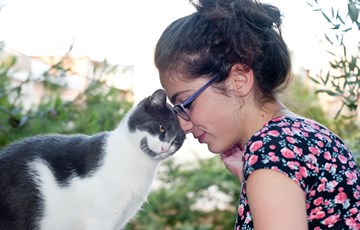
Cats have 300 million neurons; dogs have about 160 million cat’s brain is biologically more similar to a human brain than it is to a dog’s. Both humans and cats have identical regions in their brains that are responsible for emotions.[12

]Many Egyptians worshipped the goddess Bast, who had a woman’s body and a cat’s head.[12]

Amazing Animal

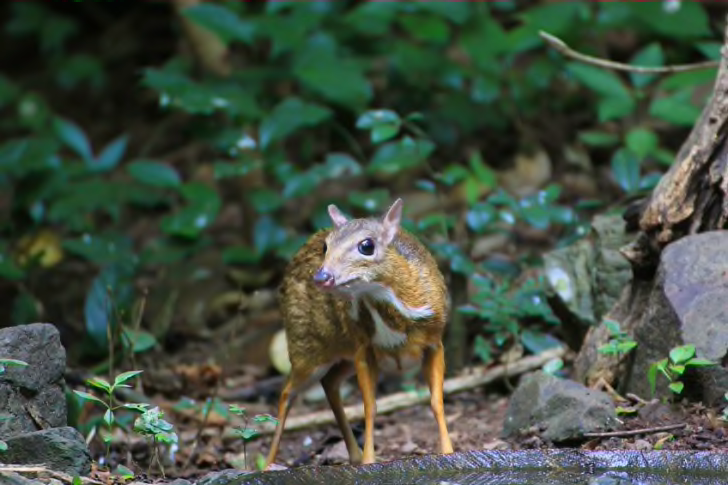
THE CHEVROTAIN IS AN ANIMAL THAT LOOKS LIKE A TINY DEER WITH FANGS. 

https://cdn.britannica.com/79/12979-004-E16CCFCC/Asiatic-chevrotain.jpg

Image result for chevrotain

Most Bizarre Animals~Angora Rabbit

bizarre animals
https://list25.com/25-bizarre-animals/#:~:text=1%20Sea%20Pigs.%20These%20deep%20sea%20creatures%20are,…%204%20Blobfish.%20…%205%20Kangaroo%20Rat.%20

Angora Rabbit

Coming from Ankara, Turkey these hairy rabbits were popular pets among French royalty in the 1700s and they are often bread for their immense wool coats.

Videos of Angora rabbits

https://www.bing.com/videos/search?q=angora+rabbit&qpvt=angora+rabbit&FORM=VDRE

http://www.lulu.com/spotlight/MwsR

Wow~ Amazing Creature

https://hubpages.com/animals/25-Most-Amazing-and-Unique-Animals-On-Earth

The Giant Coconut Crab

With the exalted title of the largest land-based arthropod in the world, it’s a wonder that the giant coconut crab doesn’t get more press than it does. These animals are generally nocturnal and live in many coastal and forest regions of Indo-Pacific islands.

They get their name from their ability to climb coconut palm trees, where they clip off the coconuts, return to the ground, peel of the coconut husks, and hammer the fruits open with rocks or their large claws. On some islands, the giant coconut crab is also known as the robber crab or palm thief because of its habit of taking shiny items.

Giant coconut crabs primarily eat nuts, seeds, and fleshy fruits such as coconuts. However, as omnivores, they will consume other items as well.

These large crabs have a body length of about 16 inches and a leg span of three feet. They can weigh up to nine pounds. There are even accounts of them growing to become more than six feet across and weighing up to 30 pounds. They can also live more than 30 years.

These crabs are unusual because they can’t swim. Though they require water to survive, even smaller ones can drown in water. They have an organ called a branchiostegal lung, which can be described as a cross between gills and lungs. This lung allows the crab to take oxygen out of the air but also has to be kept moist to function. Because of the nature of this lung, one of the most likely times to see coconut crabs is during a rainstorm, as the moisture allows them to breathe more easily.

Though an adolescent has many predators, the only danger to a fully grown coconut crab is mankind—the crab is a delicacy as well as an aphrodisiac in Southeast Asia and the Pacific Islands. Female crabs are particularly in high demand if they have eggs that can be harvested.

Unusual Creature~Spiny Orb Spider

Spiny backed orbweaver spider.jpg
https://youtu.be/EtChQK0EBe0

https://en.wikipedia.org/wiki/Spiny_orb-weaver#/media/File:Hasselt’s_spiny_spider,_gasteracantha_hasselti_-_Kaeng_Krachan_National_Park.jpg

Hasselt's spiny spider, gasteracantha hasselti - Kaeng Krachan National Park.jpg

Gasteracantha (known as spiny-backed orb-weavers, spiny orb-weavers, or spiny spiders) is a genus of orb-weaver spiders first named by Carl Jakob Sundevall in 1833.[2] The females of most species are brightly colored with six prominent spines on their broad, hardened, shell-like abdomens. The name Gasteracantha is derived from the Greek gaster (γαστήρ), meaning “belly, abdomen”, and akantha (άκανθα), meaning “thorn, spine”.[3] Spiny-backed orb-weavers are sometimes colloquially called “crab spiders” because of their shape, but they are not closely related to the true crab spiders.[4] Other colloquial names for certain species include thorn spider,[5] star spider,[6] kite spider, or jewel spider.

Members of the genus exhibit strong sexual dimorphism. Males are several times smaller than females, and they lack prominent spines or bright colors.[4][5][7]

Gasteracantha is distributed worldwide in tropical and subtropical climates. The genus is most diverse in tropical Asia, from India through Indonesia.[1] One species, G. cancriformis, occurs in the Americas.[4] Gasteracantha species are related to spine-bearing orb-weavers in several other genera (see Taxonomy and Systematics).[8]

Orb-weavers’ bites are generally harmless to humans.[9]

How Wonderfully Made!

Image result for How Wonderfully Made

Turtles/Tortoises

Turtles are reptiles of the order Testudines characterized by a special bony or cartilaginous shell developed from their ribs and acting as a shield. “Turtle” may refer to the order as a whole or to fresh-water and sea-dwelling testudines. The order Testudines includes both extant and extinct species. The earliest known members of this group date from the Middle Jurassic, making turtles one of the oldest reptile groups and a more ancient group than snakes or crocodilians. Of the 356 known species alive today, some are highly endangered.

Turtles are amazing, period.

Just to watch them move awkwardly and slow, popping up their cute wrinkled head out of their massive shells, and suddenly pulling it back in again. That in itself makes me smile every time I see it, and that is a fact.

However, here are a few more amazing turtle facts that will surely leave you wondering…

1) Turtles are Prehistoric.

The first turtle evolved even before the lizards and crocs, more than 200 million years ago. That’s old. Extremely old. Interesting facts to notice: Back then they couldn’t pull-back their heads, but they did have teeth.

2) Turtles Are Found All Over, Almost.

In a similar fashion to Snakes, also Turtles can be found all over the world, on each and every continent, except for the coldest and driest continent of all — Antarctica.

3) Turtles Have Great Senses.

Despite their old wrinkled looks, and being prehistoric, surprisingly turtles have excellent eyesight, a superb sense of smell, and they can even hear good!

4) The Turtle Shell is Not Bulletproof.

We tend to think that the powerful robust shell of the Turtle is some kind of bulletproof tank, and that as long as the turtle pulls his head back in – then he’s completely protected inside. That nothing can happen. Well, the facts tell us differently. The turtle shell has nerves and blood supply, and is actually made of up to 60 different bones that are connected together, so any injury to the shell structure—might make the turtle bleed and suffer from pain.

5) There Are Terrifying Turtles.

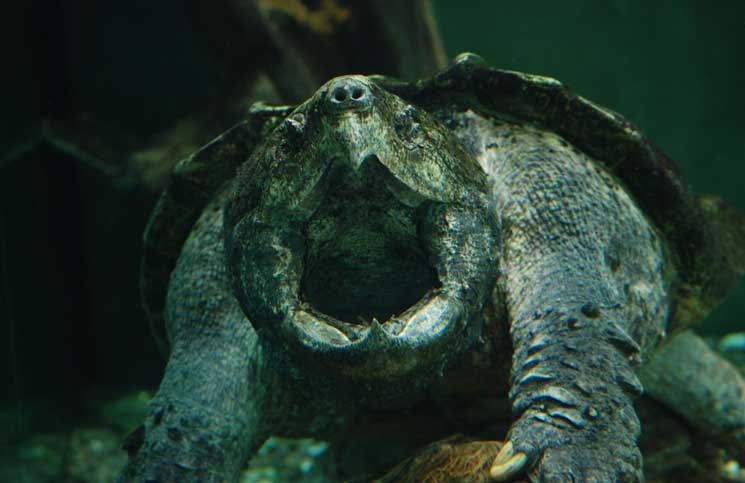
Are there really such things? It seems unthinkable, and most people I talk to have the one and only image in their minds, of the old funny-looking-Grandpa-like Turtle, slow, cautious and smiling. However, a Terrifying Turtle that is considered dangerous—does exist. It’s ‘The Alligator Snapping Turtle”, regarded as the heaviest freshwater turtle in the world, with a heavy head and a long thick shell, it resembles a dinosaur. This scary turtle lures fish using his tongue, right into his mouth, asit then devours them with tremendous speed and force. It will eat almost anything it can catch.

Alligator Snapping Turtle
Alligator Snapping Turtle. Photo by Christopher Evans. CC license. CLICK TO ENLARGE!

Still, these turtles must be handled with extreme care and considered potentially dangerous.

6) Turtles Hardly Survive.

This is definitely one of the unfortunate turtle facts on our list. Taking into account their amazing track-record of survival over more than 200 million years, it’s quite surprising that only one out of 1,000 sea turtles survive after hatching. Most are eaten in their very early stages. However, if a baby male sea turtle does make it from the land, where it just hatched, to the sea, it will most probably never step on land again.

7) Turtle’s Life Depends on Temperature.

One of the interesting Sea Turtle facts is, that during incubation the turtle’s sex is determined by Temperature. If it’s above 29 degrees – then the baby will be a female turtle. If it’s below 29 degrees – then it will be a male. If the temperature rises above 33 degrees – then the turtle will not survive at all.

8) Turtles Are Immortal, Almost.

Some turtle species have the amazing ability to surpass a hundred years of age, easily. There is one Seychelles Giant Tortoise by the name of Jonathan, that lives on the Island of Saint Helena I in the South Atlantic Ocean. He was born in 1832 and is still alive. This makes him 182 years of age. Don’t believe me? Want the original facts? Read this BBC article about Jonathan the Tortoise. 

9) Can Turtles Boost Fertility?

In ancient mythology, some cultures admired the turtle for its longevity, while others, like the Egyptians, regarded it as the enemy of the Sun God, and as the one who brings draught. The Tortoise on the other hand was portrayed as the one supporting the entire planet at its creation. Some ancient cultures believed the Tortoise had oracle powers and was associated with immortality, while others believed it was a symbol of fertility.

Image result for most beautiful turtle
See the source image
Turtle’s Mouth
Top 10 Rare and Unusual Turtles and Tortoises
Radiated Turtle

Pancake Tortoise

Top 10 Rare and Unusual Turtles and Tortoises
https://theverybesttop10.com/unusual-turtles-and-tortoises/

Leviticus 12:8 

“if she is not able to bring a lamb, then she shall bring two turtles, or two young pigeons; the one for the burnt offering, and the other for a sin offering: and the priest shall make an atonement for her, and she shall be clean.”

Jeremiah 8:7 

“Yea, the stork in the heaven knoweth her appointed times; and the turtle and the crane and the swallow observe the time of their coming; but my people know not the judgment of the LORD.”


Quotes

  • “And the turtles, of course, all the turtles are free, as turtles and, maybe, all creatures should be.” —Dr. Seuss
  • “If a turtle doesn’t have a shell, is he homeless or naked?” —George Carlin
  • “Like an alligator, he can fully digest a turtle shell.” —Bill Brasky

Baby Turtle

https://www.bing.com/videos/search?q=Live+Turtle+cam&qs=n&sp=-1&pq=live+turtle+ca&sc=6-14&sk=&cvid=E498585A28834A08AAC24EEB3F39407D&ru=%2fsearch%3fq%3dLive%2520Turtle%2520cam%26qs%3dn%26form%3dQBRE%26sp%3d-1%26pq%3dlive%2520turtle%2520ca%26sc%3d6-14%26sk%3d%26cvid%3dE498585A28834A08AAC24EEB3F39407D&view=detail&mmscn=vwrc&mid=D59C8235E75BBFB3427CD59C8235E75BBFB3427C&FORM=WRVORC

AmAzIng!

Amazing Closeup of a Gorilla’s Hand with Vitiligo

In this amazing closeup, we see the hand of a 6-year-old gorilla, Anaka, who is known for her unique pink pigmentation on her fingers. The pinkness makes her hand look strikingly, human-like.

https://twistedsifter.com/2019/12/closeup-of-gorillas-hand-with-vitiligo/

Unusual Animal!!!

Dumbo octopus

Grimpoteuthis or the dumbo octopus is the deepest living of all octopus species. It got its name for its ear-like fins, which loosely resemble those of the Disney character, Dumbo the Flying Elephant. 

Slide 5 of 27