It is official ~ I received my email stating I have an official homeschool. I am so excited. I wanted to share the good news. I hope to post more posts concerning things we do in it. So stayed tuned.
f you have kiddos that don’t sleep through the night, it might be time to give meditation a try. New research published in the Journal of Clinical Sleep Medicine found that elementary school children who practiced mindfulness twice a week over the course of two years slept an average of 74 extra minutes per night.
1 tablespoon oil (we used coconut; you could also use olive or vegetable)
3/4–2 cups boiling water
food coloring
First, figure out your workspace and prep accordingly. One of our most beloved, multipurpose tools is a large roll of brown kraft paper. It plays a multitude of roles in our craft projects, mostly as standard drawing and painting canvases, but also as a protective layer for whatever surface we are creating on. Pro tip: If you want to go all out, get a paper cutter, too.
Next, grab all your ingredients, and work out a game plan for what color you’d like your playdough to be. It will be easiest to use a color that comes straight from the selection of food coloring bottles in the box, and then choose how dark or light you want it. We tried for purple and were way off on the ratio.
I like to pre-measure everything and set it out to make it easier (read: less messy) for my kids to participate in the process of making the playdough.
How to make playdough
Start your water boiling.
Combine all dry ingredients in your large bowl.
Make a well, add in the oil, and stir.
When the water is boiling hot, safely transfer it to a container that will hold at least 2 cups. We love our clear Pyrex 2-cup measuring cup for this purpose.
Then add your food coloring directly to the water. Your other option is to NOT add any food coloring at this point. You can make the whole batch plain, then divide it into a number of smaller chunks, and follow the directions below for adding dye later to create an array of colors.
Start by pouring in 3/4 cups of water. We only needed to add a splash or two more to be able to combine everything well, but follow your own preference and add water as desired. Ultimately, you want the playdough to be mixed but sticky.
Let the mixture cool, then knead well. If you, like us, want to make an adjustment to the color of the playdough (like if you tried but failed to use enough red), now is your chance to add it in; just make a well in the dough first.
Let your little ones relish in their successful project by utilizing their fine motor skills with some cookie cutters and any other rolling, cutting, and smushing toys.
If you keep it in a zip-top bag or airtight container, the playdough should last up to three months. If you notice it drying out before then, add a drop or two of water and knead thoroughly. Read the original article on Insider
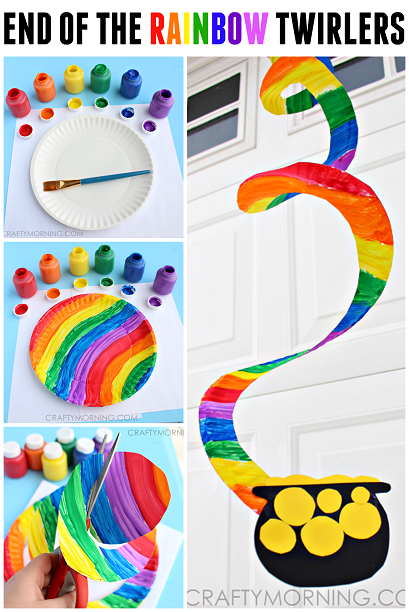
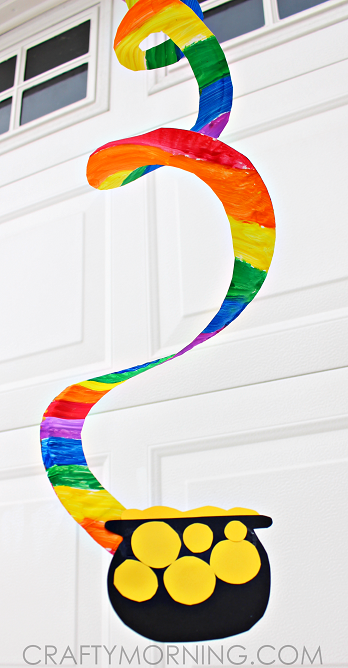
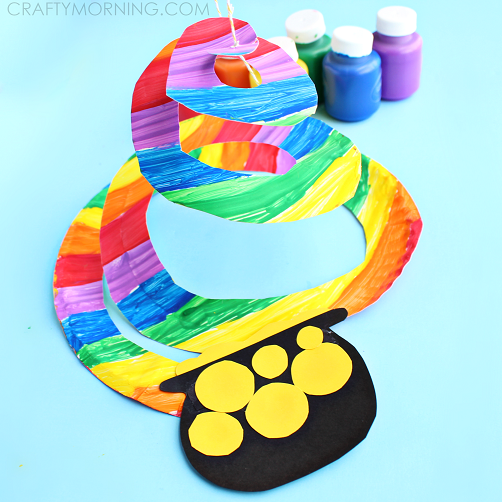
End of the Rainbow Paper Plate Twirler (Kids Craft)
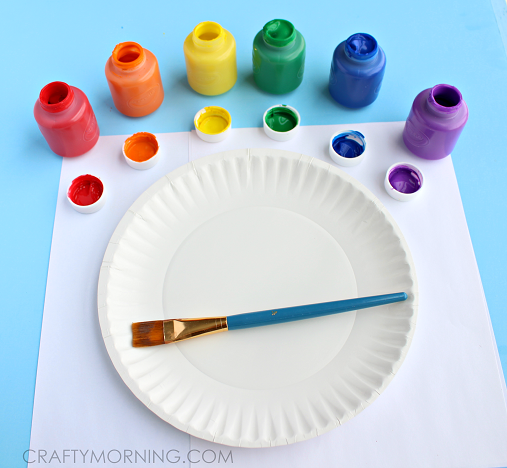
Materials Needed:
Paper plate
Paint
Black and yellow paper
Scissors
Glue
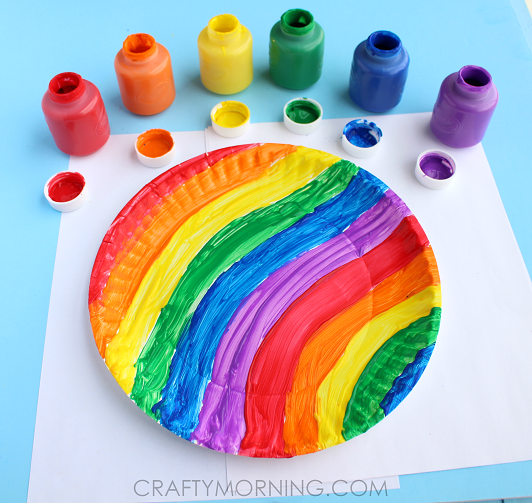
Start by having the kids paint rainbow stripes on the front of a paper plate.
Let dry and flip it over to paint the back as well. Blow dryers are great if you’re impatient!
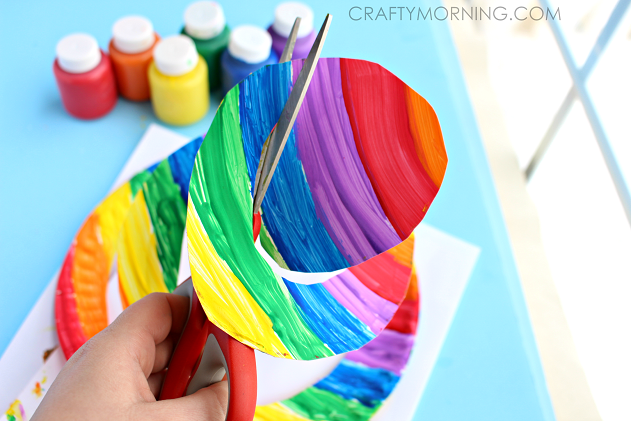
Grab a scissors and start at the outside of the plate to cut spirals. Cut out a black pot of gold and glue it to the end of the plate (we trimmed the spots that were pointy).
Glue on some yellow circles to make the gold…you can add some sparkles too! Poke a hole in the middle of the plate and add a string to hang it up!
Children with anxiety may experience some physical symptoms we typically associate with physical illnesses — like stomachaches and headaches, for example. It’s important to be aware of these physical signs of childhood anxiety because more and more children are affected by anxiety every day. According to the Centers for Disease Control and Prevention (CDC), in the U.S. alone, over 4.4 million children between ages 3 and 17 have diagnosed anxiety.
Here’s what our community shared:
1. Stomachaches and/or Vomiting
One of the most common symptoms of childhood anxiety is abdominal pain, or stomachaches, which can sometimes lead to vomiting. This is because the brain and gut are highly connected.
“If we think of the brain as a stereo receiver and speakers, it helps us understand how the gut-brain axis works. The gut reports pain to the spine, which relays the pain signals to the brain,” Nicole Sawangpont Pattamunch, Ph.D., director of general GI and GI education director at Seattle Children’s hospital said. “Children under stress, whether it be physical or emotional, will often have the volume dial turned up on their stereo receiver. How the brain receives and interprets the pain signal is highly tied to our emotional state.”
Awful stomachaches to the point where the nurse called my mother and said I was faking. I would be on the floor before school with such awful pains in my stomach. I went to so many stomach doctors and was told it was IBS, but now that I know how I feel when my anxiety is bad, I know that the doctors were wrong. None of them took a minute to think it could have been anxiety. — Amber A.
I vomit when I have severe anxiety. Did as a child growing up. — Deborah A.
A symptom of anxiety I had as a child was stomach aches. It got to a point where I needed ultrasounds to see why my stomach hurt, but as an adult I see it was because of anxiety. — Savannah W.
2. Headaches
Like adults, children can experience headaches as a result of anxiety or heightened stress. According to the Anxiety and Depression Association of America (ADAA), migraines and chronic daily headaches are also common in people who live with anxiety disorders.
Debilitating headaches that would last hours a day, nearly every day from middle school throughout high school. I got used to them because I had to, but they made everything so much harder to do. My mom would ask my doctors about them and they always blew them off, leaving me feeling like I was making them up and that they weren’t really as bad as they were. I never knew if they were tension headaches or migraines or what to call them. — Kimberly B.
3. Dizziness or Fainting
Dizziness in children is often linked to dehydration, but can also be due to anxiety. According to the Boston Children’s Hospital, a child who feels faint or dizzy might use terms like, “woozy,” “foggy” or “cloudy” to describe what they are experiencing.
Dizziness. I used to get so dizzy and convince myself I was going to faint. — Tracy K.
Was dizzy often and always scared. — Kellee S.
4. Heart Palpitations or Chest Pain
In adults, chest pain is often linked to cardiac problems, but in children, less than 2% of patients receive a cardiac diagnosis for their chest pain, according to a 2012 study. In the study, researchers found children with noncardiac chest pain reported higher levels of anxiety sensitivity.
Heart palpitations. I think every single time I’d have anxiety I’d feel my heart rev into gear and then go into full-blown panic. — Kristi A.
Left me with reoccurring chest pain throughout my adult life as an adult with anxiety. — Justine H.
Chest pain/heart palpitations and headaches/dizziness. I didn’t know it was anxiety at the time so I always thought I was going to die because of a heart issue or something. Missed so much class due to sick days and the times I was at school I remember hiding in the washroom trembling uncontrollably waiting for my panic attacks to end but wondering if/when I was finally gonna die. Not fun times. — Alicia C.
5. Hives
Ever notice when you get stressed, your skin starts to break out? Stress and anxiety can trigger acne breakouts or can even cause you to get hives on your skin. For children or adults who already have skin conditions like psoriasis, an autoimmune skin disease that causes red, scaly patches to appear on the skin, stress can trigger a flare-up.
I had hives on my arms and neck. — Katy K.
I broke out in hives constantly on my face as a child with anxiety. — Lisa D.
Severe blushing all over my body. At the time, I didn’t know it was related to anxiety. I just thought I was weirdly sensitive to heat and touch but now I know I was having severe panic attacks that would leave me bloodshot all over my body. — Mary T.
6. Loss of Appetite
Stress and anxiety sometimes suppress our appetites to help us deal with pressure. This can be true in cases of childhood anxiety. In many cases, once the stress resides, a child’s appetite will return.
I couldn’t eat. Started not eating at school and only at home. Eventually stopped eating at home as well. I was in second grade. It continued until fourth grade. I still periodically can’t eat due to nerves and nausea, but it’s nothing like it was. I didn’t know it was anxiety when I was small. I just knew I felt sick and couldn’t swallow food. — Melissa H.
7. Skin Picking or Other Body-Focused Repetitive Behaviors
According to the TLC Foundation for Body-Focused Repetitive Behaviors, body-focused repetitive behaviors (BFRBs) like scratching, compulsive skin picking or hair pulling are seldom self-harm. In most cases, people engage in BFRBs as a way to self-soothe or alleviate anxiety.
I have scarring on the inside of my mouth thanks to chewing my cheeks when I was anxious. — Amity L.
I used to pull out my hair, one strand at a time, until I had bald spots all over my scalp. It was so embarrassing, but I would do it without even recognizing what I was doing. — Jillian H.
Chewed on my fingers and nails and skin around my nails until they bled. If that wasn’t working I would, and still do, chew on the skin on my upper and lower lip. — Katherine S.
8. Shortness of Breath
Children who have difficulty breathing sometimes have health issues like asthma, lung disease or pneumonia, but in some cases, shortness of breath can be related to anxiety. Anxiety-reducing strategies like exercise and deep breathing may help a child with this symptom.
Shortness of breath. My pediatrician kept dismissing it as my asthma. I didn’t find out it was anxiety until I was 15 and went to a new doctor. — Arena G.
9. Gas and Diarrhea
Indigestion, gas and diarrhea can be common physical symptoms of anxiety in adults and children. Whether related to anxiety or a different physical condition, if you or a child in your life is experiencing gastrointestinal issues, it’s important to seek treatment.
My anxiety hit my gut resulting in cramps, gas and sometimes diarrhea which, as you can imagine, caused some pretty rough times in social situations. To make matters worse, the fear and anxiety of having those embarrassing moments, led to more intestinal irritation, so I was caught in a vicious cycle. Trying to go to college a few years ago (at age 56), the issues almost caused me to drop out. — Vicki L.




 © Alyson Aladro Your kids can help you make the playdough. Alyson Aladro

 Mws R Writings