Scientists who study cat behavior call this distinctive paw action “kneading” and believe it to be a sign of a relaxed cat. My own cats knead before taking a nap near me. While they are kneading, they purr — one of them gets so relaxed, he sometimes drools. Kneading usually occurs near a favorite person.
Unlike dogs, cats do not have a sweet tooth. Scientists believe this is due to a mutation in a key taste receptor.[5]
When a cat chases its prey, it keeps its head level. Dogs and humans bob their heads up and down.[12]
The technical term for a cat’s hairball is a “bezoar.”[8]A group of cats is called a “clowder.”[9]
A cat can’t climb head first down a tree because every claw on a cat’s paw points the same way. To get down from a tree, a cat must back down.[12]
Cats make about 100 different sounds. Dogs make only about 10.[12]
Many people in China consider cats a “warming” food that is perfect to eat during the winter every year, nearly four million cats are eaten in Asia.[10]There are more than 500 million domestic cats in the world, with approximately 40 recognized breeds.[14]
Approximately 24 cat skins can make a coat.[7]While it is commonly thought that the ancient Egyptians were the first to domesticate cats, the oldest known pet cat was recently found in a 9,500-year-old grave on the Mediterranean island of Cyprus. This grave predates early Egyptian art depicting cats by 4,000 years or more.[9]
During the time of the Spanish Inquisition, Pope Innocent VIII condemned cats as evil, and thousands of cats were burned. Unfortunately, the widespread killing of cats led to an explosion of the rat population, which exacerbated the effects of the Black Death.[9]
During the Middle Ages, cats were associated with witchcraft, and on St. John’s Day, people all over Europe would stuff them into sacks and toss the cats into bonfires. On holy days, people celebrated by tossing cats from church towers.[9]
The first cat in space was a French cat named Felicette (a.k.a. “Astrocat”) In 1963, France blasted the cat into outer space. Electrodes implanted in her brains sent neurological signals back to Earth. She survived the trip.[9]The group of words associated with a cat (catt, cath, chat, katze) stems from the Latin catus, meaning domestic cat, as opposed to feles, or wild cat.[3]The term “puss” is the root of the principal word for “cat” in the Romanian term pisica and the root of secondary words in Lithuanian (puz) and Low German puus.
Some scholars suggest that “puss” could be imitative of the hissing sound used to get a cat’s attention. As a slang word for the female pudenda, it could be associated with the connotation of a cat being soft, warm, and fuzzy.[13]
Approximately 40,000 people are bitten by cats in the U.S. annually.[9]Cats are the world’s most popular pets, outnumbering dogs by as many as three to oneCats are North America’s most popular pets: there are 73 million cats compared to 63 million dogs.
Over 30% of households in North America own a cat.[9]
According to Hebrew legend, Noah prayed to God for help protecting all the food he stored on the ark from being eaten by rats. In reply, God made the lion sneeze, and out popped a cat.[12]A cat’s hearing is better than a dog’s. And a cat can hear high-frequency sounds up to two octaves higher than a human.[1]
A a cat can travel at a top speed of approximately 31 mph (49 km) over a short distance.[1]A the cat rubs against people not only to be affectionate but also to mark out its territory with scent glands around its face. The tail area and paws also carry the cat’s scent.[1]
Researchers are unsure exactly how a cat purrs. Most veterinarians believe that a cat purrs by vibrating vocal folds deep in the throat. To do this, a muscle in the larynx opens and closes the air passage about 25 times per second.[12]
When a family cat died in ancient Egypt, family members would mourn by shaving off their eyebrows. They also held elaborate funerals during which they drank wine and beat their breasts.
The cat was embalmed with a sculpted wooden mask and the tiny mummy was placed in the family tomb or in a pet cemetery with tiny mummies of mice.[5]
In 1888, more than 300,000 mummified cats were found in an Egyptian cemetery. They were stripped of their wrappings and carted off to be used by farmers in England and the U.S. for fertilizer.[12]
Most cats give birth to a litter of between one and nine kittens. The largest known litter ever produced was 19 kittens, of which 15 survived.[4]Smuggling a cat out of ancient Egypt was punishable by death. Phoenician traders eventually succeeded in smuggling felines, which they sold to rich people in Athens and other important cities.[9]
The earliest ancestor of the modern cat lived about 30 million years ago. Scientists called it the Proailurus, which means “first cat” in Greek.
The group of animals that pet cats belong to emerged around 12 million years ago.[5] The biggest wildcat today is the Siberian Tiger.
It can be more than 12 feet (3.6 m) long (about the size of a small car) and weigh up to 700 pounds (317 kg).[1]
Cats have 300 million neurons; dogs have about 160 million cat’s brain is biologically more similar to a human brain than it is to a dog’s. Both humans and cats have identical regions in their brains that are responsible for emotions.[12
]Many Egyptians worshipped the goddess Bast, who had a woman’s body and a cat’s head.[12]
Cats, like people, can be mercurial and unpredictable. Each cat is unique. I didn’t know any cats well growing up, but developed an appreciation for them in my late 20’s. While no cat is going to act the same way all day or all week, I have noticed a few interesting and recurring cat traits which are excellent examples of Buddhist principles. Here are just three.
1. Non-Doing
The joy of non-doing is that nothing else needs to happen for this moment to be complete.
– Buddhist Meditation teacher and Author Jon Kabat Zinn, in Wherever You Go, There You Are
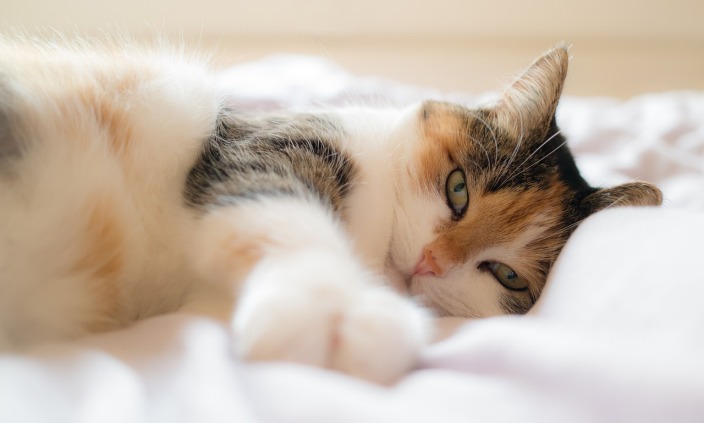
If you’ve ever seen a cat truly relaxing, you have witnessed an excellent example of non-doing. Cats are able to let go and enjoy a swath of carpet, couch, and/or sunshine with a casual abandon that is sometimes hard for humans to attain. Many times have I wanted to feel the restfulness of a relaxing cat. I take their arrival in my lap for a nap as permission to take it easy for a while.
it was morning, and lo, now it is evening, and nothing memorable is accomplished.
To let doing less be enough can be countercultural during times of overflowing media and consistent pressure to compete and produce. The paradox of non-doing is that it can actually involve doing things very efficiently; by using only the required effort and energy, and no more, actions can be performed with a smoothness and fluidity that is artful and purposeful.
2. Self-Love
According to the Buddha, you can search throughout the entire universe for someone who is more deserving of your love and affection than you are yourself, and that person is not to be found anywhere. You yourself, as much as anybody in the entire universe, deserve your love and affection. – Buddhist Meditation teacher and Author Sharon Salzberg, in Lovingkindness
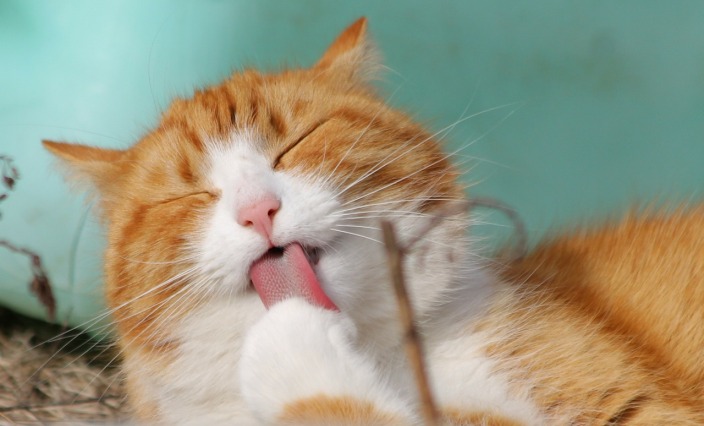
You do not have to teach cats self-love; cats love themselves immediately and fully. Like human children, when they are kittens, they love what is fun and what feels good and pursue it with relentless gusto. This attribute, for many cats, lasts their whole lives. They lick and groom themselves, they stretch luxuriantly, and they express their needs to others, often quite openly.
They are not known for giving out false affection. The demeanor a cat takes when asking or demanding to be given attention and affection (but often only in the very specific way he prefers) is an excellent model of knowing and asking for what you want. When cats are with someone they trust, they are excellent role models in receiving affection unapologetically. Fulfilling your own needs is a basic principle of self-love.
There may be times, such as when a cat is demanding a treat with a loud meow or pushing another cat out of the way for food, that this self-love also comes with a degree of self-entitlement and selfishness, or what a Buddhist might consider being tied up by ego or grasping. But we can learn from this too, and reflect on when, in our own lives, we are perhaps very much like a cat meowing for a treat.
I think most people who have enjoyed a loving friendship with a cat will agree that they are not wholly selfish animals; many are known to nuzzle, follow, lay on, play with, and befriend humans quite kindly. I was lucky enough to live with one cat named Monster who was one of the gentlest and most peaceful souls I have encountered.
3. Living Freely in the Moment
To be yourself – always yourself – without sticking to the old self. When you say “Hai! [Yes!]” you forget all about yourself and are refreshed into some new self. And before new self becomes old self, you should say another “[Yes!]” or you should walk to the kitchen. – Zen Master Shunryu Suzuki
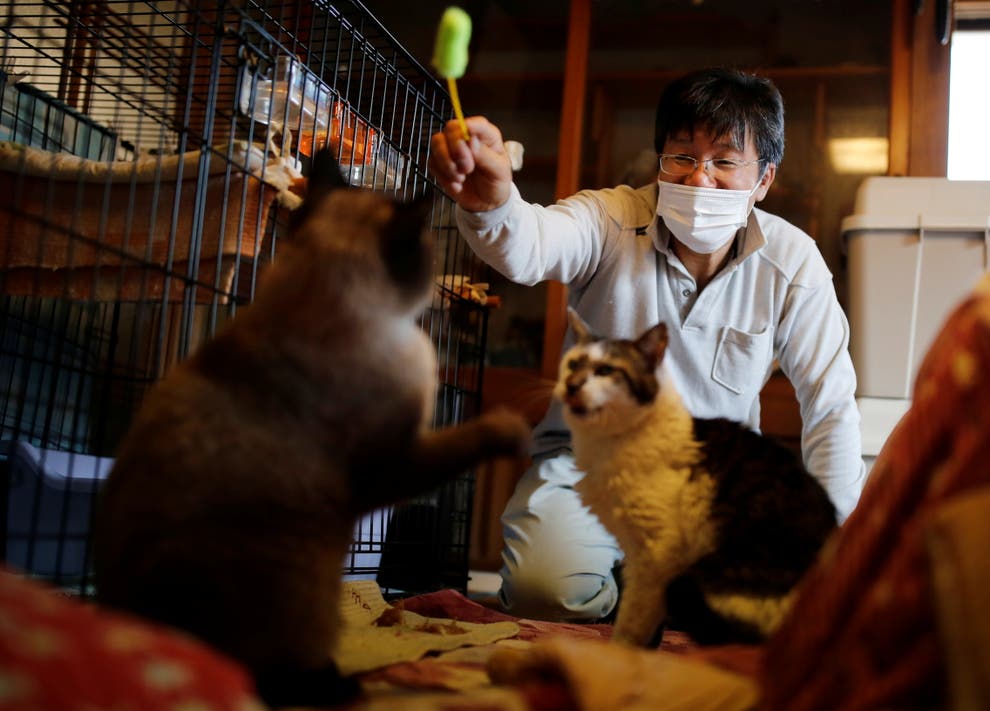
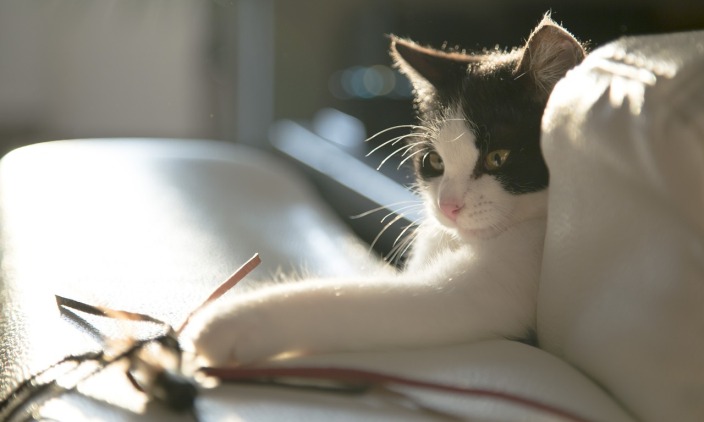
Suzuki describes the ungraspable flow of life from moment to moment and advises that we exclaim “Yes!” as we, ourselves, flow along. A cat can change very quickly from rest to playing if feathered toy whizzes by her ears. A cat says yes and follows the toy, even though it had not planned to do so a few minutes ago. Cats respond at the moment in the way that feels right to their current selves; if a cardboard box appears, they may explore, sleep in, or attack it, depending on their fancy.
The other two traits mentioned above: a cat’s ability to practice non-doing and to be self-loving, are further evidence of this third trait, living in the moment. Letting go into non-doing and self acceptance go a long way towards living freely and being present. Though the cats that live with us have become largely domesticated, they retain the grounding presence in their bodies (wherein they can experience the moment directly) that is a trait of species who remain connected to nature.
When you see a Sandpiper at the beach skipping along the sand with its backward knees, or a lion resting in the grass with his family on a nature program, you can see how well they inhabit their own bodies and the moment in which they live. Cats, though acclimated to human culture, still possess an ability to be natural that we can learn from. They say yes to where they are by living in their own bodies and responding intuitively to their surroundings.
Wendell Berry wrote in The Peace of Wild Things,
I come into the peace of wild things who do not tax their lives with forethought of grief.
Abiding in the present, letting go of ourselves, loving ourselves, non-doing – it’s a tall order to carry out. Of course, cats, like people, can be quirky, aggressive, and confusing, and do not always embody the tenets of Buddhism. The point is, simply, that cats are themselves. They live their lives at home in their bodies.
Many humans have become somewhat distanced from their own bodies, the present moment, and the natural universe, and struggle to regain a greater sense of letting go, belonging, and integration. To nap, self-nurture, and play like cats might be a good start.










 Cats are the world’s most popular pets, outnumbering dogs by as many as three to oneCats are North America’s most popular pets: there are 73 million cats compared to 63 million dogs.


 Mws R Writings