Diabetic Memes

7 Day Diabetic Meal Plan

Day 1

Breakfast (294 calories, 41 g carbohydrates)

• 1/2 cup oats cooked in 1/2 cup each 2% milk and water
• 1 medium plum, chopped
• 4 walnut halves, chopped
Top oats with plum and walnuts.

A.M. Snack (96 calories, 18 g carbohydrates)

• 3/4 cup blueberries
• 1/4 nonfat plain Greek yogurt
Top blueberries with yogurt.

Lunch (319 calories, 37 g carbohydrates)

Turkey & Apple Cheddar Melt
• 2 slices whole-wheat bread
• 2 tsp. whole-grain mustard, divided
• 1/2 medium apple, sliced
• 2 oz. low-sodium deli turkey
• 2 Tbsp. shredded Cheddar cheese, divided
• 1 cup mixed greens
Top one slice of bread with 1 tsp. mustard, apple, turkey and 1 Tbsp. cheese. Top the other slice of bread with the remaining 1 tsp. mustard and 1 Tbsp.cheese. Toast sandwich halves face-up in a toaster oven until the cheese begins to melt and bubble. Add the mixed greens to the sandwich just before serving.

*Look for a deli turkey with less than 150 mg sodium per 1-ounce serving.

P.M. Snack (58 calories, 16 g carbohydrates)

• 1/2 medium apple, sliced
• 1/2 tsp. honey
• Pinch of cinnamon
Drizzle the apple slices with honey and sprinkle with cinnamon.

Dinner (417 calories, 54 g carbohydrates)

• 2 1/2 cups Vegetable Weight-Loss Soup
• 1 serving Rosemary-Goat Cheese Toast

Make Ahead Tip: Save 1 3/4 cups soup for lunch on Day 2, and another 2 cups for lunch on Day 6.

Daily Total: 1,185 calories, 60 g protein, 166 g carbohydrates, 29 g fiber, 66 g sugar, 35 g fat, 9 g saturated fat, 1,539 mg sodium

Day 2

Breakfast (297 calories, 33 g carbohydrates)

• 1 serving Everything Bagel Avocado Toast
• 1/2 cup blueberries
• 25 pistachios

A.M. Snack (52 calories, 13 g carbohydrates)

• 10 cherries

Lunch (314 calories, 47 g carbohydrates)

• 1 3/4 cups Vegetable Weight-Loss Soup
• 2 slices whole-wheat baguette (cut ¼ inch thick)

P.M. Snack (95 calories, 25 g carbohydrates)

Cinnamon Apples
• 1 medium apple, sliced
• Cinnamon to taste
Sprinkle apple slices with cinnamon.

Dinner (420 calories, 48 g carbohydrates)

• 2 1/2 cups Lentil & Roasted Vegetable Salad with Green Goddess Dressing
• 1 serving Frozen Chocolate-Banana Bites, to enjoy after dinner

Make-Ahead Tip: Cook an extra 1/2 cup of lentils to have for lunch on Day 3.

Daily Total: 1,179 calories, 39 g protein, 166 g carbohydrates, 35 g fiber, 65 g sugar, 47 g fat, 9 g saturated fat, 1,425 mg sodium

Day 3

Breakfast (289 calories, 27 g carbohydrates)

• 1 serving Yogurt with Blueberries & Honey
• 1 tsp. ground flaxseed
• 6 walnut halves, chopped or whole
Add flaxseed to yogurt for an added boost of fiber and omega-3s. Top with chopped walnuts, or leave the walnuts whole to have on the side.

A.M. Snack (30 calories, 8 g carbohydrates)

• 1 medium plum

Lunch (347 calories, 48 g carbohydrates)

• 3 1/2 cups Mixed Greens with Lentils & Sliced Apple

P.M. Snack (62 calories, 15 g carbohydrates)

• 1 medium orange

Dinner (490 calories, 52 g carbohydrates)

• 1 1/3 cups Chicken Sausage & Peppers
• 1/2 cup cooked brown rice
• 1/2 tsp. extra-virgin olive oil
• 1/2 tsp. no-salt-added Italian seasoning
• Salt to taste
Season rice with oil, Italian seasoning and salt. Serve chicken, sausage & peppers over the rice.

• 1 1/2 cups mixed greens
• 1/4 cup shredded carrot
• 1/4 cup sliced cucumbers
• 1 Tbsp. Garlic-Oregano Vinaigrette, or a premade Italian salad dressing*
Combine greens, carrot, cucumber and vinaigrette.

*When buying premade salad dressings, look for one made without added sugars. And, choose one made with olive oil or canola oil.

Make Ahead Tip: Cook an extra 1/2 cup of brown rice to have for dinner on Day 7. You can substitute brown rice for the farro in the dinner recipe for Day 4. If you choose to do so, cook an extra 2 cups of rice tonight to save yourself time tomorrow.

Daily Total: 1,218 calories, 63 g protein, 151 g carbohydrates, 31 g fiber, 75 g sugar, 45 g fat, 9 g saturated fat, 830 mg sodium

Day 4

Breakfast (295 calories, 42 g carbohydrates)

• 1/2 cup oats cooked in 1/2 cup each 2% milk and water
• 1 tsp. ground flaxseed
• 1 medium plum, chopped
• 3 walnut halves, chopped
Mix oatmeal and flaxseed; top with plum and walnuts.

A.M. Snack (52 calories, 13 g carbohydrates)

• 10 cherries

Lunch (350 calories, 46 g carbohydrates)

• 1 serving Veggie & Hummus Sandwich
• 3 dried apricots

P.M. Snack (62 calories, 15 g carbohydrates)

• 1 medium orange

Dinner (450 calories, 41 g carbohydrates)

• 1 serving Lemon-Herb Salmon with Caponata & Farro*

*Don’t have farro? You can substitute another whole grain you have on hand, like brown rice.

Daily Total: 1,209 calories, 61 g protein, 158 g carbohydrates, 32 g fiber, 61 g sugar, 43 g fat, 8 g saturated fat, 1,032 mg sodium

Day 5

Breakfast (276 calories, 44 g carbohydrates)

• 1 serving Everything Bagel Avocado Toast
• 20 cherries

A.M. Snack (51 calories, 13 g carbohydrates)

• 6 dried apricots

Lunch (350 calories, 41 g carbohydrates)

Turkey & Pear Pita Melt
• 1/2 large whole-wheat pita round (save the other half for lunch on Day 7)
• 3 1/2 oz. low-sodium deli turkey
• 1/2 medium pear, sliced
• 2 Tbsp. shredded Cheddar cheese
• 1 cup mixed greens
Stuff pita pocket with turkey, pear and cheese. Toast in a toaster oven until the cheese starts to melt. Add greens to the pita just before eating.

• 1 medium plum

P.M. Snack (52 calories, 14 g carbohydrates)

Cinnamon Pears
• 1/2 medium pear, sliced
• Cinnamon to taste
Sprinkle pear slices with cinnamon.

Dinner (448 calories, 38 g carbohydrates)

• 1 serving Spaghetti Squash & Meatballs
• 1 slice whole-wheat baguette (cut 1/4 inch thick), toasted
• 1/2 Tbsp. goat cheese
• 1/4 tsp. fresh chopped rosemary
Toast baguette and top with cheese and rosemary.

Daily Total: 1,176 calories, 64 g protein, 151 g carbohydrates, 29 g fiber, 74 g sugar, 37 g fat, 9 g saturated fat, 1,738 mg sodium

Day 6

Breakfast (291 calories, 28 g carbohydrates)

• 1 serving Yogurt with Blueberries & Honey
• 2 tsp. ground flaxseed
• 5 walnut halves, chopped
Mix yogurt and flaxseed. Serve topped with walnuts.

A.M. Snack (72 calories, 18 g carbohydrates)

• 14 cherries

Lunch (337 calories, 42 g carbohydrates)

• 2 1/2 cups Vegetable Weight-Loss Soup

P.M. Snack (62 calories, 15 g carbohydrates)

• 1 medium orange

Dinner (422 calories, 53 g carbohydrates)

• 1 serving Apple-Glazed Chicken with Spinach
• 1/2 cup Steamed Butternut Squash
• 2 tsp. extra-virgin olive oil
• 1/2 tsp. fresh thyme or 1/8 tsp. dried
• Salt and pepper to taste
Toss squash with oil and thyme. Season with salt and pepper to taste.

Daily Total: 1,184 calories, 78 g protein, 156 g carbohydrates, 27 g total fiber, 88 g sugar, 34 g fat, 5 g saturated fat, 1,541 mg sodium

Day 7

Make Ahead Tip: Tonight’s dinner is a slow-cooker recipe. Make sure you start it early enough in the day that it will be ready in time for dinner.

Breakfast (300 calories, 40 g carbohydrates)

• 2 Blueberry-Pecan Pancakes
• 3 Tbsp. blueberries, fresh or frozen
• 2 tsp. ground flaxseed
Microwave blueberries until soft and sauce-like, about 1 minute. Stir in the flaxseed for an extra fiber kick, and serve with the pancakes.

A.M. Snack (62 calories, 15 g carbohydrates)

• 1 medium orange

Lunch (325 calories, 35 g carbohydrates)

• 2 cups mixed greens
• 1/2 cup sliced cucumber
• 1/4 cup grated carrot
• 1 1/2 Tbsp. Garlic-Oregano Vinaigrette, or a premade Italian salad dressing
Combine greens, cucumber, carrot and vinaigrette.

• 1/2 large whole-wheat pita round, toasted
• 1/4 cup hummus

P.M. Snack (95 calories, 25 g carbohydrates)

• 1 medium apple

Dinner (444 calories, 48 g carbohydrates)

• 1 serving Mushroom-Sauced Pork Chops
• 1/2 cup cooked brown rice
• 3/4 cup Roasted Brussels Sprouts with Sun-Dried Tomato Pesto

Daily Total: 1,224 calories, 54 g protein, 164 g carbohydrates, 28 g fiber, 57 g sugar, 44 g fat, 7 g saturated fat, 1,270 mg sodium

Nocturnal hypoglycemia

Thanks to the Diabetes Control and Complications Trial (DCCT), it is now well recognized that intensive glycemic control can reduce the risk of diabetes complications. Despite this knowledge, one of the biggest barriers in reaching glycemic targets is the increased risk of hypoglycemia that comes with tighter blood glucose control.

Hypoglycemia is often reported to be one of the most feared complications of diabetes. With nocturnal hypoglycemia being especially worrisome for those who live alone or travel alone. It can also be concerning (not to mention disruptive) for a significant other that you share a bed with.

What is nocturnal hypoglycemia?

  • Nocturnal hypoglycemia is low blood sugar that occurs overnight while you are asleep. It is common to sleep through a low blood sugar when it occurs during sleep.

How common is nocturnal hypoglycemia?

  • According to a journal article from Medscape General Medicine:
      • During the DCCT 43 percent of all hypoglycemia episodes and 55 percent of severe [hypoglycemic] episodes reported occurred during sleep. Incidence rates vary from 12 to 56 percent, however, because 49 to 100 percent of episodes occur without symptoms the actual incidence may be much higher.1 

Why is nocturnal hypoglycemia concerning?

  • Nocturnal hypoglycemia can be especially dangerous because an individual is unlikely to recognize symptoms or wake up during an episode.
  • Undetected nocturnal hypoglycemia is a risk factor for hypoglycemia unawareness:
    • Hypoglycemia unawareness is low blood glucose that occurs without symptoms, therefore, the person is unaware of the drop in their blood glucose, ultimately delaying treatment.
  • Nocturnal hypoglycemia may also result in physical injury, poor quality of life and possibly impairment in cognitive function.
  • Severe hypoglycemia can cause seizures and unconsciousness, requiring emergency care.

Why does low blood glucose go undetected at night?

  • When low blood glucose occurs counterregulatory hormones (such as glucagon and epinephrine) are released to raise blood glucose. The release of these hormones provides the initial symptoms (shaking, sweating, rapid heartbeat, etc.) that an individual may feel when their blood glucose is low. Such symptoms will likely trigger an individual to treat low blood glucose.
  • However, while asleep such symptoms/signals are suppressed and/or go unnoticed.
  • There is also evidence that the release of counterregulatory hormones is suppressed to some extent during sleep.

What increases the risk of nocturnal hypoglycemia?

  • Any of the following medications may cause hypoglycemia (including nocturnal hypoglycemia):
    • Insulin
    • Sulfonylureas
      • (Diabeta, Micronase, Glucotrol, Glucotrol XL, Amaryl, Glynase)
    • Meglitinides
      • (Prandin, Starlix)
    • Exercise (especially if exercise was longer or more intense than usual)
    • Alcohol (especially if consumed before bed)
    • Low blood glucose in the past 24 hours

Signs and symptoms of nocturnal hypoglycemia:

  • Vivid dreams or nightmares
  • Restless sleep
  • Morning headache
  • Night Sweats
  • Mood changes
  • Fatigue
  • Convulsions

Prevention of nocturnal hypoglycemia:

    • Check your blood glucose before going to bed.
      • Discuss with your health care provider a safe blood glucose target for bedtime.
      • Many people feel comfortable if their blood glucose is at least 100 mg/dL before going to sleep.
    • If your blood sugar is less than 100 mg/dL (discuss a blood glucose target for bedtime with your health care provider) eat at low to moderate glycemic index snack before going to bed
      • Whole wheat bread with peanut butter or whole grain crackers with a slice of cheese
  • If you were more active than usual, consumed alcohol in the evening, or had low blood glucose during the day, set an alarm to check your blood glucose at 2 a.m. or 3 a.m. in the morning.
  • If you currently take the intermediate-acting insulin, NPH, speak with your health care provider about switching to long-acting insulin such as Lantus, Levemir, or Tresiba. Long-acting insulin has a flat action profile and does not have variable peaks (like NPH does) therefore the risk of nocturnal hypoglycemia is reduced.
  • If you have a history of nocturnal hypoglycemia, hypoglycemia unawareness or have experienced severe low blood glucose, a continuous glucose monitor (CGM) may be helpful.
    • A CGM may also be beneficial if you live alone or travel alone as you can set an alarm for when your blood glucose drops below a set threshold (i.e. <70 mg/dL).

*Insurance coverage can be a challenge*

Treatment of nocturnal hypoglycemia:

  • If you are woken up by low blood glucose, first check your blood glucose to confirm it is low (<70 mg/dL).
  • Treat low blood glucose with quick acting carbs such as juice (4 ounces) or glucose tablets (3 to 4 tablets).
  • Retest blood glucose in 15 minutes. If blood glucose remains below 70 mg/dL, repeat the above treatment.
  • Once your blood glucose is above 70 mg/dL, if your typical breakfast time is still several hours away have a small snack that includes both a carb and a protein, such as a peanut butter crackers.
  • Make sure to discuss with your health care provider specifics on how he/she would like you to manage/treat nocturnal hypoglycemia.
  • If you take insulin to speak with your health care provider about getting a prescription for emergency Glucagon.

Continue reading Nocturnal hypoglycemia

Diabetic Information About Exercises

Fitness & Physical Activity

If you have type 2 diabetes, regular physical activity should be an integral part of your overall care plan. Not only will a program of regular physical activity improve glycemic control, it is a an important part of maintaining a healthy weight and reducing your risk for cardiovascular disease (heart disease and stroke) and other health complications for which people with diabetes are at high risk. Physical activity also has long list of other benefits. It is a great way to lift your mood and spirits, improve your outlook, and improve your sleep. If you join a regular exercise group (for example, a walking group or a movement class) you can make your physical activity a fun, social experience, as well.1

What do studies tell us about the benefits of physical activity for people with diabetes?

The short-term and long-term benefits of physical activity for people with diabetes have been demonstrated in a variety of well-controlled studies.

Improved insulin sensitivity. In people with type 2 diabetes, one of the short-term benefits of physical activity is improved sensitivity to insulin. As a person exercises, muscles require glucose for energy. This has the effect of helping our bodies make better use of the insulin that we produce so that glucose can be made available to the muscle cells where it is needed.1,2

With type 1 diabetes, where people make very little or no insulin and insulin injections are required, physical activity can have different effects on blood glucose. The effect will depend on how much insulin is present in the body at the time of physical activity and the timing of the most recent insulin injection1,2

Improved glycemic control. A number of studies have shown the benefit of regular physical activity on glycemic control (blood glucose). An analysis of results from several studies measuring the effects of physical activity on people with type 2 diabetes found that a regular exercise program resulted in reductions in A1C values by 0.5% to 0.7% compared with a control group (a comparison group made up of people with type 2 diabetes who did not engage in exercise). 1,2

Results from some studies suggest that an exercise program that combines both aerobic and resistance training (see below for examples of these types of exercise) may achieve the greatest benefits in terms of glycemic control. For instance, in one study conducted in 252 adults with type 2 diabetes, the combination of resistance (weight training) and aerobic (running, walking) training had a greater reduction in A1C (almost 1% point compared with a control group that did not engage in exercise) than either type of physical activity alone.3

Overall health benefits. In the Look AHEAD Study, a 4-year randomized, controlled trial conducted in 4,503 adults with type 2 diabetes who had a body mass index (BMI) of 25 or higher, an intensive program of lifestyle modification, including a program of regular physical activity, resulted in a range of health benefits, including an increased likelihood of remission of type 2 diabetes to prediabetes, improved blood glucose control, improvements in blood pressure, lipids, improvements in quality of life, improved mobility and reduced muscle and joint problems, and decreased risk for a range of diabetes-related complications (e.g., kidney disease, retinopathy).4
Although regular moderate physical activity alone is probably not sufficient for achieving and maintaining weight loss, as part of a comprehensive program of lifestyle modification, including healthy eating and calorie restriction, physical activity can be an important part of achieving and maintaining a healthy weight.4,5

Other studies have also shown the significant benefits of physical activity in terms of cardiovascular health in people with type 2 diabetes. The Nurses’ Health Study, a large, health study conducted among nurses in the US, found that among 5,125 female participants with type 2 diabetes, those who engaged in moderate to vigorous physical activity for at least 4 hours per week decreased their risk of cardiovascular disease (including stroke and coronary heart disease) by 40%.6 In the Aerobics Center Longitudinal Study, a study conducted in 2,316 men with type 2 diabetes, risk of death from cardiovascular disease and other causes was 1.7 to 6.6 times higher among participants who were defined as low-fit compared with those who were high-fit.7,8

Before you start an physical activity routine

There are many physical activity options for people with diabetes, including walking, cycling, swimming, rowing, and running. Your healthcare provider will determine whether it is necessary to do a pre-exercise examination, depending on the intensity of the physical activity your are planning to engage in and other factors, such as your age and existing health problems. For most people, with type 2 diabetes who want to engage in low-intensity physical activity, such as walking, no pre-exercise examination is necessary. However, if you are an older person not used to physical activity, you will benefit from an assessment.1

Since physical activity affects blood glucose, you should get a sense of how your exercise routine affects your blood glucose by measuring levels before, during, and after your exercise routine. This will allow you to know how you will need to adjust your insulin dose (if you take insulin) or to develop a strategy for eating foods that will keep your blood glucose at a normal level during and after physical activity. Make sure to drink adequate amounts of liquids before, during, and after physical activity to avoid becoming dehydrated. In people with diabetes, dehydration can have a direct impact on blood glucose levels.9
Learn more about factors to consider before I start a training program.

Three basic types exercises you need

Type

Examples

Resistance Training
  • Weight training
  • Yoga
  • Resistance training
Endurance (aerobic) training
  • Running
  • Swimming
  • Cycling
  • Walking
Flexibility Training
  • Yoga
  • Stretching (passive and active)
  • Pilates

What are my options for physical activity?

The list of activities that you can engage in to get exercise is almost limitless. From swimming and jogging to yoga and dancing, there is a form of physical activity that is fun and rewarding for every person.

Learn more about different types of exercise options:

There are three basic types of exercise: resistance training, endurance (aerobic) training, and flexibility (range of motion) training. Ideally, you should combine all three to get the full benefit of a total workout. You’ll find that certain activities are sources for some or all of the three types of exercise you need. For instance, yoga and Tai Chi can be used to increase or maintain both strength and range of motion. Some water aerobics programs are designed to provide aerobic and strength training at the same time.

However you mix these forms of physical activity, you should aim to get 150 minutes per week of moderate- to vigorous-intensity aerobic training, spread out during at least 3 days per week, with no more than 2 consecutive days between training sessions.1 Aerobic training of moderate intensity involves getting your heart rate up to 65% of its maximum.

Learn some pointers on how to start an aerobic training exercise routine

A good sign that your endurance training is vigorous enough is if you sweat and feel an increase in your heart rate and breathing. A good tip for how hard you should extend yourself is to find a pace at which you are slightly short of breath, but can still carry on a conversation. Determining your target heart rate is also a way to make sure that you are working hard enough, but not overdoing it. Check out the simple target heart rate calculator to find out what you should be aiming for during your workout.


Figuring out your target heart rate (HR)

Subtract your age from 220 for your maximum HR 220 – YOUR AGE (example: 50) = 170
Subtract your resting HR from your max HR 170 – RESTING HR (example: 70) = 100
Multiply the answer by 0.7 and 0.5 0.7 X 100 = 70 (70% of max reserve HR)
0.5 X 100 = 50 (50% of max reserve HR)
Add your resting HR to each of these numbers to get your target HR range 70 + 70 = 140 beats per minute
50 + 70 = 120 beats per minute
While you are exercising your heart rate should stay between 120 and 140 beats

per minute

https://type2diabetes.com/fitness-and-exercise/

Continue reading Diabetic Information About Exercises

Reading Food Labels

Reading food labels

The US Department of Agriculture (USDA) and the US Food and drug administration (FDA) require food manufacturers to provide labels that spell out the nutritional content of different food products. Only fresh fruit and vegetables or seafood do not have these labels.

“Nutrition Facts” labels are a familiar feature on most packaged foods. If you have diabetes, you should become an expert at reading these labels. Knowing your Nutrition Facts not only allows you to figure out the amount of carbohydrates in foods. It also allows you to figure out the calories per serving of food items, a piece of information that is important for successfully reducing your calorie intake.

Key information that you’ll find on the “Nutrition Facts” label includes1:

Serving size. How much of the product is considered a single serving. The nutrient amounts on the rest of the label are all based on this single serving amount.
Servings per container. This tells you how many servings you get in a container. Some food products will have a single serving, such as single serving yogurts. Others will have multiple servings, such as a bag of potato chips or a frozen pizza.

Amount per serving. Under this section you’ll find information on total calories, calories from the three major calorie groups, fat, carbohydrates, and protein, and sodium content. Fats and carbohydrates are broken down into specific sources, such as saturated fat and cholesterol for fats and sugar and dietary fiber for carbohydrates.

Vitamins and minerals. At the bottom of the label, you’ll find the vitamin and mineral content of a single serving.

Daily values per serving. On the right-hand side of the label across from each of the specific nutrients, you’ll find the daily value for each item. This is the percentage of calories or vitamins/minerals you get in terms of each nutrient in a single serving based on a 2,000 calorie per day diet. You daily target for calories may be different. After your work with your dietitian or nutritionist to determine your daily calorie target, he or she will help you figure out exactly how many calories from each nutrient group you’ll aim to get on a daily basis.

Making sense of the sections of a food label
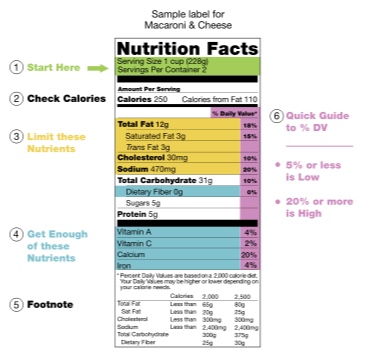
nutrition_facts

Take a look at the sample labels above and let’s practice reading the label and getting information that will help you with your diet needs.1

1. Serving size and servings per container. This section is important because it allows you to understand how all the numbers and values below relate to the contents of your container of food. All of the numbers and values for the mac and cheese product shown here are based on a single serving (1 cup or 228 grams). However, the package contains 2 cups or 2 servings. If you consume the entire contents of the package, you will need to multiply all the amounts by 2 to figure out how much you’re getting in terms of fat, carbohydrates, protein, and salt. For instance, if the total fat in a single serving of our sample is 12 grams or 18% of the total daily calories in a 2,000 calorie diet, a double serving (the entire package) will contain 24 grams of total fat, which is 2 times 18% or 36% of your total daily calories (for a 2,000 calorie diet).

2. Calories and calories from fat. Calories are a measure of how much energy is contained in food. The totals for calories and calories from fat are based on a single serving, so if you eat the whole package of mac and cheese, you’ll have to get out your calculator and multiply by 2. This section is important, because if you’re trying to lose weight, chances are you will be aiming to reduce how many calories you take in. Additionally, for a heart-healthy diet, you’ll be trying to keep the calories from fat below a certain amount per day. So, you can use both of these numbers to help you with your calorie targets.

You may ask: “How do I figure out if a meal is high in calories?” This will really depend on your target amount of calories per day. If you are aiming to consume 1,500 calories per day and you have 2 servings of mac and cheese, then you have taken in about one-third of your total for the day. A quick rule of thumb for amounts of calories per serving goes like this:

  • Low calorie serving: 40 calories
  • Moderate calorie serving: 100 calories
  • High calorie serving: 400 calories

3 and 4. Nutrient amounts. These sections show amounts in grams for different nutrients, including fats, carbohydrates, protein, and vitamins and minerals. (Note that total fat and total carbohydrates are overall amounts that include specific kinds of fats and carbohydrates.) The nutrients, including fat, cholesterol, and sodium, shown in yellow shading, tend to make up too much of our diets. These should be kept to a minimum. On the other hand, the nutrients shown in blue shading, including dietary fiber (you get this from fruit and vegetables and whole grains), as well as essential vitamins and minerals, tend to make up too little of our diets. Generally, you should aim to get more of these types of nutrients.

Learn more about the basics of healthy nutrition and how to eat well.

5. Nutrition Fact footnote information. The footnote tells you that the daily values shown above for a single serving of mac and cheese are based on a 2,000 calorie per day diet. The sample label contains more general information from nutritionists that tells you how many calories of different nutrient groups you should aim to get for both a 2,000 and 2,500 calorie diet. Not all labels will have this extra information. Let’s take a closer look at what this information tells us. A single serving of mac and cheese contains 12 grams of total fat. This is 18% of the amount of total fat that you should take in daily. You should aim to take in less than 65 grams of total fat if you are eating a 2,000 calorie per day diet. If your diet has a higher daily calorie intake, such as 2,500 calories, the target amount of total fat will be slightly higher: 80 grams (you should aim to keep your total fat intake at or below this number). So, for the yellow shaded group of nutrients (fat, cholesterol, and sodium) that we tend to get too much of in our diets, the footnote nutritional information tells us a total daily amount we should stay under. For the blue shaded group of nutrients that we should get more of in our diets (there is no fiber in our sample mac and cheese product!), the footnote nutritional information indicates that we should get “at least” 25 grams per day.

6. Daily values for nutrient groups. The daily values listed on the right side of the label help you figure out (in the context of a 2,000 calorie per day diet) whether the amount of each nutrient in a single serving is high or low.

Note that trans fats, sugar, and protein do not have a daily values. The FDA did not have enough information to establish a daily value for trans fats or sugar and could make no recommendation for precisely how much to eat in a single day. However, since trans fats clearly contribute total fat consumption and sugar to carbohydrate consumption, it is important to keep intake of these nutrients at proper levels according the overall daily calorie target of your diet.

So, how much of the daily value of a nutrient should a single serving of a food provide? As a general rule of thumb for daily values, 5% or below is considered low and 20% or more is considered high. So, if we look at total fat content of our mac and cheese product, a single serving has 18% of the daily target for total fat, given a 2,000 calorie diet. This is a little under the 20% rule of thumb. However, if you eat the whole package of mac and cheese, you will be getting 36% of your daily target for total fat and that would be considered a lot for one meal.

Comparing labels

In addition to checking the Nutrition Facts for different packaged foods, you will want to look at the ingredient list, as well. As you gain experience reading food labels, you’ll have some important insights into how different ingredients change the nutritional content of foods. Let’s compare the labels for plain and fruit yogurt. The plain yogurt is made with nonfat milk and its total fat content reflects this. The fruit yogurt is made with reduced fat milk, so it has a slightly higher amount of total fat (3 grams). The fruit yogurt has a higher fiber content, which results from the inclusion of fruit. It also has a much higher carbohydrate content, a total of 15% of the daily value for carbohydrates (given a 2,000 calorie diet). The carbohydrate content of the fruit yogurt comes mostly from added sugars. The ingredient label tells us that these are mostly from the inclusion of high fructose corn syrup.

Meyer Lemon Avocado Toast/Diabetic Friendly/Recipe

Photo of Meyer Lemon Avocado Toast by princessofmontecito

Meyer Lemon Avocado Toast


INGREDIENTS

1/2 avocado
2 tablespoons chopped fresh cilantro, or more to taste
1 teaspoon Meyer lemon juice, or to taste
1/4 teaspoon Meyer lemon zest
1 pinch cayenne pepper
1 pinch fine sea salt
1/4 teaspoon chia seeds
Add all ingredients to list

DIRECTIONS

Prep
10 m
Cook
3 m
Ready In
13 m
Toast bread slices to desired doneness, 3 to 5 minutes.
Mash avocado in a bowl; stir in cilantro, Meyer lemon juice, Meyer lemon zest, cayenne pepper, and sea salt. Spread avocado mixture onto toast and top with chia seeds.


Per Serving: 72 calories; 1.2 g fat; 11.8 g carbohydrates; 3.6 g protein; 0 mg cholesterol; 271 mg sodium. Full nutrition