Tag: Facts

Facts About Cats
Unlike dogs, cats do not have a sweet tooth. Scientists believe this is due to a mutation in a key taste receptor.[5]
When a cat chases its prey, it keeps its head level. Dogs and humans bob their heads up and down.[12]
The technical term for a cat’s hairball is a “bezoar.”[8]A group of cats is called a “clowder.”[9]
A cat can’t climb head first down a tree because every claw on a cat’s paw points the same way. To get down from a tree, a cat must back down.[12]
Cats make about 100 different sounds. Dogs make only about 10.[12]
Many people in China consider cats a “warming” food that is perfect to eat during the winter every year, nearly four million cats are eaten in Asia.[10]There are more than 500 million domestic cats in the world, with approximately 40 recognized breeds.[14]
Approximately 24 cat skins can make a coat.[7]While it is commonly thought that the ancient Egyptians were the first to domesticate cats, the oldest known pet cat was recently found in a 9,500-year-old grave on the Mediterranean island of Cyprus. This grave predates early Egyptian art depicting cats by 4,000 years or more.[9]
During the time of the Spanish Inquisition, Pope Innocent VIII condemned cats as evil, and thousands of cats were burned. Unfortunately, the widespread killing of cats led to an explosion of the rat population, which exacerbated the effects of the Black Death.[9]
During the Middle Ages, cats were associated with witchcraft, and on St. John’s Day, people all over Europe would stuff them into sacks and toss the cats into bonfires. On holy days, people celebrated by tossing cats from church towers.[9]
The first cat in space was a French cat named Felicette (a.k.a. “Astrocat”) In 1963, France blasted the cat into outer space. Electrodes implanted in her brains sent neurological signals back to Earth. She survived the trip.[9]The group of words associated with a cat (catt, cath, chat, katze) stems from the Latin catus, meaning domestic cat, as opposed to feles, or wild cat.[3]The term “puss” is the root of the principal word for “cat” in the Romanian term pisica and the root of secondary words in Lithuanian (puz) and Low German puus.
Some scholars suggest that “puss” could be imitative of the hissing sound used to get a cat’s attention. As a slang word for the female pudenda, it could be associated with the connotation of a cat being soft, warm, and fuzzy.[13]
Approximately 40,000 people are bitten by cats in the U.S. annually.[9] Cats are the world’s most popular pets, outnumbering dogs by as many as three to oneCats are North America’s most popular pets: there are 73 million cats compared to 63 million dogs.
Over 30% of households in North America own a cat.[9]
According to Hebrew legend, Noah prayed to God for help protecting all the food he stored on the ark from being eaten by rats. In reply, God made the lion sneeze, and out popped a cat.[12]A cat’s hearing is better than a dog’s. And a cat can hear high-frequency sounds up to two octaves higher than a human.[1]
A a cat can travel at a top speed of approximately 31 mph (49 km) over a short distance.[1]A the cat rubs against people not only to be affectionate but also to mark out its territory with scent glands around its face. The tail area and paws also carry the cat’s scent.[1]
Researchers are unsure exactly how a cat purrs. Most veterinarians believe that a cat purrs by vibrating vocal folds deep in the throat. To do this, a muscle in the larynx opens and closes the air passage about 25 times per second.[12]
When a family cat died in ancient Egypt, family members would mourn by shaving off their eyebrows. They also held elaborate funerals during which they drank wine and beat their breasts.
The cat was embalmed with a sculpted wooden mask and the tiny mummy was placed in the family tomb or in a pet cemetery with tiny mummies of mice.[5]
In 1888, more than 300,000 mummified cats were found in an Egyptian cemetery. They were stripped of their wrappings and carted off to be used by farmers in England and the U.S. for fertilizer.[12]
Most cats give birth to a litter of between one and nine kittens. The largest known litter ever produced was 19 kittens, of which 15 survived.[4]Smuggling a cat out of ancient Egypt was punishable by death. Phoenician traders eventually succeeded in smuggling felines, which they sold to rich people in Athens and other important cities.[9]
The earliest ancestor of the modern cat lived about 30 million years ago. Scientists called it the Proailurus, which means “first cat” in Greek.
The group of animals that pet cats belong to emerged around 12 million years ago.[5] The biggest wildcat today is the Siberian Tiger.
It can be more than 12 feet (3.6 m) long (about the size of a small car) and weigh up to 700 pounds (317 kg).[1]
Cats have 300 million neurons; dogs have about 160 million cat’s brain is biologically more similar to a human brain than it is to a dog’s. Both humans and cats have identical regions in their brains that are responsible for emotions.[12
]Many Egyptians worshipped the goddess Bast, who had a woman’s body and a cat’s head.[12]

Did You Know~ Insect Facts
8 Crunchy Facts About Insects – You Probably Didn’t Know
1. You need 22,000 Liters to produce 1 kilo of beef, and 1 Liter to produce 1 kilo of crickets
2. 2 Billion people regularly eat insects
3. We already eat insects. There are small parts in many foods. You eat 450-900 grams per year of insects.
4. In ancient Greece, cicadas were a luxury snack
5. Insects are an excellent source of high quality protein (up to 80%)
6. Mealworm tastes like roasted nuts, Locusts taste like shrimp
7. There are 1900 types of edible insects on Earth
8. In Uganda crickets are considered a delicacy


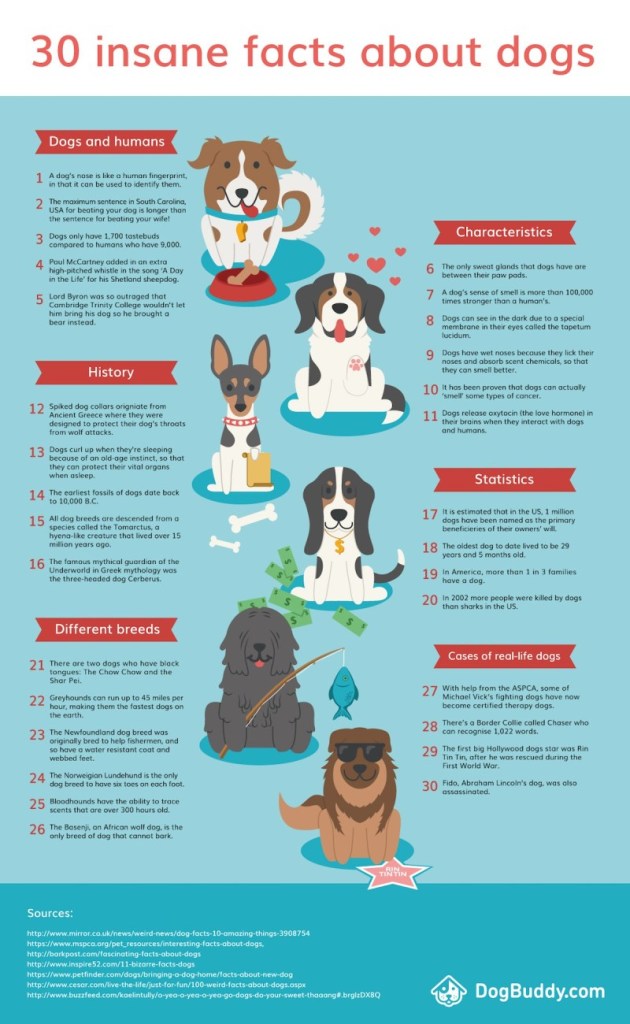
Insane Dog FACTS!
Facts About Memorial Day
Memorial Day isn’t just an excuse to take a long weekend and loaf around eating grilled meats—although those are certainly among the reasons to love the holiday.
So before you head out to your barbecues and pool parties, here are some facts about Memorial Day, everybody’s favorite summer kick-off holiday.
It was originally called Decoration Day
To honor the deceased, soldiers would decorate graves of their fallen comrades with flowers, flags and wreaths. Hence Decoration Day. Although Memorial Day became its official title in the 1880s, the holiday wouldn’t legally become Memorial Day until 1967.
It wasn’t always celebrated the last Monday of May
After the Civil War, General John A. Logan, commander in chief of the Grand Army of the Republic, called for a holiday commemorating fallen soldiers to be observed every May 30. But due to the Uniform Monday Holiday Act, which took effect in 1971, Memorial Day was moved to the last Monday of May to ensure long weekends. Some groups, like the veterans’ organization American Legion, have been working to restore the original date to set Memorial Day apart and pay proper tribute to the servicemen and women who sacrificed their lives defending the nation.
This year, Memorial Day falls on Monday, May 28.
It’s legally required to observe a National Moment of Remembrance
In December 2000, Congress passed a law requiring Americans to pause at 3 p.m. local time on Memorial Day to remember and honor the fallen. But this doesn’t appear to be common knowledge, or if it is, by 3 p.m. most people seem to be too deep into a hot dog-induced food coma to officially observe the moment.
James A. Garfield delivered a rather lengthy speech at the first Memorial Day ceremony
Of course then it was still called Decoration Day, and at the time, Garfield was a Civil War General and Republican Congressman, not yet a President. On May 30, 1868, he addressed the several thousand people gathered at Arlington National Cemetery. “If silence is ever golden,” Garfield said, “it must be beside the graves of 15,000 men, whose lives were more significant than speech, and whose death was a poem the music of which can never be sung.”
Several states observe Confederate Memorial Day
In addition to the national holiday, nine states officially set aside a day to honor those who died fighting for the Confederacy in the Civil War: Texas, South Carolina, North Carolina, Alabama, Virginia, Louisiana, Mississippi, Tennessee and Georgia. The days vary, but only Virginia observes Confederate Memorial Day on the last Monday of May, in accordance with the federal observance of Memorial Day.
Waterloo, New York is considered the birthplace of Memorial Day
According to Waterloo’s website, in 1966 Congress unanimously passed a resolution to officially recognize Waterloo as the birthplace of Memorial Day. However, it remains a contentious debate, with other towns, like Boalsburg, Pa., claiming the title of “Birthplace of Memorial Day” as well.
More than 36 million people will travel at least 50 miles from home this Memorial Day
At least, according to AAA estimates. That’s the highest total since the recession.
Continue reading Facts About Memorial Day
Cinco De Mayo Facts
Cinco de Mayo is not Mexico’s Independence Day.
Many people believe that Cinco de Mayo marks Mexico gaining independence as a country, similar to Independence Day in the U.S. Cinco de Mayo (Spanish for May 5) celebrates the Mexican army’s victory over France at the Battle of Puebla on May 5, 1862.

Mexican Independence Day Isn’t Until September
While it does celebrate a national victory, Cinco de Mayo isn’t Mexican Independence Day. The actually Mexican Independence Day is celebrated on September 16.
Mexico was the underdog in the Battle of Puebla.
The Battle of Puebla was part of the Franco-Mexican War. One of the reasons it’s so significant is because the French army was much larger and more prepared than the Mexican army. They had more weaponry and men at their disposal, but the French still lost the battle to Mexico (though they did eventually win the war).
Napoleon III had a specific interest in taking over Puebla.
He wanted to turn the Puebla area into a base that would help the Confederate Army during the American Civil War. Some historians have argued that had he succeeded, the Civil War could’ve had a very different outcome.
Mexican President Benito Juárez made it a holiday.
The anniversary of the Battle of Puebla was declared a national holiday referred to as “Battle of Puebla Day” or “Battle of Cinco de Mayo” by President Benito Juárez on May 9, 1862. However, it’s no longer considered a national holiday in Mexico.
President Franklin Roosevelt helped bring Cinco de Mayo celebrations to the U.S.
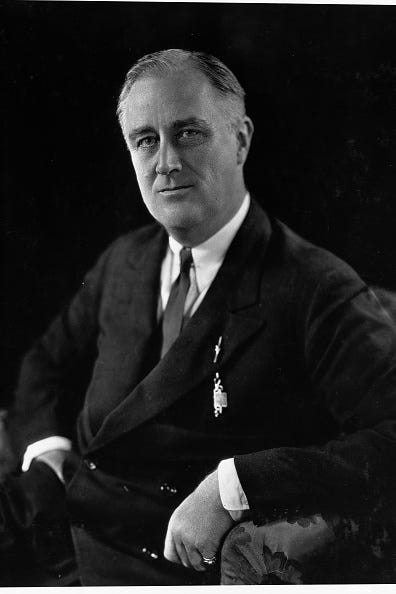
The holiday started to be celebrated in the U.S. after President Roosevelt created the “Good Neighbor Policy” in 1933 to improve relations with Latin American countries.
But it’s been a tradition in California for a long time.
In 1863, Mexican miners in the town of Columbia broke into celebration when they received news that people were resisting French occupancy back home.
In fact, the largest Cinco de Mayo celebration is in Los Angeles
With huge celebrations like Fiesta Broadway and Cinco de Mayo at Olvera Street, the California city is known for their Cinco de Mayo celebrations.

Earth Day Facts
Every year on April 22, trees are planted, litter is cleaned up, and awareness for the issues plaguing the planet are raised. In honor of the holiday, which is celebrating its 50th anniversary in 2020, we’ve gathered together 10 fascinating facts about Earth Day.
1. EARTH DAY WAS CREATED THROUGH THE TIRELESS EFFORTS OF WISCONSIN SENATOR GAYLORD NELSON.
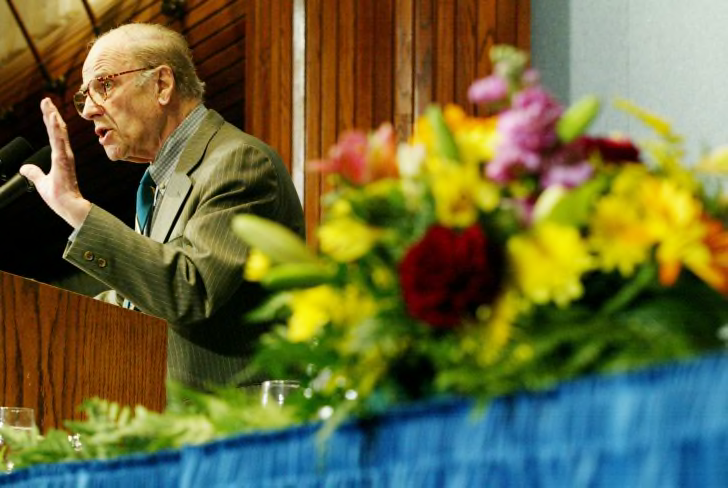
Gaylord Nelson speaks at an Earth Day event in 2003.ALEX WONG/GETTY IMAGES
Senator Gaylord Nelson arrived in Washington in 1963 looking to make the fledgling conservation movement—sparked in part by Rachel Carson’s New York Times bestseller Silent Spring, which warned against the harmful effects of widespread pesticide usage—a part of the national discourse. After witnessing the aftermath of an oil spill in California in 1969, Nelson doubled down on his commitment to raising environmental awareness. Drawing inspiration from the energetic anti-war movement of the time, he enlisted support from both sides of the political spectrum, and on April 22, 1970, Earth Day was born.
2. JOHN F. KENNEDY PLAYED A ROLE IN EARLY EFFORTS TO PROMOTE ENVIRONMENTAL CONSERVATION.
In 1963, Gaylord Nelson proposed a “conservation tour” to Attorney General Robert F. Kennedy and Arthur Schlesinger, a member of President Kennedy’s “Best and Brightest” cabinet. Schlesinger privately endorsed the idea to the president, while Nelson wrote a direct memo to Kennedy, a bold move for a freshman senator from Wisconsin. Kennedy, however, was incredibly receptive, and on September 24, 1963, JFK embarked on a conservation-themed multi-state tour.
The president, accompanied by Secretary of the Interior Stewart Udall, Secretary of Agriculture Orville Freeman, as well as Nelson and a few additional senators, visited 11 states in five days. Nelson was disappointed in the president’s speeches, saying they “didn’t have much sweep or drama to them.” In addition, members of the press ignored environmental issues and instead focused their questions on the tense nuclear situation with the Soviet Union. It would be another seven years until Earth Day became a reality.
3. THE FIRST EARTH DAY SAW 20 MILLION AMERICANS TAKE TO THE STREETS.
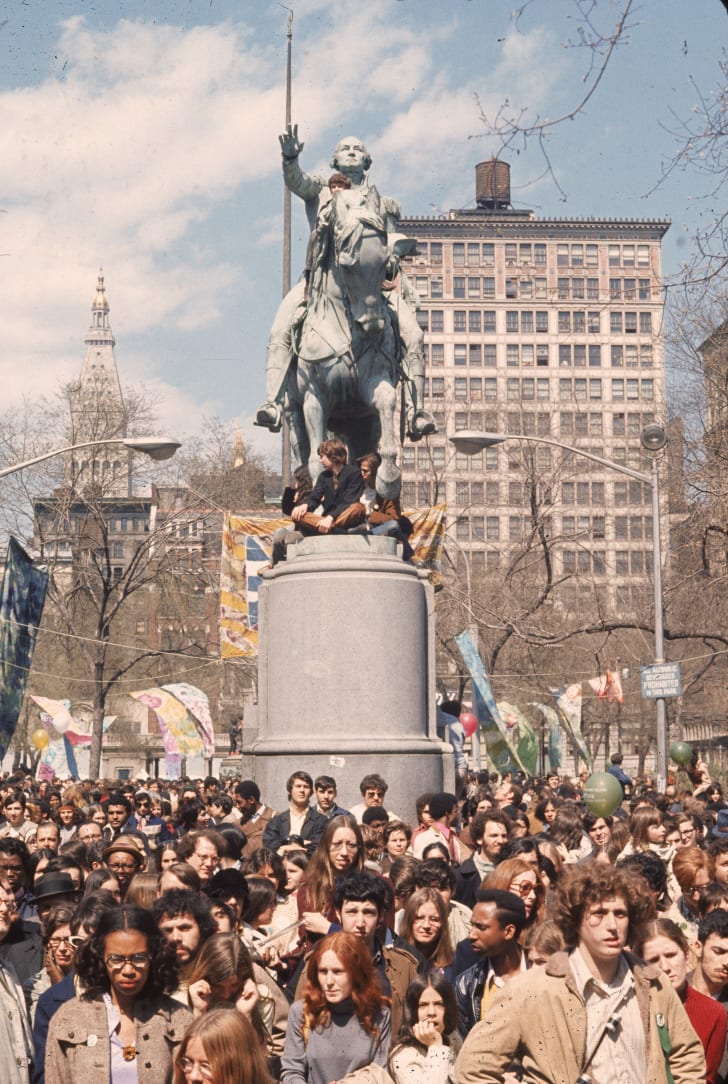
Crowds gather in Union Square in New York City for the first Earth Day in 1970. HULTON ARCHIVE/GETTY IMAGES
The first Earth Day marked a strange combination of boisterous rallies and sober reflection on the state of the planet. Protests, demonstrations, fundraisers, nature walks, speeches, concerts, and every sort of civic gathering imaginable took place at colleges, VFW halls, public squares, and parks across the United States on April 22, 1970. Environmental crusaders found themselves thrust into the limelight, and pop culture icons like poet Allen Ginsberg were asked to speak on behalf of Mother Earth.

✕
Some of the more colorful displays of the day included mock trials for polluting objects, like an old Chevrolet, which was sentenced to death by sledgehammer. (The car ultimately survived the beating and was donated to an art class.) In New York City, Earth Day celebrations effectively shut downparts of the city. Twenty-thousand people packed into Union Square to see Paul Newman and hear a speech by Mayor John Lindsay, who arrived on an electric bus.
4. THE DATE OF EARTH DAY WAS SPECIFICALLY SELECTED TO MOBILIZE COLLEGE STUDENTS.
To head up the Earth Day project, Senator Nelson enlisted Denis Hayes, then a graduate student at Harvard University. As national coordinator, Hayes recruited a staff of 85 energetic young environmental crusaders and grassroots organizers, along with thousands of field volunteers, in order to promote the fledgling holiday across the nation. The team knew that in order to gain the most traction, college students would need to play a central role, as they did in the Vietnam protests of the era. The date that Hayes selected for the first Earth Day was a calculated choice: April 22 on most college campuses falls right between Spring Break and final exams.
5. EARTH DAY FACED CRITICISM FROM THE VERY BEGINNING.
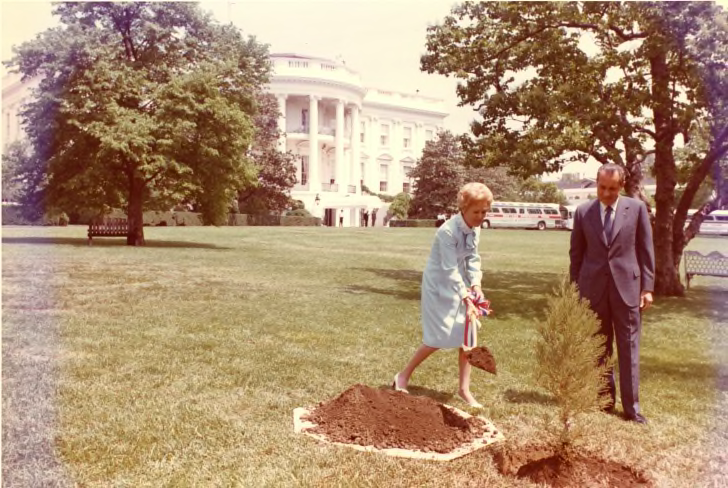
President Richard Nixon and his wife, Pat, plant a tree on the White House lawn during the first Earth Day.
WHITE HOUSE PHOTO OFFICE, WIKIMEDIA COMMONS // PUBLIC DOMAIN
According to Grist, the first Earth Day faced staunch opposition from conservative groups like the John Birch Society, which claimed that the event was a thinly veiled attempt to honor the 100th anniversary of the birth of Vladimir Lenin. In addition to detractors on the far right of the political spectrum, bleeding-heart environmental crusaders weren’t satisfied, either. Earth Day, they claimed, simply served as a distraction from the more pressing social issues of the day. Journalist I.F. Stone said, “The country is slipping into a wider war in Southeast Asia and we’re sitting here talking about litterbugs.” Critics of the holiday also point to the trend of “greenwashing,” an attempt by corporations with poor environmental track records to appear conscientious if only once a year.
6. EARTH DAY SPARKED AN UNPRECEDENTED SLATE OF ENVIRONMENTAL LEGISLATION.
With bipartisan support in Congress and thousands of civic demonstrations across the country, support for environmental reform in 1970 was undeniable. According to the EPA, “Public opinion polls indicate that a permanent change in national priorities followed Earth Day 1970. When polled in May 1971, 25 percent of the U.S. public declared protecting the environment to be an important goal, a 2500 percent increase over 1969.”
The 1970s saw the passage of the most comprehensive environmental legislation in U.S. history, including the Clean Air Act, the Water Quality Improvement Act, the Endangered Species Act, the Toxic Substances Control Act, and the Surface Mining Control and Reclamation Act. In addition, just eight months after the first Earth Day, Richard Nixon approved the creation of a new organization tasked with monitoring the nation’s natural assets: the Environmental Protection Agency.
7. ALTHOUGH IT BEGAN AS AN AMERICAN MOVEMENT, EARTH DAY IS NOW AN INTERNATIONAL PHENOMENON…
In 1990, Earth Day expanded to include countries and peoples across the globe, with 200 million people in 141 nations getting involved. A decade later, at the turn of the new millennium, Earth Day shed light on the emerging Clean Energy movement and expanded its reach, spreading to 184 countries with the help of 5000 environmental organizations. Global activities included a massive traveling drum chain in Gabon, Africa, and an unprecedented gathering of hundreds of thousands of concerned citizens at the National Mall in Washington, D.C. According to Earth Day Network, after 40 years, more than 1 billion people participate in Earth Day activities, making it the largest secular civic event in the world.
8. …AND INTERNATIONALLY, IT’S KNOWN AS INTERNATIONAL MOTHER EARTH DAY.
Earth Day is now observed around the world, albeit under a different name: In 2009, the United Nations General Assembly decided to designate April 22 as International Mother Earth Day. The symbol of Mother Earth serves as a common metaphor and representation of our planet in many countries and cultures. In the United States, the holiday is still commonly referred to as Earth Day.
9. IN 2009, NASA PLANTED A HISTORIC “MOON TREE” TO CELEBRATE EARTH DAY.
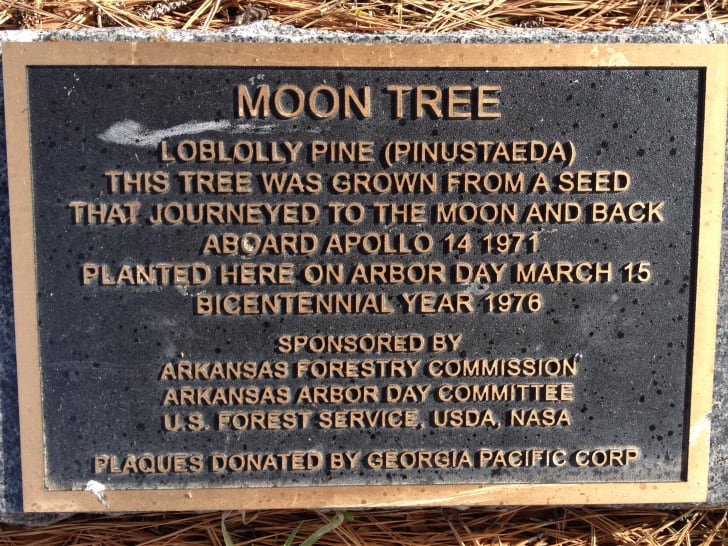
Most of Roosa’s original “Moon Trees” were planted in time for the U.S. Bicentennial in 1976.
JESSE BERRY, WIKIMEDIA COMMONS/CC BY-SA 4.0
During the Apollo 14 moon mission in 1971, astronaut Stuart Roosa brought with him hundreds of tree seeds including Loblolly Pine, Sycamore, Sweetgum, Redwood, and Douglas Fir. Roosa was a former smokejumper for the U.S. Forest Service, and he transported the seeds in his personal effects as a tribute to his former employer. Roosa and his seeds orbited the Moon 34 times in the command module Kitty Hawk. Scientists were curious whether or not exposure to the microgravity of space would impact the growth of these seeds when returned to Earth.
The experiment seemed like a lost cause when, during the post-mission decontamination process, the seed canisters broke open and the seeds were thought to be useless. However, most of the tree seeds were still fit for germination and were successfully planted and cultivated. These trees were planted around National Monuments, as well as in sites all over the world. After decades of growing side-by-side with their Earth cousins, the Moon Trees showed no differences at all. On Earth Day 2009, NASA, in partnership with the United States National Arboretum and American Forests, planted a second generation Moon Sycamore on the arboretum’s grounds in Washington, D.C.

SPONSORED BY IBMMAXIMIZE YOUR CLOUD INVESTMENTWe’ve lowered IBM Cloud bare metal server prices and included up to 20TB of bandwidth. Same power and flexibility. New competitive prices.SEE MORE
10. THE THEME FOR EARTH DAY 2020 IS “CLIMATE ACTION.”
Every year since Earth Day 2016, there has been a new theme attached to the holiday in anticipation for its 50th anniversary in 2020. In 2016, it was Trees for the Earth, followed by Environmental and Climate Literacy in 2017, End Plastic Pollution in 2018, and Protect Our Species in 2019. For 2020, organizers went with an obvious campaign: Climate Action.
Organizers are hopeful that this will be a day to raise awareness of both the dangers of climate change and the opportunities people have to make a difference in the fight. And despite the social distancing necessitated by the coronavirus pandemic, demonstrations and conferences are still happening, albeit virtually. Head to the Earth Day 2020 website find out more.
This story originally ran in 2016.
Earth Day
EARTH DAY 2020 THEME: CLIMATE ACTION
The enormous challenges — but also the vast opportunities — of acting on climate change have distinguished the issue as the most pressing topic for the 50th anniversary. Climate change represents the biggest challenge to the future of humanity and the life-support systems that make our world habitable.
At the end of 2020, nations will be expected to increase their national commitments to the 2015 Paris Agreement on climate change. The time is now for citizens to call for greater global ambition to tackle our climate crisis. Unless every country in the world steps up – and steps up with urgency and ambition — we are consigning current and future generations to a dangerous future.
Earth Day 2020 will be far more than a day. It must be a historic moment when citizens of the world rise up in a united call for the creativity, innovation, ambition, and bravery that we need to meet our climate crisis and seize the enormous opportunities of a zero-carbon future.

BUILDING ON THE EARTH DAY LEGACY
The first Earth Day in 1970 mobilized millions of Americans for the protection of the planet. On April 22, 1970, 20 million Americans — 10% of the U.S. population at the time — took to the streets, college campuses and hundreds of cities to protest environmental ignorance and demand a new way forward for our planet. The first Earth Day is credited with launching the modern environmental movement and is now recognized as the planet’s largest civic event.
Earth Day led to passage of landmark environmental laws in the United States, including the Clean Air, Clean Water and Endangered Species Acts. Many countries soon adopted similar laws, and in 2016, the United Nations chose Earth Day as the day to sign the Paris Climate Agreement into force.

“Despite that amazing success and decades of environmental progress, we find ourselves facing an even more dire, almost existential, set of global environmental challenges, from loss of biodiversity to climate change to plastic pollution, that call for action at all levels of government,” said Denis Hayes, the organizer of the first Earth Day in 1970 and Earth Day Network’s Board Chair Emeritus.
“Progress has slowed, climate change impacts grow, and our adversaries have become better financed,” said Earth Day Network president Kathleen Rogers. “We find ourselves today in a world facing global threats that demand a unified global response. For Earth Day 2020, we will build a new generation of environmentalist activists, engaging millions of people worldwide.”
 Mws R Writings