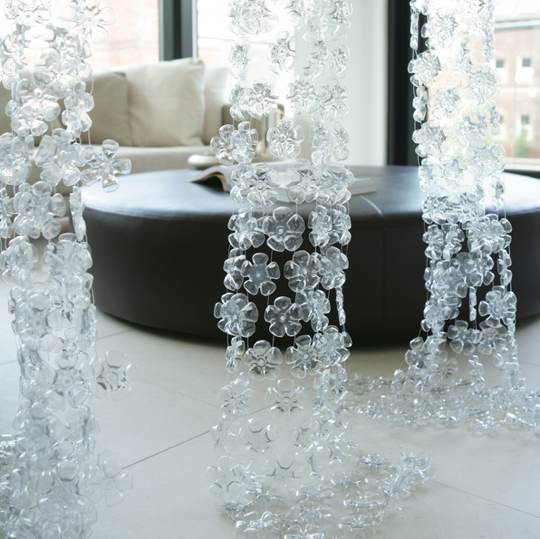
Michelle Brand is an environmental designer who specializes in upcycling plastic bottle bottoms into decor features. Michelle creates plastic bottle flowers by cutting and sanding the plastic bottle bases and tagging them together using a clothing attacher gun.
As an environmental designer, Michelle focuses on working with materials that others consider waste. By turning discarded plastic bottles into art, she challenges the notion that empty plastic bottles are useless. Michelle was drawn to plastic bottles as she find the pre-existing shape and material a challenge. She excels with the medium and uses the plastic bottle flowers to create iconic ceiling to floor pendant lights and flower walls.
In order to make a 6 foot cascade lamp Michelle must hand assemble 540 plastic bottles after first washing, drying, cutting and sanding them. To her the plastic bottle flowers are more than art and carry an educational message to consumers about reusing so-called waste material. Michelle believes consumers are becoming more environmentally savvy and are drawn to upcycled products as they are interesting and exciting. High-end USA chain Neiman Marcus carries her Cascade Lancashire chandelier range.
How better to celebrate than with free noodles? Check out the best deals below to help you make the most of the occasion
But first, how much do you really know about noodles? Check out our top facts about noodles below, from when they were first invented to how they got their name.
Top facts about noodles
Did you know? Noodles were invented in China, and according to National Geographic, a 4,000-year-old bowl of noodles has been discovered.
Though noodles have been a popular food staple for more than 2,000 years, according to National Geographic, it is unclear whether modern pasta was invented by the Chinese, Italians or Arabians.
According to the New Yorker, ramen noodles were brought to Japan by Chinese tradesmen in the nineteenth century, but they gained popularity in the 1970s.
According to the Merriam-Webster dictionary, the word noodle comes from the German word “nudel” and its first known use was in 1779.
Top National Noodle Day Deals
Noodles & Company
Noodles & Company are offering Noodles Rewards members a tasty deal. Members can claim a free small bowl of noodles, Zoodles or Caulifloodles when they buy an entrée on National Noodle Day October 6.
The offer of a free small bowl is valid on a future visit from October 7-20, 2019, and is available at all Noodles restaurants nationwide. Noodles & Company have restaurants across 30 states, so check if there’s a location near you. Find your local Noodles & Company restaurant at noodles.com.
Some of Noodles & Company’s delicious dishes include the new cauliflower rigatone in light onion cream sauce, Wisconsin mac and cheese, spaghetti and meatballs, and spicy Korean beef noodles. No matter what you’re into, there’s sure to be a noodle dish right for you.
If you’re not already, sign up to be a rewards member on the Noodles Rewards app, available in both the Apple App Store and Google Play Store. Or, you can also sign up here.
Kizuki
Kizuki is giving away all four of its most popular ramens to a lucky winner—but you have to be quick. Kizuki is hosting the giveaway on their Instagram until 11.59 p.m. tonight (October 6). All you have to do is like their page, posts, and tag a friend in the comments. The winner will be revealed on October 7, and the prize is redeemable until October 31.
Kizuki Ramen aims to serve the most traditional, authentic and delicious Japanese ramen possible, without you actually having to fly to Japan. They have locations in Washington, Oregon, Indiana, and Illinois.
Mr. Lee’s Noodles
Mr. Lee’s Noodles are hosting a competition to win a selection box of noodles. All you have to do is follow Mr. Lee’s Noodles on Twitter, and retweet their competition tweet. The contest ends at 6 p.m. on October 8.
Mr. Lee’s Noodles make their noodles with no MSG or hydrogenated fat and they are certified low in sugar and gluten-free. Plus, they have vegan options too.
How better to celebrate than with free noodles? Check out the best deals below to help you make the most of the occasion.
But first, how much do you really know about noodles? Check out our top facts about noodles below, from when they were first invented to how they got their name.
Top facts about noodles
Did you know? Noodles were invented in China, and according to National Geographic, a 4,000-year-old bowl of noodles has been discovered.
Though noodles have been a popular food staple for more than 2,000 years, according to National Geographic, it is unclear whether modern pasta was invented by the Chinese, Italians or Arabians.
According to the New Yorker, ramen noodles were brought to Japan by Chinese tradesmen in the nineteenth century, but they gained popularity in the 1970s.
According to the Merriam-Webster dictionary, the word noodle comes from the German word “nudel” and its first known use was in 1779.
Top National Noodle Day Deals
Noodles & Company
Noodles & Company are offering Noodles Rewards members a tasty deal. Members can claim a free small bowl of noodles, Zoodles or Caulifloodles when they buy an entrée on National Noodle Day October 6.
The offer of a free small bowl is valid on a future visit from October 7-20, 2019, and is available at all Noodles restaurants nationwide. Noodles & Company have restaurants across 30 states, so check if there’s a location near you. Find your local Noodles & Company restaurant at noodles.com.
Some of Noodles & Company’s delicious dishes include the new cauliflower rigatone in light onion cream sauce, Wisconsin mac and cheese, spaghetti and meatballs, and spicy Korean beef noodles. No matter what you’re into, there’s sure to be a noodle dish right for you.
If you’re not already, sign up to be a rewards member on the Noodles Rewards app, available in both the Apple App Store and Google Play Store. Or, you can also sign up here.
Kizuki
Kizuki is giving away all four of its most popular ramens to a lucky winner—but you have to be quick. Kizuki is hosting the giveaway on their Instagram until 11.59 p.m. tonight (October 6). All you have to do is like their page, posts, and tag a friend in the comments. The winner will be revealed on October 7, and the prize is redeemable until October 31.
Kizuki Ramen aims to serve the most traditional, authentic and delicious Japanese ramen possible, without you actually having to fly to Japan. They have locations in Washington, Oregon, Indiana, and Illinois.
Mr. Lee’s Noodles
Mr. Lee’s Noodles are hosting a competition to win a selection box of noodles. All you have to do is follow Mr. Lee’s Noodles on Twitter, and retweet their competition tweet. The contest ends at 6 p.m. on October 8.
Mr. Lee’s Noodles make their noodles with no MSG or hydrogenated fat and they are certified low in sugar and gluten-free. Plus, they have vegan options too.
A Guide to The Jewish Holiday of Sukkot, The Feast of Tabernacles, and the Meanings Behind it
By Menachem Posner
Sukkot 2019 (October 13-20, 2019)
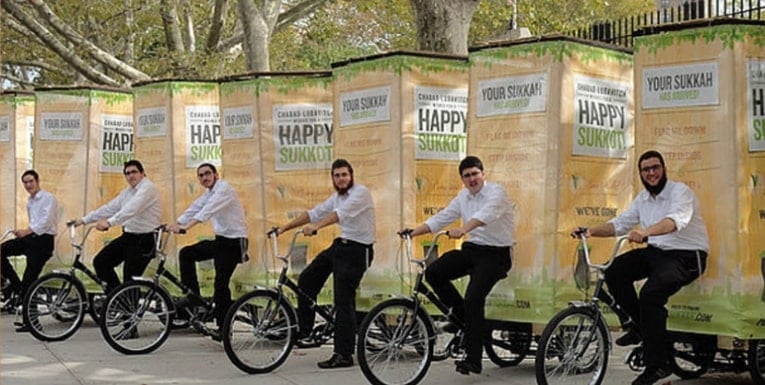
Sukkot is a weeklong Jewish holiday that comes five days after Yom Kippur. Sukkot celebrates the gathering of the harvest and commemorates the miraculous protection G‑d provided for the children of Israel when they left Egypt. We celebrate Sukkot by dwelling in a foliage-covered booth (known as a sukkah) and by taking the “Four Kinds” (arba minim), four special species of vegetation.
The first two days (sundown on October 13 until nightfall on October 15 in 2019) of the holiday (one day in Israel) are yom tov, when work is forbidden, candles are lit in the evening, and festive meals are preceded by Kiddush and include challah dipped in honey.
The intermediate days (nightfall on October 15 until sundown on October 20 in 2019) are quasi holidays, known as Chol Hamoed. We dwell in the sukkah and take the Four Kinds every day of Sukkot (except for Shabbat, when we do not take the Four Kinds).
The final two days (sundown on October 20 until nightfall on October 22 in 2019) are a separate holiday (one day in Israel): Shemini Atzeret / Simchat Torah.
The Significance of Sukkot
Of all the Jewish holidays, Sukkot is the only one whose date does not seem to commemorate a historic event. The Torah refers to it by two names: Chag HaAsif (“the Festival of Ingathering,” or “Harvest Festival”) and Chag HaSukkot (“Festival of Booths”), each expressing a reason for the holiday.
In Israel, crops grow in the winter and are ready for harvest in the late spring. Some of them remain out in the field to dry for a few months and are only ready for harvest in the early fall. Chag HaAsif is a time to express appreciation for this bounty.
The name Chag HaSukkot commemorates the temporary dwellings G‑d made to shelter our ancestors on their way out of Egypt (some say this refers to the miraculous clouds of glory that shielded us from the desert sun, while others say it refers to the tents in which they dwelled for their 40-year trek through the Sinai desert).
Dwelling in the Sukkah
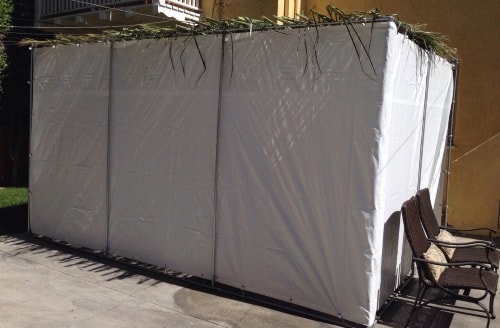
For seven days and nights, we eat all our meals in the sukkah and otherwise regard it as our home. Located under the open sky, the sukkah is made up of at least three walls and a roof of unprocessed natural vegetation—typically bamboo, pine boughs or palm branches.
The goal is to spend as much time as possible in the sukkah, at the very minimum eating all meals in the sukkah—particularly the festive meals on the first two nights of the holiday, when we must eat at least an olive-sized piece of bread or mezonot (grain-based food) in the sukkah. The Chabad practice is to not eat or drink anything outside the sukkah. Some people even sleep in the sukkah (this is not the Chabad custom).
Rabbi Danny Cohen of Chabad of Hebron and his son Shneor offer the lulav and etrog to a soldier during Sukkot. (Photo: Israel Bardugo)
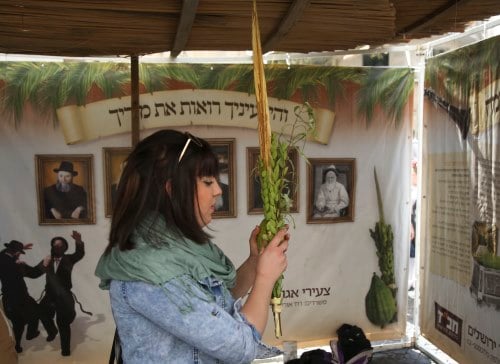
Another Sukkot observance is the taking of the Four Kinds: an etrog (citron), a lulav (palm frond), three hadassim (myrtle twigs) and two aravot (willow twigs).
(Read more here: Four Kinds Owner’s Manual)
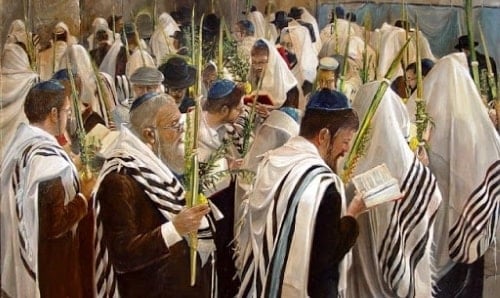
On each day of the festival (except Shabbat), we take the Four Kinds, recite a blessing over them, bring them together and wave them in all six directions: right, left, forward, up, down and backward. The sages of the Midrash tell us that the Four Kinds represent the various personalities that comprise the community of Israel, whose intrinsic unity we emphasize on Sukkot.
Jews circling the bimah on Sukkot. Credit: Alex Levin
Every day of Sukkot we say Hallel, a collection of psalms of praise (Psalms 113-118) as part of the morning prayer service. Every day aside for Shabbat, we recite Hallel while holding the Four Kinds, waving them in all directions at certain key points in the service, which are outlined in the siddur (prayerbook).
Afterward, we circle the bimah (the podium on which the Torah is read) holding the Four Kinds, reciting alphabetically arranged prayers for Divine assistance known as Hoshanot.
The seventh day of the holiday is known as Hoshanah Rabbah. This is the day when our fates for the coming year—which were signed on Rosh Hashanah and sealed on Yom Kippur—are finalized. On this day, we circle the bimah seven times. We also say a short prayer and strike the ground five times with bundles of five willows (also known as Hoshanot)
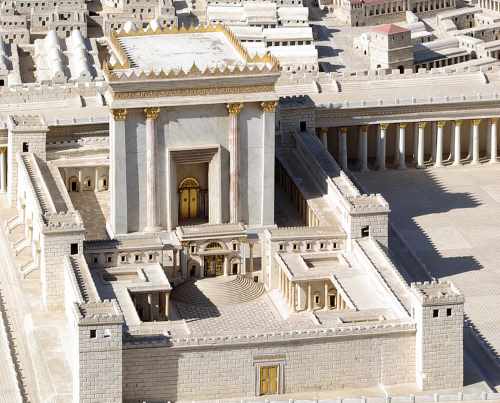
In the days of the holy Temple in Jerusalem, there was a special regimen of sacrifices that were to be brought on the altar. On the first day, no less than 13 bulls, two rams, and 14 lambs were to be sacrificed. Every day, the number of bulls was depleted by one. All in all, 70 bulls were brought, corresponding to the 70 nations of the world.
Along with Passover and Shavuot, Sukkot is one of the Shalosh Regalim, the three annual pilgrimages, when every male Jew was to be in Jerusalem. Every seven years, on Sukkot, the king would read aloud from the Torah to the entire nation—men, women and children. This special gathering was known as Hakhel.
On Sukkot, G‑d determines how much rain will fall that winter (the primary rainy season in Israel). Thus, while every sacrifice in the Temple included wine libations poured over the altar, on Sukkot, water was also poured over the altar in a special ceremony. This ritual engendered such joy that it was celebrated with music, dancing and singing all night long. This celebration was called “Simchat Beit Hasho’evah.”
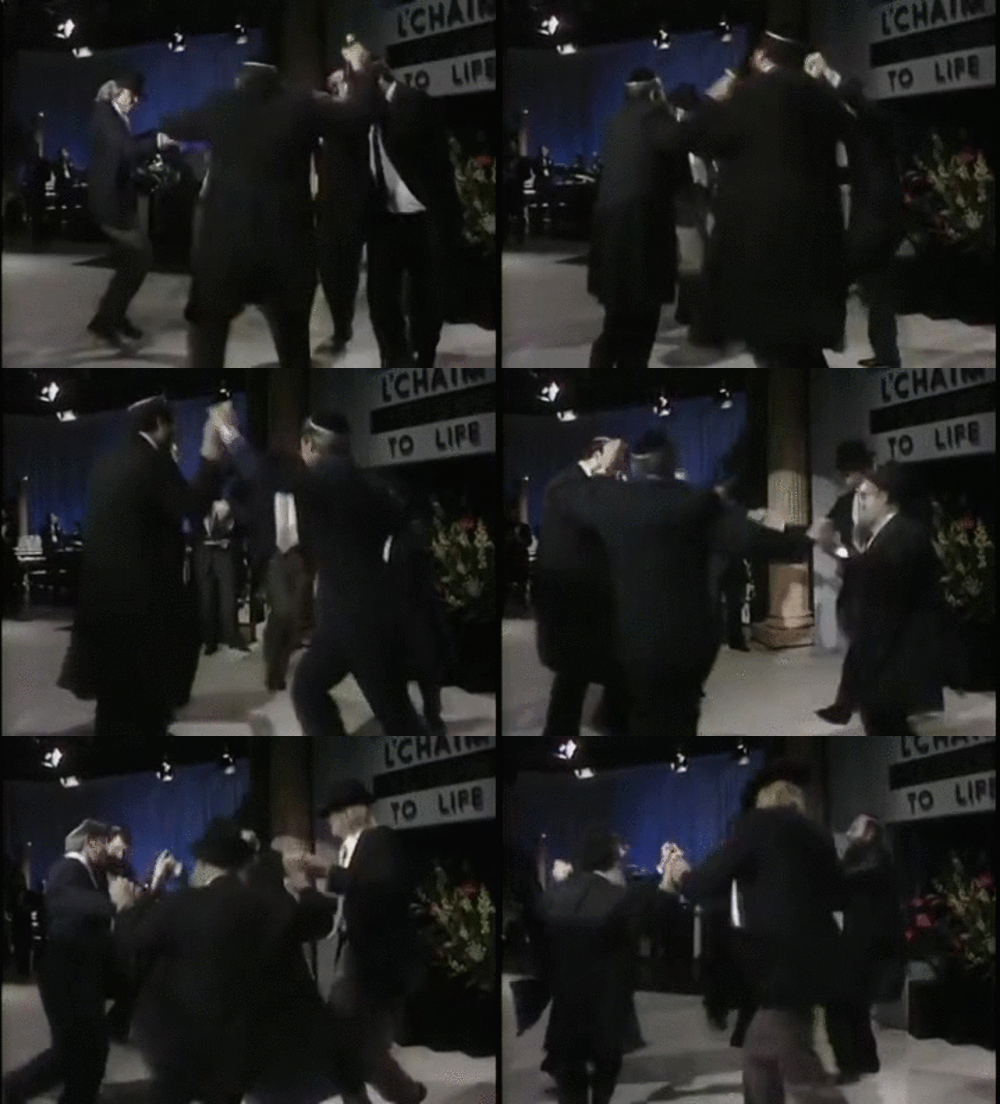
Even today, when there is no Temple, it is customary to hold nightly celebrations that include singing and dancing (and even live music during the intermediate days of the holiday).
This holiday is so joyous that in Talmudic times, when someone said the word chag (“holiday”) without specifying which one, you could know that they were referring to Sukkot.
The Torah tells us that after the seven days of Sukkot, we should celebrate an eighth day. In the diaspora, this eighth day is doubled, making two days of yom tov. On the final day, it is customary to conclude and then immediately begin the annual cycle of Torah reading, making this day Simchat Torah (“Torah Celebration”).
Although the eighth day follows Sukkot, it is actually an independent holiday in many respects (we no longer take the Four Kinds or dwell in the sukkah). Diaspora Jews eat in the sukkah, but without saying the accompanying blessing (there are some who eat just some of their meals in the sukkah on the eighth day but not the ninth).
The highlight of this holiday is the boisterous singing and dancing in the synagogue, as the Torah scrolls are paraded in circles around the bimah.
By the time Simchat Torah is over, we have experienced a spiritual roller coaster, from the solemn introspection of the High Holidays to the giddy joy of Sukkot and Simchat Torah. Now it is time to convert the roller coaster into a locomotive, making sure that the inspiration of the holiday season propels us to greater growth, learning and devotion in the year ahead.By Menachem Posner
Rabbi Menachem Posner serves as staff editor at Chabad.org, the world’s largest Jewish informational website. He has been writing, researching, and editing for Chabad.org since 2006, when he received his rabbinic degree from Central Yeshiva Tomchei Temimin Lubavitch. He resides in Chicago, Ill., with his family.More from Menachem Posner | RSS
There is a hole Where all the spillage goes. Where it all flows down The crap that comes from frowns. It’s not clear where it all goes But away from me is all I know. No stopper can keep it all in one place Just like emotions can change a person’s face. Along the way down things start to break apart Changing forever, the compound, the heart, Never to return, any more pain Like a person’s internal drain.









 Mws R Writings