Menopause is defined as the point when it’s been a full year since your last menstrual period. For women in the United States, this occurs around age 51. You may not realize that perimenopause starts as early as your late 30s, as changes in hormones begin to cause symptoms such as fatigue, brain fog and fuzzy thinking, and weight changes. You are also more likely to develop a thyroid condition as you age. This makes it confusing to tell if symptoms are due to perimenopause, thyroid disease, or both.
The Symptoms of Perimenopause/Menopause and Thyroid Are Almost Identical
Hypothyroidism can also cause amenorrhea (absence of menstrual cycles). It can be confusing to determine if your symptoms are due to perimenopause/menopause and/or thyroid disease because the signs and symptoms are almost identical.
Always Check Your Thyroid First!
If you have menopause and/or thyroid symptoms, your first step should be to ask for a comprehensive thyroid evaluation. Testing for thyroid disease — including a thyroid stimulating hormone (TSH), Free T4, Free T3, and antibody levels — can help detect an undiagnosed thyroid condition. According to the American Association of Clinical Endocrinologists, only 25 percent of women who discuss menopause with a doctor is also tested for thyroid disease. That means, it’s up to you to ask. Thyroid diseases may run in families.
If Your Periods Stop or Are Irregular, It May Be Thyroid … Not Menopause
An erratic menstrual cycle is common during perimenopause. And the most definitive sign that menopause is underway is that your menstrual periods stop. If your periods are irregular or have stopped, you and your doctor may assume that it’s related to perimenopause/menopause. Menstrual issues are, however, common symptoms of untreated thyroid conditions. Always ask for a complete thyroid evaluation to rule out your thyroid as a cause for any menstrual irregularities.
Thyroid Treatment May Resolve Your Perimenopausal/Menopausal Symptoms
In some cases, symptoms attributed to perimenopause/menopause may be partially or fully resolved when you get your thyroid condition properly diagnosed and optimally treated. If you are experiencing symptoms and are diagnosed with a thyroid problem, talk to your healthcare provider about the benefit of pursuing thyroid treatment before considering hormone replacement therapy (HRT) for menopause.
If HRT Isn’t Working, Check Your Thyroid
While hormone replacement therapy (HRT) is not used as extensively as it was in the past, women with debilitating menopausal symptoms are sometimes prescribed estrogen, progesterone, or combination HRT. If your HRT is not resolving your symptoms, however, this is an indicator that you should pursue a comprehensive thyroid evaluation.
Get Moving!
Regular exercise and physical activity can reduce inflammation, help improve your sleep and mood, and resolve many perimenopausal/menopausal symptoms. Don’t overdo it with debilitating workouts that raise stress hormones and cause burnout. My favorite program is the “Mindful Movement for Healthy Hormones and Menopause Management” DVD from exercise physiologist Teresa Tapp.
iStock
Try a Mind-body Approach
If your symptoms aren’t relieved by traditional medical treatments, consider mindfulness practices, especially guided meditation. Research shows that guided meditation and mindfulness approaches such as meditation, yoga, and breathwork can help improve a variety of menopausal symptoms. My recommendation is Demo DiMartile’s guided meditation CD/MP3 audio, Hormonal Balance: Restoring Inner Peace & Power.
Melatonin is a Master Hormonal Conductor
You may think of melatonin as a sleep or jetlag remedy. But it’s a support for hormone function. For me, after years of erratic periods during perimenopause, supplementing with 3 mg of melatonin nightly regulated my cycle and relieving morning fatigue for years. While more studies need to be done on the effect that melatonin has on thyroid hormone levels, you can learn more about the hormonal power of melatonin—including improved T4-to-T3 conversion and elimination of morning depression in menopausal women—l report on the Reversal of Aging.
iStock
Maca May Be a Helpful Natural Solution
For centuries, the root vegetable maca has been a natural remedy for menopausal symptoms — a use now supported by research. Maca doesn’t contain hormones; it helps your body balance estrogen, progesterone, and other hormones – including the thyroid – more effectively. This can relieve symptoms such as hot flashes and low sex drive. (Avoid improperly-prepared maca. If not heated, it can aggravate thyroid problems.) I recommend therapeutic-grade Royal Maca from Whole World Botanicals — one of my menopause go-to’s
iStock
See a Menopause Expert
Some endocrinologists have expertise in managing perimenopause/menopause, but many don’t. Similarly, some gynecologists have expertise in managing thyroid conditions, but many don’t. You may want to consult with Certified Menopause Practitioners (CMP) for additional guidance. https://www.healthcentral.com/slideshow/managing-menopause-and-thyroid-disease
Keeping your pantry neat and organized is a must when trying to organize your kitchen. Try taking a day to pull everything out and check expiration dates. Pitch anything that is outdated or that you are not going to ever use. Store all baking supplies in clearly labeled containers with lids that seal well. Having everything in categories like baking, breakfast, quick meals and cans can make finding items a lot faster and easier.
-Have a place for everything and keep everything in its place as soon as you finish using it. Keep all of your mixers, toasters in a central location that has plenty of space and easy to grab when you are ready to use them. It may be easier when trying to organize your kitchen to use labels inside the cabinet to help you and your family remember where each item needs to go. Make sure that you put each item back in its home immediately after using it. Soon enough you won’t have to think about it anymore…..you will have developed a new habit. 🙂
-Take time each week to clean and organize your refrigerator and freezer. There is nothing more time consuming than digging in the fridge every 5 minutes to find a missing item. Pick a day that works best for you and quickly pull everything out and wipe it down. Keep all your condiments in one centralized location like in the door or on a Lazy Susan in your fridge. These items can tend to get scattered all over your fridge making it hard to find other items. Keeping leftovers on the same shelf in clear easily identified containers will make it easier to find and helps keep waste down. Nobody likes to find a leftover science project in the back of the fridge!
Keeping your refrigerator door cleaned off and cabinets wiped down can do wonders for making your kitchen look better. Try organizing your notes or children’s artwork in another room of the house. It is beautiful but can make your kitchen look a little less tidy. Try hanging them in old picture frames in the living room for a beautiful display. If you wipe up spills that have made their way onto your counters and cabinets immediately it will take you half the time to clean them up. It’s much easier than letting the gunk dry and then trying to scrub it off.
-World renowned chefs have said many times over the years that it is important to create “stations” in your kitchen. What this does is groups items together that you would use for certain tasks and keeps you from walking back and forth across your kitchen a million times. Here are some ideas to get you started.
Cutting station – Keep items in here that you use when cutting, chopping or dicing. This station is best located near your sink and trash can. Items like knives, food processor, cutting boards and grating utensils.
Baking station – You baking station should be kept near your stove and house items like your baking pans, mixing bowls, spatulas and measuring cups keeping everything close and ready for all your baking needs.
Cooking station – This one is another that is best kept near your stove. You can store all of your pans, baking dishes, spoons, spatulas and pot holders here and ready to go.
Yoga is a known stress buster, but it’s also one of the most effective workouts for fighting stubborn fat stores, especially the ones that crop up after age 40. . The reason: Studies show that yoga lowers levels of stress hormones and increases insulin sensitivity—a signal to your body to burn food as fuel rather than store it as fat. The following yoga poses for weight loss will do just that while firming up your arms, legs, butt, and abs. Start now to see weight loss results in as little as 3 weeks. (Cinch your waist and get toned all over with Prevention’s Flat Belly Yoga DVD.)
Workout at a Glance What you need: A yoga mat or carpeted space How to do it: Follow this routine at least 3 times a week, holding each move 1 time for 3 to 5 deep breaths, unless otherwise noted. Start with the Main Move for each exercise. If it’s too difficult, do the Make It Easier variation. If it’s not challenging enough, try the Make It Harder option. For faster results, hold each pose for 5 to 8 breaths and increase repetitions (where noted) by 2 or 3.
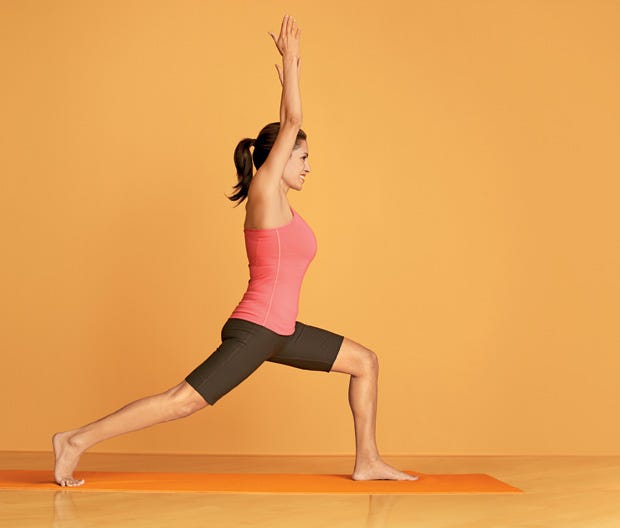
Crescent
(Firms abs, hips, and thighs)
David Martinez
Advertisement – Continue Reading Below
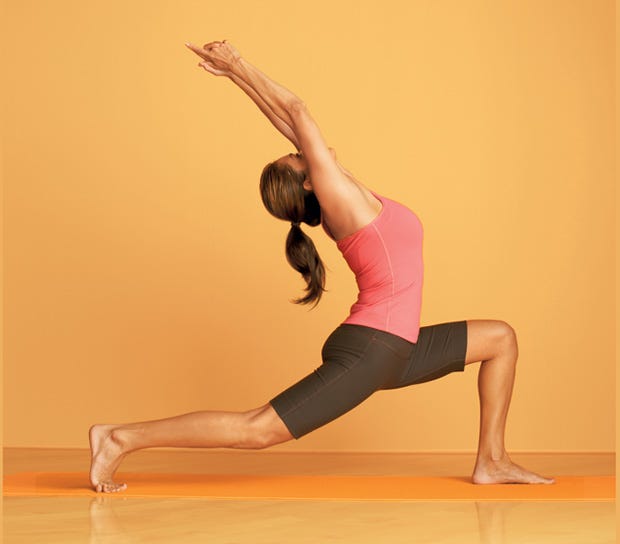
Stand with feet together, toes forward, and arms at sides. Inhale and raise arms overhead, reaching fingertips toward ceiling. Exhale, and bend forward from hips, bringing hands to floor (it’s OK to bend knees). Inhale, and as you exhale, step right leg back into a lunge (left knee bent about 90 degrees, knee over ankle; right leg extended and on ball of foot). Inhale and raise arms overhead; gaze forward. Hold, then return to standing and repeat, stepping left leg back. Make it harder:
David Martinez
From end position, inhale and arch torso, arms, and head backward, gazing at fingertips. Make it easier: Lower right knee to touch floor as you step back into a lunge, and rest hands on left thigh.
Willow
(Firms sides of abs)
David Martinez
Advertisement – Continue Reading Below
Stand with feet together, arms at sides. Place sole of left foot on inside of right thigh, knee bent to side. Touch palms in front of chest for 2 breaths. On third inhale, extend arms up, fingertips toward ceiling. Exhale, and bend torso to left. Inhale and straighten. Repeat 3 to 5 times, pressing foot into thigh; switch sides. Make it easier: Keep left foot on calf or touch toes to floor for balance. Make it harder: Close eyes as you balance and bend.
Rocking Boat
(Firms abs and back)
David Martinez
Sit with knees bent, feet on floor, hands on thighs. With torso straight and head in line with body, lean back about 45 degrees, raising feet so calves are parallel to floor, toes pointed. On an inhale, extend arms and legs, keeping legs together. Exhale, and as you inhale, lower torso and legs 3 to 4 inches so body forms a wider V shape. Exhale and raise torso and legs. Repeat 3 to 5 times. Make it easier: Hold backs of thighs with hands and keep legs bent. Lower torso only. Make it harder: Once in the wider V position, extend arms overhead.
Hover
(Firms shoulders, arms, abs, and back)
David Martinez
Begin in push-up position on toes with arms straight, hands below shoulders, and body in line from head to heels. On an exhale, lower chest toward floor, bending elbows back, arms close to body, abs tight. Hold a few inches above floor. Make it easier: Begin on hands and knees and walk hands forward until body is in line from head to knees. Make it harder: While holding the hover, lift left leg 6 to 12 inches, pause, and lower. Do 3 to 5 times, then switch legs.
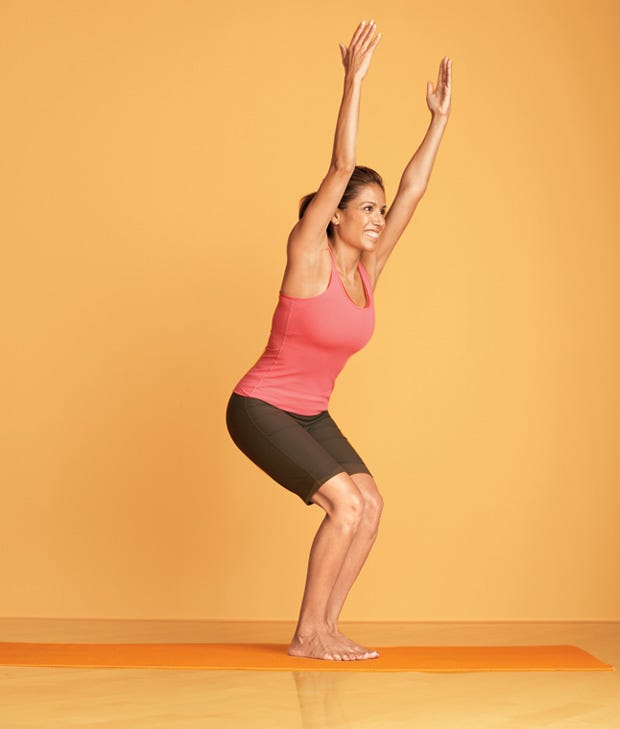
Chair
(Firms butt and thighs)
David Martinez Stand with feet together, toes forward, arms at sides. Inhale and raise arms overhead, palms facing each other. Exhale and sit back about 45 degrees, keeping knees behind toes and abs tight to support your back; gaze forward. Make it easier: Do the move with feet hip-distance apart, hands on thighs, and bend only about 30 degrees. Make it harder: After you sit back, lift heels off floor, balancing on balls of feet (knees will be in front of toes); gaze up at fingertips. marianne mcginnis Marianne McGinnis is a former Prevention associate editor.

















 Mws R Writings