Lucky for us, there are garden plants that naturally send bad bugs packing. These insect-repelling plants generally have strong odors and oils that are offensive to some mosquitoes, flies, and other bugs. Add these human-safe, natural bug-control plants to your containers and patio plantings to lessen the bug population for your next backyard gathering.
Basil
Grow this excellent mosquito repellent as a centerpiece on your patio table, or plant a drift of basil in the garden bed. Both insect-repelling and a culinary herb, basil is easy to grow from seed or transplants. There are many varieties of basil—and they all repel insects—so choose the variety that best suits your needs. Try ‘Thai Magic’ for use in Southeast Asian dishes or ‘Spicy Globe’ for a tabletop container.
Mint
Rodents will also be far away with the help of a plant. Mint plants, such as peppermint, can deter rodents in your home. Pests, such as mosquitoes, ants, flies; and other rodents, such as mice and rats, will be no more with this plant lying around. Mint can be in the form of crushed leaves, oils, sprays, or even mint gum to shoo them away for good.
Crush Leaves and Stems
You need to get rough with insect-repelling plants to bring out their repelling power! These special plants are ineffective when they’re just sitting in a pot or merely growing in the soil next to a patio. The leaves must be crushed to release their volatile oils, which ward off stinging and biting invaders.
Don’t hesitate to crush a few leaves between your fingers as you pass by insect-repelling plants. You can also rub the broken leaves on your skin for extended bug repellent.
Special note: Be sure to test for any allergy first by rubbing the leaves on a quarter-size patch of skin on your inner forearm for a day or so; if there’s no irritating skin reaction, it’s likely safe for you to rub away.
Lemongrass
Whether you grow it as a container plant or in the garden, lemongrass has an elegant upright appearance and lovely bright green foliage. The leaves and stems can be harvested for culinary use in Vietnamese and Thai dishes. Snip a few inches off the leaf tips to release the plant’s natural bug-repelling oils. Lemongrass is easy to grow from seed and is considered a tender perennial. It doesn’t tolerate freezing temperatures but enjoy it year-round by growing it in a pot and bringing it inside in the winter.
Lavender
Lavender has a charming scent we all know and love—except for some insects, that is. Mosquitoes, moths, and flies tend to stay away from lavender plants in general, but the most effective way to keep them away is to rub the plant on your skin and nearby surfaces to release the oils.
Remember: Bugs Do Good Work
The ecosystem consists of multitudes of beneficial insects. These hardworking insects are essential pollinators and crucial to our food system while keeping bothersome bugs in check. Protect the ecosystem by not using chemical bug repellents unless necessary.
Lemon Thyme
A creeping herb with a bright citrus fragrance, lemon thyme releases oils that repel many kinds of bugs. Use lemon thyme as a groundcover and enjoy its insect-repelling properties every time you tread on it. Lemon thyme grows well in full sun and well-drained soil. It is drought-tolerant and easy to grow from transplants purchased at the garden center.
A popular culinary herb, lemon thyme has the best flavor before the plant flowers.
Garlic
A great companion plant for many food crops, garlic can repel several insect pests. Plant it near plants in the cabbage family, as well as carrots and tomatoes. Garlic is planted from individual cloves purchased at the garden center. Plant the cloves in fall, and shoots will emerge from the soil the following spring.
More Bug-Smart Strategies
In addition to employing bug-repelling plants in the garden, try these tactics to keep mosquitoes, biting flies, and other troublesome bugs at bay.
Go weed-free. Weed plants create food and shelter sources for bad bugs. They also rob nutrients and water from nearby good garden plants.
Promote healthy plants. Plant the right plant in the right place to promote healthy, strong plants that naturally ward off diseases and insects. Grow sun plants in the sun and shade plants in shade.
Mulch. A 2-inch-thick layer of mulch suppresses weeds and prevents soil moisture loss, creating a healthy growing zone.
Search for pest-resistant varieties. Some plant varieties are selected to be more resistant to insect pests than other varieties. Search out plants that have good pest resistance.
Eliminate standing water.
Catnip
A perennial herb in the mint family, catnip is typically marketed to cat-lovers, but it possesses mosquito-repelling ability that rivals some commercial bug sprays. Plant in full sun and moist, well-drained soil. Start catnip from transplants purchased at the garden center; the plant’s tiny seed is tough to germinate.
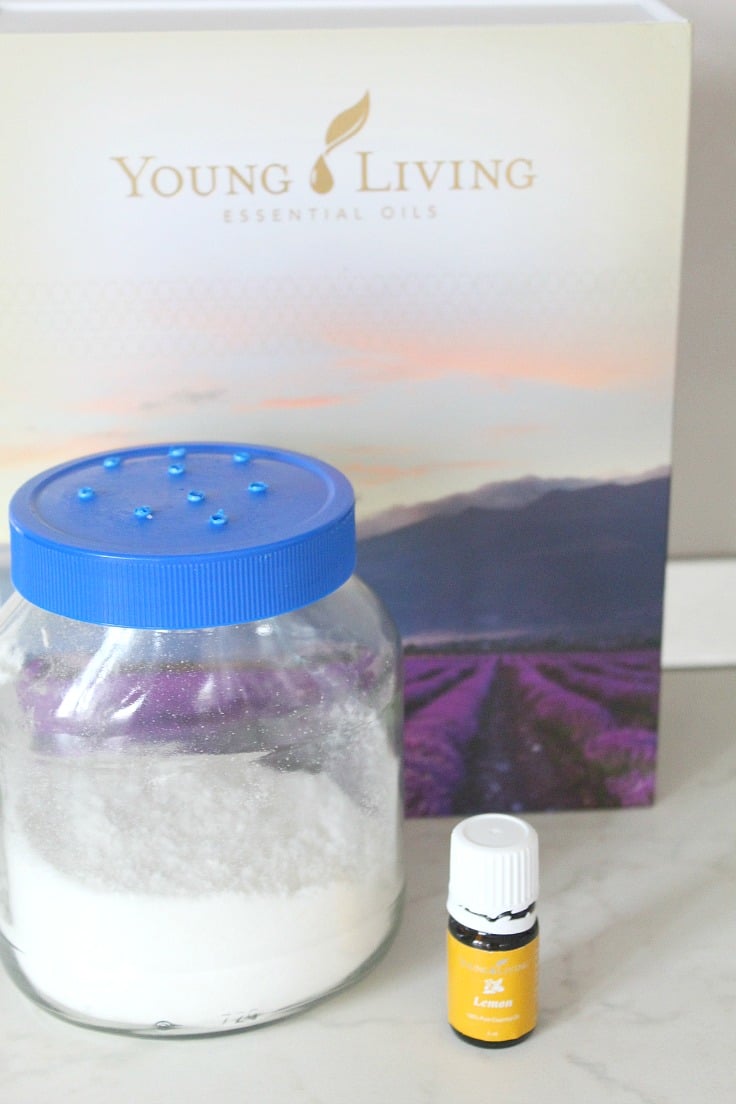
Borax, Baking soda, Salt and lemon essential oils from Young Living. Borax and baking soda will kill the adult fleas, the salt will dry up the eggs and the essential oils will make your house smell absolutely divine! Plus if you use lemon or lavender scents, these are natural flea repellents so any possible unwanted visitors that you may have missed will stay away from your house.
When we started for our drive the sun was shining brightly on Munich, and the air was full of the joyousness of early summer. Just as we were about to depart, Herr Delbruck (the maitre d’hotel of the Quatre Saisons, where I was staying) came down bareheaded to the carriage and, after wishing me a pleasant drive, said to the coachman, still holding his hand on the handle of the carriage door, “Remember you are back by nightfall. The sky looks bright but there is a shiver in the north wind that says there may be a sudden storm. But I am sure you will not be late.” Here he smiled and added,”for you know what night it is.”
Johann answered with an emphatic, “Ja, mein Herr,” and, touching his hat, drove off quickly. When we had cleared the town, I said, after signalling to him to stop:
“Tell me, Johann, what is tonight?”
He crossed himself, as he answered laconically: “Walpurgis nacht.” Then he took out his watch, a great, old-fashioned German silver thing as big as a turnip and looked at it, with his eyebrows gathered together and a little impatient shrug of his shoulders. I realized that this was his way of respectfully protesting against the unnecessary delay and sank back in the carriage, merely motioning him to proceed. He started off rapidly, as if to make up for lost time. Every now and then the horses seemed to throw up their heads and sniff the air suspiciously. On such occasions I often looked round in alarm. The road was pretty bleak, for we were traversing a sort of high windswept plateau. As we drove,I saw a road that looked but little used and which seemed to dip through a little winding valley. It looked so inviting that, even at the risk of offending him, I called Johann to stop–and when he had pulled up, I told him I would like to drive down that road. He made all sorts of excuses and frequently crossed himself as he spoke. This somewhat piqued my curiosity, so I asked him various questions. He answered fencingly and repeatedly looked at his watch in protest.
Finally I said, “Well, Johann, I want to go down this road. I shall not ask you to come unless you like; but tell me why you do not like to go, that is all I ask.” For answer he seemed to throw himself off the box, so quickly did he reach the ground. Then he stretched out his hands appealingly to me and implored me not to go. There was just enough of English mixed with the German for me to understand the drift of his talk. He seemed always just about to tell me something–the very idea of which evidently frightened him; but each time he pulled himself up saying, “Walpurgis nacht!”
I tried to argue with him, but it was difficult to argue with a man when I did not know his language. The advantage certainly rested with him, for although he began to speak in English, of a very crude and broken kind, he always got excited and broke into his native tongue–and every time he did so, he looked at his watch. Then the horses became restless and sniffed the air. At this he grew very pale, and, looking around in a frightened way, he suddenly jumped forward, took them by the bridles,and led them on some twenty feet. I followed and asked why he had done this. For an answer he crossed himself, pointed to the spot we had left, and drew his carriage in the direction of the other road, indicating a cross, and said, first in German, then in English, “Buried him–him what killed themselves.”
I remembered the old custom of burying suicides at cross roads: “Ah! I see, a suicide. How interesting!” But for the life of me I could not make out why the horses were frightened.
Whilst we were talking, we heard a sort of sound between a yelp and a bark.It was far away; but the horses got very restless, and it took Johann all his time to quiet them. He was pale and said, “It sounds like a wolf–but yet there are no wolves here now.”
“No?” I said, questioning him. “Isn’t it long since the wolves were so near the city?”
“Long, long,” he answered, “in the spring and summer; but with the snow the wolves have been here not so long.”
Whilst he was petting the horses and trying to quiet them, dark clouds drifted rapidly across the sky. The sunshine passed away, and a breath of cold wind seemed to drift over us.It was only a breath, however, and more of a warning than a fact, for the sun came out brightly again.
Johann looked under his lifted hand at the horizon and said, “The storm of snow, he comes before long time.” Then he looked at his watch again, and, straightway holding his reins firmly–for the horses were still pawing the ground restlessly and shaking their heads–he climbed to his box as though the time had come for proceeding on our journey.
I felt a little obstinate and did not at once get into the carriage.
“Tell me,” I said, “about this place where the road leads,” and I pointed down.
Again he crossed himself and mumbled a prayer before he answered, “It is unholy.”
“What is unholy?” I enquired.
“The village.”
“Then there is a village?”
“No, no. No one lives there hundreds of years.”
My curiosity was piqued, “But you said there was a village.”
“There was.”
“Where is it now?”
Whereupon he burst out into a long story in German and English, so mixed up that I could not quite understand exactly what he said. Roughly I gathered that long ago, hundreds of years, men had died there and been buried in their graves; but sounds were heard under the clay, and when the graves were opened,men and women were found rosy with life and their mouths red with blood. And so, in haste to save their lives (aye, and their souls!–and here he crossed himself)those who were left fled away to other places, where the living lived and the dead were dead and not–not something. He was evidently afraid to speak the last words. As he proceeded with his narration, he grew more and more excited. It seemed as if his imagination had got hold of him, and he ended in a perfect paroxysm of fear–white-faced, perspiring, trembling, and looking round him as if expecting that some dreadful presence would manifest itself there in the bright sunshine on the open plain.
Finally, in an agony of desperation, he cried, “Walpurgis nacht!” and pointed to the carriage for me to get in.
All my English blood rose at this,and standing back I said, “You are afraid, Johann–you are afraid. Go home, I shall return alone, the walk will do me good.” The carriage door was open. I took from the seat my oak walking stick–which I always carry on my holiday excursions–and closed the door, pointing back to Munich, and said, “Go home,Johann–Walpurgis nacht doesn’t concern Englishmen.”
The horses were now more restive than ever, and Johann was trying to hold them in, while excitedly imploring me not to do anything so foolish. I pitied the poor fellow, he was so deeply in earnest; but all the same I could not help laughing. His English was quite gone now. In his anxiety he had forgotten that his only means of making me understand was to talk my language, so he jabbered away in his native German. It began to be a little tedious. After giving the direction, “Home!” I turned to go down the cross road into the valley.
With a despairing gesture,Johann turned his horses towards Munich. I leaned on my stick and looked after him. He went slowly along the road for a while, then there came over the crest of the hill a man tall and thin. I could see so much in the distance. When he drew near the horses,they began to jump and kick about, then to scream with terror. Johann could not hold them in; they bolted down the road, running away madly. I watched them out of sight, then looked for the stranger; but I found that he, too, was gone.
With a light heart I turned down the side road through the deepening valley to which Johann had objected. There was not the slightest reason,that I could see, for his objection; and I daresay I tramped for a couple of hours without thinking of time or distance and certainly without seeing a person or a house. So far as the place was concerned, it was desolation itself. But I did not notice this particularly till, on turning a bend in the road,I came upon a scattered fringe of wood; then I recognized that I had been impressed unconsciously by the desolation of the region through which I had passed.
I sat down to rest myself and began to look around. It struck me that it was considerably colder than it had been at the commencement of my walk–a sort of sighing sound seemed to be around me with, now and then, high overhead, a sort of muffled roar. Looking upwards I noticed that great thick clouds were drafting rapidly across the sky from north to south at a great height.There were signs of a coming storm in some lofty stratum of the air. I was a little chilly, and, thinking that it was the sitting still after the exercise of walking, I resumed my journey.
The ground I passed over was now much more picturesque. There were no striking objects that the eye might single out, but in all there was a charm of beauty.I took little heed of time, and it was only when the deepening twilight forced itself upon me that I began to think of how I should find my way home. The air was cold, and the drifting of clouds high overhead was more marked. They were accompanied by a sort of far away rushing sound, through which seemed to come at intervals that mysterious cry which the driver had said came from a wolf. For a while I hesitated. I had said I would see the deserted village, so on I went and presently came on a wide stretch of open country, shut in by hills all around. Their sides were covered with trees which spread down to the plain, dotting in clumps the gentler slopes and hollows which showed here and there.I followed with my eye the winding of the road and saw that it curved close to one of the densest of these clumps and was lost behind it.
As I looked there came a cold shiver in the air, and the snow began to fall. I thought of the miles and miles of bleak country I had passed, and then hurried on to seek shelter of the wood in front. Darker and darker grew the sky, and faster and heavier fell the snow, till the earth before and around me was a glistening white carpet the further edge of which was lost in misty vagueness. The road was here but crude, and when on the level its boundaries were not so marked as when it passed through the cuttings; and in a little while I found that I must have strayed from it, for I missed underfoot the hard surface, and my feet sank deeper in the grass and moss. Then the wind grew stronger and blew with ever increasing force, till I was fain to run before it. The air became icy-cold, and in spite of my exercise I began to suffer. The snow was now falling so thickly and whirling around me in such rapid eddies that I could hardly keep my eyes open. Every now and then the heavens were torn asunder by vivid lightning, and in the flashes I could see ahead of me a great mass of trees, chiefly yew and cypress all heavily coated with snow.
I was soon amongst the shelter of the trees, and there in comparative silence I could hear the rush of the wind high overhead. Presently the blackness of the storm had become merged in the darkness of the night. By-and-by the storm seemed to be passing away,it now only came in fierce puffs or blasts. At such moments the weird sound of the wolf appeared to be echoed by many similar sounds around me.
Now and again, through the black mass of drifting cloud, came a straggling ray of moonlight which lit up the expanse and showed me that I was at the edge of a dense mass of cypress and yew trees. As the snow had ceased to fall, I walked out from the shelter and began to investigate more closely. It appeared to me that, amongst so many old foundations as I had passed, there might be still standing a house in which, though in ruins,I could find some sort of shelter for a while. As I skirted the edge of the copse, I found that a low wall encircled it, and following this I presently found an opening. Here the cypresses formed an alley leading up to a square mass of some kind of building. Just as I caught sight of this, however, the drifting clouds obscured the moon, and I passed up the path in darkness. The wind must have grown colder, for I felt myself shiver as I walked; but there was hope of shelter, and I groped my way blindly on.
I stopped, for there was a sudden stillness. The storm had passed; and, perhaps in sympathy with nature’s silence, my heart seemed to cease to beat. But this was only momentarily; for suddenly the moonlight broke through the clouds showing me that I was in a graveyard and that the square object before me was a great massive tomb of marble, as white as the snow that lay on and all around it. With the moonlight there came a fierce sigh of the storm which appeared to resume its course with a long, low howl, as of many dogs or wolves.I was awed and shocked, and I felt the cold perceptibly grow upon me till it seemed to grip me by the heart. Then while the flood of moonlight still fell on the marble tomb, the storm gave further evidence of renewing, as though it were returning on its track. Impelled by some sort of fascination, I approached the sepulchre to see what it was and why such a thing stood alone in such a place.I walked around it and read, over the Doric door, in German–
COUNTESS DOLINGEN OF GRATZ
IN STYRIA
SOUGHT AND FOUND DEATH
1801
On the top of the tomb, seemingly driven through the solid marble–for the structure was composed of a few vast blocks of stone–was a great iron spike or stake. On going to the back I saw, graven in great Russian letters: “The dead travel fast.”
There was something so weird and uncanny about the whole thing that it gave me a turn and made me feel quite faint. I began to wish, for the first time, that I had taken Johann’s advice. Here a thought struck me, which came under almost myssterious circumstances and with a terrible shock. This was Walpurgis Night!
Walpurgis Night was when, according to the belief of millions of people, the devil was abroad–when the graves were opened and the dead came forth and walked. When all evil things of earth and air and water held revel. This very place the driver had specially shunned. This was the depopulated village of centuries ago.This was where the suicide lay; and this was the place where I was alone–unmanned, shivering with cold in a shroud of snow with a wild storm gathering again upon me! It took all my philosophy, all the religion I had been taught,all my courage,not to collapse in a paroxysm of fright.
And now a perfect tornado burst upon me. The ground shook as though thousands of horses thundered across it; and this time the storm bore on its icy wings, not snow, but great hailstones which drove with such violence that they might have come from the thongs of Balearic slingers–hailstones that beat down leaf and branch and made the shelter of the cypresses of no more avail than though their stems were standing corn. At the first I had rushed to the nearest tree;but I was soon fain to leave it and seek the only spot that seemed to afford refuge, the deep Doric doorway of the marble tomb. There, crouching against the massive bronze door, I gained a certain amount of protection from the beating of the hailstones, for now they only drove against me as they ricochetted from the ground and the side of the marble.
As I leaned against the door, it moved slightly and opened inwards. The shelter of even a tomb was welcome in that pitiless tempest and I was about to enter it when there came a flash of forked lightning that lit up the whole expanse of the heavens. In the instant, as I am a living man, I saw, as my my eyes turned into the darkness of the tomb, a beautiful woman with rounded cheeks and red lips, seemingly sleeping on a bier. As the thunder broke overhead, I was grasped as by the hand of a giant and hurled out into the storm. The whole thing was so sudden that, before I could realize the shock, moral as well as physical, I found the hailstones beating me down. At the same time I had a strange, dominating feeling that I was not alone. I looked towards the tomb. Just then there came another blinding flash which seemed to strike the iron stake that surmounted the tomb and to pour through to the earth, blasting and crumbling the marble, as in a burst of flame. The dead woman rose for a moment of agony while she was lapped in the flame, and her bitter scream of pain was drowned in the thundercrash. The last thing I heard was this mingling of dreadful sound,as again I was seized in the giant grasp and dragged away, while the hailstones beat on me and the air around seemed reverberant with the howling of wolves. The last sight that I remembered was a vague, white, moving mass,as if all the graves around me had sent out the phantoms of their sheeted dead, and that they were closing in on me through the white cloudiness of the driving hail.
Gradually there came a sort of vague beginning of consciousness, then a sense of weariness that was dreadful. For a time I remembered nothing, but slowly my senses returned. My feet seemed positively racked with pain, yet I could not move them. They seemed to be numbed. There was an icy feeling at the back of my neck and all down my spine, and my ears, like my feet, were dead yet in torment; but there was in my breast a sense of warmth which was by comparison delicious.It was as a nightmare–a physical nightmare, if one may use such an expression; for some heavy weight on my chest made it difficult for me to breathe.
This period of semilethargy seemed to remain a long time, and as it faded away I must have slept or swooned. Then came a sort of loathing, like the first stage of seasickness, and a wild desire to be free of something–I knew not what.A vast stillness enveloped me, as though all the world were asleep or dead–only broken by the low panting as of some animal close to me. I felt a warm rasping at my throat, then came a consciousness of the awful truth which chilled me to the heart and sent the blood surging up through my brain. Some great animal was lying on me and now licking my throat. I feared to stir, for some instinct of prudence bade me lie still; but the brute seemed to realize that there was now some change in me, for it raised its head. Through my eyelashes I saw above me the two great flaming eyes of a gigantic wolf. Its sharp white teeth gleamed in the gaping red mouth, and I could feel its hot breath fierce and acrid upon me.
For another spell of time I remembered no more. Then I became conscious of a low growl, followed by a yelp, renewed again and again. Then seemingly very far away, I heard a “Holloa! holloa!” as of many voices calling in unison. Cautiously I raised my head and looked in the direction whence the sound came, but the cemetery blocked my view. The wolf still continued to yelp in a strange way, and a red glare began to move round the grove of cypresses, as though following the sound. As the voices drew closer, the wolf yelped faster and louder. I feared to make either sound or motion. Nearer came the red glow over the white pall which stretched into the darkness around me. Then all at once from beyond the trees there came at a trot a troop of horsemen bearing torches. The wolf rose from my breast and made for the cemetery. I saw one of the horsemen (soldiers by their caps and their long military cloaks) raise his carbine and take aim. A companion knocked up his arm,and I heard the ball whiz over my head. He had evidently taken my body for that of the wolf. Another sighted the animal as it slunk away, and a shot followed. Then, at a gallop, the troop rode forward–some towards me, others following the wolf as it disappeared amongst the snow-clad cypresses.
As they drew nearer I tried to move but was powerless, although I could see and hear all that went on around me. Two or three of the soldiers jumped from their horses and knelt beside me. One of them raised my head and placed his hand over my heart.
“Good news, comrades!” he cried. “His heart still beats!”
Then some brandy was poured down my throat; it put vigor into me, and I was able to open my eyes fully and look around. Lights and shadows were moving among the trees, and I heard men call to one another. They drew together, uttering frightened exclamations; and the lights flashed as the others came pouring out of the cemetery pell-mell, like men possessed. When the further ones came close to us, those who were around me asked them eagerly, “Well, have you found him?”
The reply rang out hurriedly, “No! no! Come away quick-quick! This is no place to stay, and on this of all nights!”
“What was it?” was the question, asked in all manner of keys.The answer came variously and all indefinitely as though the men were moved by some common impulse to speak yet were restrained by some common fear from giving their thoughts.
“It–it–indeed!” gibbered one, whose wits had plainly given out for the moment.
“A wolf–and yet not a wolf!” another put in shudderingly.
“No use trying for him without the sacred bullet,” a third remarked in a more ordinary manner.
“Serve us right for coming out on this night!Truly we have earned our thousand marks!” were the ejaculations of a fourth.
“There was blood on the broken marble,” another said after a pause, “the lightning never brought that there. And for him — is he safe? Look at his throat! See comrades, the wolf has been lying on him and keeping his blood warm.”
The officer looked at my throat and replied, “He is all right, the skin is not pierced. What does it all mean? We should never have found him but for the yelping of the wolf.”
“What became of it?” asked the man who was holding up my head and who seemed the least panic-stricken of the party, for his hands were steady and without tremor. On his sleeve was the chevron of a petty officer.
“It went home,” answered the man, whose long face was pallid and who actually shook with terror as he glanced around him fearfully. “There are graves enough there in which it may lie. Come, comrades–come quickly! Let us leave this cursed spot.”
The officer raised me to a sitting posture, as he uttered a word of command; then several men placed me upon a horse.He sprang to the saddle behind me, took me in his arms, gave the word to advance; and, turning our faces away from the cypresses, we rode away in swift military order.
As yet my tongue refused its office, and I was perforce silent. I must have fallen asleep; for the next thing I remembered was finding myself standing up, supported by a soldier on each side of me. It was almost broad daylight, and to the north a red streak of sunlight was reflected like a path of blood over the waste of snow. The officer was telling the men to say nothing of what they had seen, except that they found an English stranger, guarded by a large dog.
“Dog! that was no dog,” cut in the man who had exhibited such fear. “I think I know a wolf when I see one.”
The young officer answered calmly, “I said a dog.”
“Dog!” reiterated the other ironically.It was evident that his courage was rising with the sun; and, pointing to me, he said, “Look at his throat. Is that the work of a dog, master?”
Instinctively I raised my hand to my throat, and as I touched it I cried out in pain. The men crowded round to look, some stooping down from their saddles;and again there came the calm voice of the young officer, “A dog, as I said. If aught else were said we should only be laughed at.”
I was then mounted behind a trooper, and we rode on into the suburbs of Munich. Here we came across a stray carriage into which I was lifted , and it was driven off to the Quatre Saisons–the young officer accompanying me, whilst a trooper followed with his horse, and the others rode off to their barracks.
When we arrived, Herr Delbruck rushed so quickly down the steps to meet me, that it was apparent he had been watching within. Taking me by both hands he solicitously led me in.The officer saluted me and was turning to withdraw, when I recognized his purpose and insisted that he should come to my rooms. Over a glass of wine I warmly thanked him and his brave comrades for saving me. He replied simply that he was more than glad, and that Herr Delbruck had at the first taken steps to make all the searching party pleased; at which ambiguous utterance the maitre d’hotel smiled, while the officer plead duty and withdrew.
“But Herr Delbruck,” I enquired, “how and why was it that the soldiers searched for me?”
He shrugged his shoulders, as if in depreciation of his own deed, as he replied, “I was so fortunate as to obtain leave from the commander of the regiment in which I serve, to ask for volunteers.”
“But how did you know I was lost?” I asked.
“The driver came hither with the remains of his carriage, which had been upset when the horses ran away.”
“But surely you would not send a search party of soldiers merely on this account?”
“Oh, no!” he answered, “but even before the coachman arrived, I had this telegram from the Boyar whose guest you are,” and he took from his pocket a telegram which he handed to me, and I read:
Bistritz. Be careful of my guest–his safety is most precious to me. Should aught happen to him, or if he be missed, spare nothing to find him and ensure his safety. He is English and therefore adventurous. There are often dangers from snow and wolves and night. Lose not a moment if you suspect harm to him. I answer your zeal with my fortune. –Dracula.
As I held the telegram in my hand,the room seemed to whirl around me,and if the attentive maitre d’hotel had not caught me,I think I should have fallen. There was something so strange in all this, something so weird and impossible to imagine, that there grew on me a sense of my being in some way the sport of opposite forces–the mere vague idea of which seemed in a way to paralyze me. I was certainly under some form of mysterious protection. From a distant country had come, in the very nick of time, a message that took me out of the danger of the snow sleep and the jaws of the wolf.
The first copies of the classic vampire novel Dracula, by Irish writer Bram Stoker, appear in London bookshops on May 26, 1897.
A childhood invalid, Stoker grew up to become a football (soccer) star at Trinity College, Dublin. After graduation, he got a job in civil service at Dublin Castle, where he worked for the next 10 years while writing drama reviews for the Dublin Mail on the side. In this way, Stoker met the well-respected actor Sir Henry Irving, who hired him as his manager. Stoker stayed in the post for most of the next three decades, writing Irving’s voluminous correspondence for him and accompanying him on tours in the United States. Over the years, Stoker began writing a number of horror stories for magazines, and in 1890 he published his first novel, The Snake’s Pass.
Stoker would go on to publish 17 novels in all, but it was his 1897 novel Dracula that eventually earned him literary fame and became known as a masterpiece of Victorian-era Gothic literature. Written in the form of diaries and journals of its main characters, Dracula is the story of a vampire who makes his way from Transylvania—a region of Eastern Europe now in Romania—to Yorkshire, England, and preys on innocents there to get the blood he needs to live. Stoker had originally named the vampire “Count Wampyr.” He found the name Dracula in a book on Wallachia and Moldavia written by retired diplomat William Wilkinson, which he borrowed from a Yorkshire public library during his family’s vacations there.
Vampires–who left their burial places at night to drink the blood of humans–were popular figures in folk tales from ancient times, but Stoker’s novel catapulted them into the mainstream of 20th-century literature. Upon its release, Dracula enjoyed moderate success, though when Stoker died in 1912 none of his obituaries even mentioned Dracula by name. Sales began to take off in the 1920s, when the novel was adapted for Broadway. Dracula mania kicked into even higher gear with Universal’s blockbuster 1931 film, directed by Tod Browning and starring the Hungarian actor Bela Lugosi. Dozens of vampire-themed movies, television shows and literature followed, though Lugosi, with his exotic accent, remains the quintessential Count Dracula. Late 20th-century examples of the vampire craze include the bestselling novels of American writer Anne Rice and the cult hit TV series Buffy the Vampire Slayer. The 21st century saw the wildly popular Twilight film and book series.
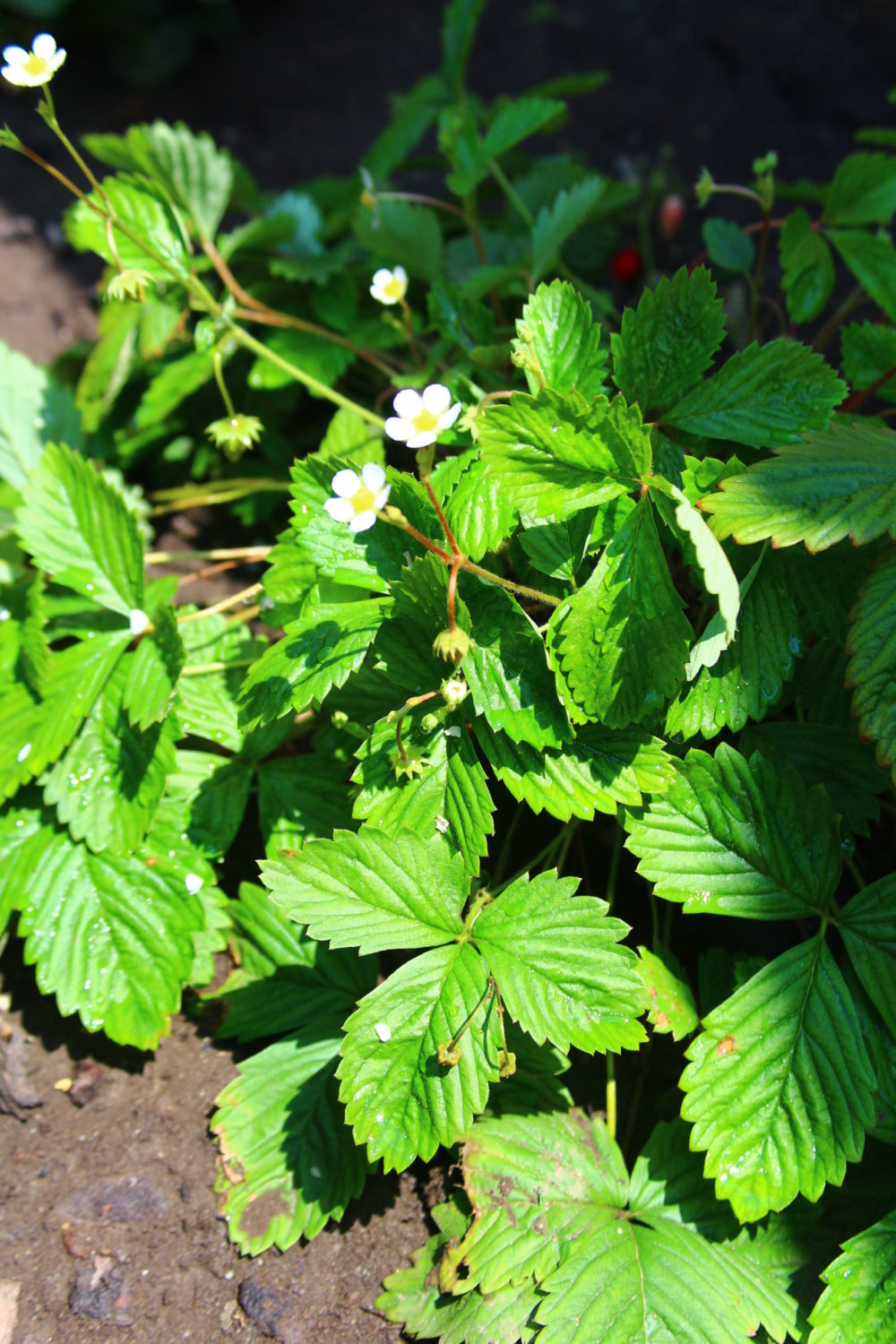
There’s nothing better than growing your own strawberries! If you’ve ever wondered how to care for strawberry bushes to get a healthy, strawberry patch, here are a few simple but efficient tips for strawberry plant care!
HOW TO CARE FOR STRAWBERRIES
Have you ever thought about growing you own supply of juicy, healthy strawberries? It’s so much fun and oh, so easy if you know the basics! Read along and I’ll give you some simple and easy tips for strawberry plant care so you enjoy your delicious strawberries all summer long!
Before growing strawberry plants you need to know there are three types of strawberries: spring bearing which produces fruit in spring, June bearing which will give fruit in early summer and everbearing, providing fruit all summer long. I chose the spring and everbearing ones so I could enjoy my strawberries from spring to end of summer.
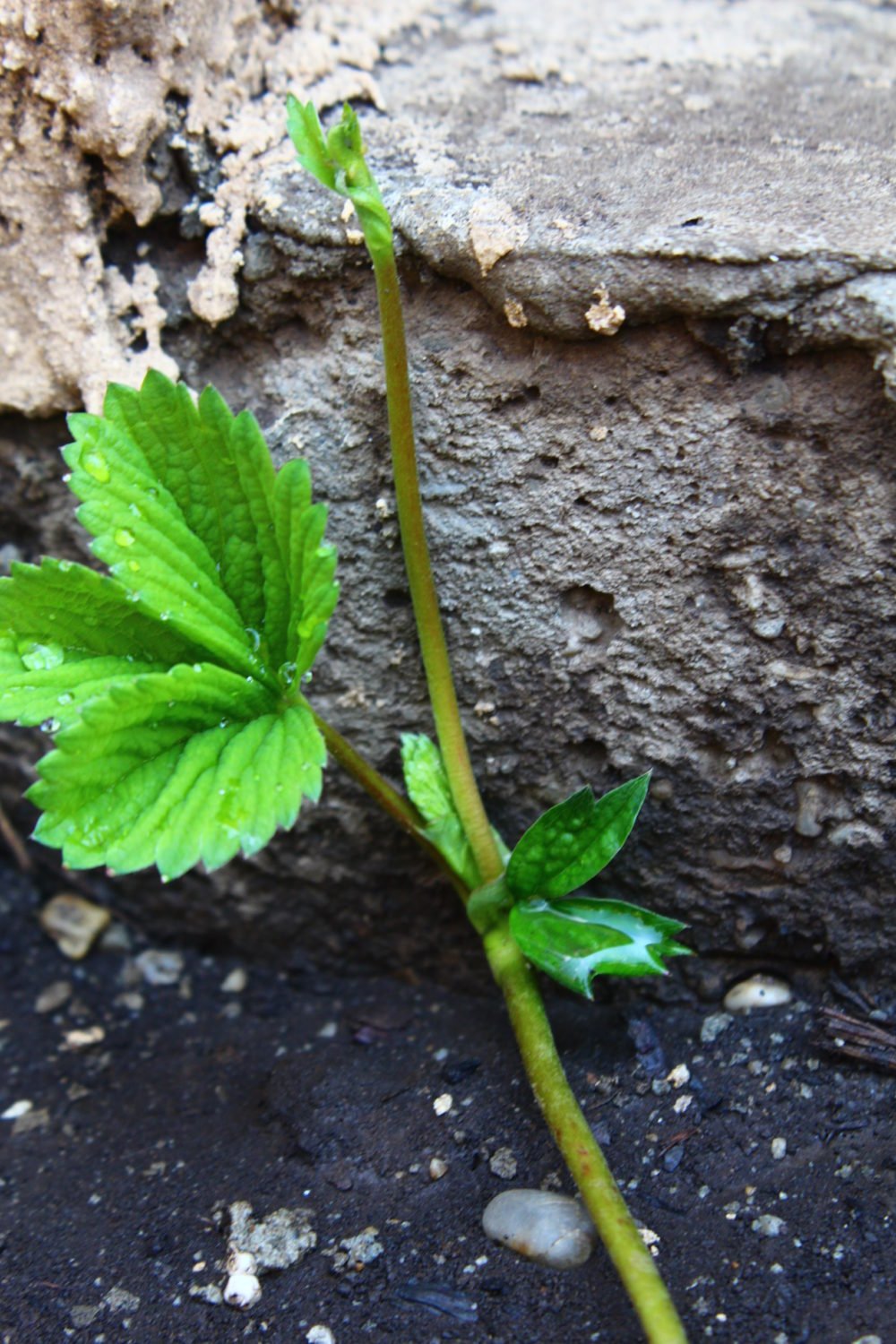
When planning for strawberry care, bear in mind the spring and June plants will grow daughters also known as runners (which will form new plants and will expand rapidly). So when making your strategy for strawberry plant care, make sure you leave plenty of room between plants, for the daughters to roam around freely. Allow about 20-30″ between plants on each row and about 3 feet between rows. On the other hand, the ever bearing plants won’t grow daughters so you won’t need that much space for these. They’ll grow bigger strawberries though so don’t plant too close either, strawberries need light and sun to grow healthy and strong.close
Volume 0%
STRAWBERRY PLANT CARE
Strawberries need at least 6 hours of sun every day so before planting them, make sure the spot you choose gets plenty of full sun.
They’ll also need good drainage so you may need to add some sand to your soil if it’s too heavy in clay or even plant strawberries in a raised bed.
Plant strawberries very early in spring, as soon as the ground is workable. I planted mine first week of March.
Plant when the sun is not too strong, preferably in the morning, late morning on cooler days.
Leave enough room for plants to grow and for daughters/runners to spread.
Dig a small hole that barely fits the root, about 2/3. Lightly cover roots with dirt.
Apply some organic fertilizer right after planting and water plants to give them a jump start.
During hot summer days, water 3 times a week, preferably early in the morning and apply organic fertilizer every 2 weeks. Spreading some mulch around the roots will help retain moisture.
Pinch blossoms and runners in the first year to encourage the plant to grow stronger and supply more fruit.
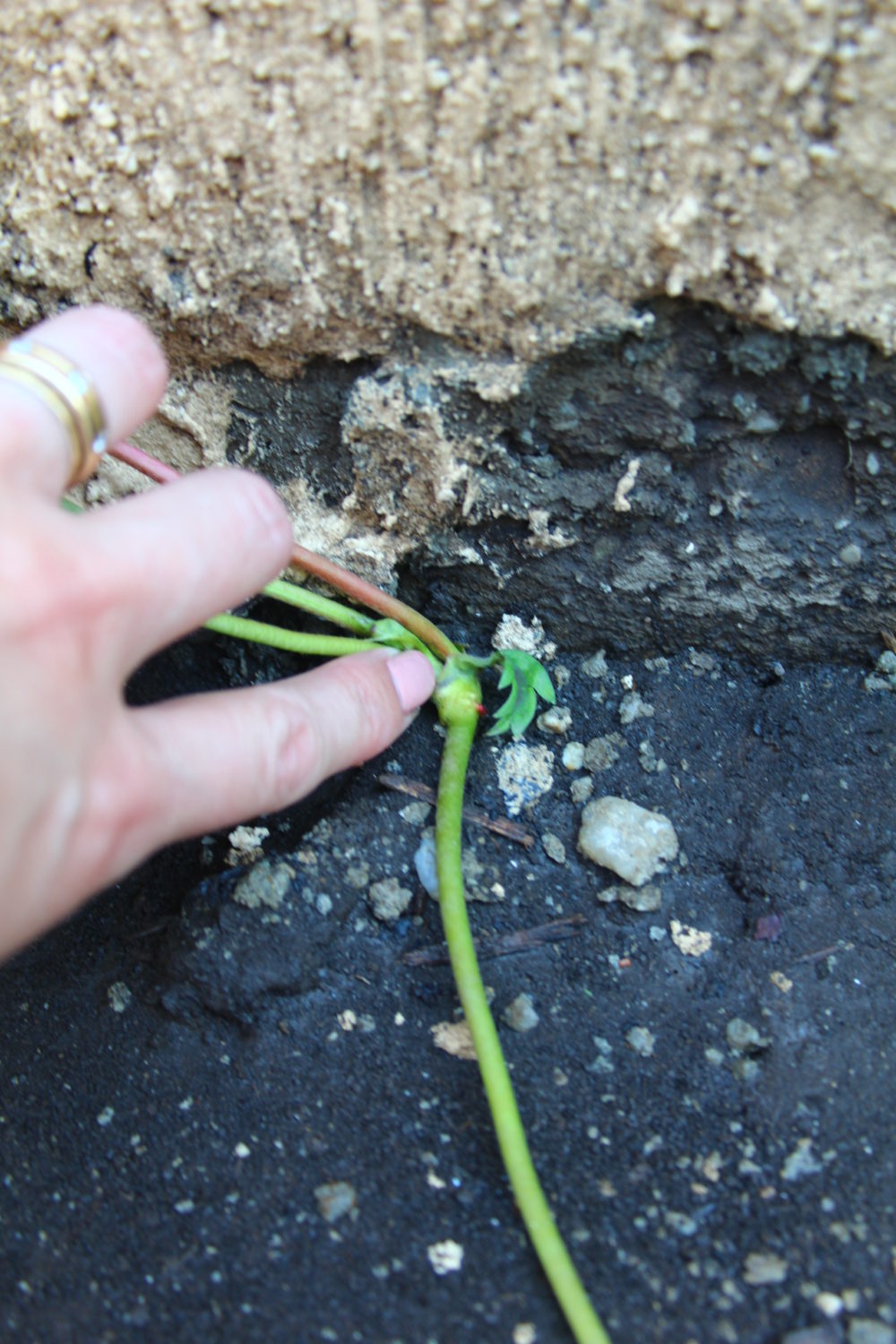
When the runners (daughters) start growing, pinch them out and plant on other spots if you want to expand your strawberry patch but would like to keep it tidy.
If you don’t want the runners to spread, cover the soil around and between plants in foil, then spread mulch. This will also help control weeds.
Pick weeds regularly, preferably when the soil is moist.
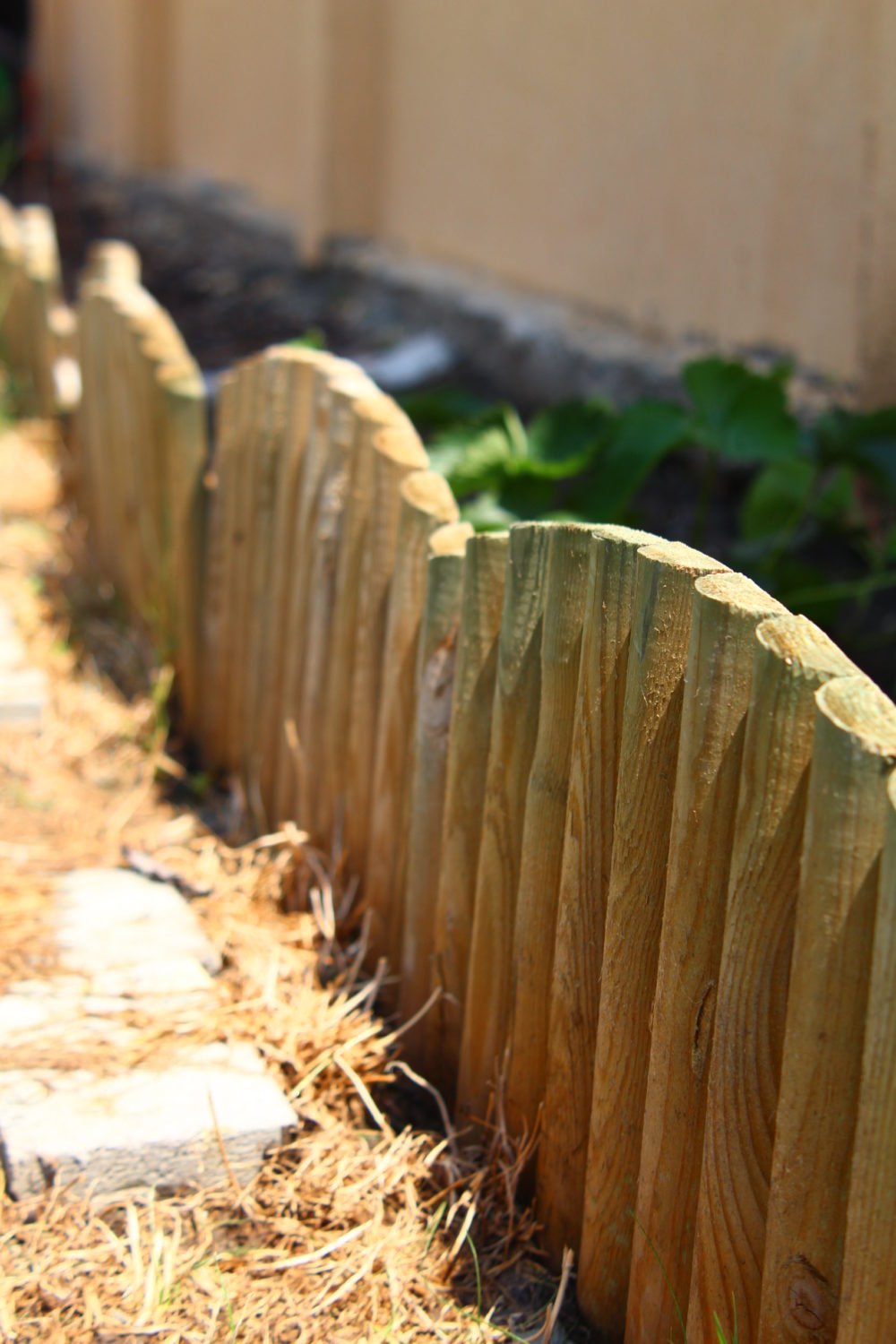
Surround your patch with a fence if your bushes produce daughters; left alone, strawberries tend to spread rapidly and are hard to control once they took over other parts of the garden.
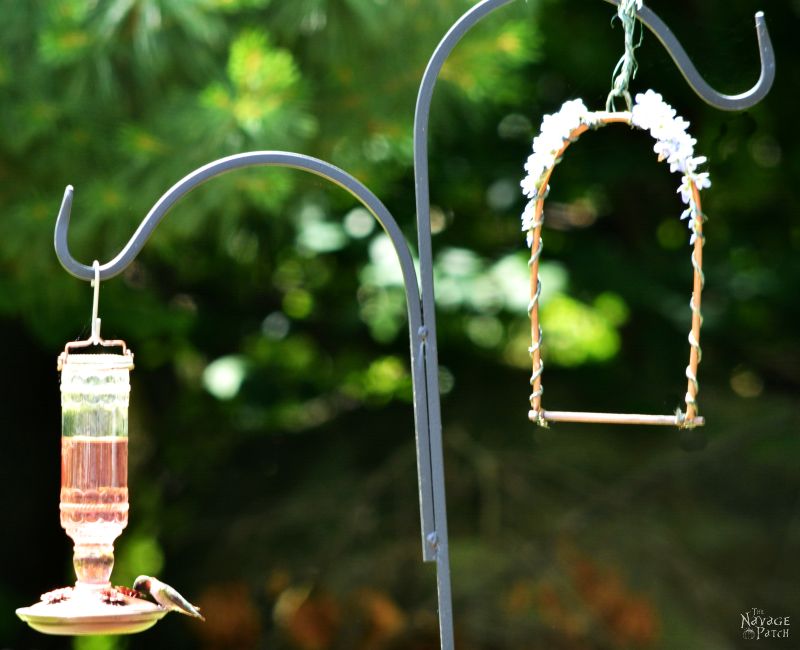
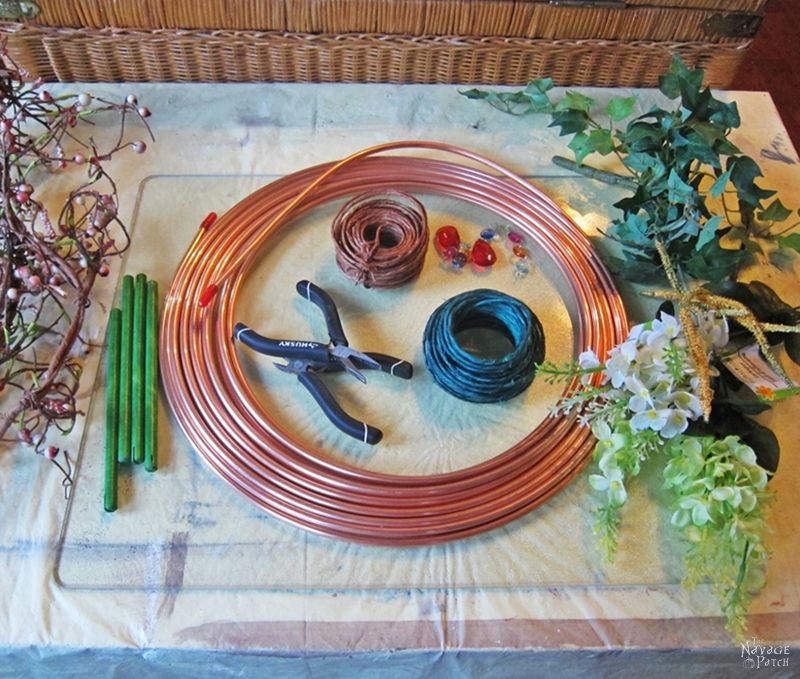
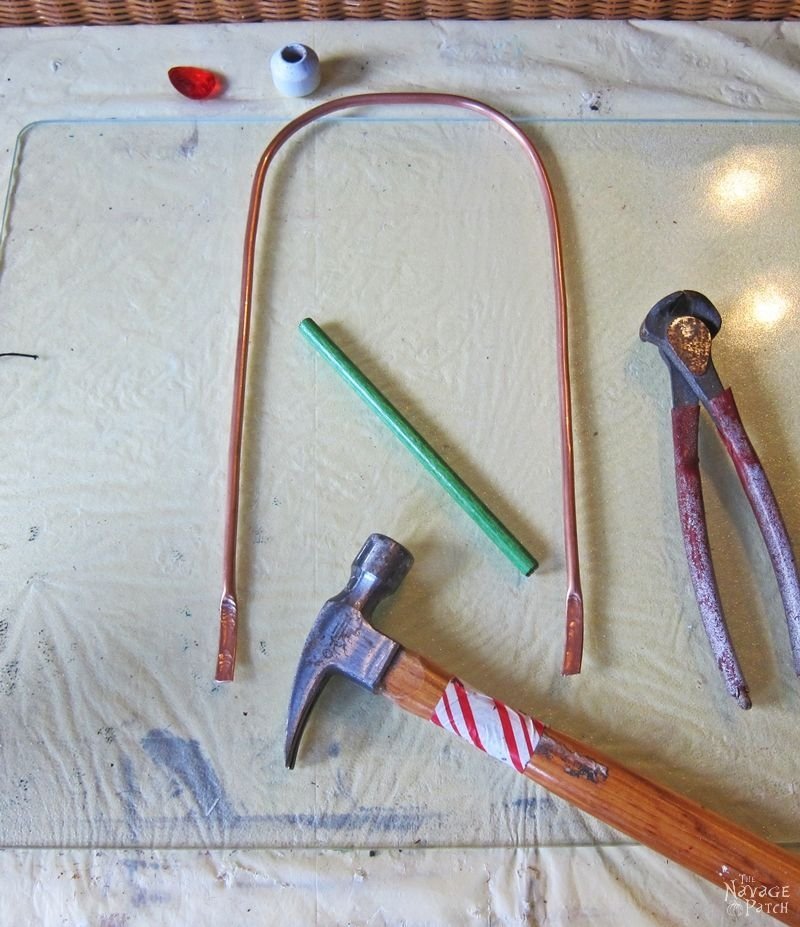
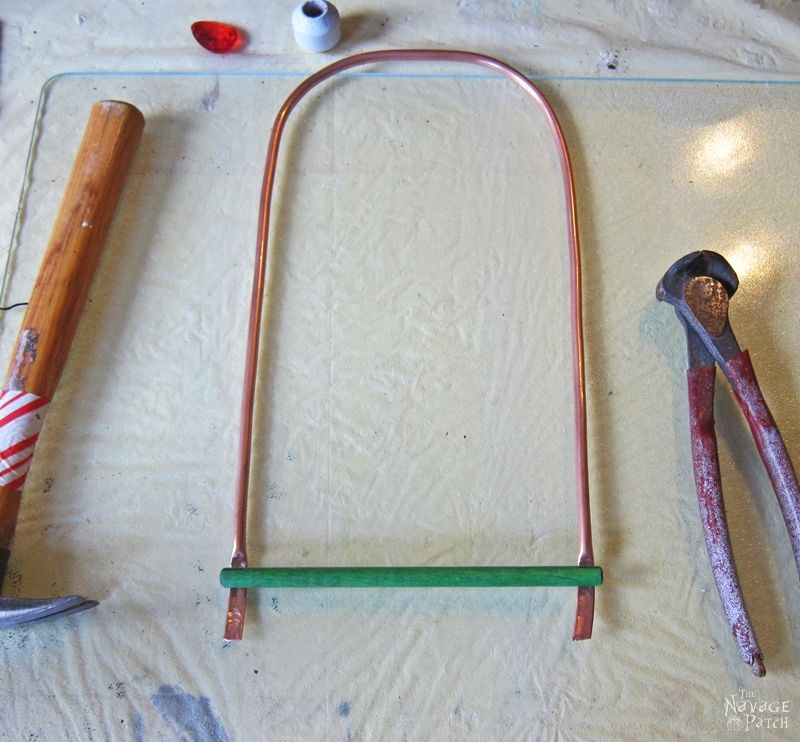
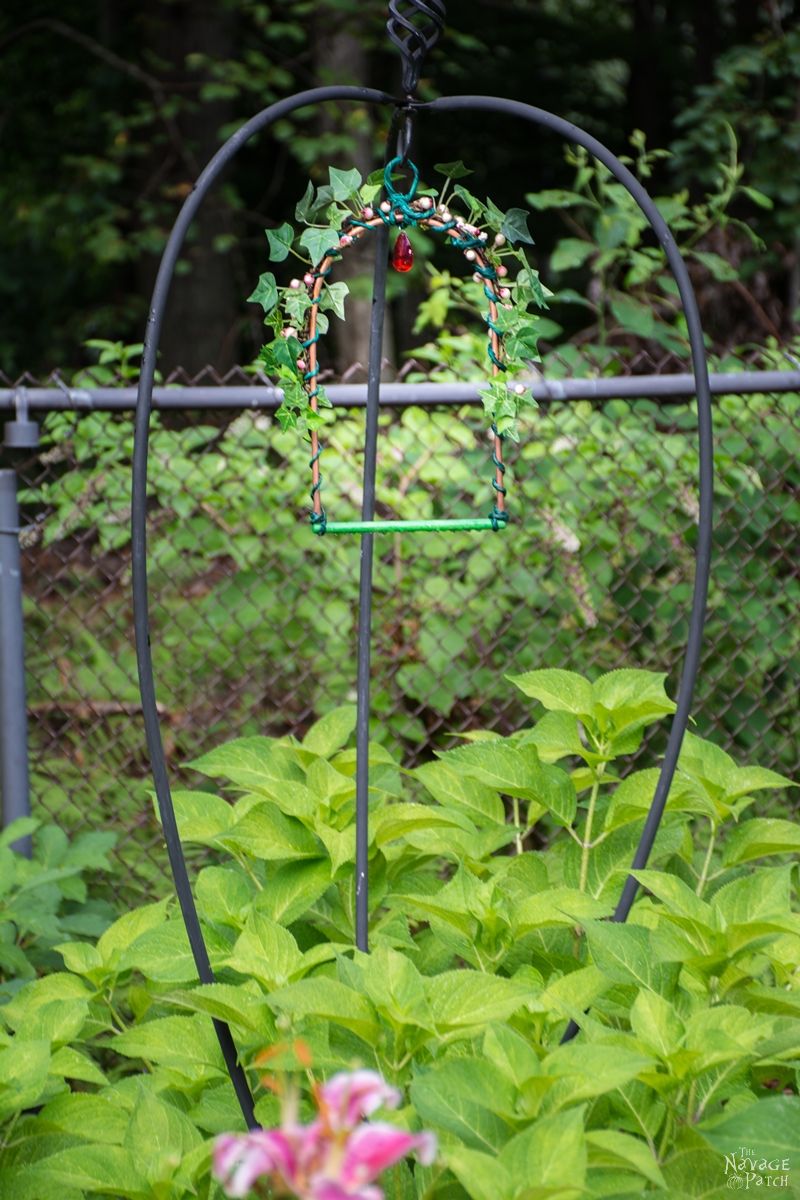
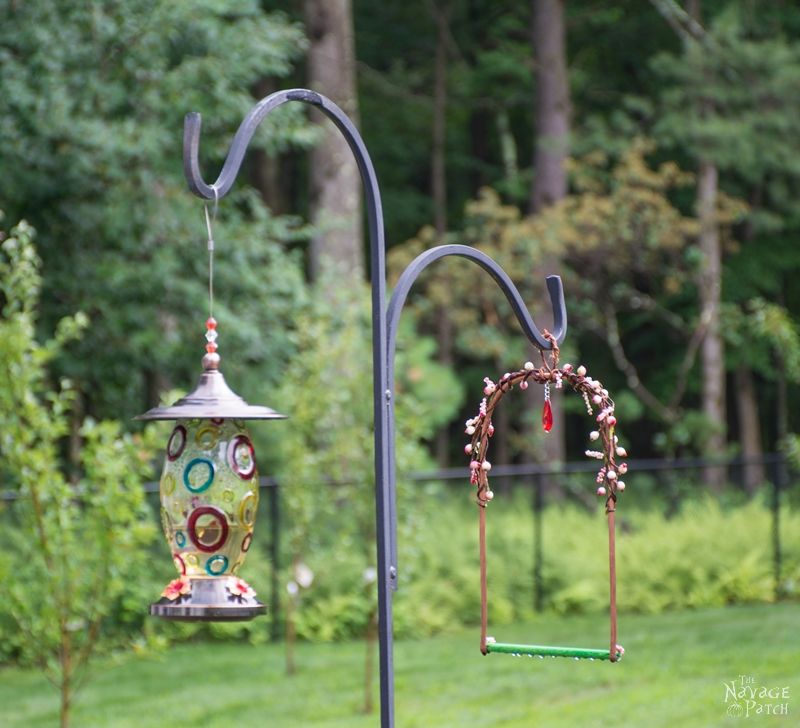
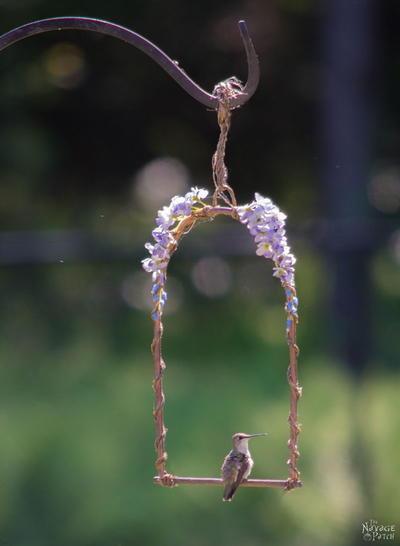
To make a hummingbird perch, all I used was a short dowel (which I found among our son’s old toys), some floral wire, copper pipe (thick and sturdy wire could substitute) and some old faux flowers. I also used a red prism/faux gem, because the red color attracts hummingbirds.
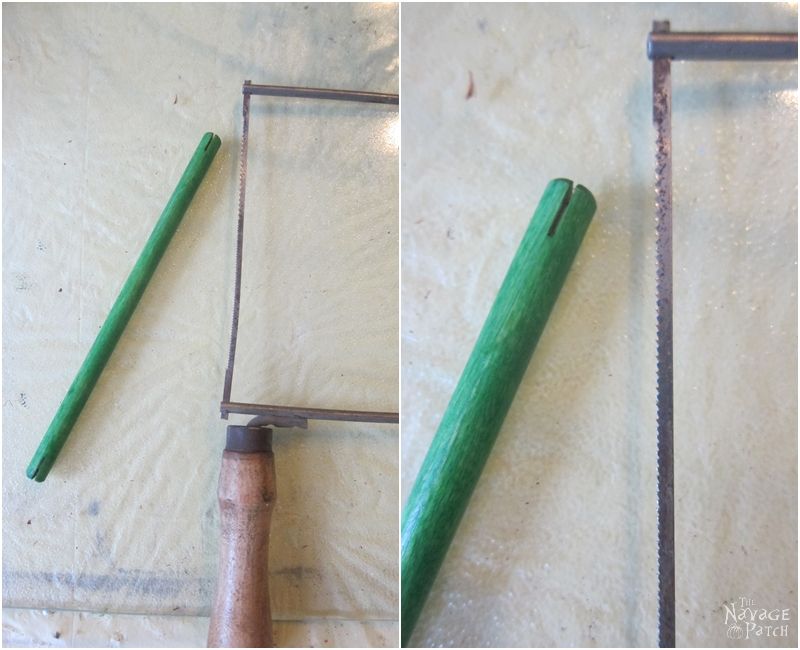
First, I prepared my dowel pieces. I cut the dowels into 7 inch lengths, then I cut a notch at the both ends of the dowel.
Now, you might be thinking cutting a notch like that is not easy. I am not going to argue with that, but instead I will give you a workaround. Therefore, if you don’t want to bother with the notches, then just have your 7 inch dowel and move on to the next step.
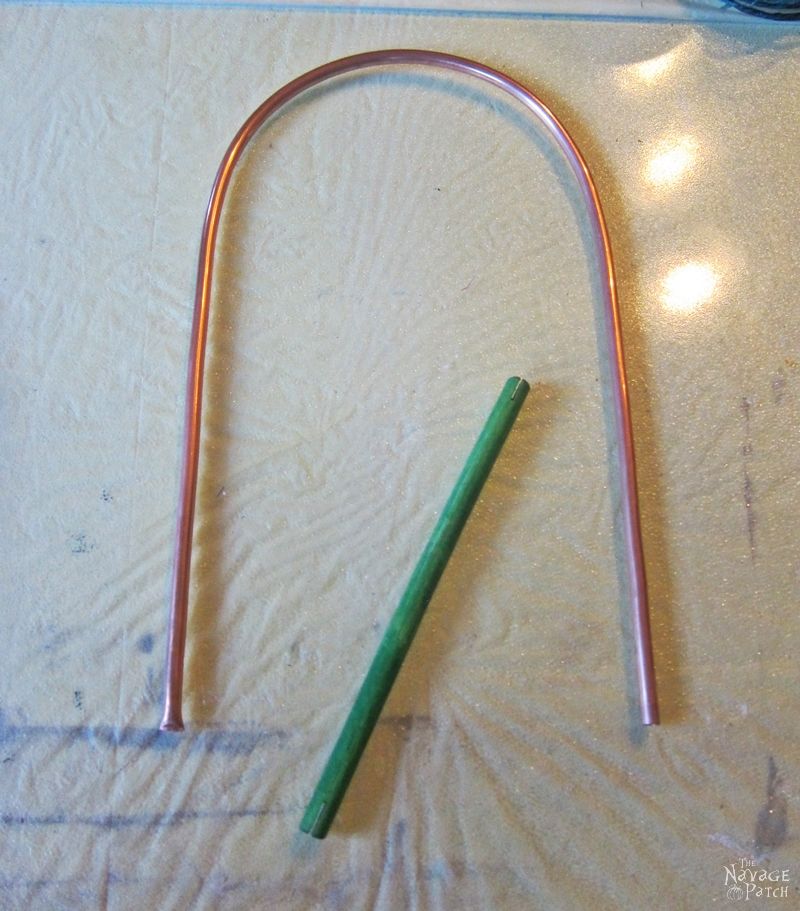
Next, I cut a 24 inch length of copper pipe and bent it to make an arch shape.
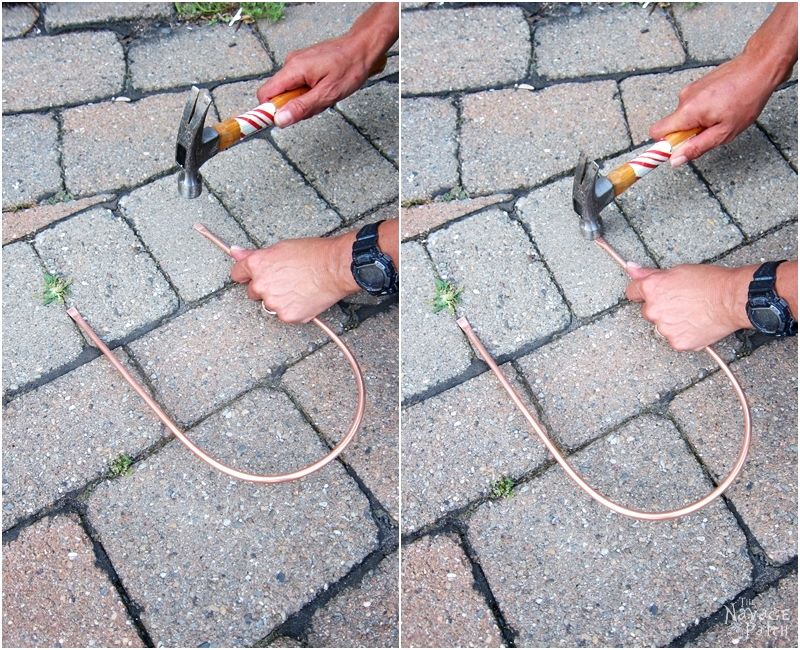
Then, I took my hammer and the copper arch outside to a stone (or concrete) surface, and hammered the ends of the arch to flatten them. For the dowel with the notches, I flattened only a little part of the ends…
…but for the dowel with no notches, I flattened a longer part of the copper arch, as shown in picture below.
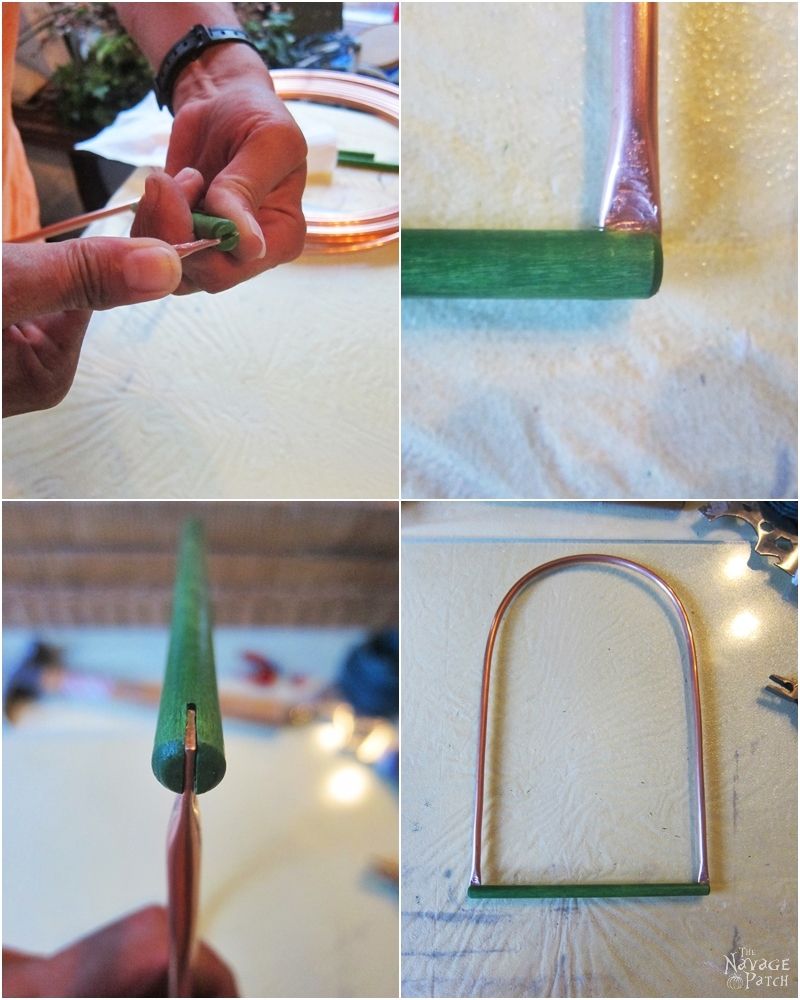
With the notch version, I inserted the flattened copper ends into those notches.
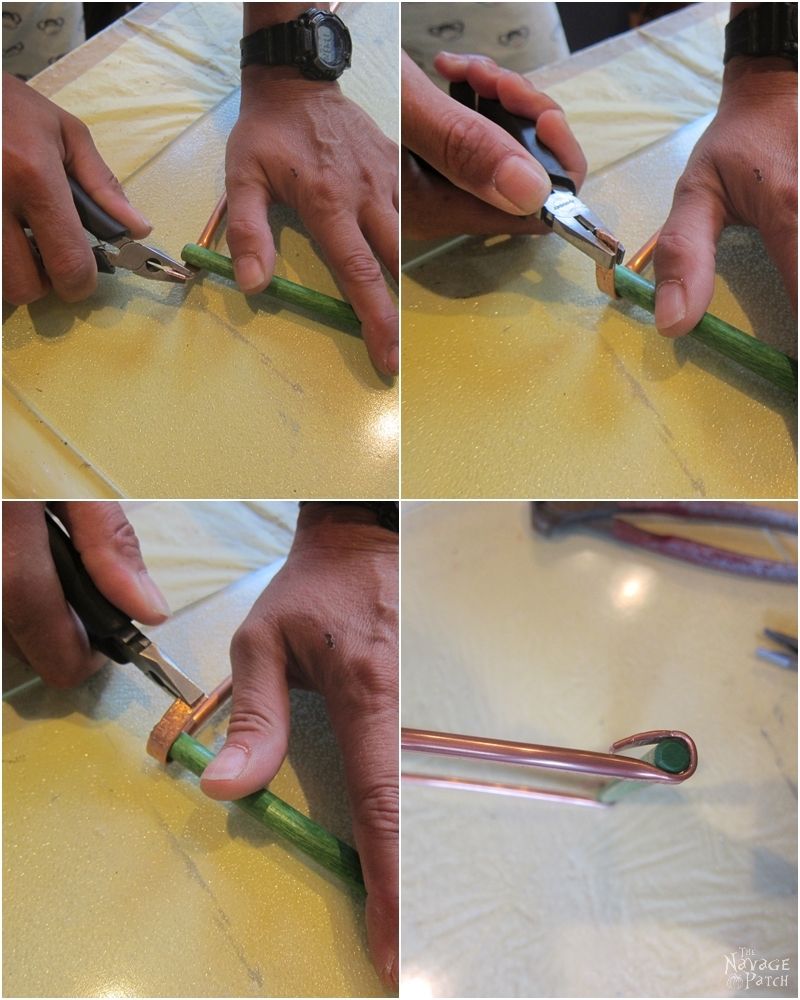
With the notchless version, I placed the dowel on the flattened part and…
…started to wrap the flattened ends around the dowel.
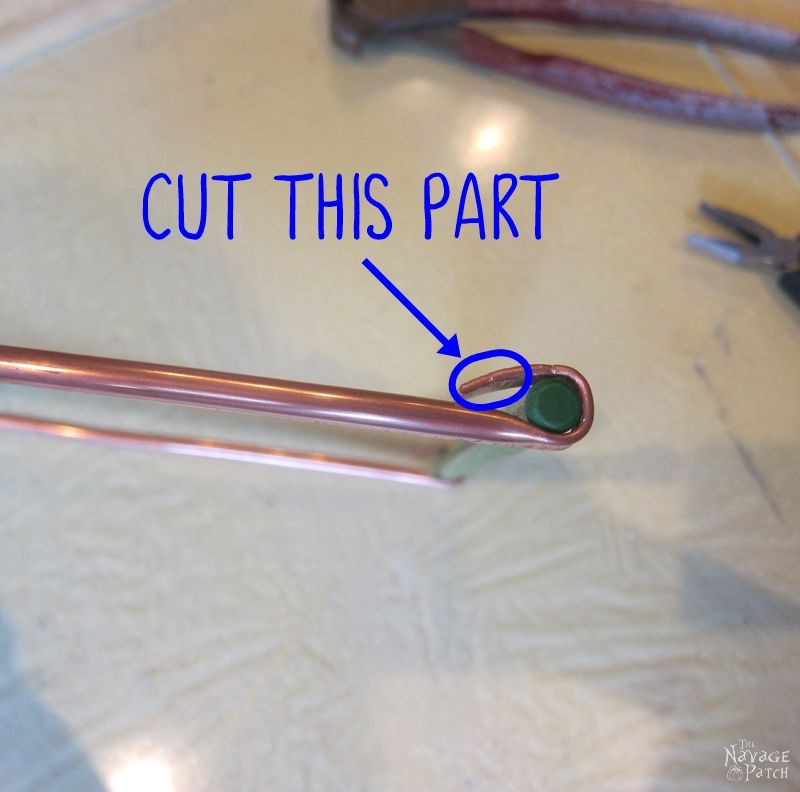
Then, I cut the excess part and…
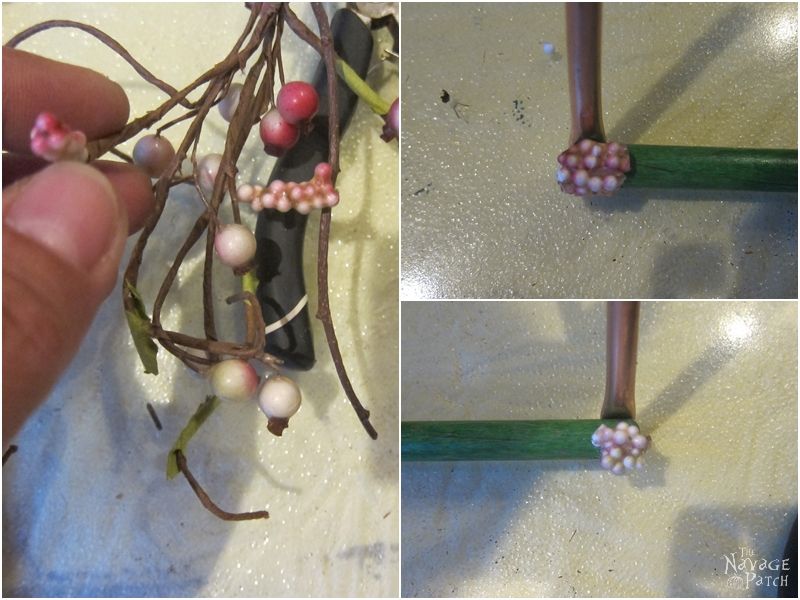
…hot glued some faux berries on the cut part. This was so the cut copper would be covered and wouldn’t hurt anyone when touched.
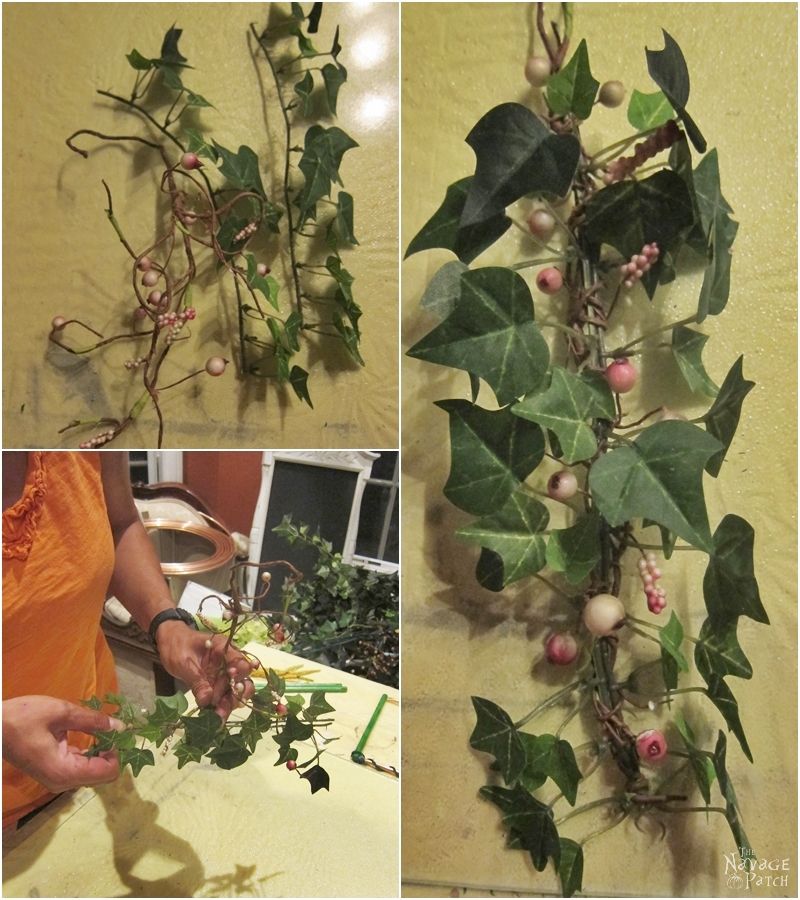
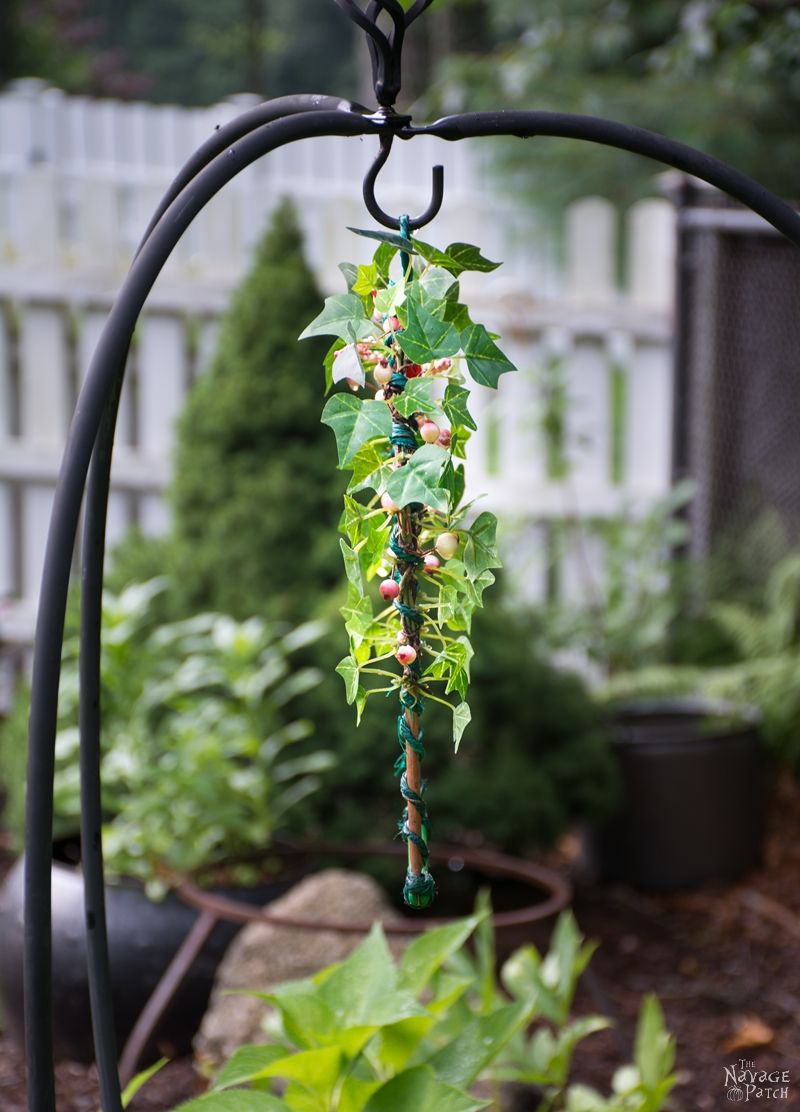
Now that both perch versions were complete, it was time to pretty them up a little bit. For that, I put together a small arrangement of floral picks I had on hand.
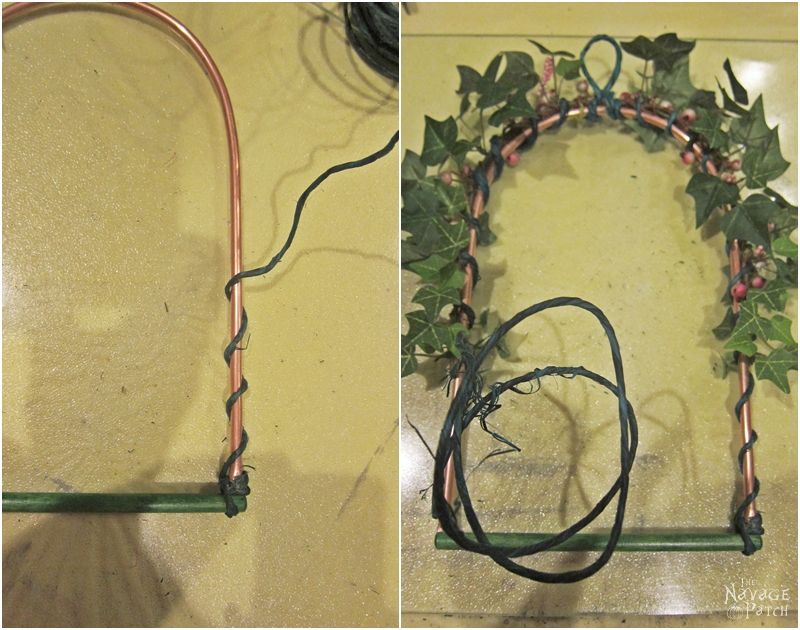
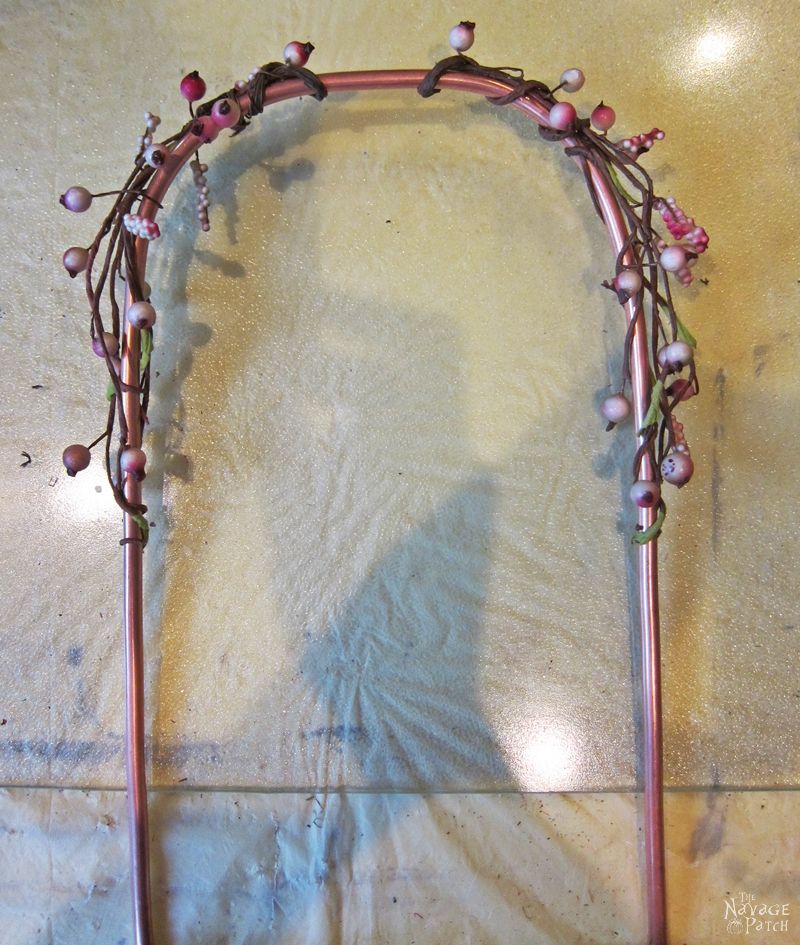
Then, using a floral wire, I attached it along the copper arch.
This is the one with notch.
This is the notchless one.
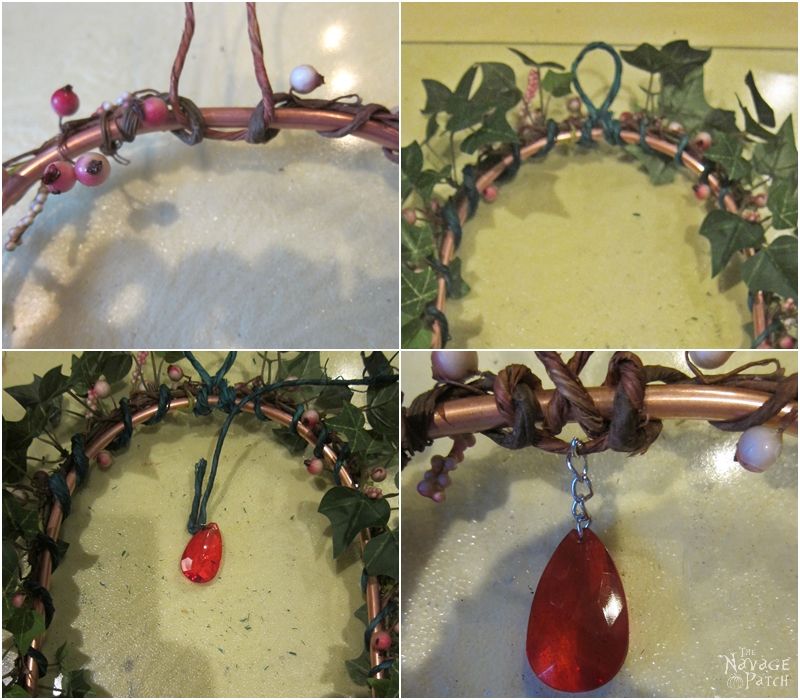
Next, using floral wire, I created hanging loops on the copper arch. As the final touch, I added a red teardrop prism on top.
1. Know your USDA Hardiness Zone. Use it as a guide so you don’t plant trees, shrubs, and perennials that won’t survive conditions in your area. You’ll also get a better idea of when to plant vegetables and fruits in your area.
2. Not sure when to prune? Prune spring-flowering shrubs, such as lilacs, and large-flower climbing roses immediately after the blooms fade. They set their flower buds in autumn on last year’s growth. If you prune them in fall or winter, you remove next spring’s flower buds.
MARTY BALDWIN
3. Apply only composted, rotted manure that has cured for at least six months to your soil. Fresh manure is too high in nitrogen and can “burn” plants; it may also contain pathogens or parasites. Manure from pigs, dogs, and cats should never be used in gardens or compost piles because they may contain parasites that can infect humans.
4. Perennials generally need three years to achieve mature growth. Remember the adage that they “sleep, creep, and leap” over the three-year period.
5. Learn how long your growing season is—your last frost in spring and first frost in fall—so you can start some plants inside or avoid growing them.
JASON DONNELLY
6. Deadheading is a good practice for perennials and annuals. Because the goal of annual plants is to flower, set seed, and die, removing the old blooms tells annual plants to produce more flowers. Removing spent flowers also encourages plants to place energies into stronger leaves and roots instead of seed production. Avoid deadheading plants grown especially for their fruits or pods, such as money plant (Lunaria).
7. How much light do plants need? Grow vegetables in a location that gets at least 8 hours of direct sunlight every day. Most vegetables need full sun to perform well. If you have some shade, try growing cool-season crops such as lettuce, spinach, radishes, and cabbage.
8. The best approaches to controlling weeds in the garden are hand-weeding and hoeing. Avoid deep hoeing or cultivating that can bring weed seeds to the soil’s surface. Weed early and often so weeds don’t go to seed. Use mulch to smother and prevent annual weeds.
9. Hostas don’t need to be divided unless you want to rejuvenate an old plant or increase the numbers you have, or because you simply prefer the look of single plants.
10. Not all hydrangeas grow in the shade. Panicle hydrangeas (Hydrangea paniculata) need sun for best flowering. Some top panicle varieties include ‘Limelight’, Little Lime, Vanilla Strawberry, and Bombshell.
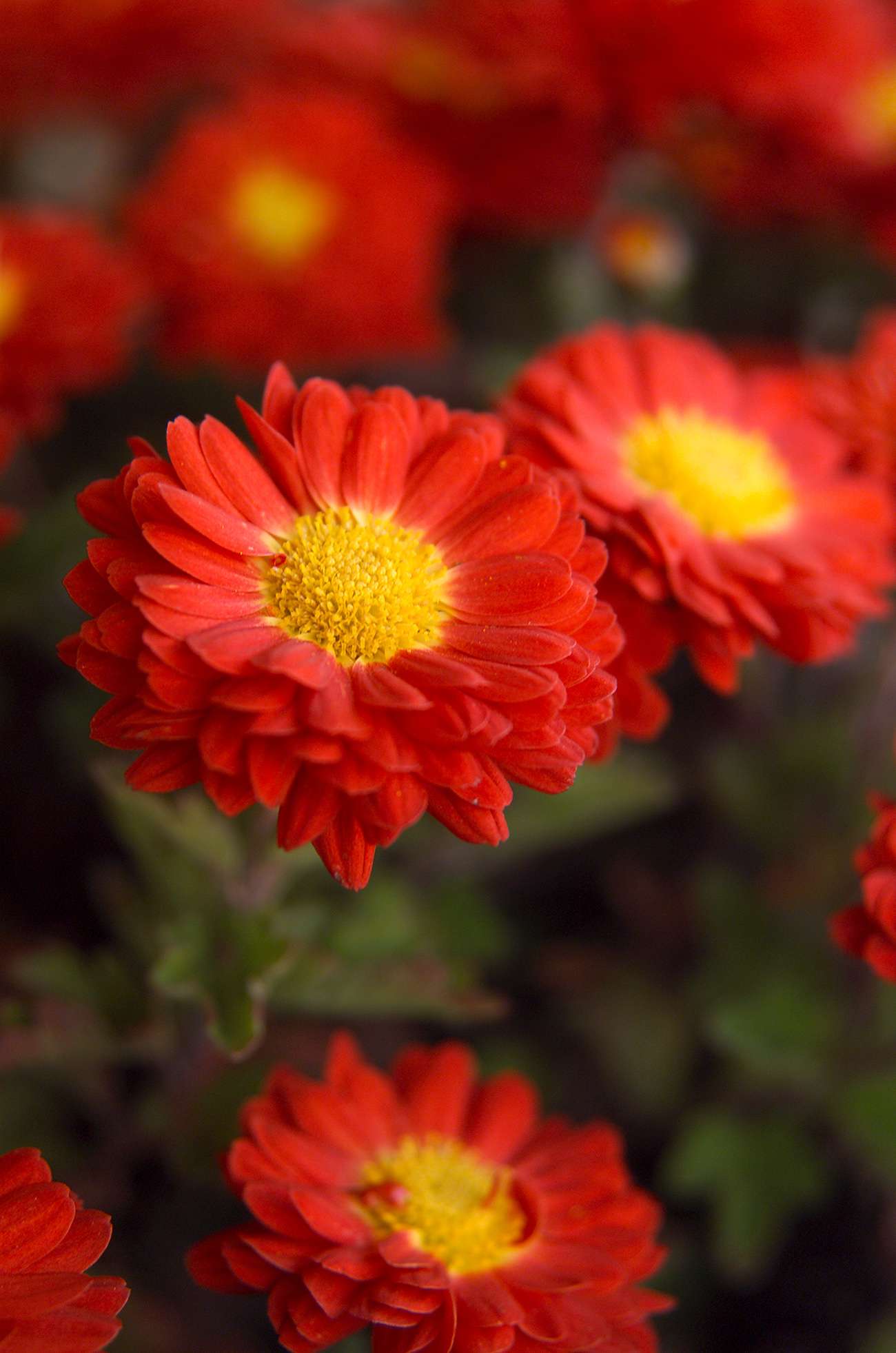
11. Don’t clean up everything in your garden in fall. Leave ornamental grasses for beauty and the seed heads of perennials such as coneflowers to feed the birds. Avoid cutting back marginally hardy perennials, such as garden mums, to increase their chances of surviving a harsh winter.
SCOTT LITTLE
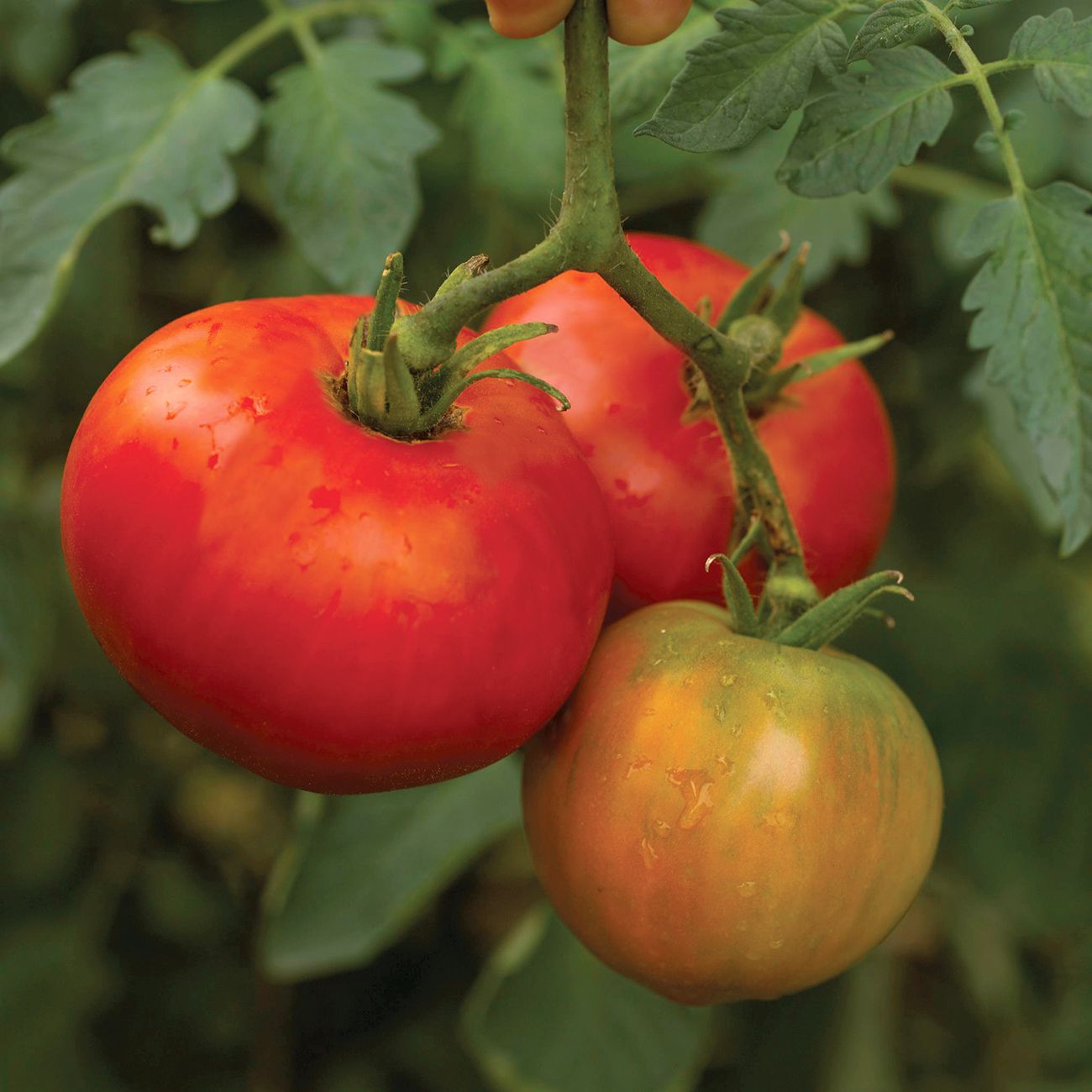
12. Vegetable gardening tip: The optimal temperature for ripening tomatoes is between 68-77 degrees F. And at 85 degrees F, it’s too hot for the plants to produce lycopene and carotene, the pigments responsible for the fruit color. Once temperatures consistently drop below 50 degrees F, green fruits will not ripen. Tomatoes that have a bit of color change can be brought inside to finish ripening.
13. Plant spring-blooming bulbs, such as tulips, daffodils, crocuses, and hyacinths, in the fall before the ground freezes. In general, place the bulb in a hole that’s two to three times the depth of the bulb.
14. Deadhead spent flowers on spring-blooming bulbs so the plants send energy to the bulbs instead of into making seeds. Leave the foliage until it turns brown and can be removed with a gentle tug. The leaves store nutrients needed for the bulb to bloom the following year. Braiding or tying the leaves is not recommended because it reduces the amount of light to the leaf surfaces.
MARTY BALDWIN
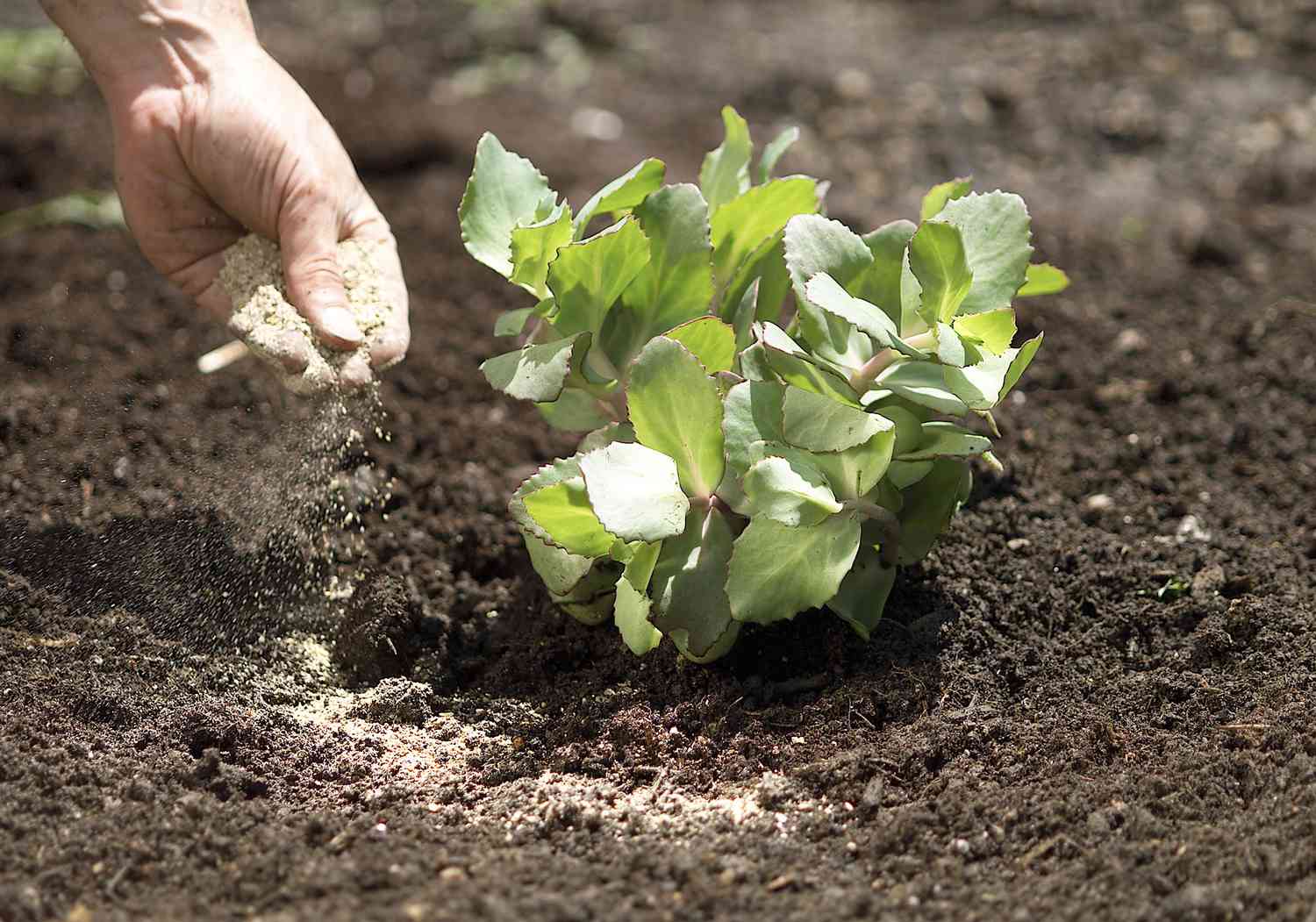
15. Fertilizer is not the answer to growing the best plants; soil quality is. Add organic amendments such as compost and well-aged manure to your soil. The best soil structure is crumbly, easy to dig, accepts water easily, and offers oxygen for plant roots. If you choose to use fertilizer, use an organic one to add nitrogen, phosphate, and potash.
16. Late summer or early autumn is the best time to divide and transplant spring-blooming perennials. The most commonly divided perennials are irises, peonies, hostas, and daylilies.
17. If your rhubarb sends up flower stalks, remove them so the plant will focus on foliage production, not seed production.
18. When transplanting container-grown plants, dig a hole larger than the soil ball of the plant to aid with root establishment.
19. Mound your potato plants deep under the soil and store harvested potatoes in complete darkness. Exposure to light turns the skin of potatoes green, an indication that the potato has produced a colorless alkaloid called solanine, a bitter-tasting toxin that, consumed in large quantities, can cause illness. Cutaway any green portions or sprouts on potatoes to avoid the problem.
20. Most in-ground garden plants grow best with 1 to 2 inches of water per week. If not enough rain falls, water deeply once a week instead of watering lightly daily. Frequent, shallow watering only moistens the top layer of soil and encourages the plant’s roots to move there instead of growing deeper.
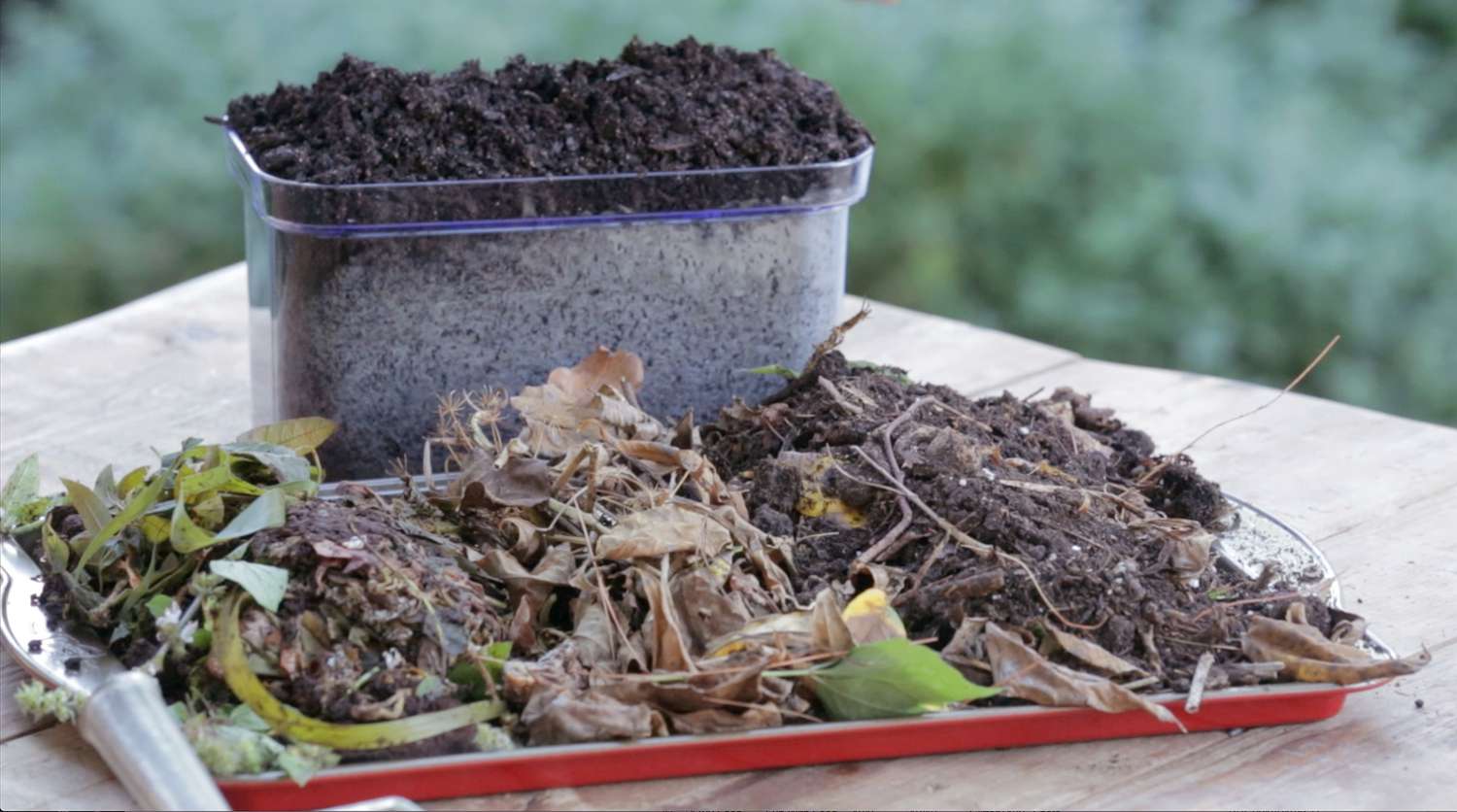
21. Don’t send your fall leaves away! Chop them up and use them as compost ingredients. Pulverized leaves can be left to nourish the lawn. After several hard freezes, when plants have gone completely dormant, you also can use 3-6 inches of shredded leaves as mulch over tender perennials to keep them dormant over winter. Remove the mulch in spring.
22. Avoid digging or planting in wet soil; working it damages the soil structure. Wait until the soil is crumbly and no longer forms a ball in your hand (it doesn’t have to be bone-dry) to till or dig.
23. Understand your soil’s drainage. Roots need oxygen, and if your soil is consistently wet, there are no air pockets for the roots to thrive. Many plants prefer well-drained soil, so amend your soil with organic materials to improve the soil quality.
MARTY BALDWIN
24. Some plants flower in response to day length. Chrysanthemums, poinsettias, strawberries, and others need long nights to produce flowers. If you want strawberries that flower and produce fruit when temperatures are between 35 degrees F and 85 degrees F, choose a variety labeled “day-neutral.”
25. The roots of walnut trees produce a substance called juglone that is toxic to many sun-loving garden plants, including tomatoes and potatoes. (Black walnuts do not harm many shade-loving plants.) The toxic zone from a mature tree can be 50-80 feet away from the trunk. And the juglone chemical can get into your compost if you compost walnut leaves or nuts.
1 tablespoon oil (we used coconut; you could also use olive or vegetable)
3/4–2 cups boiling water
food coloring
First, figure out your workspace and prep accordingly. One of our most beloved, multipurpose tools is a large roll of brown kraft paper. It plays a multitude of roles in our craft projects, mostly as standard drawing and painting canvases, but also as a protective layer for whatever surface we are creating on. Pro tip: If you want to go all out, get a paper cutter, too.
Next, grab all your ingredients, and work out a game plan for what color you’d like your playdough to be. It will be easiest to use a color that comes straight from the selection of food coloring bottles in the box, and then choose how dark or light you want it. We tried for purple and were way off on the ratio.
I like to pre-measure everything and set it out to make it easier (read: less messy) for my kids to participate in the process of making the playdough.
How to make playdough
Start your water boiling.
Combine all dry ingredients in your large bowl.
Make a well, add in the oil, and stir.
When the water is boiling hot, safely transfer it to a container that will hold at least 2 cups. We love our clear Pyrex 2-cup measuring cup for this purpose.
Then add your food coloring directly to the water. Your other option is to NOT add any food coloring at this point. You can make the whole batch plain, then divide it into a number of smaller chunks, and follow the directions below for adding dye later to create an array of colors.
Start by pouring in 3/4 cups of water. We only needed to add a splash or two more to be able to combine everything well, but follow your own preference and add water as desired. Ultimately, you want the playdough to be mixed but sticky.
Let the mixture cool, then knead well. If you, like us, want to make an adjustment to the color of the playdough (like if you tried but failed to use enough red), now is your chance to add it in; just make a well in the dough first.
Let your little ones relish in their successful project by utilizing their fine motor skills with some cookie cutters and any other rolling, cutting, and smushing toys.
If you keep it in a zip-top bag or airtight container, the playdough should last up to three months. If you notice it drying out before then, add a drop or two of water and knead thoroughly. Read the original article on Insider










 © Alyson Aladro Your kids can help you make the playdough. Alyson Aladro
