How to Make a Shamrock Wreath – DIY St. Patrick’s Day Decor Idea
This project was a bit time consuming, but it wasn’t hard at all. You can get your kids involved and make it a fun family project.
DIY Shamrock Wreath
Shamrock Wreath Supplies
1-yard green polka dot fabric
1-yard shamrock fabric
1-yard lime green fabric
1/4” yard green polka dot fabric
12” wire wreath frame
Scissors
Iron/ironing board
Measuring tape
How to Make A Shamrock Wreath For St. Patrick’s Day
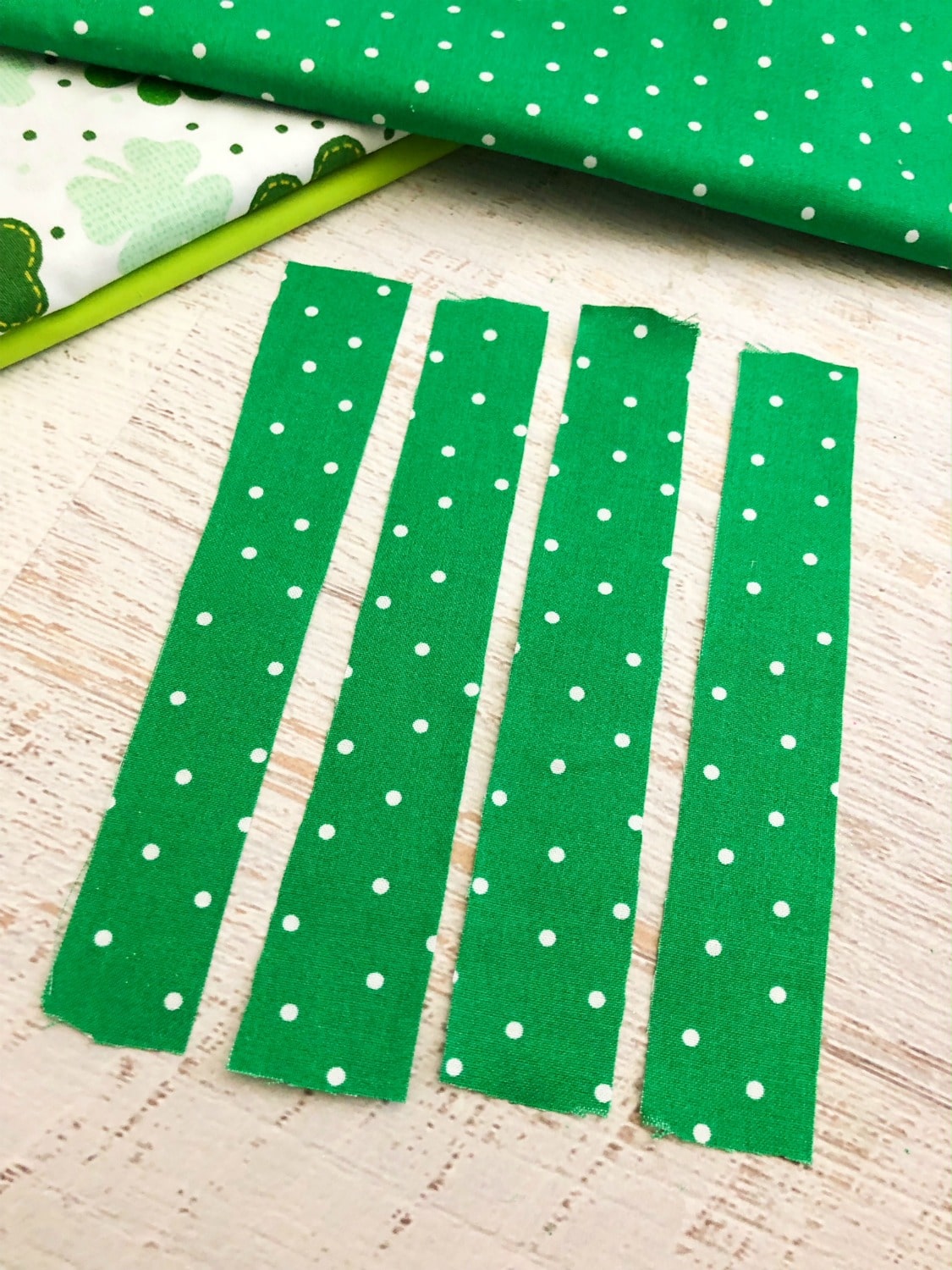
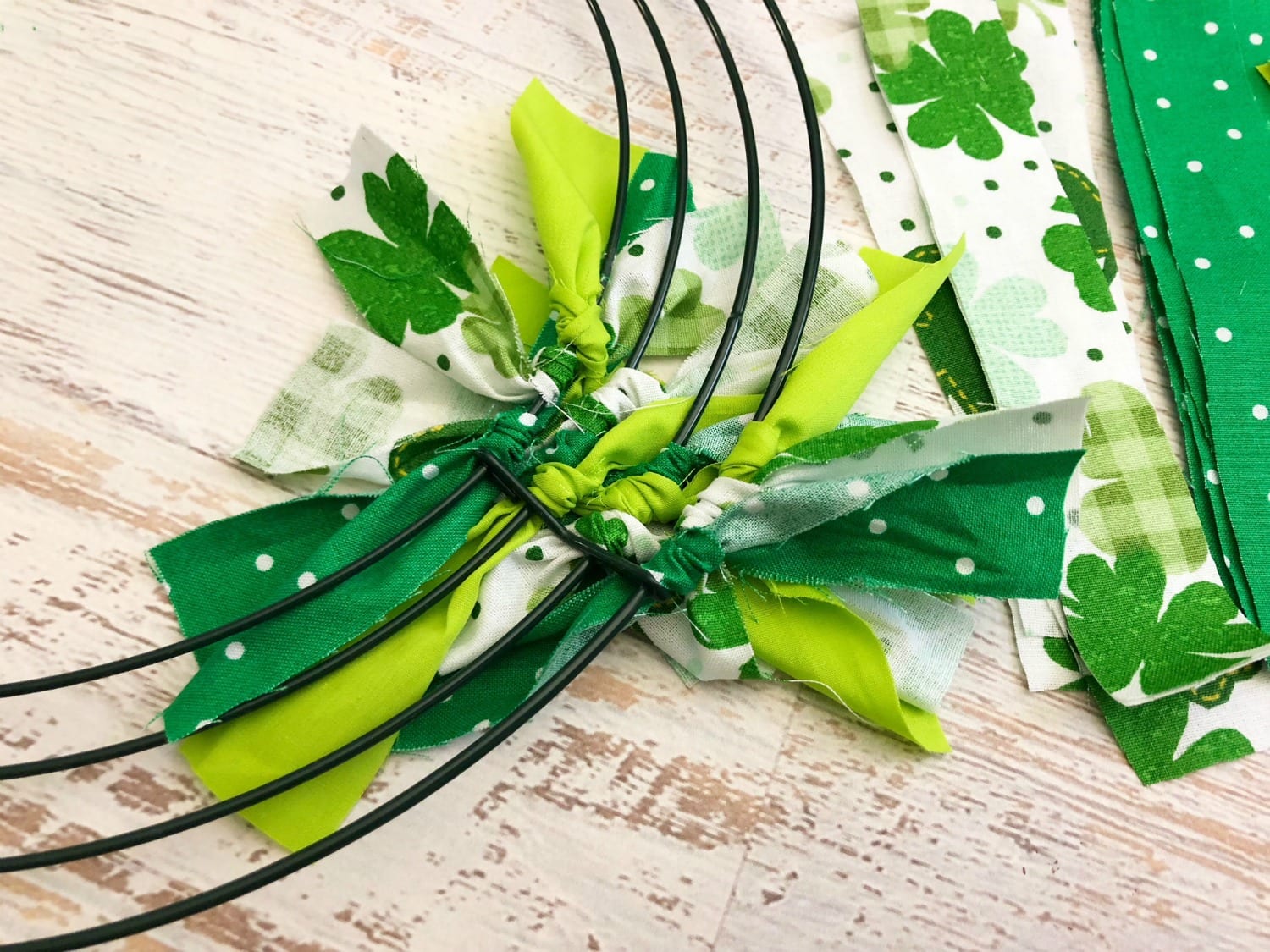
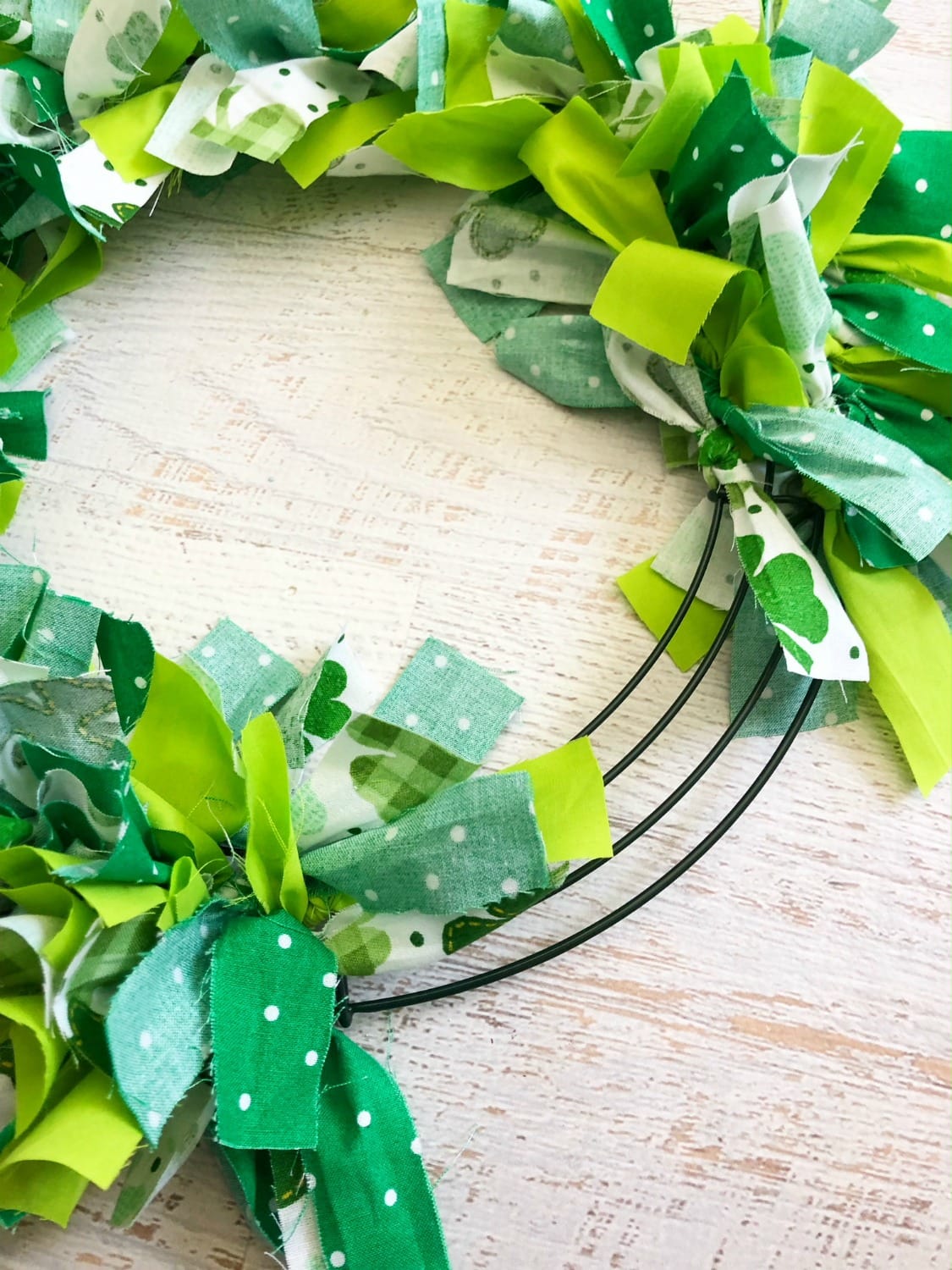
1. Measure and cut your 3 yards of fabric into 1.5” x 7” strips of fabric. 2. Tie on strips of fabric on your wire wreath in a pattern (green polka dot, shamrock, lime green) one at a time starting on the outer edge and working your way in. 3. Keep tiring your fabric strips on in a pattern once section at a time.
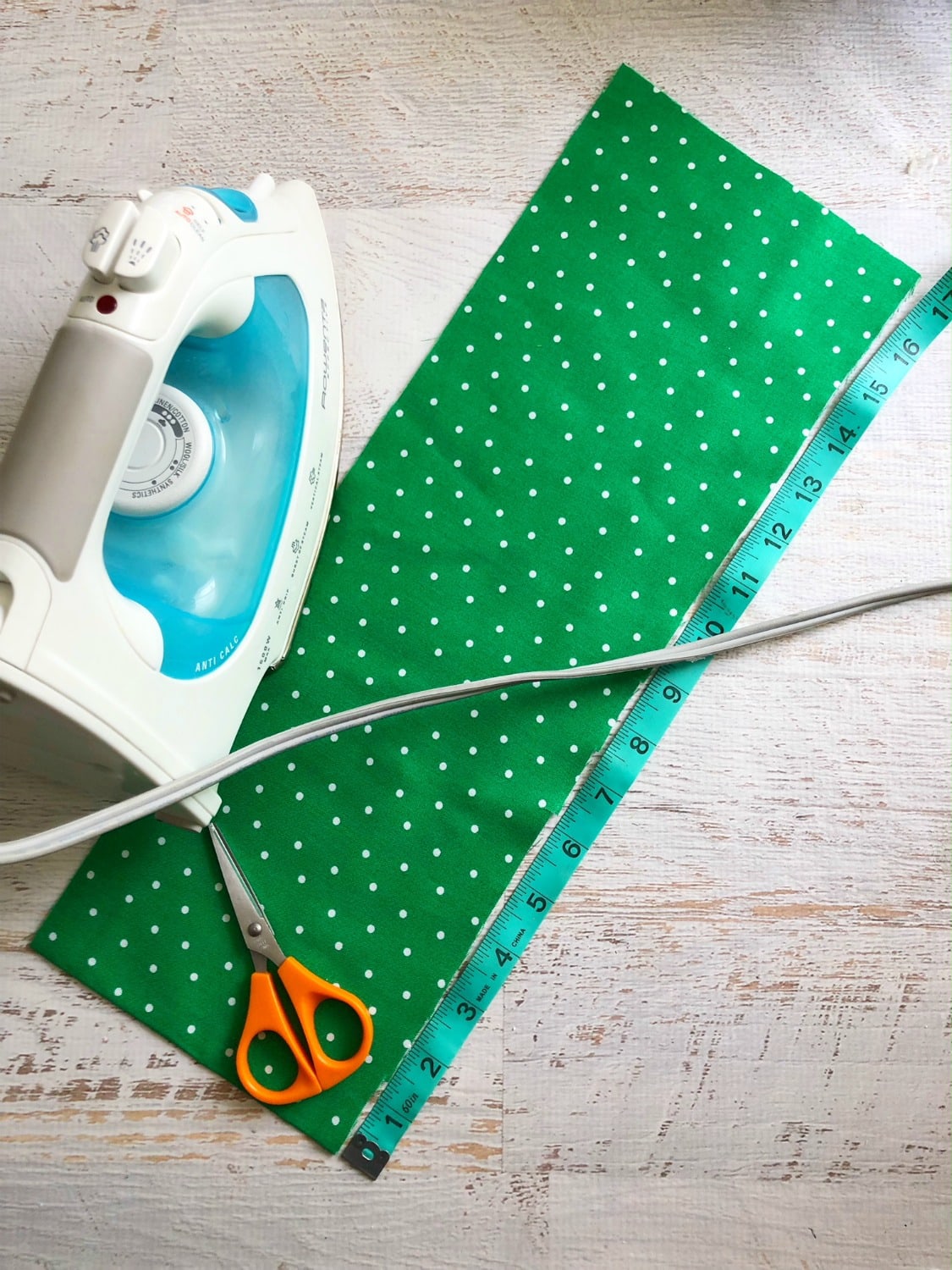
4. When your wreath is full cut a piece of fabric that is 34” x 7” from your 1/4” yard green polka dot fabric. 5. Fold the vertical sides in and iron in place making the fabric look like a strip of 3” wide ribbon. 6. Place your strip of fabric through the center of the wreath and tie the ends into a knot. Pull the knot behind the wreath and your wreath is ready to hang.
”You are the God who performs miracles; you display your power among the peoples.” Psalm 77:14 (NIV)
In this verse, the psalmist refers to all the miraculous works God had performed for the people of Israel time and time again. In countless situations, God had proven His faithfulness to His people by rescuing them from trouble and answering their prayers in miraculous ways. This verse compels us to not only remember God is a God of miracles but also to let that truth crush our doubts of God’s miraculous abilities and faithfulness in our lives.
Only a mighty, miracle-working God could have orchestrated some of the things that answered many of my prayers over the past few years. Not all my prayers were answered, of course, but enough to help me remember He is still the God of miracles today. He helped me fully realize Heis my provider. Not a man, not a job, not my own talents or efforts — Him alone.
God is always worthy of our praise — for the answered prayers we thought were unanswerable and the unanswered prayers we still lift up to Him each day. He is always faithful and always trustworthy. He hears our prayers and knows all of our needs.
If you have prayers you’ve been praying for quite some time, keep the faith. God is at work behind the scenes. Nothing is impossible for God.
I really haven’t ever decorated for St. Patricks day before. I normally can’t wait and just skip right
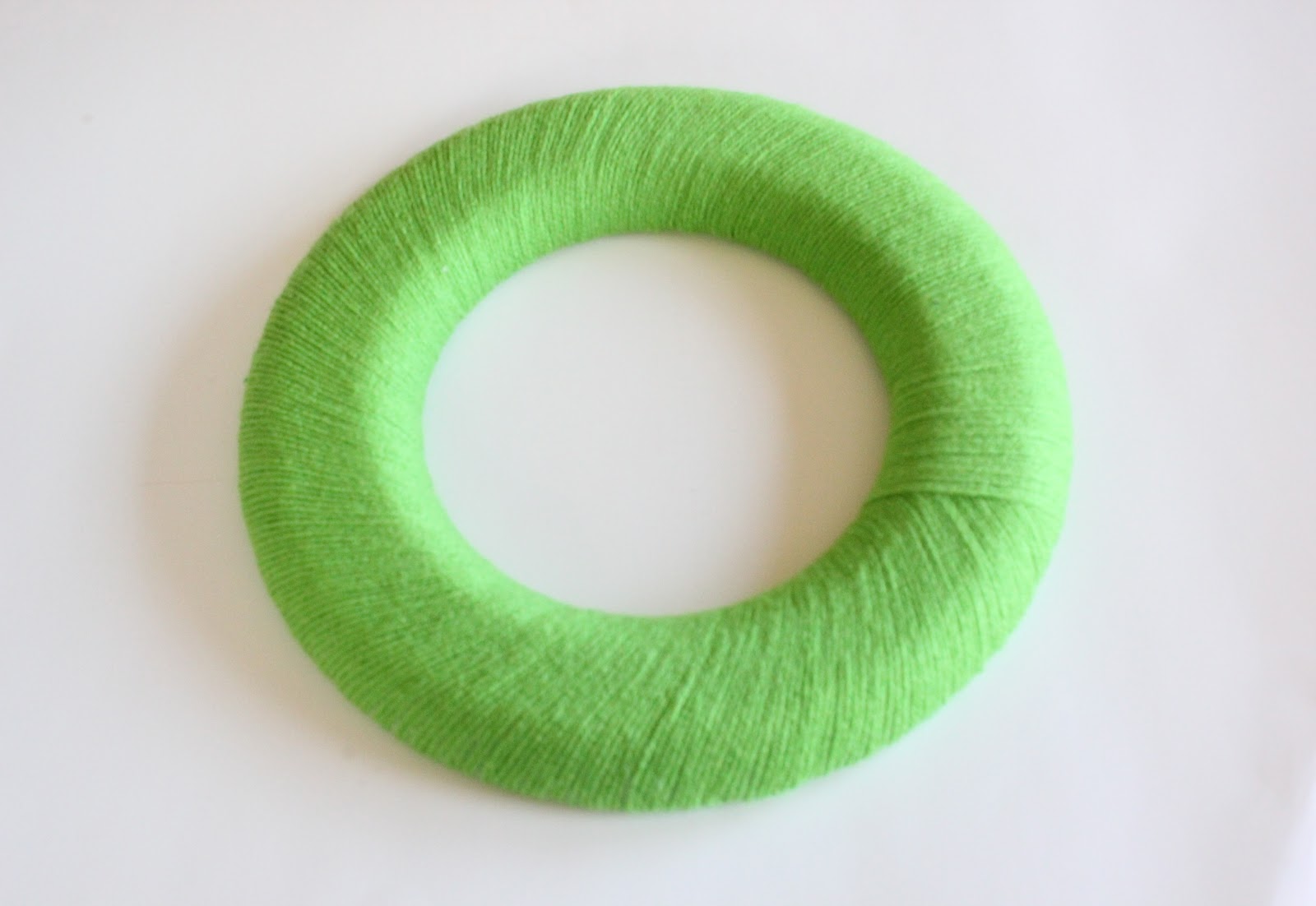
to Easter!This year I decided the holiday should get it’s fair chance so I decided to try out a yarn wreath and it turned out really great, and super easy. I wasn’t planning on making this a tutorial but people are already asking how to do it, so sorry for a gap in some pictures!
Gather your suplies: foam wreath, scissors, green yarn, marker, sheet of green felt, hot glue gun, ribbon (I used gold), gold beads, and clover template (below).
Step 1: To cover the wreath I cut yarn into long pieces instead of going right off the roll. I found this easier. Apply a drop of hotglue to somewhere on the back of the wreath and begin wrapping. The trick is to be consistent with how tight you pull the yarn, this will keep it looking smooth and even. Every few inches add a drop of glue on the back to hold in place. The yarn begings to tilt as you go round since the inside is smaller, so at the end I had to over lap. Not a problem thought because that will be covered up. Sry about the lack of pics!
Step 2: Print and cut this template for the clover leafs. Or you could make your own. (click pic to print)
Step 3: Trace patterns onto the felt and cut. You will need eith 3 or 4 of one size for a clover. I mixed 3 and 4 leafe clovers.
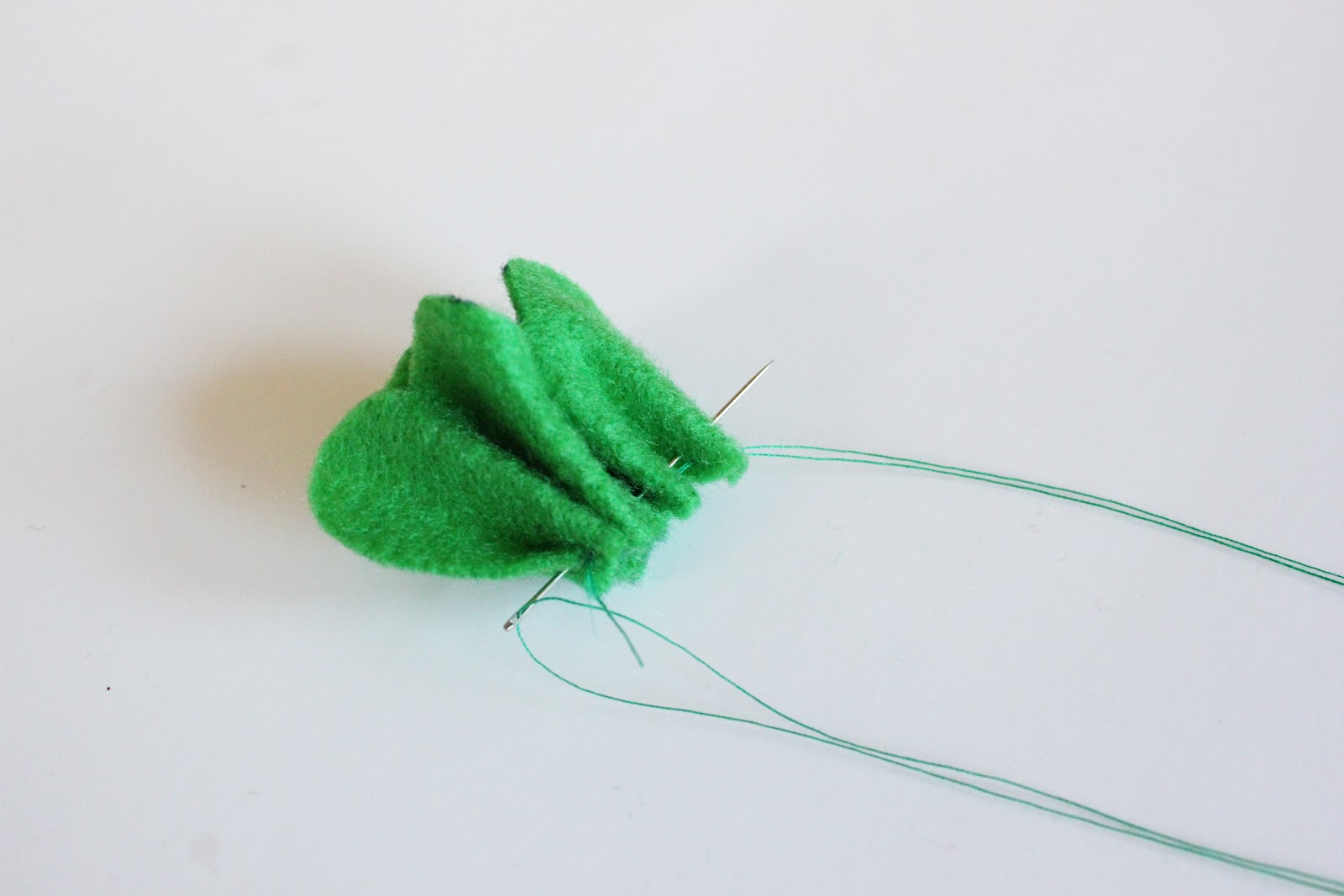
Step 4: Thread a needle and tie a knot. Sew under, over, under, over to each leaf.
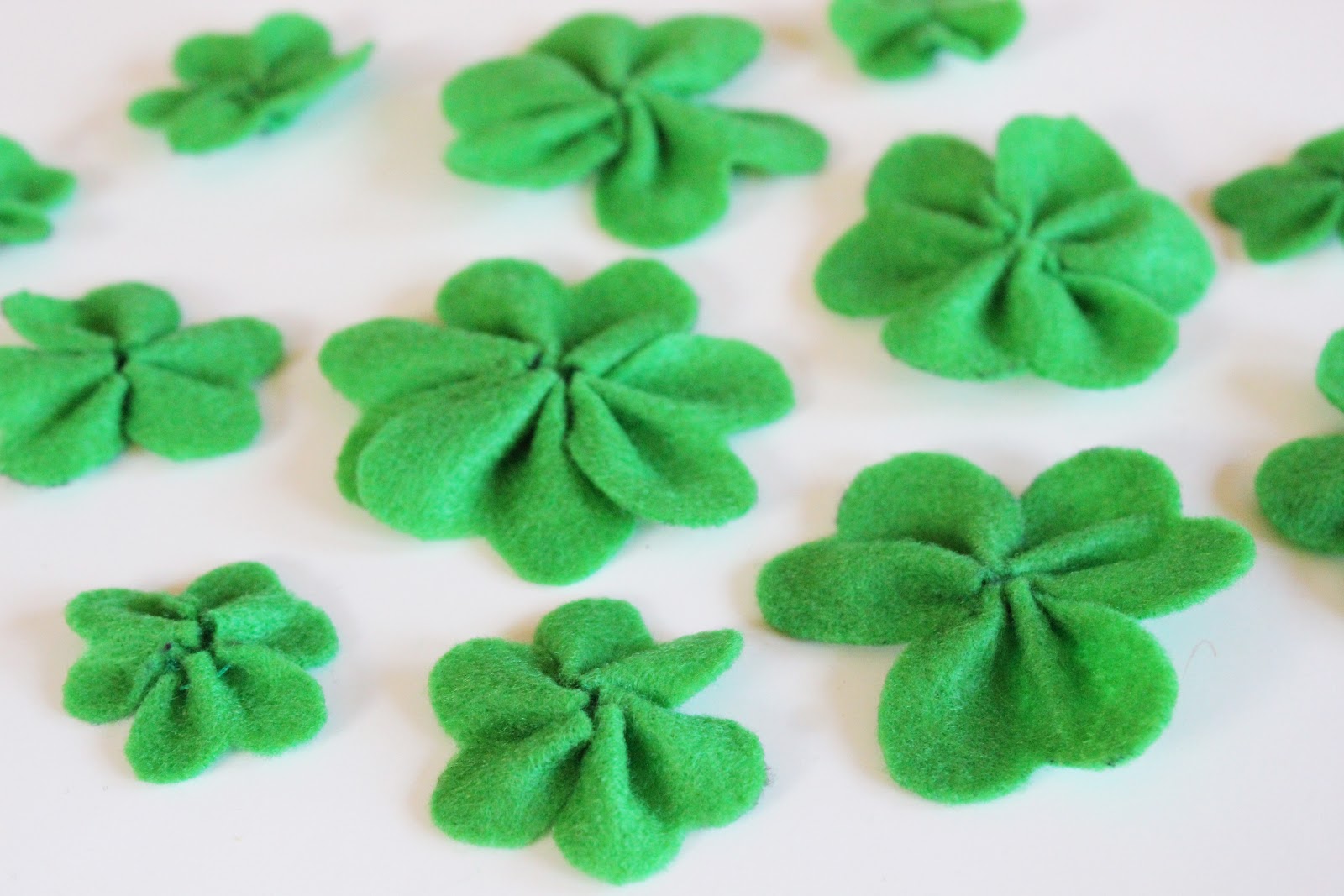
Step 5: Gently pull the thread till the clovers gather. Continue to gather until they fold into a nice straight line so you can slide the needle through the bottom.
Here’s what they should like! Wouldn’t these be cute on hair clips??
Step 6: Arrange you clovers how you would like, then gently life one side of each and put a drop of glue underneath.
Step 7: Add a little gold bling if you would like!
Step 8: Attach a ribbon loop on the back with hot glue, whatever length you would like!
All done!
I can’t wait to try more yarn wreaths. This was SO easy, cute, and cheap! I displayed it in our entry way with this little ceramic pot filled with gold hershy bars. 🙂
End of the Rainbow Paper Plate Twirler (Kids Craft)
Materials Needed:
Paper plate
Paint
Black and yellow paper
Scissors
Glue
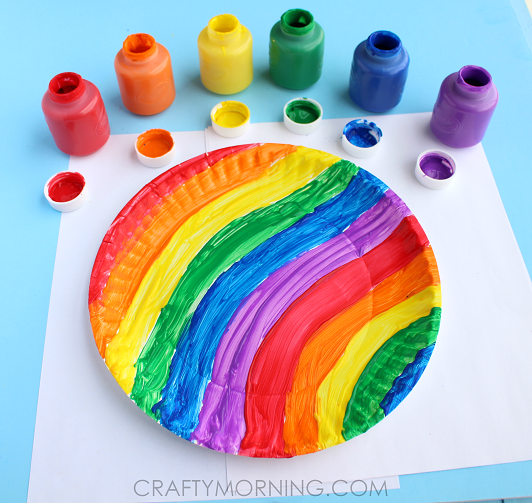
Start by having the kids paint rainbow stripes on the front of a paper plate.
Let dry and flip it over to paint the back as well. Blow dryers are great if you’re impatient!
Grab a scissors and start at the outside of the plate to cut spirals. Cut out a black pot of gold and glue it to the end of the plate (we trimmed the spots that were pointy).
Glue on some yellow circles to make the gold…you can add some sparkles too! Poke a hole in the middle of the plate and add a string to hang it up!
Welcome to the third month of the year—or, if you were born before 150 B.C., the first! According to the oldest Roman calendars, one year was ten months long, beginning in March and ending in December. It may sound crazy, but you can still see traces of this old system in our modern calendar: because December was the tenth month, it was named for the number ten in Latin (decem), just like September was named for seven (septem). So, what about January and February? They were just two nameless months called “winter,” proving that winter is literally so awful it doesn’t even deserve a spot on the calendar. Check out these vintage photos that prove winter was way worse in the past.
2. It’s the best month for basketball (but worst for productivity)
For civilians, on the other hand, March is known for one thing above all others: brackets. March Madness, as the NBA calls it, runs from March 11 to April 2 this year, and the safest bet you can make is that lots and lots of people will be distracted. One number-crunching firm predicted last year that American companies would lose $1.9 billion in wages paid to unproductive workers spending company time on betting pool priorities. (Suffice it to say, March is not a productive month—this is the single most productive hour and month of the year.) How to recoup these costs? Go into gambling. According to the American Gaming Association, fans wagered more than $2 billion on March Madness brackets for the 2015 tournament. Each one of those 70-million-or-so brackets has a one in 9.2 quintillion (that’s 9 followed by 18 zeroes) chance of predicting the correct winners of every game. Good luck!
3. It’s also the best month for vasectomies
March Madness is a cherished time to reacquaint oneself with the couch, especially during the early tournament days when dozens of games unfold consecutively. In other words, it’s the perfect week to recover from a vasectomy!
According to doctors at the Cleveland Clinic, the number of vasectomies surges by 50 percent during the first week of March Madness. Why? Patients typically need “at least a day with ice” to keep swelling down, says urologist Stephen Jones, MD, “So if they’re going to spend a whole day doing nothing, it’s not hard to figure out that they’d want to do it on a day they’d like to be sitting in front of the television.”
Smart clinics even offer incentives, like the Cape Cod urologists who offered a free pizza with every vasectomy in March 2012. That deal is certainly a cut above the rest!
4. March was named for war—and lives up to its title
So, if so many months were named for their Latin numbers, why wasn’t March called… unumber? Firstly, because that sounds ridiculous, and secondly, because the Gods had dibs on it. March was actually named for the Latin Martius—aka Mars, the Roman God of war and a mythical ancestor of the Roman people via his wolf-suckling sons, Romulus and Remus. With the winter frosts melting and the ground becoming fertile for harvest again in the Northern hemisphere, March was historically the perfect month for both farmers to resume farming, and warriors to resume warring.
Incidentally, the Pentagon still seems to agree with this Roman tradition: with the exception of the recent War on Afghanistan, almost all major US-NATO led military operations since the invasion of Vietnam have begun in the month of March. You can see a full list here, but to name a few: Vietnam (initiated March 8, 1965), Iraq (March 20, 2003), and Libya (March 19, 2011) all follow the trend.
5. Beware The Ides of March unless you’re a cat
We’ve all heard it uttered, but what does “beware the Ides of March” actually mean? On the Roman calendar, the midpoint of every month was known as the Ides. The Ides of March fell on March 15th. This day was supposed to correlate with the first full moon of the year (remember, winter didn’t count then) and marked by religious ceremonies, but thanks to Shakespeare’s Julius Caesar we know it for another reason. Supposedly, in 44 BC, a seer told Julius Caesar that his downfall would come no later than the Ides of March. Caesar ignored him, and when the fated day rolled around he joked with the seer, “The Ides of March have come.” The seer replied, “aye, Caesar; but not gone.” Caesar continued on to a senate meeting at the Theatre of Pompey, and was summarily murdered by as many as 60 conspirators. Ironically, the spot where Caesar was assassinated is protected in today’s Rome as a no-kill cat sanctuary.
So, if someone tells you “beware the Ides of March,” they are probably just being a jerk, or letting you know they’ve read Shakespeare. Don’t miss more facts about the Ides of March you should know.
Need more reasons to love March? Here are a dozen.
6. March 1: As the saying goes, March comes “in like a lion, out like a lamb.” That was certainly true on March 1st, 2007, when a detachment of 170 Swiss infantrymen accidentally invaded neighboring Liechtenstein when they got lost on a training mission.
7. March 2: NASA astronaut Scott Kelly returned from space after one full year, setting a new record for the longest uninterrupted trip to space.
8. March 5: Thirsty bros observe Cinco De Marcho, initiating a 12-day drinking regimen for anyone who wishes to “train one’s liver for the closing ceremonies on St. Patrick’s Day.” By the way, this is why we wear green for St. Patrick’s Day.
9. March 6: The Day of The Dude encourages participants to honor The Big Lebowski by takin’er easy all day, man.
10. March 13: Daylight saving time begins, freeing American city-dwellers from the constant refrain of “it’s dark before I even leave work.” Don’t miss these other daylight saving time facts you probably didn’t know.
11. March 14: Pi Day celebrates the annual occurrence of 3/14 with math jokes, pi-reciting competitions, and (of course) freshly baked pie.
12. March 17: St. Patrick’s Day turns the Chicago River green, and too many livers cirrhosis-damage-brown. (You’ll want to check out these St. Patrick’s Day “facts” that are actually false.) And on this day in 1973, Pink Floyd’s “Dark Side of The Moon” first hits the Billboard Top 200 chart at number 95. A mere 14 years later (736 chart weeks, to be exact), it finally leaves the top 200 for the first time, setting a still-unbroken world record. (You’ve got a long way to go, Adele.)
13. March 20: The sun shines on the equator for the Vernal Equinox, giving us a near 50-50 split of day and night.
14. March 21: The 10th anniversary Twitter founder Jack Dorsey inaugurating the social media site with its profound first tweet: “just setting up my twttr”
15. March 27: Easter Sunday
16. March 28: Gorge Yourself on Discount Easter Candy Monday
It’s Shrove Tuesday today, also known as Shrovetide Tuesday or Pancake Tuesday.
By Greg Garrison | ggarrison@al.com
It’s Shrove Tuesday today, also known as Shrovetide Tuesday or Pancake Tuesday. So what does “Shrove” mean? And why are some Christians eating pancakes today?
Pancakes were traditionally eaten on the day before Ash Wednesday because they were a way to use up eggs, milk, and sugar before the fasting season of the 40 days of Lent. Liturgical fasting during Lent emphasizes eating plainer food and refraining from “pleasurable” foods such as meat, dairy and eggs. Many people “give something up” during Lent as a way to prepare for Easter, which is on April 12 this year.
Shrove is the past tense of shrive, which means to gain absolution of sins by confession and repentance. Shrove Tuesday is also known as Pancake Tuesday in some western European countries. The pancake aspect is not as widely observed in the United States as it is in England.
Of course, in America today is more popularly known as Mardi Gras, which is “Fat Tuesday” in French.
It’s called Fat Tuesday because it’s the last day of indulgence before Ash Wednesday, when ashes are imposed on the forehead in the mark of a cross, with the minister quoting Genesis on the mortality of man.
Many Episcopal churches have pancake suppers on Shrove Tuesday, often as fundraisers for parish youth groups.






























 Mws R Writings