Today’s things are: death, humor, stupid
https://thehauntedwordsmith.wordpress.com/2018/09/27/three-things-challenge-27-sept-2018/
The humor to me is that noone buries a tree
Trees can die and they experience death
How stupid it is to think!
MwsR ❤
Today’s things are: death, humor, stupid
https://thehauntedwordsmith.wordpress.com/2018/09/27/three-things-challenge-27-sept-2018/
The humor to me is that noone buries a tree
Trees can die and they experience death
How stupid it is to think!
MwsR ❤
https://esthernewtonblog.wordpress.com/2018/09/27/i-challenge-you-to-33/
Today it is

FAVOURITE BOOK…
I love the books whose stories go on and on
Whose endings really never end
Whose words take meaning and deliver
Those or the books that I favor.
The books whose characters take on in our own lives
Each playing a starring role
Whenever something impending happens
This is when it starts to grab hold.
Books are like a life between their own covers
My favourite one of these is too many to say
I love the ones who I can guess and follow
Un-ending forever in the mind of its readers.
MwsR ❤
 Ingredients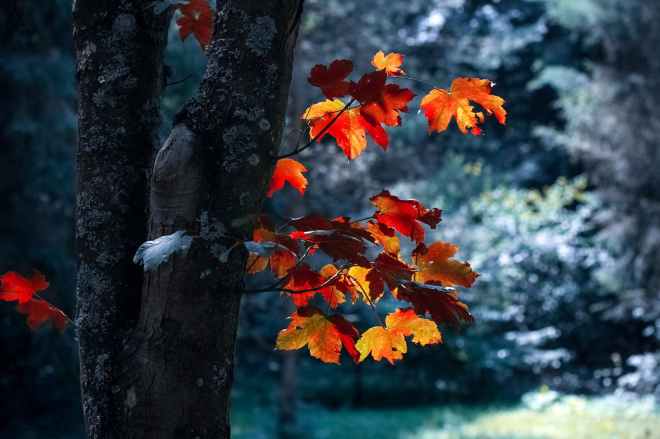
Chlorophyll usually steals the spotlight, but leaves also contain other pigments (that’s a substance that provides color), including the ones that make carrots orange and turn egg yolks yellow. Without chlorophyll’s green, these pigments finally make themselves known.
Sometimes, trees also produce the same red pigments that give raspberries their color. Leaves make those red pigments only in the fall, and scientists aren’t sure why it happens. But it must be for a good reason, because it takes a lot of sugar — which the tree needs to save up as much as possible. One guess is that these deep reds help protect dying leaves from sun damage, allowing them to collect energy just a little longer. They may also serve as a warning to animals that might otherwise eat or lay eggs on the leaves.
The exact coloring of fall foliage is the result of a mix of these red, orange and yellow pigments. So environmental conditions that change how much there is of each — such as sun exposure, soil moisture and temperature — can make a big difference. Colors vary by species, too.
Eventually, sunlight and frost kill off all pigments but tannin, which is brown. The very cells of the leaf will break down as well, making them fragile and dry. Meanwhile, the tree creates corklike cells to seal itself off from its leaves, even creating a sort of scab where each one connects to the branches. Eventually wind or some other disturbance will break the dying leaf away, leaving the tree with a tiny scar.
That’s how we get those brilliant bursts of color — and wonderful leaf piles to hop around in. In the spring, trees get to make new leaves and start the whole process again.
https://www.msn.com/en-us/kids/science-tech/why-do-leaves-change-colors/ar-BBN0pJQ?ocid=spartandhp
 Two of my three children, when they were kids. My youngest girl and my baby, my son.
Love those mischievous faces!
 My daughter bought me this, this week! I love it! It has mini bulbs in its eyes.
 My grandson’s art work. He is an artist, can’t you tell, lol?
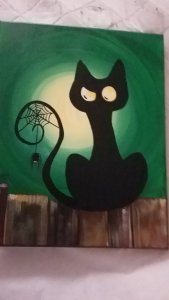 A drawing that my dear friend made for me this week. See anyone who knows me knows I love cats, especially my black cats. I love Halloween season because there are so many things about black cats. My friend drew this herself. Isn’t it wonderful?
 And this is not my personal photo, but it is funny and I wanted to share it.
Ingredients
15 oz. mushrooms
3 oz. butter
1 tsp salt
pepper, to taste
2 tbsp fresh parsley
2 cups heavy whipping cream
2 tbsp Dijon mustard
8 oz. shredded cheese
25 oz. white fish, for example cod
20 oz. broccoli or cauliflower
3 oz. butter or olive oil
Nutrition
Keto fish casserole with mushrooms and French mustard
Instructions
Preheat the oven to 350°F (175°C).
Cut the mushrooms into wedges. Fry in butter until the mushrooms have softened, about 5 minutes. Add salt, pepper, and parsley.
Pour in the heavy cream and mustard and lower the heat. Let simmer for 5-10 minutes to reduce the sauce a bit.
Season the fish with salt and pepper and place in a greased baking dish. Sprinkle 3/4 of the cheese on and pour the creamed mushrooms on top. Top with the remaining cheese.
Bake for about 30 minutes if the fish is frozen, or slightly less if it’s fresh. Probe with a sharp knife after 20 minutes; the fish is done if it flakes easily with a fork. And remember that the fish will continue to cook even after you have taken it out of the oven.
Meanwhile, make the side dish. Cut the broccoli or cauliflower into florets. Boil in lightly salted water for a few minutes. Strain off the water and add olive oil or butter.
Mash coarsely with a wooden spoon or fork.
Season with salt and pepper and serve with the fish.
Tip!
Did you know that the stem of broccoli and cauliflower is wonderful, too? Simply peel the rough outer layer off with a sharp knife or a potato peeler. And then cut the stems lengthwise into rods, or dice them. Voila! More cruciferous love!
![Grilled-Cheese-and-Avocado-Sandwich_EXPS_TMBSTK18_229389_A03_12__1b-696x696[1].jpg](https://mwsrwritings.com/wp-content/uploads/2018/08/grilled-cheese-and-avocado-sandwich_exps_tmbstk18_229389_a03_12__1b-696x6961.jpg?w=660)

Pumpkin Spice Crème Brûlée
November 15, 2017
By
Daisy Nichols
This surprising slow cooker dessert is simply delicious.
Stock up on 3 or 4 cans of pure canned pumpkin in the autumn in case the store doesn’t have any when pumpkin is out of season.
You can omit the last two steps. Instead, treat the brûlée as a less fussy custard and top it with fresh whipped cream or just serve it plain. It has great flavor—and it’s a surprising way to prepare brûlée, especially when the oven is full or the day is hot.
Ingredients
3 large egg yolks
2 large eggs
2 Cups whipping cream
1/2 Cup pureed pumpkin (canned is fine as long as it’s pure pumpkin)
1 1/3 Cup sugar, divided
1 Teaspoon ground cinnamon
1 Teaspoon ground ginger
1/4 Teaspoon ground cloves
Directions
Place the egg yolks and eggs in a good-size bowl. Beat them gently.
Slowly pour in the whipping cream, mixing it into the eggs as you pour.
Gradually add the pumpkin puree, stirring continually.
In a small bowl, stir together 1⁄3 cup sugar, cinnamon, ginger, and cloves. Stir those dry ingredients into the liquid mixture gradually.
Grease a 1 1⁄2- or 2-quart baking dish that fits into your 6- or 7-quart oval slow cooker crock. Fill the baking dish with the pumpkin mixture. Place it in the crock.
Pour water around the baking dish in the crock until it comes halfway up the sides of the dish. Be careful not to get any water in the filled dish.
Cover the cooker. Cook on Low 2 to 3 hours, or until the brûlée is set but not hard. It should be a little soft in the center.
Using oven mitts, remove the baking dish from the crock and set it on a wire rack to cool to room temperature.
Then cover and refrigerate for 2 to 8 hours.
Before serving, let the brûlée stand at room temperature for 30 minutes.
To caramelize the sugar for the topping, heat remaining 1 cup sugar in an 8-inch heavy skillet over medium-high until it begins to melt. Shake the skillet rather than stirring the sugar to heat it evenly. When the sugar starts to melt, reduce the heat to low. Cook it for 3 to 5 minutes more, or until it’s golden, stirring it as needed with a wooden spoon so it doesn’t burn.
Quickly drizzle the caramelized sugar over the brûlée. Serve it immediately.
Excerpted from Stock the Crock by Phyllis Good. Copyright © 2017 Oxmoor House.
 Mws R Writings