Follow these easy instructions to learn how to make shaving cream Easter eggs. You should be able to color Easter eggs with shaving cream in under an hour.
BRIE PASSANO
Step 1: Prepare Eggs
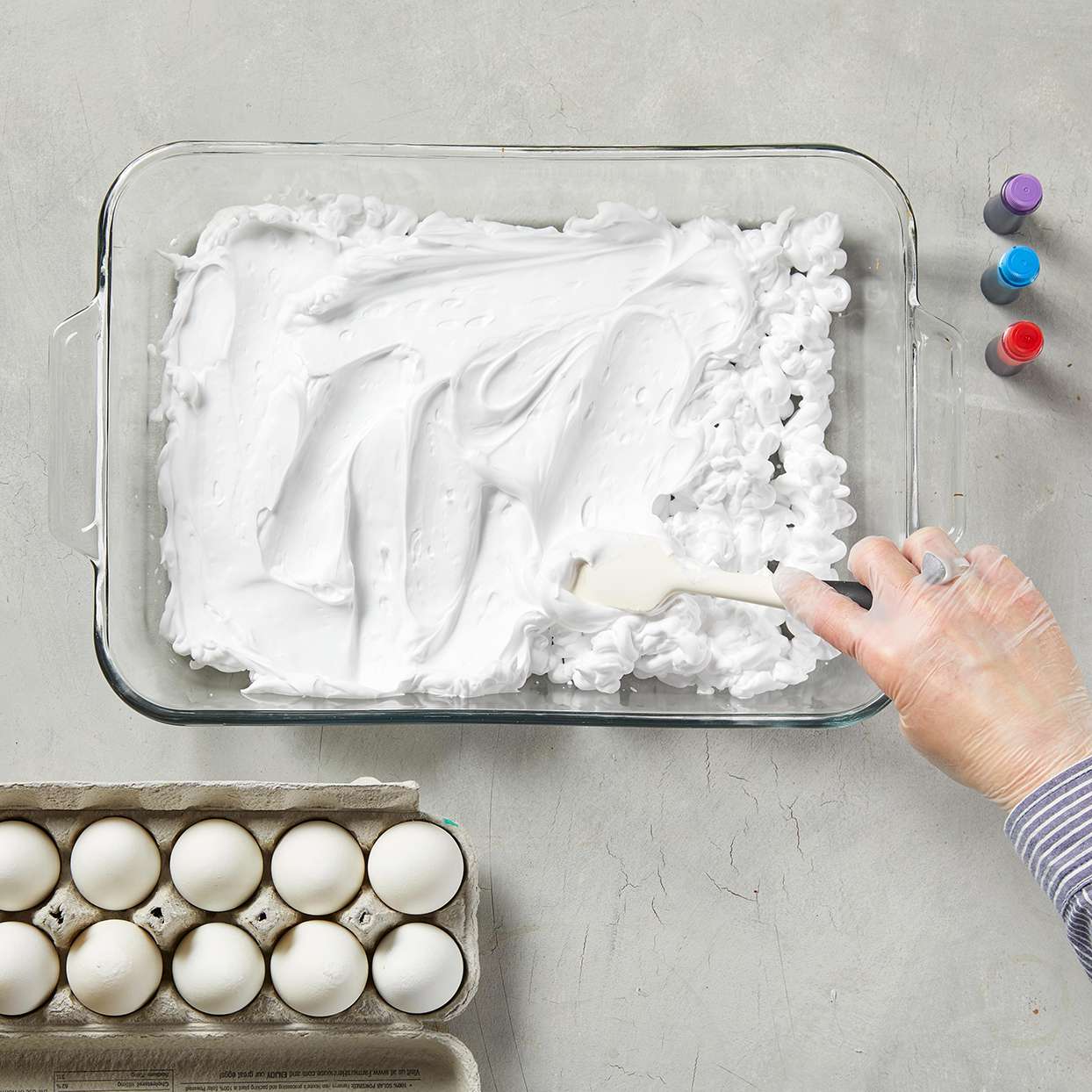
Start this easy Easter craft by preparing a batch of hard-boiled eggs. When the eggs have cooled, place them in a large bowl of vinegar. Let the eggs soak for 20 minutes; this will allow the dye to adhere more permanently to the shells. Fill a shallow glass baking dish (like this Pyrex Oblong Glass Baking Dish, $10.99) with a thick layer of shaving cream; we used a plain drugstore shaving cream. Spray the shaving cream so that it covers the bottom of a pan with a layer that is about an inch thick.
Editor’s Tip: To make whipped cream dyed eggs, simply spread a layer of non-dairy whipped topping in the bottom of your pan about an inch thick. Follow the rest of the instructions to make dyed eggs with shaving cream or whipped cream eggs.
BRIE PASSANO
Step 2: Add Color to Shaving Cream
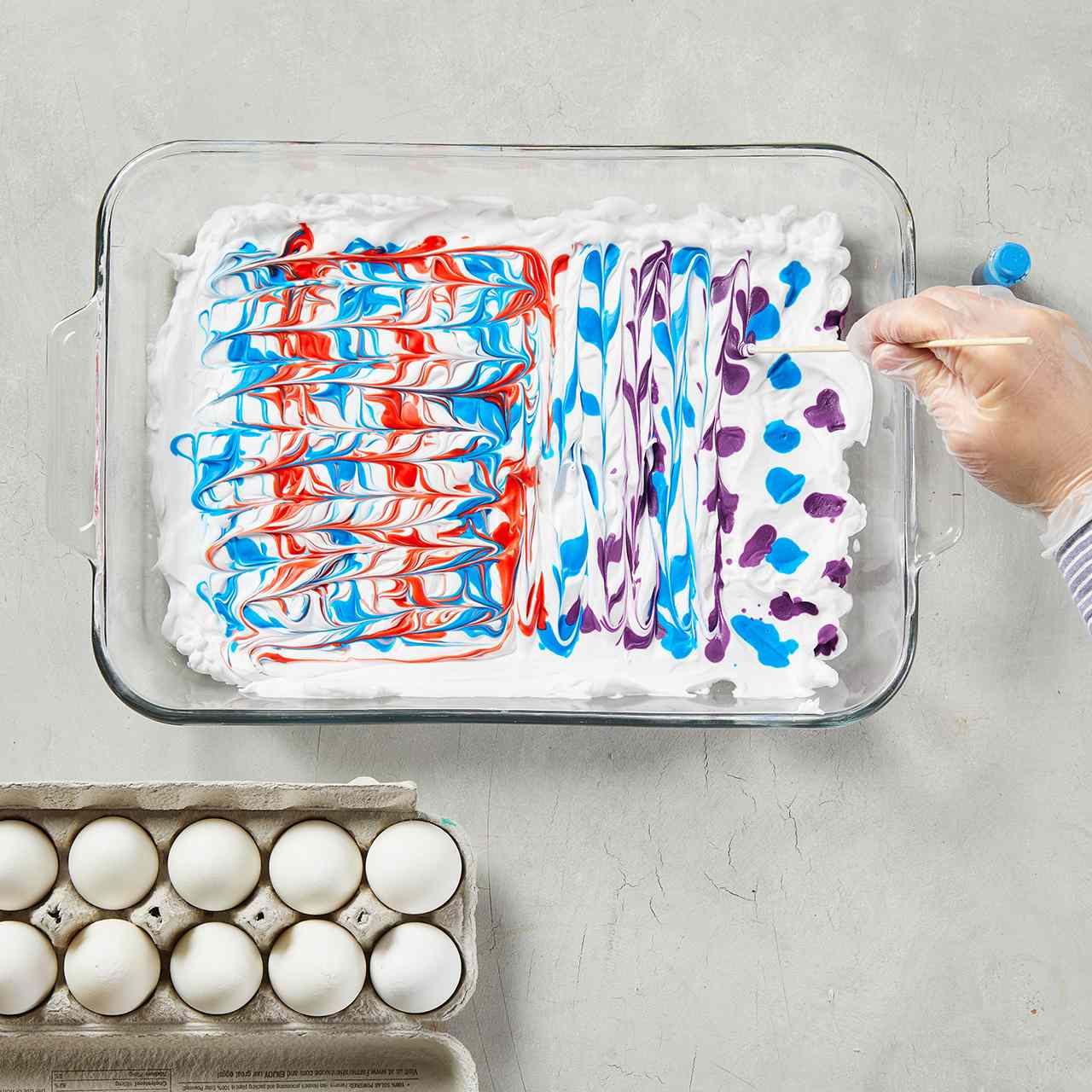
Generously place drops of food coloring on top of the shaving cream; we used a two-color combination for each set of eggs. You can use one color combination for the whole pan or divide the pan of shaving cream into halves or quarters to create more color combinations. When most of the surface is covered with food coloring, drag a bamboo skewer across the top of the shaving cream to swirl and marble the colors.
BRIE PASSANO
Step 3: Roll Eggs
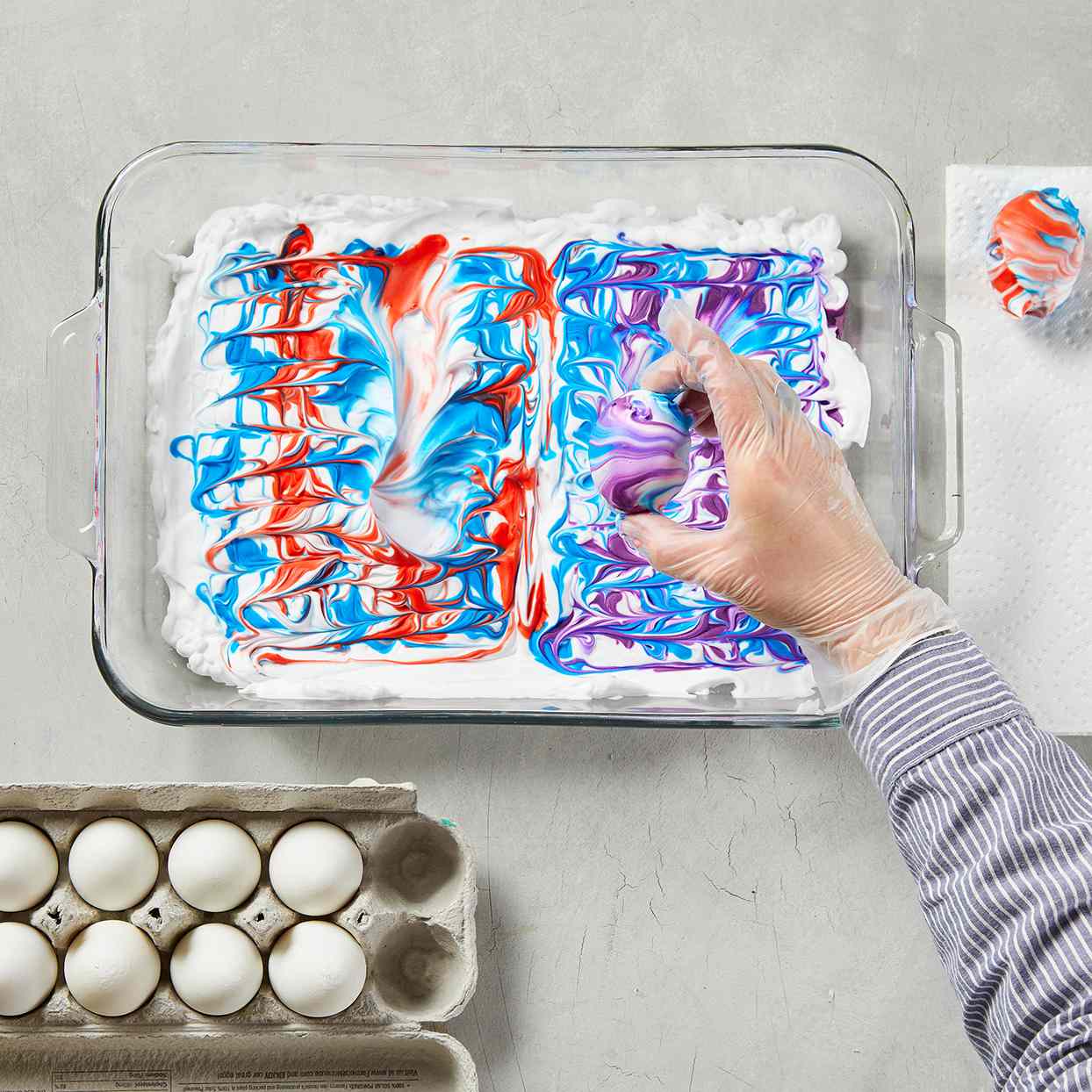
When the colored shaving cream is ready, put on a pair of gloves to protect your hands from the dye. Pick up a hard-boiled egg and set it gently on the surface of the shaving cream. Slowly roll the egg over the surface, so that the colored shaving cream completely coats the egg’s shell. Place the egg on a paper towel and let dry for 20 minutes—don’t wipe off any of the shaving cream until the egg has completely dried. Repeat this process with as many hard-boiled eggs as you’d like to color, reusing the colored shaving cream mixture.
BRIE PASSANO
Step 4: Clean and Display
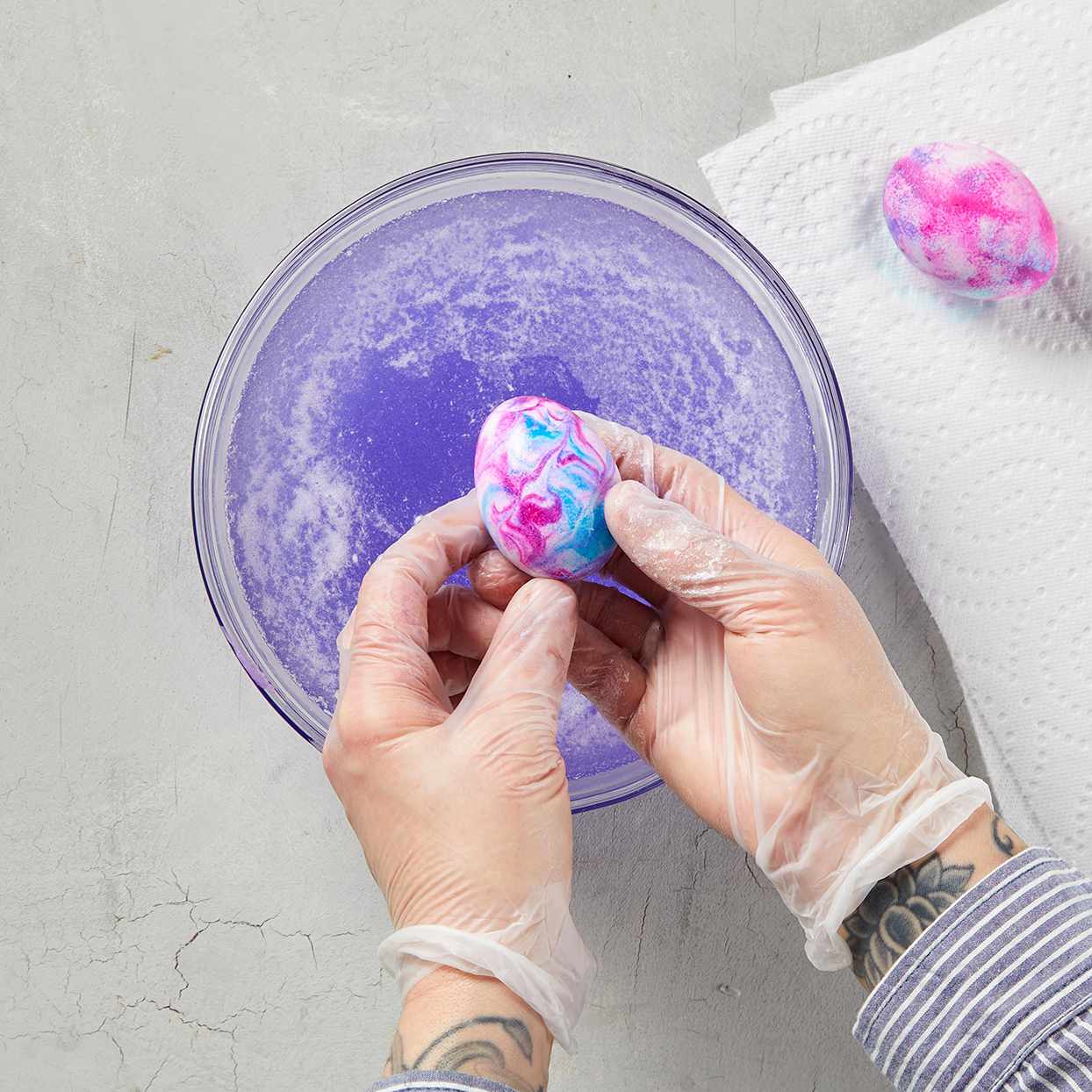
To clean the dried shaving cream egg, carefully dip each egg into a bowl of water. The water will remove the excess shaving cream while leaving the colored design on the egg’s shell. Pat each egg dry with a paper towel but be careful not to rub or wipe the surface of the egg, as this might smear or remove the dye from the shell. When each egg has been cleaned and dried, add the eggs to a colorful display. To add sheen to the finished shaving cream Easter eggs, rub them with a little vegetable oil. Eggs decorated with shaving cream are not edible, but whipped cream dyed eggs are safe to eat as long as they are stored in the refrigerator.
Did you know these 19 facts about the Christian holiday turned commercial powerhouse?
1. The tallest Easter egg chocolate was made in Italy in 2011. It stood at 10.39 meters and weighed an astounding 7,200 kg.
2. In the US, only 12 of the 50 states recognize Good Friday as a holiday.
3. The art of painting eggs is called pysanka, which originated in Ukraine. It involves using wax and dyes to color the egg.
4. The term Easter gets its name from Eastre, the Anglo-Saxon goddess who symbolizes the hare and the egg.
5. The exchange or giving of Easter eggs actually dates to before Easter and the giving of eggs is actually considered a symbol of rebirth in many cultures.
6. There used to be a tradition churches observed that resembled the game of “hot potato.” Here, the priest would toss a hard-boiled egg to one of the choir boys.
The boys would toss the egg amongst themselves and when the clock struck 12, whomever had the egg was the winner and got to keep the egg.
7. Peep peep… did you know Americans buy more than 700 million marshmallow Peeps during Easter? This makes Peeps the most popular non-chocolate Easter candy.
8. Americans consume more than 16 million jelly beans during this holiday. That is enough jelly beans to circle the globe not once, not twice, but three times.
9. Are you an ears, arms or tail person? Seventy-six percent of people eat the ears on the chocolate bunny first, 5 percent go for the feet and 4 percent for the tail.
10. During the holiday, more than 90 million chocolate bunnies, 91.4 billion eggs and 700 million Peeps are produced each year in the United States alone.
11. Next to Halloween, Easter is the biggest candy-consuming holiday of the year. Good thing they are almost six months apart, perfect for your yearly dentist check-ups!
12. An estimated $14.7 billion is spent in total for Easter in the US.
13. The Easter egg is said to symbolize and represent joy, celebration and new life.
14. Easter is the celebration of the resurrection of Christ; it is the oldest Christian holiday and one of the most important days of the year.
15. Half the states in the United States banned the dyeing of chicks on Easter; however, Florida recently overturned this law and now prevents the dyeing of all animals.
16. Not only did Florida overturn the dyeing of animals, but the state also held the largest Easter egg hunt, where 9,753 children searched for 501,000 eggs.
17. The White House of tradition of the Easter Egg Roll started back in 1878, with President Rutherford B. Hayes!
18. Workers in Birmingham, who make the famous Cadbury Creme Egg, produce more than 1.5 million egg delights a year.
19. The idea of the Easter bunny giving candies and eggs is said to have originated in Germany during the middle ages.
No matter how old you are or where you are in the world, Easter is a fun family tradition that never gets old.
From the Easter egg hunts to the taking your first bite into that chocolate bunny, it is not only a special religious holiday that marks an end to Lent, but one that represents the resurrection of Christ, too.
For those who aren’t so religious, Easter marks a long weekend, filled with fun.
A man with a heavenly start Came to the earth when the clouds did part. He lived among the saints and the sinners He preached so we all could be eternal winners. Temptation he withstood Aways taught us to be like we should. Anger and deceit finally took reign No one to stop death for him, he took the blame. You could hear whispers of his holy name. Faultless he bore it all So we all could be with him, and rise up tall. He was laid in a tomb in a poor sort of way Then he miraculously arose from the grave, in three days. My! my Savior can walk with me He can talk to me And he tells me I am his own. Praise be to His Holy Name, and to his throne.
Easter is a time when we come together to celebrate family, friendship, and faith. And no matter what the Easter Bunny brings, you can always treasure the memories you and your loved ones make on this special holiday. From gathering around the table to catch up with everyone to discovering who in the family is best at Easter egg art, there are so many opportunities to cherish the day.
This year, make Easter Sunday extra special by taking part in a few festive Easter games that go beyond the traditional Easter egg hunt. Some of these Easter games take a few hours to set up, while others you can play on a whim. The best part? Anyone from toddlers to grandparents can join in the fun.
The Easter Egg Toss Game
Shutterstock
Though this is one of the simplest Easter games, it’s also a ton of fun. To prep, fill plastic Easter eggs with confetti, or, if you’re willing to play outside, water. Have players pair up and toss the eggs back and forth. If a duo drops their egg, they’re out. The last pair standing wins.
The best part about this game is that it can be adapted to any number of players (as long as you’ve got an even number) and works great for ages three and up. Just make sure that players stand closer together if there are younger kids partaking in the holiday fun. Afterward, you can watch one of these classic Easter movies.
The Egg Commands Game
Shutterstock
Here’s an Easter game that will have everyone laughing by the end. Before your party, write a few funny commands on slips of paper, i.e., “Hop like a bunny 10 times,” “Name five things you might find in an Easter basket,” or “Take all of the remaining eggs out of your basket one by one and then put them back.” Put each slip of paper inside a plastic egg, and divide the eggs evenly into two baskets.
To play, split your group into two teams and have them line up across the room (or yard) from the baskets. On the count of three, the first person on each team runs up to the basket, selects an egg, and performs the action inside that egg. Once they’ve completed the action, they run back and tap the next team member. The first team to finish their basket wins. You’ll want to have anywhere from six to twelve players, ages seven and up.
The Pile of Peeps Game
Shutterstock
This Easter game is just like Jenga, only with Peeps! To play, place a coaster in the middle of your table and put a Peep on it. (Make sure you buy the flat bunny Peeps, not the lumpy chick ones). Players take turns adding Peeps to the pile until the pile falls over. And, of course, the person who causes that to happen is out.
The Spoon and Egg Race
Shutterstock
No list of Easter games would be complete without this picnic classic. Each player places a hard-boiled egg on a spoon and holds it in their mouth. On the count of three, each player races to the finish line, trying to keep the egg balanced. The first person to make it to the finish line with their egg still intact wins. This is a great way to utilize all those eggs you dyed!
The Jellybean Scoop Game
Shutterstock
Jelly beans are the MVP of Easter candies, and they are perfect for playing all sorts of Easter games. For this game, each player gets one empty bowl, one bowl filled with jelly beans, and one spoon. The challenge: Put the spoon in your mouth and use it to move all of the jelly beans from the jelly bean bowl to the empty bowl. The first person to do that wins. (Of course, in the end, everyone gets to eat them.) This game can be played with kids ages four and up, in any size group (while jelly beans last).
Bocce Eggs
Shutterstock
This is a fun Easter twist on bocce ball that you can easily create at home. To prep, hard boil some eggs—you’ll need four for each player, plus one extra. (You can also use a set of wooden eggs from the craft store). Keep one of the eggs white and dye the others in colored sets of four. Roll (or toss) the white egg onto the lawn, and take turns rolling the colored eggs to see who can get the closest to the white egg without touching it.
The Easter Egg Puzzle Hunt
Shutterstock
This is an exciting twist on the classic Easter egg hunt. To play, buy an easy (this is key!) Easter-themed puzzle and some plastic eggs. Place one piece of the puzzle in each egg and hide them around the house or yard. Everyone searches for the eggs and puts the puzzle together as they find each piece. This game is great for kids ages seven and up.
The Carrot in the Basket Game
Shutterstock
Of course, every Easter Bunny needs a ton of carrots. But all you need for this cute game is two big Easter baskets and a pile of carrots. Divide your group into two teams and have them toss the carrots into the baskets. Whichever team gets the most carrots in their basket wins. This is one of those Easter games that’s great for younger kids, ages one to five.
The Bunny Nose Race
Shutterstock
This little game will get everyone in the family giggling. Each player gets a bowl full of cotton balls (or bunny tails, if you will). Everyone puts a small amount of Vaseline on their nose and tries to move the cotton balls out of their bowl with just their nose. Whoever moves all of the cotton balls out of the bowl first wins. For larger groups, you can split into teams and do it relay style. This Easter game is best for ages six and up, and works for any size group—just make sure you buy enough cotton balls!
Bunny Bowling
Shutterstock
It’s actually pretty easy to turn a regular set of toy bowling pins into bunny bowling pins (like these, by Handmade Charlotte). Set them up in your yard and see who can knock down the most. For an extra Easter twist, you could use dyed hard-boiled eggs instead of a plastic ball. The game is perfect for kids ages six and up and works wonderfully with groups of two to ten players.
Pin the Tail on the Easter Bunny
Shutterstock
This party classic is perfect for any Easter gathering. To play, hang a paper bunny on the wall. Players take turns being blindfolded and trying to pin the bunny tail on the Easter Bunny’s rump. You can buy a Pin the Tail on the Easter Bunny set, or, if you’re feeling creative, you can draw one of your own!
The Chalk Bunny Hop Game
Shutterstock
Here’s a great way to get everyone moving and grooving outside. Use a picture of a bunny and a piece of cardboard to make a chalk bunny template. Use sidewalk chalk and your template to draw a few bunnies all around your driveway or another safe concrete area. Start by having everyone hop from bunny to bunny. Then have everyone dance from bunny to bunny. Then have everyone skip from bunny to bunny. Take suggestions from the kids for more movement ideas—and don’t forget to put on some fun tunes to make this game even more exciting.
The Easter Egg Matching Game
Shutterstock
If you want your Easter games to be educational, this one is a winner. Take some plastic eggs and use a Sharpie to write uppercase letters on one half, and the corresponding lowercase letters on the other half. Twist the eggs to mix them up, and challenge your kiddos to match the letters together. It’s the perfect game for any youngster still learning their letters. The Alphabet Easter Egg Game is recommended for ages four to six and can be played with groups of one to five kids.
The Easter Egg Tower Game
Shutterstock
Once your Easter egg hunt is over, chances are you’ll have a bunch of empty plastic eggs leftover. That’s the perfect opportunity to have an Easter egg tower-building contest! Stack egg halves on top of each other, and see who can build the tallest tower without it falling down.
The Don’t Eat the Peep Game
Shutterstock
This printable game is easy as pie to set up. Print out the game boards and distribute them to players. Give each player a little bowl filled with jellybeans, cereal, or some other type of candy. Everyone puts one piece on each square of the board. One person is “it” and leaves the room. The remaining players decide which square is “the Peep.” Once that’s decided, the player who’s “it” comes back into the room; their job is to find “the Peep” by eating pieces of candy one square at a time. If they eat the piece of candy on the Peep square, everyone else yells “Don’t eat the Peep!” This is a great game for younger kids (ages three to seven) who will think yelling “Don’t eat the Peep!” is hilarious.
Bunny Bunny
Shutterstock
This is a classic improv game that is perfectly on brand for Easter. Have everyone form a circle. Each player pats their hands on their laps to a moderate beat, while saying “oomba” together. Then, on the beat, the first “leader” (select this person in advance) makes bunny ears with their fingers and points them toward themselves twice, and then (making eye contact) they point their bunny fingers toward another player, while saying “Bunny, bunny. Bunny, bunny.”
That player then becomes the leader, and repeats the motion, passing to another player. Once you’ve got the hang of passing the bunny fingers around the circle, add on a new twist. When the bunny fingers are passed to a new leader, the people on either side of the leader wave their hands and say “tokey tokey” along with them. Watch a video of the game being played to get the hang of it quickly. This game is best played in groups of four or more.
The Jelly Bean Guessing Game
Shutterstock
The jelly bean guess is one of the most popular Easter games out there, and there’s a reason why: Everyone loves it! Before the party starts, fill a mason jar with jelly beans. As your guests arrive, have them guess how many jelly beans are in the jar. The person whose guess is the closest wins the jar.
The Chubby Bunny Game
Shutterstock
Chubby Bunny is a classic (and the perfect excuse to eat more Peeps!). Each round, every player puts a Peep into their mouth and says “Chubby Bunny.” Once you’ve got so many marshmallows in your mouth that you can’t say “Chubby Bunny” articulately or with a straight face, you’re out. The last person standing wins.
You’ll want to make sure all your players are old enough to understand the concept of a choking hazard. Aside from that, this is one of those Easter games where you can have as many players as you’d like!
The Classic Egg Tapping Easter Game
Shutterstock
Egg tapping—or egg fight as some call it—is a classic Easter game tradition that dates back centuries. And fortunately, this Easter game is pretty simple. All you need to play is two hard-boiled eggs. One person holds an egg in their hand while the other player taps their egg against it, hoping to break their opponent’s egg without breaking their own. The first person to have their egg cracked loses. This game can be extended by having the winner continue to challenge new opponents—and the last one standing with an uncracked egg after everyone has been challenged wins.
The Paint-Filled Eggs on Canvas Activity
Shutterstock
This Easter game is less of a challenge and more about just having fun. You’ll need empty eggshells with the tops cut off so you can fill them with various colors of paint. Go for Easter pastels or vibrant colors—it’s your choice! Once you have your eggs filled, put tissue paper squares over each eggshell and use glue to carefully secure them, making sure they’re completely dry. After that, all you need is to go outside and start letting the little ones throw the paint-filled eggs at some blank canvases. It’s fun to do, and you’ll get some amazing pieces of art out of it!
The Egg Rolling Game
Shutterstock
An Easter twist on the classic horse race, this game is simple to execute, but still fun for the whole family. All you need is some kind of incline and a few hard-boiled eggs. Each person stands at the top of the incline and rolls their eggs down all at once. The first person to have their egg reach the bottom is the winner. The steeper the hill, the more entertaining.
The Swinging Basket Game
Shutterstock
This is another one of those Easter games that is all about aim and hand-eye coordination—a challenge the bigger kids will certainly enjoy. All you need is some rope, a basket, plastic Easter eggs, popcorn kernels, and tape. Fill your plastic eggs with popcorn kernels and tape them shut to give them a little weight. Then, after you hang your basket from a tree branch, line the children up and have them take turns trying to throw eggs into the basket. Once the kids get a hang of it, take up the difficulty by swinging the basket back and forth while they try to throw their eggs in.
“I had to say that while Easter eggs mostly hatched rabbits, there were instances in which they hatched other things, as, for instance, handfuls of eagles and half-eagles and double-eagles, especially in the case of the golden eggs that the goose laid. They knew all about that goose…”
Easter Joys postcard, 1915
The old fellow who told that story of dream-transference on a sleeping-car at Christmas-time was again at the club on Easter Eve. Halson had put him up for the winter, under the easy rule we had, and he had taken very naturally to the Turkish room for his after-dinner coffee and cigar. We all rather liked him, though it was Minver’s pose to be critical of the simple friendliness with which he made himself at home among us, and to feign a wish that there were fewer trains between Boston and New York, so that old Newton (that was his name) could have a better chance of staying away. But we noticed that Minver was always a willing listener to Newton’s talk, and that he sometimes hospitably offered to share his tobacco with the Bostonian. When brought to book for his inconsistency by Rulledge, he said he was merely welcoming the new blood, if not young blood, that Newton was infusing into our body, which had grown anaemic on Wanhope’s psychology and Rulledge’s romance; or, anyway, it was a change.
Newton now began by saying abruptly, in a fashion he had, “We used to hear a good deal in Boston about your Easter Parade here in New York. Do you still keep it up?”
No one else answering, Minver replied, presently, “I believe it is still going on. I understand that it’s composed mostly of milliners out to see one another’s new hats, and generous Jewesses who are willing to contribute the ‘dark and bright’ of the beauty in which they walk to the observance of an alien faith. It’s rather astonishing how the synagogue takes to the feasts of the church. If it were not for that, I don’t know what would become of Christmas.”
“What do you mean by their walking in beauty?” Rulledge asked over his shoulder.
“I shall never have the measure of your ignorance, Rulledge. You don’t even know Byron’s lines on Hebrew loveliness?
“‘She walks in beauty like the night Of cloudless climes and starry skies, And all that’s best of dark and bright Meets in her aspect and her eyes.'”
“Pretty good,” Rulledge assented. “And they _are_ splendid, sometimes. But what has the Easter Parade got to do with it?” he asked Newton.
“Oh, only what everything has with everything else. I was thinking of Eastertime long ago and far away, and naturally I thought of Easter now and here. I saw your Parade once, and it seemed to me one of the great social spectacles. But you can’t keep anything in New York, if it’s good; if it’s bad, you can.”
“You come from Boston, I think you said, Mr. Newton,” Minver breathed blandly through his smoke.
“Oh, I’m not a _real_ Bostonian,” our guest replied. “I’m not abusing you on behalf of a city that I’m a native proprietor of. If I were, I shouldn’t perhaps make your decadent Easter Parade my point of attack, though I think it’s a pity to let it spoil. I came from a part of the country where we used to make a great deal of Easter, when we were boys, at least so far as eggs went. I don’t know whether the grown people observed the day then, and I don’t know whether the boys keep it now; I haven’t been back at Eastertime for several generations. But when I was a boy it was a serious thing. In that soft Southwestern latitude, the grass had pretty well greened up by Easter, even when it came in March, and grass colors eggs a very nice yellow; it used to worry me that it didn’t color them green. When the grass hadn’t got along far enough, winter wheat would do as well. I don’t remember what color onion husks would give; but we used onion husks, too. Some mothers would let the boys get logwood from the drugstore, and that made the eggs a fine, bold purplish black. But the greatest egg of all was a calico egg, that you got by coaxing your grandmother (your mother’s mother) or your aunt (your mother’s sister) to sew up in a tight cover of brilliant calico. When that was boiled long enough the colors came off in a perfect pattern on the egg. Very few boys could get such eggs; when they did, they put them away in bureau drawers till they ripened and the mothers smelt them and threw them out of the window as quickly as possible. Always, after breakfast, Easter Morning, we came out on the street and fought eggs. We pitted the little ends of the eggs against one another, and the fellow whose egg cracked the other fellow’s egg won it, and he carried it off. I remember grass and wheat-colored eggs in such trials of strength, and onion and logwood colored eggs; but never calico eggs; _they_ were too precious to be risked; it would have seemed wicked.
“I don’t know,” the Boston man went musingly on, “why I should remember these things so relentlessly; I’ve forgotten all the important things that happened to me then; but perhaps these were the important things. Who knows? I only know I’ve always had a soft spot in my heart for Easter, not so much because of the calico eggs, perhaps, as because of the grandmothers and the aunts. I suppose the simple life is full of such aunts and grandmothers still; but you don’t find them in hotel apartments, or even in flats consisting of seven large, light rooms and bath.” We all recognized the language of the advertisements, and laughed in sympathy with our guest, who perhaps laughed out of proportion with a pleasantry of that size.
When he had subdued his mirth, he resumed at a point apparently very remote from that where he had started.
“There was one of those winters in Cambridge, where I lived then, that seemed tougher than any other we could remember, and they were all pretty tough winters there in those times. There were forty snowfalls between Thanksgiving and Fast Day–you don’t know what Fast Day is in New York, and we didn’t, either, as far as the fasting went–and the cold kept on and on till we couldn’t, or said we couldn’t, stand it any longer. So, along about the middle of March somewhere, we picked up the children and started south. In those days New York seemed pretty far south to us; and when we got here we found everything on wheels that we had left on runners in Boston. But the next day it began to snow, and we said we must go a little farther to meet the spring. I don’t know exactly what it was made us pitch on Bethlehem, Pennsylvania; but we had a notion we should find it interesting, and, at any rate, a total change from our old environment. We had been reading something about the Moravians, and we knew that it was the capital of Moravianism, with the largest Moravian congregation in the world; I think it was Longfellow’s ‘Hymn of the Moravian Nuns’ that set us to reading about the sect; and we had somehow heard that the Sun Inn, at Bethlehem, was the finest old-fashioned public house anywhere. At any rate, we had the faith of our youthful years, and we put out for Bethlehem.
“We arrived just at dusk, but not so late that we couldn’t see the hospitable figure of a man coming out of the Sun to meet us at the omnibus door and to shake hands with each of us. It was the very pleasantest and sweetest welcome we ever had at a public house; and though we found the Sun a large, modern hotel, we easily accepted the landlord’s assurance that the old Inn was built up inside of the hotel, just as it was when Washington stayed in it; and after a mighty good supper we went to our rooms, which were piping warm from two good base-burner stoves. It was not exactly the vernal air we had expected of Bethlehem when we left New York; but you can’t have everything in this world, and, with the snowbanks along the streets outside, we were very glad to have the base-burners.
“We went to bed pretty early, and I fell into one of those exemplary sleeps that begin with no margin of waking after your head touches the pillow, or before that, even, and I woke from a dream of heavenly music that translated itself into the earthly notes of bugles. It made me sit up with the instant realization that we had arrived in Bethlehem on Easter Eve, and that this was Easter Morning. We had read of the beautiful observance of the feast by the Moravians, and, while I was hurrying on my clothes beside my faithful base-burner, I kept quite superfluously wondering at myself for not having thought of it, and so made sure of being called. I had waked just in time, though I hadn’t deserved to do so, and ought, by right, to have missed it all. I tried to make my wife come with me; but after the family is of a certain size a woman, if she is a real woman, thinks her husband can see things for her, and generally sends him out to reconnoitre and report. Besides, my wife couldn’t have left the children without waking them, to tell them she was going, and then all five of them would have wanted to come with us, including the baby; and we should have had no end of a time convincing them of the impossibility. We were a good deal bound up in the children, and we hated to lie to them when we could possibly avoid it. So I went alone.
“I asked the night porter, who was still on duty, the way I wanted to take, but there were so many people in the streets going the same direction that I couldn’t have missed it, anyhow; and pretty soon we came to the old Moravian cemetery, which was in the heart of the town; and there we found most of the Moravian congregation drawn up on three sides of the square, waiting and facing the east, which was beginning to redden. Of all the cemeteries I have seen, that was the most beautiful, because it was the simplest and humblest. Generally a cemetery is a dreadful place, with headstones and footstones and shafts and tombs scattered about, and looking like a field full of granite and marble stumps from the clearing of a petrified forest. But here all the memorial tablets lay flat with the earth. None of the dead were assumed to be worthier of remembrance than another; they all rested at regular intervals, with their tablets on their breasts, like shields, in their sleep after the battle of life. I was thinking how right and wise this was, and feeling the purity of the conception like a quality of the keen, clear air of the morning, which seemed to be breathing straight from the sky, when suddenly the sun blazed up from the horizon like a fire, and the instant it appeared the horns of the band began to blow and the people burst into a hymn–a thousand voices, for all I know. It was the sublimest thing I ever heard, and I don’t know that there’s anything to match it for dignity and solemnity in any religious rite. It made the tears come, for I thought how those people were of a church of missionaries and martyrs from the beginning, and I felt as if I were standing in sight and hearing of the first Christians after Christ. It was as if He were risen there ‘in the midst of them.'”
Rulledge looked round on the rest of us, with an air of acquiring merit from the Bostonian’s poetry, but Minver’s gravity was proof against the chance of mocking Rulledge, and I think we all felt alike. Wanhope seemed especially interested, though he said nothing.
“When I went home, I told my wife about it as well as I could, but, though she entered into the spirit of it, she was rather preoccupied. The children had all wakened, as they did sometimes, in a body, and were storming joyfully around the rooms, as if it were Christmas; and she was trying to get them dressed. ‘Do tell them what Easter is like; they’ve never seen it kept before,’ she said; and I tried to do so, while I took a hand, as a young father will, and tried to get them into their clothes. I don’t think I dwelt much on the religious observance of the day, but I dug up some of my profane associations with it in early life, and told them about coloring eggs, and fighting them, and all that; there in New England, in those days, they had never seen or heard of such a thing as an Easter egg.
“I don’t think my reminiscences quieted them much. They were all on fire–the oldest hoy and girl, and the twins, and even the two-year-old that we called the baby–to go out and buy some eggs and get the landlord to let them color them in the hotel kitchen. I had a deal of ado to make them wait till after breakfast, but I managed, somehow; and when we had finished–it was a mighty good Pennsylvania breakfast, such as we could eat with impunity in those halcyon days: rich coffee, steak, sausage, eggs, apple butter, buckwheat cakes and maple syrup–we got their out-door togs on them, while they were all stamping and shouting round and had to be caught and overcoated, and fur-capped and hooded simultaneously, and managed to get them into the street together. Ever been in Bethlehem?”
We all had to own our neglect of this piece of travel; and Newton, after a moment of silent forgiveness, said:
“Well, I don’t know how it is now, but twenty-five or thirty years ago it was the most interesting town in America. It wasn’t the old Moravian community that it had been twenty-five years before that, when none but Moravians could buy property there; but it was like the Sun Hotel, and just as that had grown round and over the old Sun Inn, the prosperous manufacturing town, with its iron-foundries and zinc-foundries, and all the rest of it, had grown round and over the original Moravian village. If you wanted a breath of perfect strangeness, with an American quality in it at the same time, you couldn’t have gone to any place where you could have had it on such terms as you could in Bethlehem. I can’t begin to go into details, but one thing was hearing German spoken everywhere in the street: not the German of Germany, but the Pennsylvania German, with its broad vowels and broken-down grammatical forms, and its English vocables and interjections, which you caught in the sentences which came to you, like _av coorse_, and _yes_ and _no_ for _ja_ and _nein_. There were stores where they spoke no English, and others where they made a specialty of it; and I suppose when we sallied out that bright Sunday morning, with the baby holding onto a hand of each of us between us, and the twins going in front with their brother and sister, we were almost as foreign as we should have been in a village on the Rhine or the Elbe.
“We got a little acquainted with the people, after a while, and I heard some stories of the country folks that I thought were rather good. One was about an old German farmer on whose land a prospecting metallurgist found zinc ore; the scientific man brought him the bright yellow button by which the zinc proved its existence in its union with copper, and the old fellow asked in an awestricken whisper: ‘Is it a gold-mine?’ ‘No, no. Guess again.’ ‘Then it’s a _brass-mine_!’ But before they began to find zinc there in the lovely Lehigh Valley–you can stand by an open zinc-mine and look down into it where the rock and earth are left standing, and you seem to be looking down into a range of sharp mountain peaks and pinnacles–it was the richest farming region in the whole fat State of Pennsylvania; and there was a young farmer who owned a vast tract of it, and who went to fetch home a young wife from Philadelphia way, somewhere. He drove there and back in his own buggy, and when he reached the top overlooking the valley, with his bride, he stopped his horse, and pointed with his whip. ‘There,’ he said, ‘as far as the sky is blue, it’s all ours!’ I thought that was fine.”
“Fine?” I couldn’t help bursting out; “it’s a stroke of poetry.”
Minver cut in: “The thrifty Acton making a note of it for future use in literature.”
“Eh!” Newton queried. “Oh! I don’t mind. You’re welcome to it, Mr. Acton. It’s a pity somebody shouldn’t use it, and of course _I_ can’t.”
“Acton will send you a copy with the usual forty-per-cent. discount and ten off for cash,” the painter said.
They had their little laugh at my expense, and then Newton took up his tale again. “Well, as I was saying–By the way, what _was_ I am saying?”
The story loving Rulledge remembered. “You went out with your wife and children for Easter eggs.”
“Oh yes. Thank you. Well, of course, in a town geographically American, the shops were all shut on Sunday, and we couldn’t buy even an Easter egg on Easter Sunday. But one of the stores had the shade of its show-window up, and the children simply glued themselves to it in such a fascination that we could hardly unstick them. That window was full of all kinds of Easter things–I don’t remember what all; but there were Easter eggs in every imaginable color and pattern, and besides these, there were whole troops of toy rabbits. I had forgotten that the natural offspring of Easter eggs is rabbits, but I took a brace, remembered the fact, and announced it to the children. They immediately demanded an explanation, with all sorts of scientific, which I gave them, as reckless of the truth as I thought my wife would suffer without contradicting me. I had to say that while Easter eggs mostly hatched rabbits, there were instances in which they hatched other things, as, for instance, handfuls of eagles and half-eagles and double-eagles, especially in the case of the golden eggs that the goose laid. They knew all about that goose; but I had to tell them what those unfamiliar pieces of American coinage were and promise to give them one each when they grew up if they were good. That only partially satisfied them, and they wanted to know specifically what other kinds of things Easter eggs would hatch if properly treated. Each one had a preference; the baby always preferred what the last one said; and _she_ wanted an ostrich, the same as her big brother; he was seven then.
“I don’t really know how we lived through the day; I mean the children, for my wife and I went to the Moravian church, and had a good long Sunday nap in the afternoon, while the children were pining for Monday morning, when they could buy eggs and begin to color them, so that they could hatch just the right kind of Easter things. When I woke up I had to fall in with a theory they had agreed to between them that any kind of two-legged or four-legged chick that hatched from an Easter egg would wear the same color, or the same kind of spots or stripes, that the egg had.
“I found that they had arranged to have calico eggs, and they were going to have their mother cover them with the same sort of cotton prints that I had said my grandmother and aunts used, and they meant to buy the calico in the morning at the same time that they bought the eggs. We had some tin vessels of water on our stoves to take the dryness out of the hot air, and they had decided that they would boil their eggs in these, and not trouble the landlord for the use of his kitchen.
“There was nothing in this scheme wanting but their mother’s consent–I agreed to it on the spot–but when she understood that they each expected to have two eggs apiece, with one apiece for us, she said she never could cover a dozen eggs in the world, and that the only way would be for them to go in the morning with us, and choose each the handsomest egg they could out of the eggs in that shop-window. They met this proposition rather blankly at first; but on reflection the big brother said it would be a shame to spoil mamma’s Easter by making her work all day, and besides it would keep till that night, anyway, before they could begin to have any fun with their eggs; and then the rest all said the same thing, ending with the baby: and accepted the inevitable with joy, and set about living through the day as well as they could.
“They had us up pretty early the next morning–that is, they had me up; their mother said that I had brought it on myself, and richly deserved it for exciting their imaginations, and I had to go out with the two oldest and the twins to choose the eggs; we got off from the baby by promising to let her have two, and she didn’t understand very well, anyway, and was awfully sleepy. We were a pretty long time choosing the six eggs, and I don’t remember now just what they were; but they were certainly joyous eggs; and–By the way, I don’t know why I’m boring a brand of hardened bachelors like you with all these domestic details?”
“Oh, don’t mind _us_,” Minver responded to his general appeal. “We may not understand the feelings of a father, but we are all mothers at heart, especially Rulledge. Go on. It’s very exciting,” he urged, not very ironically, and Newton went on.
“Well, I don’t believe I could say just how the havoc began. They put away their eggs very carefully after they had made their mother admire them, and shown the baby how hers were the prettiest, and they each said in succession that they must be very precious of them, for if you shook an egg, or anything, it wouldn’t hatch; and it was their plan to take these home and set an unemployed pullet, belonging to the big brother, to hatching them in the coop that he had built of laths for her in the back yard with his own hands. But long before the afternoon was over, the evil one had entered Eden, and tempted the boy to try fighting eggs with these treasured specimens, as I had told we boys used to fight eggs in my town in the southwest. He held a conquering course through the encounter with three eggs, but met his Waterloo with a regular Bluecher belonging to the baby. Then he instantly changed sides; and smashed his Bluecher against the last egg left. By that time all the other children were in tears, the baby roaring powerfully in ignorant sympathy, and the victor steeped in silent gloom. His mother made him gather up the ruins from the floor, and put them in the stove, and she took possession of the victorious egg, and said she would keep it till we got back to Cambridge herself, and not let one of them touch it. I can tell you it was a tragical time. I wanted to go out and buy them another set of eggs, and spring them for a surprise on them in the morning, after they had suffered enough that night. But she said that if I dared to dream of such a thing–which would be the ruin of the children’s character, by taking away the consequences of their folly–she should do, she did not know what, to me. Of course she was right, and I gave in, and helped the children forget all about it, so that by the time we got back to Cambridge I had forgotten about it myself.
“I don’t know what it was reminded the boy of that remaining Easter egg unless it was the sight of the unemployed pullet in her coop, which he visited the first thing; and I don’t know how he managed to wheedle his mother out of it; but the first night after I came home from business–it was rather late and the children had gone to bed–she told me that ridiculous boy, as she called him in self-exculpation, had actually put the egg under his pullet, and all the children were wild to see what it would hatch. ‘And now,’ she said, severely, ‘what are you going to do? You have filled their heads with those ideas, and I suppose you will have to invent some nonsense or other to fool them, and make them believe that it has hatched a giraffe, or an elephant, or something; they won’t be satisfied with anything less.’ I said we should have to try something smaller, for I didn’t think we could manage a chick of that size on our lot; and that I should trust in Providence. Then she said it was all very well to laugh; and that I couldn’t get out of it that way, and I needn’t think it.
“I didn’t, much. But the children understood that it took three weeks for an egg to hatch, and anyway the pullet was so intermittent in her attentions to the Easter egg, only sitting on it at night, or when held down by hand in the day, that there was plenty of time. One evening when I came out from Boston, I was met by a doleful deputation at the front gate, with the news that when the coop was visited that morning after breakfast–they visited the coop every morning before they went to school–the pullet was found perched on a cross-bar in a high state of nerves, and the shell of the Easter egg broken and entirely eaten out. Probably a rat had got in and done it, or, more hopefully, a mink, such as used to attack eggs in the town where I was a boy. We went out and viewed the wreck, as a first step towards a better situation; and suddenly a thought struck me. ‘Children,’ I said, ‘what did you really expect that egg to hatch, anyway?’ They looked askance at one another, and at last the boy said: ‘Well, you know, papa, an egg that’s been cooked–‘ And then we all laughed together, and I knew they had been making believe as much as I had, and no more expected the impossible of a boiled egg than I did.”
“That was charming!” Wanhope broke out. “There is nothing more interesting than the way children join in hypnotizing themselves with the illusions which their parents think _they_ have created without their help. In fact, it is very doubtful whether at any age we have any illusions except those of our own creation; we–“
“Let him go on, Wanhope,” Minver dictated; and Newton continued.
“It was rather nice. I asked them if their mother knew about the egg; and they said that of course they couldn’t help telling her; and I said: ‘Well, then, I’ll tell you what: we must make her believe that the chick hatched out and got away–‘ The boy stopped me: ‘Do you think that would be exactly true, papa?’ ‘Well, not _exactly_ true; but it’s only for the time being. We can tell her the exact truth afterwards,’ and then I laid my plan before them. They said it was perfectly splendid, and would be the greatest kind of joke on mamma, and one that she would like as much as anybody. The thing was to keep it from her till it was done, and they all promised that they wouldn’t tell; but I could see that they were bursting with the secret the whole evening.
“The next day was Saturday, when I always went home early, and I had the two oldest children come in with the second-girl, who left them to take lunch with me. They had chocolate and ice-cream, and after lunch we went around to a milliner’s shop in West Street, where my wife and I had stopped a long five minutes the week before we went to Bethlehem, adoring an Easter bonnet that we saw in the window. I wanted her to buy it; but she said, No, if we were going that expensive journey, we couldn’t afford it, and she must do without, that spring. I showed it to them, and ‘Now, children,’ I said, ‘what do you think of that for the chick that your Easter egg hatched?’ And they said it was the most beautiful bonnet they had ever seen, and it would just exactly suit mamma. But I saw they were holding something back, and I said, sharply, ‘Well?’ and they both guiltily faltered out: ‘The _bird_, you know, papa,’ and I remembered that they belonged to the society of Bird Defenders, who in that day were pledged against the decorative use of dead birds or killing them for anything but food. ‘Why, confound it,’ I said, ‘the bird is the very thing that makes it an Easter-egg chick!’ but I saw that their honest little hearts were troubled, and I said again: ‘Confound it! Let’s go in and hear what the milliner has to say.’ Well, the long and short of it was that the milliner tried a bunch of forget-me-nots over the bluebird that we all agreed was a thousand times better, and that if it were substituted would only cost three dollars more, and we took our Easter-egg chick home in a blaze of glory, the children carrying the bandbox by the string between them.
“Of course we had a great time opening it, and their mother acted her part so well that I knew she was acting, and after the little ones were in bed I taxed her with it. ‘Know? Of course I knew!’ she said. ‘Did you think they would let you _deceive_ me? They’re true New-Englanders, and they told me all about it last night, when I was saying their prayers with them.’ ‘Well,’ I said, ‘they let you deceive _me_; they must be true Westerners, too, for they didn’t tell me a word of your knowing.’ I rather had her there, but she said: ‘Oh, you goose–‘ We were young people in those days, and goose meant everything. But, really, I’m ashamed of getting off all this to you hardened bachelors, as I said before–“
“If you tell many more such stories in this club,” Minver said, severely, “you won’t leave a bachelor’s in it. And Rulledge will be the first to get married.”
The Chick Of The Easter Egg was featured as The Short Story of the Day on Sun, Apr 21, 2019
Easter is a Christian holiday that celebrates the belief in the resurrection of Jesus Christ. In the New Testament of the Bible, the event is said to have occurred three days after Jesus was crucified by the Romans and died in roughly 30 A.D. The holiday concludes the “Passion of Christ,” a series of events and holidays that begins with Lent—a 40-day period of fasting, prayer and sacrifice—and ends with Holy Week, which includes Holy Thursday (the celebration of Jesus’ Last Supper with his 12 Apostles), Good Friday (on which Jesus’ crucifixion is observed), and Easter Sunday. Although a holiday of high religious significance in the Christian faith, many traditions associated with Easter date back to pre-Christian, pagan times.
When Is Easter?
Easter 2019 occurs on Sunday, April 21. However, Easter falls on a different date each year.
Easter Sunday and related celebrations, such as Ash Wednesday and Palm Sunday, are considered “moveable feasts,” although, in western Christianity, which follows the Gregorian calendar, Easter always falls on a Sunday between March 22nd and April 25th.
In Eastern Orthodox Christianity, which adheres to the Julian calendar, Easter falls on a Sunday between April 4th and May 8th each year.
In some denominations of Protestant Christianity, Easter Sunday marks the beginning of Eastertide, or the Easter Season. Eastertide ends on the 50th day after Easter, which is known as Pentecost Sunday.ADVERTISEMENTThanks for watching!
In Eastern Orthodox branches of Christianity, Easter Sunday serves as the start of the season of Pascha (Greek for “Easter”), which ends 40 days later with the holiday known as the Feast of the Ascension.
Despite its significance as a Christian holy day, many of the traditions and symbols that play a key role in Easter observances actually have roots in pagan celebrations—particularly the pagan goddess Eostre (or Ostara), the ancient Germanic goddess of spring—and in the Jewish holiday of Passover.
Religious Tradition of Easter
The resurrection of Jesus, as described in the New Testament of the Bible, is essentially the foundation upon which the Christian religions are built. Hence, Easter is a very significant date on the Christian calendar.
According to the New Testament, Jesus was arrested by the Roman authorities, essentially because he claimed to be the “Son of God,” although historians question this motive, with some saying that the Romans may have viewed him as a threat to the empire.
He was sentenced to death by Pontius Pilate, the Roman prefect in the province of Judea from 26 to 36 A.D. Jesus’ death by crucifixion, marked by the Christian holiday Good Friday (the Friday before Easter), and subsequent resurrection three days later is said, by the authors of the gospels, to prove that he was the living son of God.
In varying ways, all four of the gospels in the New Testament (Matthew, Mark, Luke, and John) state that those who believe in Jesus’ death and resurrection are given “the gift of eternal life,” meaning that those of faith will be welcomed into the “Kingdom of Heaven” upon their earthly death.
Passover and Easter
Notably, Easter is also associated with the Jewish holiday of Passover, as well as the exodus of the Jews from Egypt, as described in the Old Testament. These links are clearly seen in the Last Supper, which occurred the night before Jesus’ arrest and the sufferings Jesus endured following his arrest.
The Last Supper was essentially a Passover feast. However, the New Testament describes it as being given new significance by Jesus: He identified the matzah (or bread) he shared with his 12 apostles as his “body” and the cup of wine they drank as his “blood.”
These rituals would come to symbolize the sacrifice he was about to make in death, and became the basis for the Christian ritual of Holy Communion, which remains a fundamental part of Christian religious services.
As Jesus’ arrest and execution were said to have occurred during the Jewish observance of Passover, the Easter holiday is often close to the former celebration on the Judeo-Christian calendar.
Easter Traditions
In western Christianity, including Roman Catholicism and Protestant denominations, the period prior to Easter holds special significance.
This period of fasting and penitence is called Lent. It begins on Ash Wednesday, and lasts for 40 days (not including Sundays).
The Sunday immediately prior to Easter is called Palm Sunday, and it commemorates Jesus’ arrival in Jerusalem, when followers laid palm leaves across the road to greet him.
Many churches begin the Easter observance in the late hours of the day before (Holy Saturday) in a religious service called the Easter Vigil.
In Eastern Orthodox Christianity, Easter rituals start with the Great Lent, which begins on Clean Monday (40 days prior to Easter, not including Sundays). The last week of Great Lent is referred to as Palm Week, and it ends with Lazarus Saturday, the day before Palm Sunday.
Palm Sunday marks the beginning of Holy Week, which ends on Easter.
Easter Eggs
Irrespective of denomination, there are many Easter-time traditions with roots that can be traced to non-Christian and even pagan or non-religious celebrations. Many non-Christians choose to observe these traditions while essentially ignoring the religious aspects of the celebration.
Examples of non-religious Easter traditions include Easter eggs, and related games such as egg rolling and egg decorating.
It’s believed that eggs represented fertility and birth in certain pagan traditions that pre-date Christianity. Egg decorating may have become part of the Easter celebration in a nod to the religious significance of Easter, i.e., Jesus’ resurrection or re-birth.
Many people—mostly children—also participate in Easter egg “hunts,” in which decorated eggs are hidden.
Easter Bunny
In some households, a character known as the Easter Bunny delivers candy and chocolate eggs to children on Easter Sunday morning. These candies often arrive in an Easter basket.
The exact origins of the Easter Bunny tradition are unknown, although some historians believe it arrived in America with German immigrants in the 1700s. Rabbits are, in many cultures, known as enthusiastic procreators, so the arrival of baby bunnies in springtime meadows became associated with birth and renewal.
Notably, several Protestant Christian denominations, including Lutherans and Quakers, have opted to formally abandon many Easter traditions, deeming them too pagan. However, many religious observers of Easter also include them in their celebrations.
An Easter dinner of lamb also has historical roots, since a lamb was often used as a sacrificial animal in Jewish traditions, and lamb is frequently served during Passover. The phrase “lamb of God” is sometimes used to refer to Jesus and the sacrificial nature of his death.
Today, Easter is a commercial event as well as a religious holiday, marked by high sales for greeting cards, candies (such as Peeps, chocolate eggs and chocolate Easter bunnies) and other gifts.
Sources
McDougall, H. (2010). “The pagan roots of Easter.” TheGuardian.com. Sifferlin, A. (2015). “What’s the origin of the Easter bunny?” Time.com. Barooah, J. (2012). “Easter eggs: History, Origin, Symbolism, and tradition.” Huffington Post. Chapman, E. and Schreiber, S. (2018). “The history behind your favorite Easter traditions.” Goodhousekeeping.com.
Easter tables in Poland, Italy, Lithuania, Greece, and England.
01 of 31 Roasted Lamb Diana Miller/Getty Images Lamb is the one food that is common in the Easter celebrations of many cultures. The roasted lamb dinner that many eat on Easter Sunday actually predates Easter—it is derived from the first Passover Seder of the Jewish people. You will find recipes featuring different flavorings and spices depending on the dishes’ origin, but this simple version uses somewhat universal ingredients, like garlic, lemon, and herbs, which are rubbed on the lamb before roasting.
02 of 31 Polish Jajka Faszerowany (Polish Stuffed Eggs) Barbara Rolek In Poland, the Easter brunch buffet table is plentiful, showcasing some of the country’s best dishes. One of the staples you will find is faszerowany jajka, which are stuffed eggs that are similar to deviled eggs, except they’re broiled with a breadcrumb topping. They have a delicious filling of ham, cheese, sour cream, and mustard, making them hard to resist.
03 of 31 Polish Żurek (Ryemeal Soup) KLMircea / Flickr / CC BY 2.0 The Polish Easter brunch also typically includes a ryemeal soup known as żurek. The base of the soup is żur, fermented rye flour (referred to as ryemeal sour), which is started the week leading up to the holiday. In the soup are biała kiełbasa, or Polish sausage, made from the family’s own recipe, as well as potatoes and hard-cooked eggs.
04 of 31 Polish White Borscht Soup Dobromila / Wikimedia Commons / CC-BY-SA-4.0,3.0,2.5,2.0,1.0 A white borscht soup, called either biały barszcz or żurek wielkanocny, is also a Polish tradition. Recipes for this dish are passed down through generations, so each is unique. Typically, you will find potatoes, garlic, sour cream, kielbasa, eggs, and rye bread as the ingredients. Continue to 5 of 31 below.
05 of 31 Polish Braised Red Cabbage Brian Yarvin / Getty Images Braised red cabbage may be the easiest food on the Polish dinner table. Known as czerwona kapusta zasmażana, it often accompanies the main dish, which can be almost any meat, including roast leg of lamb, roast suckling pig, baked ham, and roasted turkey. You are likely to find a potato dish and horseradish on the table as well. If you use a food processor to shred the cabbage, you can put this dish together quite quickly. The cabbage and onion are sauteed until they begin to soften, and then combined with a mixture of water, vinegar, sugar, salt, and pepper and cooked down until soft and tender.
06 of 31 Polish Chalka Leah Maroney Chałka is a braided egg bread that is very popular in Poland. It’s rather fun to make and it is slightly sweet and dotted with raisins. A yeast dough of warm milk, butter, sugar, eggs, flour, and raisins is left to rise and then divided into three pieces to be braided. The loaf rises again and then is baked until golden. Any leftovers make a great bread pudding the next day.
07 of 31Polish Lamb Cake Barbara Rolek The adorable lamb cake is not just an American tradition, it is part of the Polish Easter table as well. You will need a lamb-shaped mold but can use a simple pound cake mix for this recipe to make it quick and easy. Decorate with a cream cheese frosting and use raisins for the eyes and nose. Coconut flakes died green work well as the “grass”.
08 of 31 Polish Babka Wielkanocna Barbara Rolek Babka wielkanocna is a true representation of the celebration of rich foods after the Lenten fast. It is a yeasty cake made with a whopping 15 eggs, but this recipe uses only three to simplify a bit (and requires only one rise instead of two). While there are many recipes for babka enjoyed throughout Eastern European countries, you cannot go wrong with this traditional Polish recipe, studded with raisins and topped with a lemony icing if you prefer. Continue to 9 of 31 below.
09 of 31 Polish Mazurek Królewski Barbara Rolek Another sweet treat for a Polish Easter dessert is Mazurek królewski. This flat pastry is relatively easy to make and it’s very delicious. It is often topped with almond paste and apricot, cherry, or raspberry preserves. You can even add dried fruit and nuts if you like.
10 of 31Italian Brodetto Pasquale Harald Walker/Stocksy United Eggs and lamb are two important and symbolic foods at Easter for the Italians, and they join together—along with asparagus—in this frittata-like dish that is one of the best-known and most-loved Italian recipes. Brodetto Pasquale makes perfect use of the early spring vegetable and can be served room temperature—something to keep in mind when preparing large Easter dinner.
11 of 31 Italian Wedding Soup Sarah Bossert/Getty Images Italian wedding soup (minestra maritata)or minestra di Pasqua (a traditional Easter soup made with pork, beef, and kale) are commonly served at the holiday meal. Sweet Italian sausage and tender greens give minestra maritata a satisfying texture and delicious flavor.
Either soup is the perfect complement for lamb, which is almost always the main dish. It’s also common to find at least one side dish that includes artichokes.
12 of 31 Neapolitan Grain Pie zzayko/Getty Images A popular Italian dessert is the Neapolitan grain pie (Pastiera Napoletana). This ricotta cake is flavored with orange-flower water (recipes will vary on the amount used) and sweet pastry cream. The cake requires presoaked grain, which you may be able to find canned at some Italian delicatessens. You can make your own, but it will take about two weeks.Continue to 13 of 31 below.
13 of 31Lithuanian Vedarai (Potato Sausage) Eddie Gerald/Getty Images After church on Easter morning, Lithuanian families return home to enjoy a special breakfast along with the foods from their blessed food basket. The family either shares an egg as a sign of unity or each enjoys a hard-boiled egg to symbolize rebirth.The main meal is dinner, complete with several traditional dishes. The entree is either a roast pig, chicken, ham, or lamb and you will most certainly find vedarai, a type of sausage made of potatoes. It may either be meatless or contain bacon, depending on the family’s recipe.
14 of 31Lithuanian Cepelinai (Potato Dumplings)Tobin / Flickr / CC By 2.0 An Easter dinner in Lithuania will also often include cepelinai. These delicious dumplings are also called zeppelins as they are shaped much like the famous airships. The potato dumplings are very hearty and often filled with meat or cheese. This recipe features a pork filling and creamy bacon gravy.
15 of 31Lithuanian Kugelis Flickr CC 2.0 Potatoes are a big part of the Lithuanian diet and make another appearance in kugelis. This is a savory potato pudding that is a very traditional side dish and is also thought of as the national dish of the country, so few Easter dinners will be found without it. Grated potatoes are mixed with sauteed bacon and onion, eggs, milk, and farina and baked until golden brown. You’ll also find several salads and many dishes that include mushrooms alongside a kugelis.
16 of 31Lithuanian Velykos Pyragas Anshu / Getty Images With dinner, Lithuanians also serve a semi-sweet yeast bread with white raisins called velykos pyragas. This may be one of the best fruit cakes you’ll ever try; it includes a variety of glaceed fruit, walnuts, and a delicious cinnamon-sugar filling.Continue to 17 of 31 below.
17 of 31Lithuanian Paska Foodcollection / Getty Images Desserts abound at a Lithuanian Easter celebration. You will likely see paska, a molded cheese delicacy—it’s no ordinary cheese, either. The dry curd is sweetened, includes heavy cream and almonds, and is adorned with fruits and candies.The word paska literally means “Easter” so you will hear it often in Eastern Europe. A number of treats take on the name as well, and in Ukraine, it refers to a lovely sweet bread.
18 of 31Lithuanian Aguonu Sausainiukai Foodcollection / Getty Images Another time-honored sweet in Lithuania is the traditional poppy seed cookie called aguonu sausainiukai. The recipe is as easy as any other drop cookie and includes poppy seed filling and sour cream, and they’re often dusted with confectioners’ sugar.
19 of 31Greek Tsoureki Jupiterimages / Getty Images Although Greek Orthodox Easter falls on a different day than the Catholic Easter holiday, that doesn’t mean there is a shortage of delicious delicacies. The Greek Easter feast actually begins after the midnight church service, but the main event is held on Easter Sunday.On every Greek household table, you will find lamb, red eggs, and tsoureki, an orange and spice-scented bread. The dough is braided and then died red eggs are nestled on top before baking, making for a festive and unique looking bread.
20 of 31Greek Tiropitas Molly Watson While the lamb is cooking, it’s customary for Greeks to snack on a variety of cheese pastries. Tiropitas are among the favorites. These delicious treats are flaky phyllo triangles filled with four different types of cheese. They may take a little time to make, but are the perfect bite to tide you over, and are great for breakfast too.Continue to 21 of 31 below.
21 of 31Greek Kalitsounia Nancy Gaifyllia Kalitsounia is a sweeter cheese pastry that is enjoyed most often on the Greek island of Crete. The rolled dough made with yogurt and brandy is filled with soft mizithra cheese, cinnamon, and orange peel. No matter if you choose to bake or fry them, these pastries are beyond delicious.
22 of 31Greek Tzatziki Westend61 / Getty Images Along with the pastries, Greeks enjoy several savory mezethes (appetizers). These often include olives, feta dip, and tzatziki. The tzatziki is a staple in Greece and one of the country’s most famous condiments. It is a cucumber dip made with sour cream and yogurt with a hint of garlic. Not only does it make a great dip for warm pita triangles, but it can also adorn grilled meats and vegetables on the Easter table.
23 of 31Greek Dolmathakia me Kima (Stuffed Grape Leaves) The Spruce Dolmathakia me Kima is Greece’s other famous meze. These stuffed grape leaves are irresistible. The filling combines rice, dill, mint, and either beef or lamb. It’s hard to find a Greek celebration any time of year that doesn’t include them on the holiday table.
24 of 31Greek Aavgolemono The Spruce In Greece, the main course can begin with avgolemono, a quintessential Greek chicken soup that you’ll also often find at restaurants. It is made with orzo and a lemon-egg mixture that is quite unique. It can also be served as a sauce for the stuffed grape leaves.Continue to 25 of 31 below.
25 of 31Greek Patates sto Fourno Philip Wilkins / Getty Images Roasted potatoes just seem like a natural accompaniment to roasted lamb. A popular side dish to lamb in Greece is patates to fourno. Potatoes are tossed with a mixture of olive oil, oregano, garlic, lemon juice, and chicken broth, and then roasted until nice and crispy.
26 of 31Greek Spanakopita Jonathan Bielaski/Light Imaging / Getty Images Possibly the most iconic dish from Greece is spanakopita, which can be found on nearly every dinner table across the country, especially at Easter. It can be in the form of a pie or individual triangles; spinach is mixed with feta cheese and layered between flaky sheets of phyllo dough. One taste and you’ll discover why it’s so popular.
27 of 31Greek Galaktoboureko Lynn Livanos Athan The Greek Easter has no shortage of dessert options, either, and galaktoboureko is a favorite addition. This delicious custard pie is made with flaky phyllo and then drenched in a citrus-flavored syrup. You do need to make this recipe the same day you plan to enjoy it, however, so make sure you plan accordingly.
28 of 31Greek Koulourakia Lynn Livanos Athan Koulourakia are butter cookies with sesame seeds that are quite fun to make. You can either twist, braid, or shape them into an “S,” or make a combination of all three. You will often find them served with other desserts and strong Greek coffee as well as one of the famous Greek wines such as raki.Continue to 29 of 31 below.
29 of 31British Hot Cross Buns Debby Lewis-Harrison / Getty Images It seems that almost every country celebrating Easter has its own special Easter bread or cake, and yet, hot cross buns are a favorite in many areas, especially in Britain. These individual spiced yeast buns are filled with dried fruit and drizzled with lemon icing in the form of a cross along the top. The tradition supposedly derived from ancient Anglo-Saxons who baked small wheat cakes in honor of the springtime goddess, Eostre. After converting to Christianity, the church substituted those with sweetbreads blessed by the church.
30 of 31British Leg of Lamb Elaine Lemm An Easter lunch is the traditional meal in Britain and the main course typically features a delicious leg of lamb, perhaps seasoned simply with garlic and rosemary. It will often be served with a gravy as well as a fresh mint sauce.Typical British sides will feature spring vegetables such as cabbage and a recipe that utilizes the prized Jersey royal potatoes.
31 of 31British Simnel Cake joy skipper/Getty Images A classic British cake for Easter is the simnel cake. It signals the end of Lent as it is filled with ingredients—spices, fruits, and marzipan—that were forbidden during the fast.As if that isn’t decadent enough, chocolate often makes an appearance in both egg-form as well as dessert treats. This can include anything from a chocolate cake to chocolate mousse.






 Mws R Writings