Month: June 2020

Upcycle This~Windows
WINDOW COFFEE TABLE
It should come as no surprise that with our passion for old items and repurposed treasures, we are also mad about collectables. Vintage trays, antique keys, He-man and the Masters of the Universe collection, if it’s from an era bygone we are into it. But with this kind of hobby comes a need for display cabinets, and the best kinds of display cabinets are multi-functional. Enter the window coffee table. This clever unit combines our love for collecting with our passion for upcycling, turning an old window into a display coffee table. Brilliant.
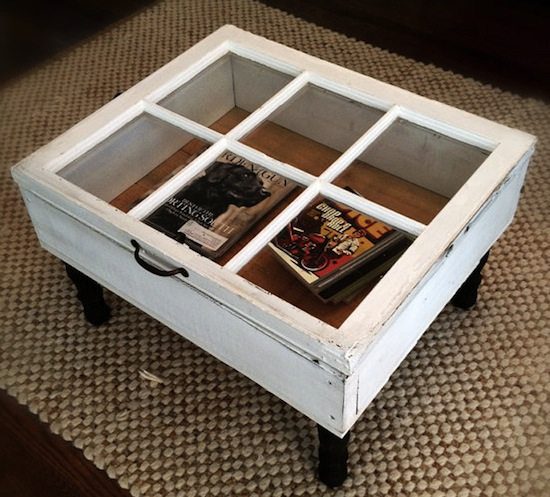
When you take a good look at this window coffee table you will see that the construction is actually quite simple. It is comprised of a salvaged window placed on top of a wooden frame with some unfinished wood as the backing. Add some table legs and you’ve got a complete window coffee table. It’s so simple and so gorgeous that we’ll bet you’re gonna start looking at old windows a bit differently. Here’s how to make your own.
How to make a window coffee table
To make your own window coffee table first measure your window. Now decide if you’d like your table to have a lip with the top of the table hanging slightly over the bottom. If so subtract an inch from the length and width from the measurement and build your window base to this specification. Otherwise cut your 2x4s to the exact measurements. These 2x4s will become the box that the window rests on. Cut a sheet of plywood to the same size as the 2×4 base. Screw the 2x4s together, attach the sheet of plywood to the bottom and flip this box over. With the plywood sheet on top, pre-drill holes in each corner and screw in the wooden coffee legs. For this project you can use salvaged coffee table legs or even buy ready made ones.

Now flip the table back onto it’s legs and attach the hinges to the window frame and top of the 2×4 frame.
Next prepare the window coffee table for paint by sanding down the window frame and wooden box. Prime the wood and let it dry. Next prep your window for paint by lining the window panes with tape to avoid getting paint on the glass. Choose your paint treatment and decide how much of a vintage look you’d like your coffee table to have. From crackle paint to high gloss it’s up to you.
Paint and then allow time for your window coffee table to dry. Complete the project by adding a handle to the window pane top. Place your collectibles inside and admire your handiwork. Ready for more upcycling ideas?
Image source: Oh Glory Vintage
Did You Know?
Unusual Creature~Spiny Orb Spider


Gasteracantha (known as spiny-backed orb-weavers, spiny orb-weavers, or spiny spiders) is a genus of orb-weaver spiders first named by Carl Jakob Sundevall in 1833.[2] The females of most species are brightly colored with six prominent spines on their broad, hardened, shell-like abdomens. The name Gasteracantha is derived from the Greek gaster (γαστήρ), meaning “belly, abdomen”, and akantha (άκανθα), meaning “thorn, spine”.[3] Spiny-backed orb-weavers are sometimes colloquially called “crab spiders” because of their shape, but they are not closely related to the true crab spiders.[4] Other colloquial names for certain species include thorn spider,[5] star spider,[6] kite spider, or jewel spider.
Members of the genus exhibit strong sexual dimorphism. Males are several times smaller than females, and they lack prominent spines or bright colors.[4][5][7]
Gasteracantha is distributed worldwide in tropical and subtropical climates. The genus is most diverse in tropical Asia, from India through Indonesia.[1] One species, G. cancriformis, occurs in the Americas.[4] Gasteracantha species are related to spine-bearing orb-weavers in several other genera (see Taxonomy and Systematics).[8]
Orb-weavers’ bites are generally harmless to humans.[9]
Poem
Jaded by MwsR
Remembering things the way you see fit
I am not an idiot
Things were construed in this way and that
Perhaps it’d be better if all went “splat”
Seems pretty jaded
All the black and white has faded
Hard to trace, hard to be certain for sure
Looks like your the fish hooked by the lure.
Trapped because you want to be right
I wonder if it keeps you awake at night.
Seems to be jaded
Nothing ever gets corrected
Things just sit where they are,
Where they have been, at least so far.
Seems to be jaded
Why does your heart get traded
For falsehoods and misperceptions?
Like in a bubble is where you are
Too close but yet so far.
Jaded.
Health Benefits of Gardening


Hey all,
While I’ve been absent from my page for a while now, I am planning on coming back with some posts, etc. I’ve been homeschooling still and soon the year of fourth grade will be done. I will have more free time and this plan to do some”me” things. My garden is doing fair and I…

What Happens When You Take Insulin~Diabetes Information
The effects of insulin on the body
Insulin is a natural hormone produced by your pancreas that controls how your body uses and stores blood sugar (glucose). It’s like a key that allows glucose to enter cells throughout your body.
Insulin is a vital part of metabolism. Without it, your body would cease to function.
When you eat, your pancreas releases insulin to help your body make energy out of glucose, a type of sugar found in carbohydrates. It also helps you store energy.
In type 1 diabetes, the pancreas is no longer able to produce insulin. In type 2 diabetes, the pancreas initially produces insulin, but the cells of your body are unable to make good use of the insulin. This is called insulin resistance.
Unmanaged diabetes allows glucose to build up in the blood rather than being distributed to cells or stored. This can wreak havoc with virtually every part of your body.
Blood tests can quickly indicate whether your glucose levels are too high or too low.
Complications of diabetes include kidney disease, nerve damage, heart problems, eye problems, and stomach problems.
People with type 1 diabetes need insulin therapy to live. Some people with type 2 diabetes must also take insulin therapy to control their blood sugar levels and avoid complications.
If you have diabetes, insulin therapy can do the job your pancreas can’t. The following types of insulin are available:
- Rapid-acting insulin reaches the bloodstream within 15 minutes and keeps working for up to 4 hours.
- Short-acting insulin enters the bloodstream within 30 minutes and works for up to 6 hours.
- Intermediate-acting insulin finds its way into your bloodstream within 2 to 4 hours and is effective for about 18 hours.
- Long-acting insulin starts working within a few hours and keeps glucose levels even for about 24 hours.
Insulin injection sites
Insulin is usually injected into the abdomen, but it can also be injected into the upper arms, thighs, or buttocks.
Injection sites should be rotated within the same general location. Frequent injections in the same spot can cause fatty deposits that make delivery of insulin more difficult.
Insulin pump
Instead of frequent injections, some people use a pump that regularly delivers small doses of insulin throughout the day.
The pump includes a small catheter that is placed in the fatty tissue underneath the skin of the abdomen. It also has a reservoir that stores the insulin and thin tubing that transports the insulin from the reservoir to the catheter.
The insulin in the reservoir needs to be refilled as necessary. To avoid an infection, the insertion site must be changed every 2 to 3 days.
Produced in the pancreas
When you eat, food travels to your stomach and small intestines, where it’s broken down into nutrients that include glucose. The nutrients are absorbed and distributed via your bloodstream.
The pancreas is a gland located behind your stomach that performs an essential role in the digestion process. It creates enzymes that break down the fat, starches, and sugar in the food. It also secretes insulin and other hormones into your bloodstream.
Insulin is created in the beta cells of the pancreas. Beta cells comprise about 75% of pancreatic hormone cells.
Other hormones produced by the pancreas are:
- glucagon, which alerts your liver to raise your blood sugar if it gets too low
- gastrin, which stimulates the production of gastric acid in your stomach
- amylin, which helps control your appetite
Energy creation and distribution
The function of insulin is to help transform glucose into energy and distribute it throughout your body, including the central nervous system and cardiovascular system.
Without insulin, cells are starved for energy and must seek an alternative source. This can lead to life threatening complications
Liver storage
Insulin helps your liver take in excess glucose from your bloodstream. If you have enough energy, the liver stores the glucose you don’t need right away so it can be used for energy later.
In turn, the liver produces less glucose on its own. This keeps your blood glucose levels in check. The liver releases small amounts of glucose into your bloodstream between meals to keep your blood sugars within that healthy range.
Muscle and fat storage
https://www.healthline.com/health/diabetes/insulin-effects-on-body
Insulin helps your muscles and fat cells store extra glucose so it doesn’t overwhelm your bloodstream.
It signals your muscle and fat tissue cells to stop breaking down glucose to help stabilize your blood sugar level.
The cells then begin creating glycogen, the stored form of glucose. Glycogen provides your body with energy when your blood sugar level drops.
When your liver can hold no more glycogen, insulin triggers your fat cells to take in glucose. It’s stored as triglycerides, a type of fat in your blood, that can be used for energy later.
Balanced blood sugars
Blood sugar, or glucose, is used by your body for energy. When you eat, it’s created by many of the carbohydrates you’re consuming. Glucose is either used right away or stored in your cells. Insulin helps keep the glucose in your blood within a normal range.
It does this by taking glucose out of your bloodstream and moving it into cells throughout your body. The cells then use the glucose for energy and store the excess in your liver, muscles, and fat tissue.
Too much or too little glucose in your blood can cause serious health problems. Besides diabetes, it can lead to heart, kidney, eye, and blood vessel problems.
Healthy cells
Cells in every part of your body need energy to function and remain healthy. Insulin provides the glucose that cells use for energy.
Without insulin, the glucose remains in your bloodstream, which can lead to dangerous complications like hyperglycemia.
Along with glucose, insulin helps amino acids enter the body’s cells, which builds muscle mass. Insulin also helps cells take in electrolytes like potassium, which keeps your bodily fluids level.
In the bloodstream
When insulin enters your bloodstream, it helps cells throughout your body — including in your central nervous system and cardiovascular system — to absorb glucose. It’s the circulatory system’s job to deliver insulin.
As long as the pancreas produces enough insulin and your body can use it properly, blood sugar levels will be kept within a healthy range.
A buildup of glucose in the blood (hyperglycemia) can cause complications like nerve damage (neuropathy), kidney damage, and eye problems. Symptoms of high blood glucose include excessive thirst and frequent urination.
Too little glucose in the blood (hypoglycemia) can make you feel irritable, tired, or confused. Low blood sugar can lead to loss of consciousness.
Ketone control
Insulin helps your cells use glucose for energy. When cells can’t use the extra glucose, they begin to burn fat for energy. This process creates a dangerous buildup of chemicals called ketones.
Your body tries to get rid of the ketones through your urine, but sometimes it can’t keep up. This can lead to a life threatening condition called diabetic ketoacidosis (DKA). Symptoms include sweet-smelling breath, dry mouth, nausea, and vomiting.HEALTHLINE CHALLENGESLooking to cut back on sugar? We’ll give you some sweet tips
 Mws R Writings