"If you are going to write, write from the heart." MwsR
"Life has not been the easiest, but it could have been worse!" MwsR
Life is about doing all you can to help others.
Don't go chasing rainbows, make your own pot of gold.
Love, Hope, Faith, the greatest of these is Love!
A Thing of Beauty Is a Joy Forever was published in 1818 as Endymion, Book I.
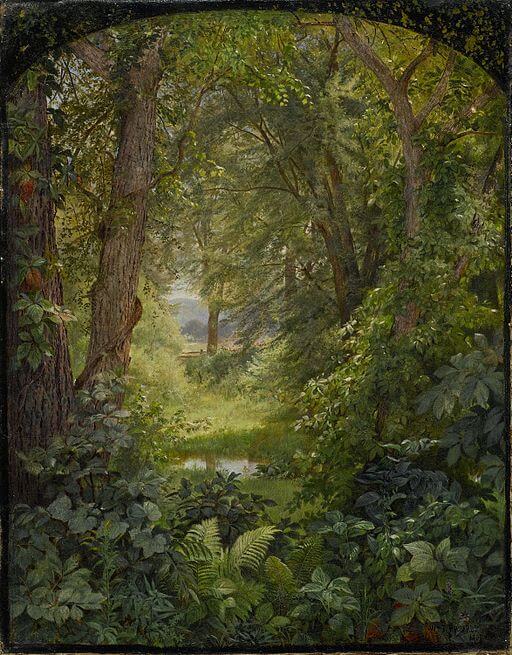
William Trost Richards, Woodland landscape, 1860
A thing of beauty is a joy for ever: Its lovliness increases; it will never Pass into nothingness; but still will keep A bower quiet for us, and a sleep Full of sweet dreams, and health, and quiet breathing. Therefore, on every morrow, are we wreathing A flowery band to bind us to the earth, Spite of despondence, of the inhuman dearth Of noble natures, of the gloomy days, Of all the unhealthy and o’er-darkn’d ways Made for our searching: yes, in spite of all, Some shape of beauty moves away the pall From our dark spirits. Such the sun, the moon, Trees old and young, sprouting a shady boon For simple sheep; and such are daffodils With the green world they live in; and clear rills That for themselves a cooling covert make ‘Gainst the hot season; the mid-forest brake, Rich with a sprinkling of fair musk-rose blooms: And such too is the grandeur of the dooms We have imagined for the mighty dead; An endless fountain of immortal drink, Pouring unto us from the heaven’s brink.
A slip of the knife here, an overzealous fork there, and suddenly you’ve got a stack of unsightly scratched plates in your kitchen. Fortunately, it’s easy to make your plates look brand new again with some baking soda. Simply make a paste of baking soda and water, buff it into the scratches, and in no time, your dishes will look as good as new.
Connecting with nature can have a very grounding effect on the mind and the body. Nature and Forest Therapists recommend finding a Sit Spot for yourself — a place where you can regularly visit and connect with the earth. Even in urban environments, finding a regular Sit Spot is wildly beneficial for body, mind and soul.
How to find a Sit Spot
Finding a Sit Spot may be as easy as looking to your own backyard. I have a gorgeous tree in my yard that provides shade on sunny days that I’ve chosen for my Sit Spot. A few of the roots are partially exposed, and bees love to buzz overhead when it blossoms in the spring. It’s also a great place to connect with nature because I know no one is going to walk up and disturb me — or if they do, it’s a member of my family. In other words, I feel safe there.
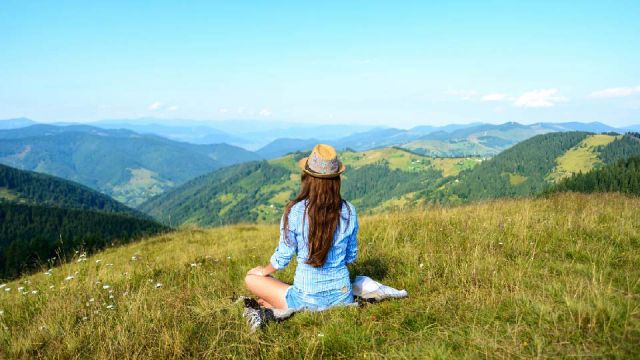
If you have a quiet place in your front or backyard, then pick a part of it for your Sit Spot. If you live in an apartment or city, select a small part of a nearby park for your Sit Spot. You can select a bench or large rock to sit on, or you can just sit down on the ground. Once you’ve found your place, simply sit, relax and observe the world around you.
Here are some of the many benefits:
1. You’ll experience improved mindfulness
Much like meditation, a Sit Spot offers a great way to engage in self-guided mindfulness training. Attention Restoration Theory (ART) states that when we’re out in nature, our ability for directed attention is restored. It’s easy to lose this as we go about our busy lives, but a Sit Spot interrupts the pattern of your fatigue or stress. As you sit and observe the world around you, you are training your brain to focus on one thing at a time, without the distraction of technology or the interruption of a coworker or family member. Soon, you’ll find yourself able to just “be” when you’re in your Sit Spot.
2. You’ll get a chance to disconnect
While there’s no right or wrong way to enjoy your Sit Spot, be sure to leave your phone at home or on your desk. You should be able to enjoy a 30-minute Sit Spot experience without your phone, no matter how much it may annoy you the first time out. For most of us, nothing earth-shattering or life-changing is going to happen during that time. Emails and texts can wait until you are done with your practice. The effect might surprise you by helping you approach those messages with a calmer outlook.
3. You’ll connect with nature
If your Sit Spot has a water element to it, which is ideal, then you’ll have more chances of observing different types of wildlife. Birds, squirrels and — depending on when you go — deer might happen across your path. Even a park with a duck pond will reveal a number of different species of waterfowl and fauna. Plus, as you make visiting your Sit Spot a regular practice, you’ll begin to notice changes in the seasons in the wildlife and plant life around you.
4. Your stress levels will drop
According to Psychoevolutionary Theory (PET), our positive response to nature is due to our evolutionary development. The outdoors were our first home, and it’s believed that being around natural resources helps lower our stress levels. A Japanese study published in 2010 examined the practice of Shinrin-yoku or “forest bathing,” and found that there’s credence to the theory.
People who regularly spent time in nature experienced lower levels of the stress hormone cortisol, lower blood pressure, lower pulse rate and lower sympathetic nerve activity than those who did not get out in nature. Other research also shows that the consumption of Mycobacterium vaccae — a bacterium found in soil — helps decrease anxiety levels.
5. You’ll experience improved mood
Being indoors all day can leave you feeling unhappy. If you work indoors, your whole day — even the time you’re in the car — is detached from nature to some degree. But getting outside can have a profound impact on your mood. A 2015 study from Stanford University found that people who walked in nature, as opposed to those who walked the same length of time in an urban setting, experienced less anxiety, less rumination or focused attention on the negative parts about yourself, and had a more positive outlook overall.
6. You might become more creative
One of the other great benefits of a Sit Spot is it can help boost your creativity. When you detach from everyday distractions, you relieve attention fatigue. We have all experienced brain fog or simply feeling drained after a particularly difficult task at work. Moving away from things that demand our attention, or taking a Sit Spot break in your workday, can help boost creativity.
In 2012, a study from the University of Kansas found that people on a four-day backpacking trip were able to solve puzzles easier and quicker than the control group at a rate of 47 percent more. It stands to reason that shorter periods outside have a positive effect on your creativity as well. Another study, published in the journal Psychological Science, found that being out in nature helps restore people’s ability to pay attention to harder tasks afterward.
7. You will become kinder
As you connect with nature on a more regular basis, it’s impossible to avoid the sense that you are just one part of a much larger whole. Researchers at the University of California, Berkeley, found in a series of studies published in 2014 that people who regularly observe and engage with nature experience higher levels of generosity, trust and a willingness to help others when compared to those who don’t get out among the birds and trees.
It’s clear getting out in nature is good for us, but giving yourself a place to relax in the form of a Sit Spot might make your life better in ways you can only imagine.
‘Mindfulness’ has become a bit of a buzz word, and seems to be gaining in popularity every day. It’s easy to see why.
Unlike a formal meditation practice, which requires a commitment to retreat from the world, sit still, and be quiet for a period of time, mindfulness is a technique that can be practiced throughout the day as you go about your life. This makes the technique especially appealing for people who are busy, or feel daunted by a more formal meditation practice.
So what exactly is mindfulness? According to mindfulness teacher and writer, Jon Kabat Zinn, “Mindfulness means paying attention in a particular way; On purpose, in the present moment, and nonjudgmentally.” In other words, mindfulness involves consciously directing your attention onto what you’re doing, feeling, thinking, or experiencing in the present moment.
As Kabat Zinn says, to practice mindfulness, we must, “watch this moment, without trying to change it at all. What is happening? What do you feel? What do you see? What do you hear?” Many people find that practicing short, mindful moments of this nature regularly throughout the day to be an effective way to relax, refocus attention, and reconnect with the present moment.
Mindfulness can be practiced at literally any time throughout the day, during any activity. However, sometimes when we are first starting to practice, we forget to be mindful. For this reason, it can be useful to incorporate some mindfulness exercises into our day that allow us to get used to the practice.
Here are 5 mindfulness exercises that take one minute or less.
Before answering the phone, take a breath.
Mindfulness teacher and monk, Thich Naht Hanh, advises to use the ring of the telephone as a ‘bell of mindfulness.’ Instead jumping up in instinctively to answer it, take a deep, mindful breath before you respond to the sound. The same can be done with text messages, emails or other notifications that we tend to react to immediately.
Walk mindfully.
Walking is a great opportunity to incorporate mindfulness throughout your day. Whether you’re walking to a meeting, the bathroom, or the fridge, take that short amount of time to notice and be thankful for every step your feet take, or as Thich Naht Hanh says: “Walk as if you are kissing the Earth with your feet.”
Just breathe.
Whenever you find yourself ruminating on the past or worrying about the future, you can connect with the present moment through your breath. Notice the way it feels entering your nostrils, and how your chest and belly rise with your inhales, and fall with your exhales. Say to yourself: “Breathing in, I know that I am breathing in,” and “Breathing out, I know that I am breathing out.”
Body scan.
Take one minute to scan your body from head to toe, noticing any sensations you discover along the way, pleasant or unpleasant, without judgment. You might have a headache, tension in your neck, an itch on your cheek, a pleasant tingling or warmth in your fingers—anything. Don’t react or judge.
After scanning, take another minute to focus your mind on consciously relaxing the areas where you experienced tension or pain, and then again, notice any changes or differences.
Take two mindful bites.
Although many teachers suggest making every bite mindful, this can be hard to practice in our day-to-day lives, as meal times are often social times, full of conversation. Instead, try to make the first two bites or swallows of any eating or drinking you do, mindful.
Notice the taste, texture, appearance, smell, and temperature of the food or drink, the sounds you make and the sensations in your mouth and throat as you chew and swallow. You may notice that after starting your meal times this way, you naturally become more mindful throughout the eating process.
Practice regularly and eventually you will see, as Thich Naht Hanh says:
“The present moment is filled with joy and happiness. If you are attentive, you will see it.”
adjective Definition~ having failed, missed, or fallen short, especially because of circumstances or a defect of character; unsuccessful; unfulfilled or frustrated (usually used postpositively): a poet manqué who never produced a single book of verse.