Fasting

Is it a good idea to “starve” yourself just a little bit each day, or a couple of days a week? Mounting evidence indicates that yes, intermittent fasting (IF) could have a very beneficial impact on your health and longevity.

I believe it’s one of the most powerful interventions out there if you’re struggling with your weight and related health issues. One of the primary reasons for this is because it helps shift your body from burning sugar/carbs to burning fat as its primary fuel.

As discussed in the featured article,1 intermittent fasting is not about binge eating followed by starvation, or any other extreme form of dieting. Rather what we’re talking about here involves timing your meals to allow for regular periods of fasting.

I prefer daily intermittent fasting, but you could also fast a couple of days a week if you prefer, or every other day. There are many different variations.

To be effective, in the case of daily intermittent fasting, the length of your fast must be at least 16 hours. This means eating only between the hours of 11am until 7pm, as an example. Essentially, this equates to simply skipping breakfast, and making lunch your first meal of the day instead.

You can restrict it even further — down to six, four, or even two hours if you want, but you can still reap many of these rewards by limiting your eating to an eight-hour window each day.

This is because it takes about six to eight hours for your body to metabolize your glycogen stores; after that you start to shift to burning fat. However, if you are replenishing your glycogen by eating every eight hours (or sooner), you make it far more difficult for your body to use your fat stores as fuel.

Intermittent Fasting — More a Lifestyle Than a Diet

I have been experimenting with different types of scheduled eating for the past two years and currently restrict my eating to a 6- to 7-hour window each day. While you’re not required to restrict the amount of food you eat when on this type of daily scheduled eating plan, I would caution against versions of intermittent fasting that gives you free reign to eat all the junk food you want when not fasting, as this seems awfully counterproductive.

Also, according to research published in 2010, 2 intermittent fasting with compensatory overeating did not improve survival rates nor delay prostate tumor growth in mice. Essentially, by gorging on non-fasting days, the health benefits of fasting can easily be lost. If so, then what’s the point?

I view intermittent fasting as a lifestyle, not a diet, and that includes making healthy food choices whenever you do eat. Also, proper nutrition becomes even more important when fasting, so you really want to address your food choices before you try fasting.

This includes minimizing carbs and replacing them with healthful fats, like coconut oil, olive oil, olives, butter, eggs, avocados, and nuts. It typically takes several weeks to shift to fat burning mode, but once you do, your cravings for unhealthy foods and carbs will automatically disappear. This is because you’re now actually able to burn your stored fat and don’t have to rely on new fast-burning carbs for fuel. Unfortunately, despite mounting evidence, many health practitioners are still reluctant to prescribe fasting to their patients. According to Brad Pilon, author ofEat Stop Eat: 3

“Health care practitioners across the board are so afraid to recommend eating less because of the stigma involved in that recommendation, but we are more than happy to recommend that someone start going to the gym. If all I said was you need to get to the gym and start eating healthier, no one would have a problem with it. When the message is not only should you eat less, you could probably go without eating for 24 hours once or twice a week, suddenly it’s heresy.”

The Health Benefits of Intermittent Fasting

Aside from removing your cravings for sugar and snack foods and turning you into an efficient fat-burning machine, thereby making it far easier to maintain a healthy body weight, modern science has confirmed there are many other good reasons to fast intermittently. For example, research presented at the 2011 annual scientific sessions of the American College of Cardiology in New Orleans 4 showed that fasting triggered a 1,300 percent rise of human growth hormone (HGH) in women, and an astounding 2,000 percent in men. HGH, human growth hormone, commonly referred to as “the fitness hormone,” plays an important role in maintaining health, fitness and longevity, including promotion of muscle growth, and boosting fat loss by revving up your metabolism. The fact that it helps build muscle while simultaneously promoting fat loss explains why HGH helps you lose weight without sacrificing muscle mass, and why even athletes can benefit from the practice (as long as they don’t overtrain and are careful about their nutrition). The only other thing that can compete in terms of dramatically boosting HGH levels is high-intensity interval training. Other health benefits of intermittent fasting include:

-Improving biomarkers of disease What is intermittent fasting and is it right for you?
-Reducing inflammation and lessening free radical damage
-Preserving memory functioning and learning
-Normalizing your insulin and leptin sensitivity, which is key for optimal health
-Normalizing ghrelin levels, also known as “the hunger hormone”
-Lowering triglyceride levels


Intermittent Fasting Is as Good or Better Than Continuous Calorie Restriction

According to Dr. Stephen Freedland, associate professor of urology and pathology at the Duke University Medical Center, “undernutrition without malnutrition” is the only experimental approach that consistently improves survival in animals with cancer, as well as extends lifespan overall by as much as 30 percent. 5 Interestingly enough, intermittent fasting appears to provide nearly identical health benefits without being as difficult to implement and maintain. It’s easier for most people to simply restrict their eating to a narrow window of time each day, opposed to dramatically decreasing their overall daily calorie intake. Mark Mattson, senior investigator for the National Institute on Aging, which is part of the US National Institutes of Health (NIH), has researched the health benefits of intermittent fasting, as well as the benefits of calorie restriction. According to Mattson, 6 there are several theories to explain why fasting works: “The one that we’ve studied a lot, and designed experiments to test, is the hypothesis that during the fasting period, cells are under a mild stress, and they respond to the stress adaptively by enhancing their ability to cope with stress and, maybe, to resist disease… There is considerable similarity between how cells respond to the stress of exercise and how cells respond to intermittent fasting.” In one of his studies, 7 overweight adults with moderate asthma lost eight percent of their body weight by cutting their calorie intake by 80 percent on alternate days for eight weeks. Markers of oxidative stress and inflammation also decreased, and asthma-related symptoms improved, along with several quality-of-life indicators. More recently, Mattson and colleagues compared the effectiveness of intermittent fasting against continuous calorie restriction for weight loss, insulin sensitivity and other metabolic disease risk markers. The study, published in the International Journal of Obesity in 2011, 8 found that intermittent fasting was as effective as continuous calorie restriction for improving all of these issues, and slightly better for reducing insulin resistance. According to the authors: “Both groups experienced comparable reductions in leptin, free androgen index, high-sensitivity C-reactive protein, total and LDL cholesterol, triglycerides, blood pressure and increases in sex hormone binding globulin, IGF binding proteins 1 and 2. Reductions in fasting insulin and insulin resistance were modest in both groups, but greater with IER [intermittent fasting] than with CER [continuous energy restriction].”

How Intermittent Fasting Benefits Your Brain

Your brain can also benefit from intermittent fasting. As reported in the featured article: “Mattson has also researched the protective benefits of fasting to neurons. If you don’t eat for 10–16 hours, your body will go to its fat stores for energy, and fatty acids called ketones will be released into the bloodstream. This has been shown to protect memory and learning functionality, says Mattson, as well as slow disease processes in the brain.” Besides releasing ketones as a byproduct of burning fat, intermittent fasting also affects brain function by boosting production of a protein called brain-derived neurotrophic factor (BDNF). Mattson’s research suggests that fasting every other day (restricting your meal on fasting days to about 600 calories), tends to boost BDNF by anywhere from 50 to 400 percent,9 depending on the brain region. BDNF activates brain stem cells to convert into new neurons, and triggers numerous other chemicals that promote neural health. This protein also protects your brain cells from changes associated with Alzheimer’s and Parkinson’s disease. BDNF also expresses itself in the neuro-muscular system where it protects neuro-motors from degradation. (The neuromotor is the most critical element in your muscle. Without the neuromotor, your muscle is like an engine without ignition. Neuro-motor degradation is part of the process that explains age-related muscle atrophy.) So BDNF is actively involved in both your musclesand your brain, and this cross-connection, if you will, appears to be a major part of the explanation for why a physical workout can have such a beneficial impact on your brain tissue — and why the combination of intermittent fasting with high intensity exercise appears to be a particularly potent combination.

Give Intermittent Fasting a Try

If you’re ready to give intermittent fasting a try, consider skipping breakfast, make sure you stop eating and drinking anything but water three hours before you go to sleep, and restrict your eating to an 8-hour (or less) time frame every day. In the 6-8 hours that you do eat, have healthy protein, minimize your carbs like pasta, bread, and potatoes and exchange them for healthful fats like butter, eggs, avocado, coconut oil, olive oil and nuts — essentially the very fats the media and “experts” tell you to avoid. This will help shift you from carb burning to fat burning mode. Once your body has made this shift, it is nothing short of magical as your cravings for sweets, and food in general, rapidly normalizes and your desire for sweets and junk food radically decreases if not disappears entirely. Remember it takes a few weeks, and you have to do it gradually, but once you succeed and switch to fat burning mode, you’ll be easily able to fast for 18 hours and not feel hungry. The “hunger” most people feel is actually cravings for sugar, and these will disappear, as if by magic, once you successfully shift over to burning fat instead. Another phenomenal side effect/benefit that occurs is that you will radically improve the beneficial bacteria in your gut. Supporting healthy gut bacteria, which actually outnumber your cells 10 to one, is one of the most important things you can do to improve your immune system so you won’t get sick, or get coughs, colds and flus. You will sleep better, have more energy, have increased mental clarity and concentrate better. Essentially every aspect of your health will improve as your gut flora becomes balanced. Based on my own phenomenal experience with intermittent fasting, I believe it’s one of the most powerful ways to shift your body into fat burning mode and improve a wide variety of biomarkers for disease. The effects can be further magnified by exercising while in a fasted state.

Continue reading Fasting

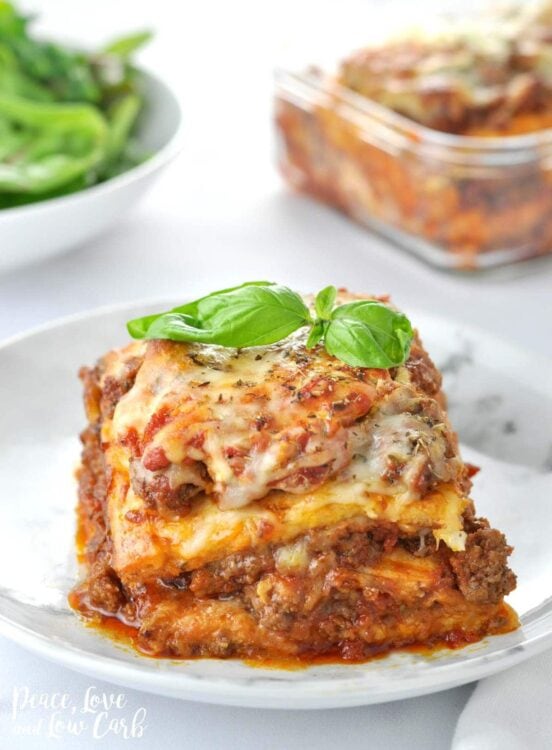
Keto Lasagna

"Just Like the Real Thing" Low Carb Keto Lasagna - Peace Love and Low Carb

“Just Like The Real Thing” LASAGNA!!


  • Author: Peace Love and Low Carb
  • Prep Time: 30 minutes
  • Cook Time: 40 minutes
  • Total Time: 1 hour 10 minutes
  • Yield: 4 Servings

Ingredients

For the “Noodles”:

  • 2 large eggs
  • 4 oz cream cheese, softened
  • 1/4 cup Parmesan cheese, grated
  • 1 1/4 cup mozzarella cheese, shredded
  • 1/4 tsp Italian seasoning
  • 1/4 tsp garlic powder
  • 1/4 tsp onion powder

For the Filling:

  • 1 lb ground beef
  • 1 1/2 cups Three Cheese Marinara Sauce, divided (get the recipe here)
  • 3/4 cup mozzarella cheese, shredded
  • 6 tbsp whole milk ricotta cheese
  • 1 tbsp minced onion flakes (I use this brand)
  • 1 tsp dried oregano
  • 1 tsp garlic powder
  • 1 tsp dried basil
  • 1 tsp Italian seasoning

Instructions

For the “Noodles”:

  1. This part will take the longest, so feel free to make the “noodles” the night before and just leave them in the fridge until you are ready for them.
  2. Preheat oven to 375° Line a 9×13 baking dish with parchment paper
  3. In a large mixing bowl, using a hand mixer, cream together cream cheese and eggs.
  4. Next, add Parmesan cheese, Italian seasoning, garlic powder, and onion powder. Mix until all ingredients are well combined.
  5. Using a rubber spatula, fold in mozzarella cheese and mix until well incorporated.
  6. Spread the mixture into the baking dish, forming a nice even layer.
  7. Bake on the middle rack for 20-25 minutes.
  8. When the “noodles” are done baking, cool in the fridge for about 20 minutes and then cut into thirds. This makes three perfectly sized “noodle” layers for an 8.5 X 4.5 X 2.5 loaf pan.

For the Filling:

  1. In a large skillet over medium-high heat, combine ground beef, minced onion, oregano, garlic powder, dried basil and a pinch of salt. Cook until the meat is browned.
  2. Drain excess fat from pan and add ¾ cup marinara sauce to meat. Reduce heat to low and simmer for 10 minutes.

Putting it all together:

  1. Pour ¼ cup marinara sauce into bottom of loaf pan. Top with the first “noodle” layer
  2. Layer a third of the ground beef mixture. Top with ¼ cup mozzarella cheese and 3 tbsp ricotta cheese, and cover with another “noodle” layer. Repeat these steps.
  3. Cover the top “noodle” layer with remaining ground beef, and mozzarella cheese. Sprinkle Italian seasoning over top. Bake for 20 minutes.

Notes

Per Serving – Calories: 486 | Fat: 34g | Protein: 57g | Net Carbs: 9.5g

Laugh a Little

Blue, Did Not Recognize Her

There was this one day …

Timeline

The time line for this story was the teenage years of Blue, she was around 15 and still unaware of most things in her life around then. Un-expectantly, she had a visit from someone she did not recognize.

Story

Blue was alone this particular day, as she was most days while school was out and her parents had to work. Her brother was visiting a friend. She had the whole house to herself.  Times like this was very nice for her. She could walk around the house freely and enjoy playing her music as loud as she wished. Music had been her constant companion since she first discovered it. There was several different genres that she enjoyed. Frankly, almost anything out on the radio was her favorite. She knew the words to almost everything and had no qualms about singing them out loud.

Today Blue was going to organize the bathroom closet. Why? Because she wanted to , and especially since she was not made to. She enjoyed pretending that her parents house was hers and that she was in charge. Part of that imagination led her to change things up a bit. She loved changing the layout of things, because she got bored real easy. She was constantly trying to win her mother’s approval to and since organizing the bathroom closet was something she enjoyed, she was also hoping for “brownie points” from her mother, in doing it.

She turned up her music so loud she guessed the neighbors could hear it. She really did not care, music was on, the sun was shinning and she was going to play around with organizing a bathroom closet that was in diar need of being done. She went to the front door, made sure it was locked, checked the back door to, she did not want anyone coming in on her while she was at the back of the house. So, she set forth to organize that bathroom closet.

She proceeded to take out things one by one until all the shelfs in the closet were empty. Next she went into work mode by folding and sorting the towels and the wash cloths that lay in the floor. She thought she would sort them by their colors and switch things up a bit by placing a wash  cloth and a towel of likeness together. She proceeded to fold the wash cloth up in the towel and set them on the shelfs, one by one. She just knew that her mother was going to love this. No more searching for a washcloth to match a towel. She thought it was rather “genius” of herself.

This went on for the next hour and when the bathroom closet was finished, she took a long look at it and was very pleased. She also could not wait till her mother saw how nice and convenient things were now in that closet. Sometimes, while she was doing little things like this she felt proud of herself and felt that she was going to make herself invaluable to her parents.

She really did not know that she should have been valuable even if she never helped out around the  house. All kids should be valuable to their parents regardless of what they do or what they don’t do.

The next thing she decided to do was to get her some soup to eat because she was getting hungry. Tomato soup was her go to soup and her favorite to eat. Especially when she ate it with saltines crackers. She knew her mother would not like it anyway, if she ate something else. She turned off her music and turned on her tv. There was a show called, Bonanza”, and it was one of her favorites. Back in those days, there was not much to watch on tv and you had a pick of about three channels to watch. Kids watched cartoons on weekends and sometimes afternoons after school. No much variety but the shows had a lot more depth then. Morals were shown on almost every channel and there wasn’t any real bad to watch programs. Blue loved being able to watch movies. Her mother watched soap operas and she liked them to, but movies were her favorite.

As she was heating her soup up in a pot he heard what sounded to be a knock on the front door. She was thinking to herself that her mind was playing tricks on her. Then suddenly as if a second later, there came another knock. She went to the front windows and peered through the curtains. A car she did not recognize was out in the driveway. There was a person whom she could not really get a good look at, standing outside the front door. Blue knew her mother forbade her to open the door for anyone while her parents were not there. She also knew that she would be in big trouble if she did. Her curiosity was getting thee best of her She figured she would call her mother at her work and get further instruction on what to do. She headed to the phone when she heard the person outside say, “I am your aunt”, and she was in shock. Blue was thinking to herself on who this really was, while dialing her mother’s work number. Her mother got on the ohone and she told her that a lady who said she was her aunt was standing out front of her house. Her mother told her to go ahead and open the door and that her aunt Jean was there, she was guessing.

Blue hung up from talking to her mother, and went to the front door to open it. There in front of her stood a woman. The woman was a little taller than her, with greyish black hair. This woman was very thin, looked to be about 80 pounds. She was dressed in a fake fur coat. Immediately this woman, Blue’s aunt, gave her a big hug and said, “You must be Blue?” Blue said, “yes and who are you?” The woman replied she was her mother’s sister from Washington. Blue invited her in and told her that Blue’s mother was coming home and would arrive shortly.  As she sat there she found herself staring at the woman she barely recognized. It was an awkward quietness. Blue did not know how to strike a conversation with her.

The awkward silence could have been cut by a knife it was so thick. Blue offered her aunt a drink or something and that started a conversation. Blue’s aunt asked her if she knew who she was at first. Blue said she did not recognize her at all. Then her aunt proceeded to tell Blue that she had leukemia and had lost so much weight. She said she was wanting to come and visit her sister and her family before she could no longer travel. She also said she was very sick, She informed Blue that she was 74 pounds, and that she was probably dying. Wow, that was a lot for Blue to take in at once. Blue was very sad for her aunt and could not wrap her head around this thing called Leukemia. She did not know exactly what that was.

It was hard looking at the face of someone who was potentially dying. Someone who was her aunt and she never even knew her. She was puzzled as to why she did not know all this already, and why she had not grown to know her. This was a lot to take in and Blue had so many questions she wanted to ask, but she knew she better not. Her mother made it very clear on the phone to say very little to her aunt and to mind her own business. Then Blue saw her mother coming in the door and Blue figured she would learn more about her aunt.  Blue was wrong though, as soon as her mother got there she sent Blue to her room, and whatever was spoken in the living room, Blue could not ease drop on because it was like they were whispering. This was puzzling.

It was not very long after being sent to her room, that Blue heard the car start-up and then saw her aunt leaving.  It was not very long, especially for someone who came from Washington state to visit. What really hurt was that her aunt was dying and she never even knew her or got to say goodbye. Blue knew that something was not right with the whole thing. It was not normal to have family come visit and them not be offered a place to stay or some time spent with the family they came to see. What in the world?

Some things like that day, stayed forever in Blue’s mind. She did not understand those types of situations. They happened more often than not.

arch architecture art blue
Photo by Pixabay on Pexels.com


Word of the Week

ei·do·lon

[īˈdōlən]

NOUN
literary
eidola (plural noun) · eidolons (plural noun)
  1. an idealized person or thing.
  2. a specter or phantom.
    synonyms:
    specter · phantom · wraith · spirit · soul · shadow · presence · vision · apparition · hallucination · bodach · Doppelgänger · duppy · spook · phantasm · shade · revenant · visitant · wight · eidolon · manes · lemures
ORIGIN
early 19th century: from Greek eidōlon, from eidos ‘form’.

Reading Food Labels

Reading food labels

The US Department of Agriculture (USDA) and the US Food and drug administration (FDA) require food manufacturers to provide labels that spell out the nutritional content of different food products. Only fresh fruit and vegetables or seafood do not have these labels.

“Nutrition Facts” labels are a familiar feature on most packaged foods. If you have diabetes, you should become an expert at reading these labels. Knowing your Nutrition Facts not only allows you to figure out the amount of carbohydrates in foods. It also allows you to figure out the calories per serving of food items, a piece of information that is important for successfully reducing your calorie intake.

Key information that you’ll find on the “Nutrition Facts” label includes1:

Serving size. How much of the product is considered a single serving. The nutrient amounts on the rest of the label are all based on this single serving amount.
Servings per container. This tells you how many servings you get in a container. Some food products will have a single serving, such as single serving yogurts. Others will have multiple servings, such as a bag of potato chips or a frozen pizza.

Amount per serving. Under this section you’ll find information on total calories, calories from the three major calorie groups, fat, carbohydrates, and protein, and sodium content. Fats and carbohydrates are broken down into specific sources, such as saturated fat and cholesterol for fats and sugar and dietary fiber for carbohydrates.

Vitamins and minerals. At the bottom of the label, you’ll find the vitamin and mineral content of a single serving.

Daily values per serving. On the right-hand side of the label across from each of the specific nutrients, you’ll find the daily value for each item. This is the percentage of calories or vitamins/minerals you get in terms of each nutrient in a single serving based on a 2,000 calorie per day diet. You daily target for calories may be different. After your work with your dietitian or nutritionist to determine your daily calorie target, he or she will help you figure out exactly how many calories from each nutrient group you’ll aim to get on a daily basis.

Making sense of the sections of a food label

nutrition_facts

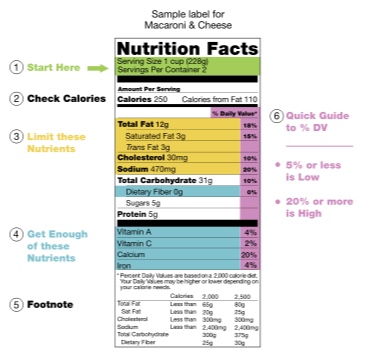
Take a look at the sample labels above and let’s practice reading the label and getting information that will help you with your diet needs.1

1. Serving size and servings per container. This section is important because it allows you to understand how all the numbers and values below relate to the contents of your container of food. All of the numbers and values for the mac and cheese product shown here are based on a single serving (1 cup or 228 grams). However, the package contains 2 cups or 2 servings. If you consume the entire contents of the package, you will need to multiply all the amounts by 2 to figure out how much you’re getting in terms of fat, carbohydrates, protein, and salt. For instance, if the total fat in a single serving of our sample is 12 grams or 18% of the total daily calories in a 2,000 calorie diet, a double serving (the entire package) will contain 24 grams of total fat, which is 2 times 18% or 36% of your total daily calories (for a 2,000 calorie diet).

2. Calories and calories from fat. Calories are a measure of how much energy is contained in food. The totals for calories and calories from fat are based on a single serving, so if you eat the whole package of mac and cheese, you’ll have to get out your calculator and multiply by 2. This section is important, because if you’re trying to lose weight, chances are you will be aiming to reduce how many calories you take in. Additionally, for a heart-healthy diet, you’ll be trying to keep the calories from fat below a certain amount per day. So, you can use both of these numbers to help you with your calorie targets.

You may ask: “How do I figure out if a meal is high in calories?” This will really depend on your target amount of calories per day. If you are aiming to consume 1,500 calories per day and you have 2 servings of mac and cheese, then you have taken in about one-third of your total for the day. A quick rule of thumb for amounts of calories per serving goes like this:

  • Low calorie serving: 40 calories
  • Moderate calorie serving: 100 calories
  • High calorie serving: 400 calories

3 and 4. Nutrient amounts. These sections show amounts in grams for different nutrients, including fats, carbohydrates, protein, and vitamins and minerals. (Note that total fat and total carbohydrates are overall amounts that include specific kinds of fats and carbohydrates.) The nutrients, including fat, cholesterol, and sodium, shown in yellow shading, tend to make up too much of our diets. These should be kept to a minimum. On the other hand, the nutrients shown in blue shading, including dietary fiber (you get this from fruit and vegetables and whole grains), as well as essential vitamins and minerals, tend to make up too little of our diets. Generally, you should aim to get more of these types of nutrients.

Learn more about the basics of healthy nutrition and how to eat well.

5. Nutrition Fact footnote information. The footnote tells you that the daily values shown above for a single serving of mac and cheese are based on a 2,000 calorie per day diet. The sample label contains more general information from nutritionists that tells you how many calories of different nutrient groups you should aim to get for both a 2,000 and 2,500 calorie diet. Not all labels will have this extra information. Let’s take a closer look at what this information tells us. A single serving of mac and cheese contains 12 grams of total fat. This is 18% of the amount of total fat that you should take in daily. You should aim to take in less than 65 grams of total fat if you are eating a 2,000 calorie per day diet. If your diet has a higher daily calorie intake, such as 2,500 calories, the target amount of total fat will be slightly higher: 80 grams (you should aim to keep your total fat intake at or below this number). So, for the yellow shaded group of nutrients (fat, cholesterol, and sodium) that we tend to get too much of in our diets, the footnote nutritional information tells us a total daily amount we should stay under. For the blue shaded group of nutrients that we should get more of in our diets (there is no fiber in our sample mac and cheese product!), the footnote nutritional information indicates that we should get “at least” 25 grams per day.

6. Daily values for nutrient groups. The daily values listed on the right side of the label help you figure out (in the context of a 2,000 calorie per day diet) whether the amount of each nutrient in a single serving is high or low.

Note that trans fats, sugar, and protein do not have a daily values. The FDA did not have enough information to establish a daily value for trans fats or sugar and could make no recommendation for precisely how much to eat in a single day. However, since trans fats clearly contribute total fat consumption and sugar to carbohydrate consumption, it is important to keep intake of these nutrients at proper levels according the overall daily calorie target of your diet.

So, how much of the daily value of a nutrient should a single serving of a food provide? As a general rule of thumb for daily values, 5% or below is considered low and 20% or more is considered high. So, if we look at total fat content of our mac and cheese product, a single serving has 18% of the daily target for total fat, given a 2,000 calorie diet. This is a little under the 20% rule of thumb. However, if you eat the whole package of mac and cheese, you will be getting 36% of your daily target for total fat and that would be considered a lot for one meal.

Comparing labels

In addition to checking the Nutrition Facts for different packaged foods, you will want to look at the ingredient list, as well. As you gain experience reading food labels, you’ll have some important insights into how different ingredients change the nutritional content of foods. Let’s compare the labels for plain and fruit yogurt. The plain yogurt is made with nonfat milk and its total fat content reflects this. The fruit yogurt is made with reduced fat milk, so it has a slightly higher amount of total fat (3 grams). The fruit yogurt has a higher fiber content, which results from the inclusion of fruit. It also has a much higher carbohydrate content, a total of 15% of the daily value for carbohydrates (given a 2,000 calorie diet). The carbohydrate content of the fruit yogurt comes mostly from added sugars. The ingredient label tells us that these are mostly from the inclusion of high fructose corn syrup.