Blue, Did Not Recognize Her

There was this one day …

Timeline

The time line for this story was the teenage years of Blue, she was around 15 and still unaware of most things in her life around then. Un-expectantly, she had a visit from someone she did not recognize.

Story

Blue was alone this particular day, as she was most days while school was out and her parents had to work. Her brother was visiting a friend. She had the whole house to herself.  Times like this was very nice for her. She could walk around the house freely and enjoy playing her music as loud as she wished. Music had been her constant companion since she first discovered it. There was several different genres that she enjoyed. Frankly, almost anything out on the radio was her favorite. She knew the words to almost everything and had no qualms about singing them out loud.

Today Blue was going to organize the bathroom closet. Why? Because she wanted to , and especially since she was not made to. She enjoyed pretending that her parents house was hers and that she was in charge. Part of that imagination led her to change things up a bit. She loved changing the layout of things, because she got bored real easy. She was constantly trying to win her mother’s approval to and since organizing the bathroom closet was something she enjoyed, she was also hoping for “brownie points” from her mother, in doing it.

She turned up her music so loud she guessed the neighbors could hear it. She really did not care, music was on, the sun was shinning and she was going to play around with organizing a bathroom closet that was in diar need of being done. She went to the front door, made sure it was locked, checked the back door to, she did not want anyone coming in on her while she was at the back of the house. So, she set forth to organize that bathroom closet.

She proceeded to take out things one by one until all the shelfs in the closet were empty. Next she went into work mode by folding and sorting the towels and the wash cloths that lay in the floor. She thought she would sort them by their colors and switch things up a bit by placing a wash  cloth and a towel of likeness together. She proceeded to fold the wash cloth up in the towel and set them on the shelfs, one by one. She just knew that her mother was going to love this. No more searching for a washcloth to match a towel. She thought it was rather “genius” of herself.

This went on for the next hour and when the bathroom closet was finished, she took a long look at it and was very pleased. She also could not wait till her mother saw how nice and convenient things were now in that closet. Sometimes, while she was doing little things like this she felt proud of herself and felt that she was going to make herself invaluable to her parents.

She really did not know that she should have been valuable even if she never helped out around the  house. All kids should be valuable to their parents regardless of what they do or what they don’t do.

The next thing she decided to do was to get her some soup to eat because she was getting hungry. Tomato soup was her go to soup and her favorite to eat. Especially when she ate it with saltines crackers. She knew her mother would not like it anyway, if she ate something else. She turned off her music and turned on her tv. There was a show called, Bonanza”, and it was one of her favorites. Back in those days, there was not much to watch on tv and you had a pick of about three channels to watch. Kids watched cartoons on weekends and sometimes afternoons after school. No much variety but the shows had a lot more depth then. Morals were shown on almost every channel and there wasn’t any real bad to watch programs. Blue loved being able to watch movies. Her mother watched soap operas and she liked them to, but movies were her favorite.

As she was heating her soup up in a pot he heard what sounded to be a knock on the front door. She was thinking to herself that her mind was playing tricks on her. Then suddenly as if a second later, there came another knock. She went to the front windows and peered through the curtains. A car she did not recognize was out in the driveway. There was a person whom she could not really get a good look at, standing outside the front door. Blue knew her mother forbade her to open the door for anyone while her parents were not there. She also knew that she would be in big trouble if she did. Her curiosity was getting thee best of her She figured she would call her mother at her work and get further instruction on what to do. She headed to the phone when she heard the person outside say, “I am your aunt”, and she was in shock. Blue was thinking to herself on who this really was, while dialing her mother’s work number. Her mother got on the ohone and she told her that a lady who said she was her aunt was standing out front of her house. Her mother told her to go ahead and open the door and that her aunt Jean was there, she was guessing.

Blue hung up from talking to her mother, and went to the front door to open it. There in front of her stood a woman. The woman was a little taller than her, with greyish black hair. This woman was very thin, looked to be about 80 pounds. She was dressed in a fake fur coat. Immediately this woman, Blue’s aunt, gave her a big hug and said, “You must be Blue?” Blue said, “yes and who are you?” The woman replied she was her mother’s sister from Washington. Blue invited her in and told her that Blue’s mother was coming home and would arrive shortly.  As she sat there she found herself staring at the woman she barely recognized. It was an awkward quietness. Blue did not know how to strike a conversation with her.

The awkward silence could have been cut by a knife it was so thick. Blue offered her aunt a drink or something and that started a conversation. Blue’s aunt asked her if she knew who she was at first. Blue said she did not recognize her at all. Then her aunt proceeded to tell Blue that she had leukemia and had lost so much weight. She said she was wanting to come and visit her sister and her family before she could no longer travel. She also said she was very sick, She informed Blue that she was 74 pounds, and that she was probably dying. Wow, that was a lot for Blue to take in at once. Blue was very sad for her aunt and could not wrap her head around this thing called Leukemia. She did not know exactly what that was.

It was hard looking at the face of someone who was potentially dying. Someone who was her aunt and she never even knew her. She was puzzled as to why she did not know all this already, and why she had not grown to know her. This was a lot to take in and Blue had so many questions she wanted to ask, but she knew she better not. Her mother made it very clear on the phone to say very little to her aunt and to mind her own business. Then Blue saw her mother coming in the door and Blue figured she would learn more about her aunt.  Blue was wrong though, as soon as her mother got there she sent Blue to her room, and whatever was spoken in the living room, Blue could not ease drop on because it was like they were whispering. This was puzzling.

It was not very long after being sent to her room, that Blue heard the car start-up and then saw her aunt leaving.  It was not very long, especially for someone who came from Washington state to visit. What really hurt was that her aunt was dying and she never even knew her or got to say goodbye. Blue knew that something was not right with the whole thing. It was not normal to have family come visit and them not be offered a place to stay or some time spent with the family they came to see. What in the world?

Some things like that day, stayed forever in Blue’s mind. She did not understand those types of situations. They happened more often than not.


arch architecture art blue
Photo by Pixabay on Pexels.com


Word of the Week

ei·do·lon

[īˈdōlən]

NOUN
literary
eidola (plural noun) · eidolons (plural noun)
  1. an idealized person or thing.
  2. a specter or phantom.
    synonyms:
    specter · phantom · wraith · spirit · soul · shadow · presence · vision · apparition · hallucination · bodach · Doppelgänger · duppy · spook · phantasm · shade · revenant · visitant · wight · eidolon · manes · lemures
ORIGIN
early 19th century: from Greek eidōlon, from eidos ‘form’.

Reading Food Labels

Reading food labels

The US Department of Agriculture (USDA) and the US Food and drug administration (FDA) require food manufacturers to provide labels that spell out the nutritional content of different food products. Only fresh fruit and vegetables or seafood do not have these labels.

“Nutrition Facts” labels are a familiar feature on most packaged foods. If you have diabetes, you should become an expert at reading these labels. Knowing your Nutrition Facts not only allows you to figure out the amount of carbohydrates in foods. It also allows you to figure out the calories per serving of food items, a piece of information that is important for successfully reducing your calorie intake.

Key information that you’ll find on the “Nutrition Facts” label includes1:

Serving size. How much of the product is considered a single serving. The nutrient amounts on the rest of the label are all based on this single serving amount.
Servings per container. This tells you how many servings you get in a container. Some food products will have a single serving, such as single serving yogurts. Others will have multiple servings, such as a bag of potato chips or a frozen pizza.

Amount per serving. Under this section you’ll find information on total calories, calories from the three major calorie groups, fat, carbohydrates, and protein, and sodium content. Fats and carbohydrates are broken down into specific sources, such as saturated fat and cholesterol for fats and sugar and dietary fiber for carbohydrates.

Vitamins and minerals. At the bottom of the label, you’ll find the vitamin and mineral content of a single serving.

Daily values per serving. On the right-hand side of the label across from each of the specific nutrients, you’ll find the daily value for each item. This is the percentage of calories or vitamins/minerals you get in terms of each nutrient in a single serving based on a 2,000 calorie per day diet. You daily target for calories may be different. After your work with your dietitian or nutritionist to determine your daily calorie target, he or she will help you figure out exactly how many calories from each nutrient group you’ll aim to get on a daily basis.

Making sense of the sections of a food label

nutrition_facts

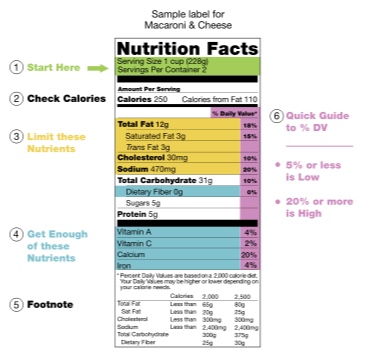
Take a look at the sample labels above and let’s practice reading the label and getting information that will help you with your diet needs.1

1. Serving size and servings per container. This section is important because it allows you to understand how all the numbers and values below relate to the contents of your container of food. All of the numbers and values for the mac and cheese product shown here are based on a single serving (1 cup or 228 grams). However, the package contains 2 cups or 2 servings. If you consume the entire contents of the package, you will need to multiply all the amounts by 2 to figure out how much you’re getting in terms of fat, carbohydrates, protein, and salt. For instance, if the total fat in a single serving of our sample is 12 grams or 18% of the total daily calories in a 2,000 calorie diet, a double serving (the entire package) will contain 24 grams of total fat, which is 2 times 18% or 36% of your total daily calories (for a 2,000 calorie diet).

2. Calories and calories from fat. Calories are a measure of how much energy is contained in food. The totals for calories and calories from fat are based on a single serving, so if you eat the whole package of mac and cheese, you’ll have to get out your calculator and multiply by 2. This section is important, because if you’re trying to lose weight, chances are you will be aiming to reduce how many calories you take in. Additionally, for a heart-healthy diet, you’ll be trying to keep the calories from fat below a certain amount per day. So, you can use both of these numbers to help you with your calorie targets.

You may ask: “How do I figure out if a meal is high in calories?” This will really depend on your target amount of calories per day. If you are aiming to consume 1,500 calories per day and you have 2 servings of mac and cheese, then you have taken in about one-third of your total for the day. A quick rule of thumb for amounts of calories per serving goes like this:

  • Low calorie serving: 40 calories
  • Moderate calorie serving: 100 calories
  • High calorie serving: 400 calories

3 and 4. Nutrient amounts. These sections show amounts in grams for different nutrients, including fats, carbohydrates, protein, and vitamins and minerals. (Note that total fat and total carbohydrates are overall amounts that include specific kinds of fats and carbohydrates.) The nutrients, including fat, cholesterol, and sodium, shown in yellow shading, tend to make up too much of our diets. These should be kept to a minimum. On the other hand, the nutrients shown in blue shading, including dietary fiber (you get this from fruit and vegetables and whole grains), as well as essential vitamins and minerals, tend to make up too little of our diets. Generally, you should aim to get more of these types of nutrients.

Learn more about the basics of healthy nutrition and how to eat well.

5. Nutrition Fact footnote information. The footnote tells you that the daily values shown above for a single serving of mac and cheese are based on a 2,000 calorie per day diet. The sample label contains more general information from nutritionists that tells you how many calories of different nutrient groups you should aim to get for both a 2,000 and 2,500 calorie diet. Not all labels will have this extra information. Let’s take a closer look at what this information tells us. A single serving of mac and cheese contains 12 grams of total fat. This is 18% of the amount of total fat that you should take in daily. You should aim to take in less than 65 grams of total fat if you are eating a 2,000 calorie per day diet. If your diet has a higher daily calorie intake, such as 2,500 calories, the target amount of total fat will be slightly higher: 80 grams (you should aim to keep your total fat intake at or below this number). So, for the yellow shaded group of nutrients (fat, cholesterol, and sodium) that we tend to get too much of in our diets, the footnote nutritional information tells us a total daily amount we should stay under. For the blue shaded group of nutrients that we should get more of in our diets (there is no fiber in our sample mac and cheese product!), the footnote nutritional information indicates that we should get “at least” 25 grams per day.

6. Daily values for nutrient groups. The daily values listed on the right side of the label help you figure out (in the context of a 2,000 calorie per day diet) whether the amount of each nutrient in a single serving is high or low.

Note that trans fats, sugar, and protein do not have a daily values. The FDA did not have enough information to establish a daily value for trans fats or sugar and could make no recommendation for precisely how much to eat in a single day. However, since trans fats clearly contribute total fat consumption and sugar to carbohydrate consumption, it is important to keep intake of these nutrients at proper levels according the overall daily calorie target of your diet.

So, how much of the daily value of a nutrient should a single serving of a food provide? As a general rule of thumb for daily values, 5% or below is considered low and 20% or more is considered high. So, if we look at total fat content of our mac and cheese product, a single serving has 18% of the daily target for total fat, given a 2,000 calorie diet. This is a little under the 20% rule of thumb. However, if you eat the whole package of mac and cheese, you will be getting 36% of your daily target for total fat and that would be considered a lot for one meal.

Comparing labels

In addition to checking the Nutrition Facts for different packaged foods, you will want to look at the ingredient list, as well. As you gain experience reading food labels, you’ll have some important insights into how different ingredients change the nutritional content of foods. Let’s compare the labels for plain and fruit yogurt. The plain yogurt is made with nonfat milk and its total fat content reflects this. The fruit yogurt is made with reduced fat milk, so it has a slightly higher amount of total fat (3 grams). The fruit yogurt has a higher fiber content, which results from the inclusion of fruit. It also has a much higher carbohydrate content, a total of 15% of the daily value for carbohydrates (given a 2,000 calorie diet). The carbohydrate content of the fruit yogurt comes mostly from added sugars. The ingredient label tells us that these are mostly from the inclusion of high fructose corn syrup.

Poem, MwsR

ache-adult-depression-expression-41253
Photo by Public Domain Pictures on Pexels.com

Torment In My Brain.  By MwsR
To many times I have let chaos be my norm

Many dreams turned into nightmares and kept me torn.

Peace was hard to have , to expect, or even see.

Why couldn’t I get some for little Ole me?

Moments spent pondering and rehashing old dreams,

Felt like I was coming apart at the seams.

Turning and tossing at night just to rest my weary brain,

Often times that had left me in so much pain.

It’s almost as if I’d let it all point at me like a gun in my own hand,

Aiming for my own heart was almost more than I could stand.

Will it ever end?

The silent miserable attack,

Or will it keep coming for me and pushing me on my back?

Maybe it’s like a curse, the one that holds true,

I guess you’re thinking, better me than you.

Did You Know/Health Tip

Here are some great brain healthy foods that really pack the power:

1. Walnuts

Good for both your heart and your brain, all nuts in general are good sources of healthy fats. Walnuts specifically are high in alpha-linolenic acid (ALA), a type of the famous Omega-3 fatty acid. In fact, a study completed in 2015 linked increased walnut consumption with improved cognitive testing scores.[1]

2. Salmon

Fatty fishes such as salmon have gotten so much great attention related to their healthy fat content. Well here is another benefit to add to the list:

Because salmon is such an abundant source of Omega-3 fatty acids, they are a good source of decreasing blood levels of beta-amyloid. Beta-amyloid is the protein that forms the dangerous clumps in your brain leading to Alzheimer’s disease.[2]

3. Turmeric

It is now known that the neurons in our brains can continue to form new connections throughout adulthood which was once believed to be impossible. One of the main drivers in the process of building these new pathways is called brain-derived neurotrophic factor (BDNF).

The great news is that it is likely that turmeric can increase BDNF levels leading to improved brain function and decreased risk of degenerative brain processes.[3]

4. Blueberries

The anti-oxidative properties of berries are powerful! It has been shown that consuming at least two servings of berries each week can improve memory and prevent memory decline.

5. Tomatoes

With the composition of your brain being mostly fat, 60% to be exact, the fat soluble nutrients in tomatoes act as a powerful safeguard. Specifically known as carotenoids, these nutrients are great antioxidants that help to neutralize free radicals. This is an important process to keep your brain functioning at its highest level.[4]

6. Chia Seeds

Another great source of healthy fats, the Omega-3 fatty acids found in chia seeds are a powerful brain enhancer.[5]

Here’re the amazing benefits of chia seeds (and some refreshing recipes).

7. Broccoli

Research suggests that consuming dark green vegetables regularly slows cognitive decline. This is likely due to these veggies being rich in brain healthy nutrients such as Vitamin A, K, folate, lutein, and fiber.

8. Apples

Studies from 2006 showed that a common compound in apples, quercetin, may protect the neurons in our brain against oxidation. It is believed that the quercetin reduces cellular death in the brain related to oxidation and inflammation of the neurons. This process may play an important role in reducing neurodegenerative disorders such as Alzheimer’s.[6]

9. Spinach

Again! Those leafy greens! Leafy greens are a powerhouse of brain protective nutrients and antioxidants.

10. Onions

Onions are a good natural source of folate. Folate has been shown to improve the blood flow to the brain by decreasing homocysteine levels in the body. This also may have beneficial effects for those suffering with depression.[7]

11. Flax Seeds

Another rich source of Omega 3 and ALA! Flax seeds can help reduce blood pressure and therefor improve blood flow to the brain. This reduction of blood pressure also helps reduce the risk of cardiovascular disease and strokes. It’s a win, win!

12. Coffee

The caffeine in your daily cup of Joe may be doing more than wake you up. A 2014 study showed that those with higher caffeine consumption had improved test scores on mental function and had better memory recall.[8]

13. Tea

The combination of caffeine and the amino acid L-Theanine found in tea, has been shown to have powerful effects on brain function. In a 2017 study, green tea was shown to improve cognition, memory power, and reduce anxiety.[9]

The Bottom Line

There are many foods that have been shown to benefit the brain! What is most important to keep in mind is to focus on whole, real foods.

In summary and in looking at the above list, you can see that nature has powerful benefits. Eating what nature is providing us is the fastest way to feeding your brain.

Featured photo credit: Lars Blankers via unsplash.com

Health, Did You Know

Quote

Ice or Heat?

FB_IMG_1548367180509